


 12/05/2026
  363 views
STP is a crucial and indispensable strategy in every business’s marketing plan. Applying the STP strategy correctly will help businesses build a competitive advantage and successfully conquer market share by focusing on serving the potential customer segments where they have the greatest advantage. So, what is the STP model? How can you effectively implement the STP Marketing strategy in each stage? Let’s find out with 1Office in the article below.
Mục lục
1. What is STP?
STP is a model commonly used in target marketing—a modern marketing strategy where a business focuses its marketing efforts on a specific market segment, also known as the target market. The purpose of STP is to help businesses plan and develop an effective marketing mix strategy for a specific target audience.
STP is an acronym for 3 words—corresponding to the 3 basic stages a business must go through when implementing a target marketing strategy:
- Segmentation – Market Segmentation
- Targeting – Target Market Selection
- Positioning – Market Positioning
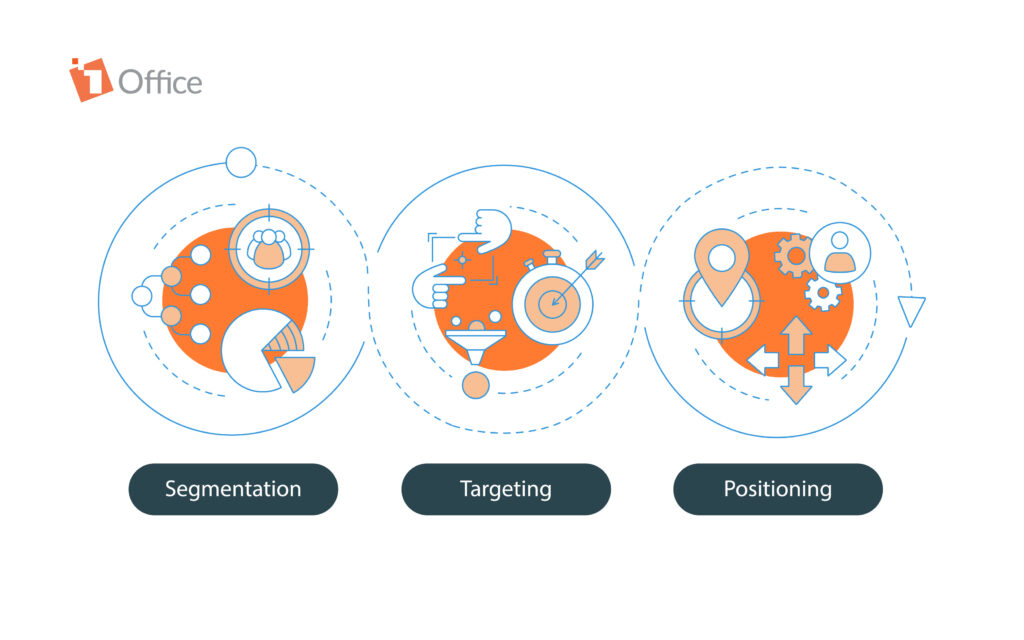
Simply put, when applying the STP strategy, a business will divide the overall market into smaller customer segments with different characteristics and traits. Then, the business selects one or more market segments where it has a competitive advantage and implements marketing strategies tailored to the target customer group to build a clear, impressive, and consistent brand image in the chosen segment.
2. What is the role of the STP model in a business’s marketing strategy?
It can be affirmed that every marketing plan in a business begins with market research and establishing the STP model. STP serves as the foundation that helps businesses develop effective marketing campaigns and is also the core focus of modern marketing methods. Implementing the STP model has strategic significance for a business’s marketing activities; specifically, STP helps businesses:
2.1. Effectively exploit the market and leverage competitive advantages
The overall market consists of a large number of consumers with different needs, characteristics, and purchasing power, and each customer group has unique requirements for products and services. Meanwhile, each business only has strengths in certain aspects; no single business has the capability to meet all the needs and desires of potential customers. Furthermore, a business will face many competitors of different sizes and scales, each with their own distinct strengths.
Therefore, to conquer market share and establish a solid competitive position, a business must find its own path by targeting segments where it can serve and meet customer needs better than its competitors. The STP plan is the key that helps businesses correctly identify the right potential customer base to exploit the market and leverage their strengths most effectively.
2.2. Increase customer loyalty
In fact, 59% of users state that personalizing the customer journey strongly influences their purchasing decisions, and another 44% say that a personalized shopping experience will affect whether they become loyal customers of a brand.
It is clear that as social life improves, there are changes in consumer lifestyles, needs, and tastes. Customers are now less interested in mass-produced products widely available on the market; instead, they prioritize products and services that can precisely satisfy their own needs and desires, and they highly value quality experiences.
The STP strategy in marketing represents a shift from product-centric marketing to customer-centric marketing. This change gives businesses the opportunity to better understand their target customers and develop appropriate outreach methods. In summary, the more personalized and targeted the marketing efforts are, the easier it is for a business to conquer the market.

See more: What is Retention Rate? Methods to Effectively Improve Customer Retention Rate
2.3. Optimize the marketing budget
With a broad marketing approach covering the entire market, there will be segments that do not bring efficiency and real value to the business because the customer base has low demand, does not match consumer tastes, etc., leading to a waste of budget and resources.
Meanwhile, with the STP strategy, businesses only pursue high-potential segments that bring a large return on investment. Therefore, the budget and resources for Marketing activities will be optimized and deliver outstandingly high efficiency.
3. Analyzing the elements in the STP Marketing model
3.1. Segmentation – Market Segmentation
a. What is Segmentation in STP?
Segmentation – Market segmentation is the process of dividing the total market into smaller, distinct segments. Customers within the same market segment will have uniformity in needs, wants, purchasing power, buying behavior, etc., or will have similar responses to the same marketing stimulus. Based on these characteristics, businesses will research and develop suitable Marketing campaigns specifically for each customer segment.
b. Market segmentation criteria
Businesses will conduct segmentation based on specific market criteria. The 2 most common target customer markets for businesses are the organizational market and the consumer market (corresponding to the 2 business models B2B and B2C). For organizational and individual customers, market segmentation needs to be carried out based on different criteria. Specifically:
- Consumer market segmentation
| By geography |
|
| By demographics |
|
| By psychographics |
|
| By consumer behavior |
|
- Organizational market segmentation
| By customer size | Based on:
This criterion helps businesses build appropriate management policies for large customers |
| By organization type | Based on:
|
| By business sector | Based on:
|
c. Requirements for market segmentation
To ensure the effectiveness and clarity of the segmentation process, each market segment must meet the following 5 requirements:
- Measurable: The market segment must have quantifiable factors to measure its size, purchasing power, and other characteristics to determine its magnitude.
- Accessible: The business must have sufficient capabilities and resources to reach, attract, and satisfy potential customers in the market segment.
- Substantial: The market size must be large enough for the business to be profitable and generate positive cash flow (revenue > costs) when exploited.
- Differentiable: The most important factor to consider when segmenting the market is that the resulting segments must have distinct characteristics, be easily identifiable, and distinguishable from each other to develop separate marketing strategies for each.
3.2. Targeting – Selecting the Target Market
a. What is Targeting in STP?
After segmenting the market, the business will evaluate and select one or more of the most promising market segments to focus its marketing efforts on to achieve its business objectives. This process is called Targeting – Selecting the Target Market.
b. Basis for Selecting the Target Market
To select its target market, a business needs to evaluate the attractiveness of the market segments and choose the most suitable one by comparing the results. The criteria used to identify the market include:
- Market size and growth rate: This reflects the market’s profitability potential. Indicators used include: sales volume, profit margins, demand fluctuations, etc.
- Structural attractiveness of the market: The characteristics of the 5 competitive forces in the market will determine the attractiveness of that segment’s profitability. These 5 factors include:
-
-
- Barriers to market entry
- Bargaining power of buyers
- Bargaining power of suppliers
- Threat of substitute products
- Rivalry among existing competitors
-
- Company objectives and capabilities: An attractive market segment must meet long-term exploitation needs and align with the company’s capabilities (human resources, technology, finance, marketing, etc.).
c. Methods for selecting a target market
- Focusing on a single segment
Also known as a single-segment strategy. With this method, the business will choose only one market segment to pursue, typically a segment with no competitors or one that competitors have overlooked.
| Advantages | Disadvantages |
|
|
The single-segment strategy is suitable for startups and small to medium-sized enterprises with limited resources.

- Selective specialization
This is a strategy of selecting a few market segments specialized according to the company’s capabilities.
| Advantages | Disadvantages |
|
|
- Market specialization
The business will focus its efforts on meeting the various needs of a specific customer segment.
| Advantages | Disadvantages |
|
|
- Specialization by product characteristics
The business focuses its resources on producing a specific type of product to serve many market segments.
| Advantages | Disadvantages |
|
|
- Full Market Coverage
The business targets all customer groups and provides all the products and services they might need.
| Advantages | Disadvantages |
|
|
This strategy is only suitable for large, multi-industry corporations and enterprises.
3.3. Positioning – Market Positioning
a. What is Positioning in STP?
Positioning – Market positioning is the process where a business focuses its marketing efforts to build a distinct image for its product and brand, leaving a strong impression in the minds of the target customer group. During the positioning stage, the business needs to decide which points to emphasize to both differentiate itself from competitors and have a significant impact on target customers.
b. Requirements for Market Positioning
A good positioning strategy needs to meet the following criteria:
- Establish a specific image of the product and brand in the customer’s mind
- Clearly define the business’s position in the target market (often emphasized as a pioneer, leader, unique, etc.)
- Build differentiation for the product and brand in terms of image, service, design, etc. Importantly, the point of differentiation must be unique and not easily copied.
- The business’s products and services provide superior value compared to competitors
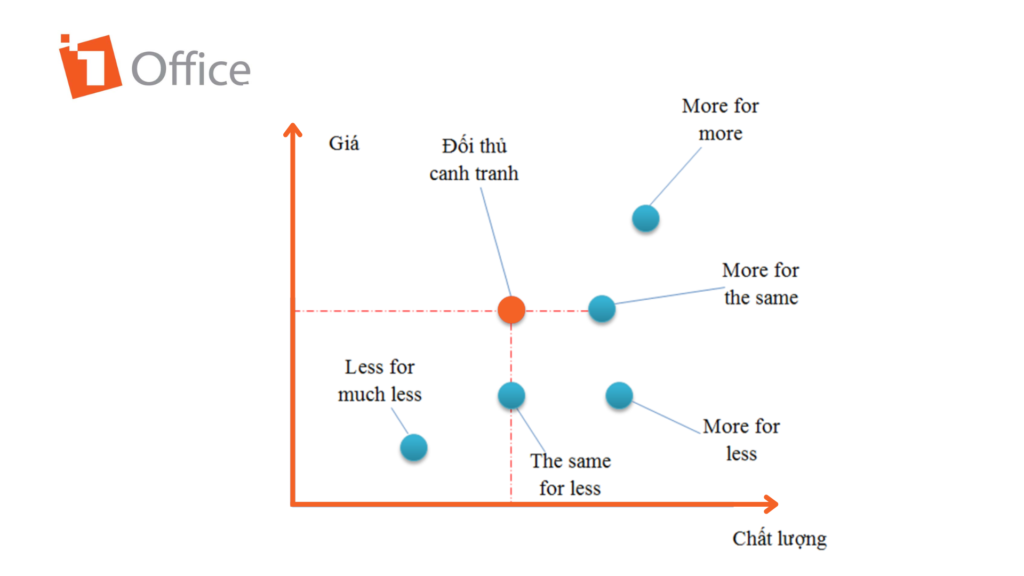
c. Creating a Positioning Map
A positioning map is a coordinate system used to describe a business’s position relative to its competitors in the market. Each position on the map represents an element of the product/brand that the business must establish in the customer’s mind, and it also indicates which competitors the business will have to compete with to win over customers.
Example of a positioning map:
4. 6 Steps to Effectively Implement an STP Strategy in Marketing
Step 1. Market Research
A business can only successfully conquer a market when it has a thorough understanding of that market and can estimate its size and scale before deciding to enter.
To measure market size, here are 3 metrics that a business needs to understand:
- Total Available Market (TAM): TAM is the total market demand for a product or service. In other words, TAM is the maximum revenue a business can generate if it captures 100% of the market share.
- Serviceable Available Market (SAM): SAM is a subset of TAM, meaning the portion of the total available market that fits the business’s product or service. A business can determine its SAM based on geography or product specialization.
- Serviceable Obtainable Market (SOM): SOM is a subset of SAM, meaning the segment of the serviceable available market that the business can realistically reach after considering factors like product differentiation, budget, and competitive advantages.
For example: In the case of Coca-Cola, the TAM is the entire beverage market, the SAM is the soft drink segment, and the SOM is the market segment that Pepsi does not own.
Step 2. Market Segmentation
This is the Segmentation stage in the STP model. Market segmentation creates focused customer groups that a business can attract with personalized messages. Research by McKinsey shows that companies excelling at personalization generate 40% more revenue from marketing activities than other companies.
Step 3. Select the Target Market Segment
In this step, the business identifies its target market segment based on the criteria mentioned in the Targeting stage.
Step 4. Analyze the Target Market Segment
With the chosen market segment, the business needs to analyze the competitive situation in that segment by “scouting” competitors. At this stage, the business should use the SWOT model to identify its strengths, weaknesses, opportunities, and threats in the market segment, and then build a positioning strategy to leverage its strengths.
Step 5. Market Positioning
To win the largest market share, a business needs to focus on creating and establishing a strong brand image in the minds of consumers. To do Positioning well, a business can position itself in the market based on the following criteria:
- Competitor-based positioning: What aspects does the business perform better in than its competitors.
- Consumer-based positioning: How well the product meets consumer needs.
- Price-based positioning: How you price competitively and provide customers with more value for their money.
- Benefit-based positioning: How customers benefit from purchasing the business’s product.
- Attribute-based positioning: The USP and superior values the product offers beyond benefits and price.
- Prestige-based positioning: How customers enhance their status by purchasing the business’s product
Step 6. Build a Marketing Mix Strategy
The final step in implementing marketing activities according to the STP model is to build a Marketing Mix strategy based on the 4Ps:
- Product: Represents factors such as quality, benefits, features, design, services, support, availability, and competitive advantage.
- Price: Reflects what customers are willing to pay for the product. It includes list price, discounts, payment methods, etc. Pricing your product much lower than competitors might give you an immediate advantage but will be detrimental to revenue in the long run.
- Place: Includes the channels chosen to distribute the product, such as e-commerce, physical stores, etc.
- Promotion: Represents how the business will bring the product to customers. It includes marketing campaigns, advertising, public relations, sales promotions, word-of-mouth, influencer marketing, etc.
5. 1Office CRM – The Superior Solution for Winning Customers
To succeed in the battle to conquer the market, businesses not only need to apply the STP model to implement effective marketing campaigns but also need to optimize business processes by applying technology. 1Office CRM is the market’s most superior toolkit for supporting business operations, helping companies effectively tap into target customer groups and develop professional customer acquisition and retention strategies.
- Effectively leverage customer data with features for filtering and classifying customer data based on status, needs, characteristics, etc.
- Build a professional customer care process with automated multi-channel scenarios, optimizing the customer experience at every touchpoint.
- Support the implementation of marketing automation campaigns to increase brand reach and closely follow the customer journey.
In this article, 1Office has provided readers with useful knowledge about what STP is and shared strategies for effectively applying STP in Marketing. The 1Office software solution is the key to helping businesses conquer the market. For a free consultation and a trial experience of the software, please contact us using the information below.
For more detailed information, please see:
- Hotline: 083 483 8888
- Fanpage: https://www.facebook.com/1officevn/
- Youtube: https://www.youtube.com/channel/UCeTIRNqxaTwk0_kcTw6SxmA
















