


 12/05/2026
  240 views
A company’s salary and bonus regulations need to be adjusted and changed after a certain period to improve. Besides businesses that need to change their salary regulations in the new year, many companies are still struggling to find an effective way to establish their salary and bonus policies. In today’s article, 1Office will share with you how to build a detailed 2026 salary and bonus regulation template that both ensures compliance and is easy to apply for any business.
Mục lục
- I. The Purpose of Establishing Salary and Bonus Regulations
- II. Why is it necessary to update and build a 2026 salary and bonus regulation template?
- III. Legal Basis for Building the 2026 Salary and Bonus Regulation Template
- IV. Detailed Guide to Building a 2026 Salary and Bonus Policy
- V. Free download of the latest 2026 salary and bonus regulation template
I. The Purpose of Establishing Salary and Bonus Regulations
A well-invested salary and bonus regulation, built with detailed, scientific content that ensures fairness, plays a very important role for a business. The purpose of creating a salary and bonus regulation template is to ensure sustainable development in the operational structure and all activities of the company. Specifically:
- Ensure the livelihood of staff
A salary and bonus regulation template helps ensure the livelihood of staff, serving to meet the basic living standards of the organization’s members. This allows them to work with peace of mind and be ready to contribute to the company.
- Encourage employees to perform better
The company’s regulations clearly define the salary, bonuses, and benefits that employees will receive. This gives employees more motivation to work and contribute to achieving better results.
- Help employees clearly understand how salaries and bonuses are calculated
Salary payment regulations help members of the company or organization clearly understand how bonuses, salaries, and related allowances are calculated for their respective positions.
In addition, salary and bonus regulations are the basis for ensuring the rights of all members within the business. An effective salary and bonus regulation template will ensure implementation in accordance with current legal provisions on salary, bonus, and benefit policies for employees.
II. Why is it necessary to update and build a 2026 salary and bonus regulation template?
Building the latest salary and bonus regulations requires businesses to base them on the company’s current conditions while also complying with legal provisions. However, a company’s conditions are constantly changing over time, and legal regulations are also subject to adjustments and amendments. Sticking to old salary and bonus regulations will be unsuitable and may lead to many inadequacies. That is why businesses need to update and build new salary and bonus regulation templates to be more appropriate.
In addition, updating the 2026 salary and bonus regulation template will help businesses:
- Attract more talent
Building the latest attractive salary and bonus regulations that are regularly updated and follow current trends will help businesses attract more talent, and the staff will in turn have more motivation to develop.
Furthermore, the 2026 salary and bonus regulation template is also a way to foster loyalty among long-term core employees.
- Build a reputation in the market
An attractive salary and bonus system helps affirm the company’s position in the market. This is because a business with an attractive benefits policy must certainly have a strong foundation of business development.
For this reason, looking at the salary and bonus regulations can, to some extent, help assess whether a business is developing well.
III. Legal Basis for Building the 2026 Salary and Bonus Regulation Template
Currently, there are many legal documents regulating employee salary payments that businesses can refer to.
Specifically:
| Official Dispatch No. 4320/LĐTBXH-TL dated 29/12/1998 of the Ministry of Labor, Invalids and Social Affairs | Guidance on building a salary payment regulation in state-owned enterprises |
| Decree No. 49/2013/NĐ-CP Detailing the implementation of a number of articles of the Labor Code | Regarding salaries for employees |
| Decree 51/2016/NĐ-CP dated 13/6/2016 of the Government | Regulating labor management, salaries, and bonuses for employees in single-member limited liability companies with 100% charter capital held by the State. |
| Decree No. 52/2016/NĐ-CP | Regulating salaries, remuneration, and bonuses for managers of single-member limited liability companies with 100% charter capital held by the state. |
After researching and identifying the appropriate legal basis to apply, the next step is to build a 2026 salary and bonus policy template that is suitable for your business.
IV. Detailed Guide to Building a 2026 Salary and Bonus Policy
To build an effective salary and bonus policy template, managers need to follow these steps:
1. Create an overall plan for the annual salary fund
Every implementation plan requires initial steps to determine the overall costs. When creating a salary and bonus policy, administrators need to plan and forecast the estimated expenditure for salaries, while also calculating the ratio of that expenditure to revenue.
From that overview, administrators can determine the salary unit rate for the year. This unit rate will be the basis for the business to determine the basic salary for each job title group and the foundation for calculating piece-rate wages based on revenue or product units. Clearly planning the annual salary fund will help with cost forecasting and more effective allocation of salary and bonus categories.
| Read more: The Most Accurate Way to Calculate Payroll Fund by Revenue for 2026 |
2. Group job titles appropriately
Next, managers need to list and group jobs together. This step should be based on the nature and complexity of the work for classification.
This grouping requires managers to refer to job descriptions and detailed requirements for each title, then group them based on fundamental factors.
For example:
- Educational level
- Professional experience
- Specialized knowledge
- Related skill sets
- Job responsibilities
Based on these factors, managers will determine a coefficient or score corresponding to each job title. You need to carefully consider the gap coefficient between job positions to ensure a reasonable spread between the highest and lowest positions in the company, as well as adjacent positions.
3. Build a system for monitoring, evaluation, and rewards
To ensure encouragement and fairness in the salary and bonus policy template, managers need to build a system of job completion standards. This system of standards, in written form, serves as a basis for both leadership and employees to use for evaluation.
To implement this effectively, the job descriptions created by the business must be accurate and realistic. Additionally, managers must ensure that the planning and monitoring processes in each department are carried out very strictly.
In addition, the management team can convert job completion levels into coefficients, corresponding to labor grades like A, B, C or I, II, III. Another common method used by companies is to reward good performance and penalize mistakes.
4. Decide on the form of salary and bonus payments for employees
For innovations in the business system in 2026, managers can apply various salary payment methods for each type of labor and each department within the organization. This could include applying a fixed salary for administrative positions, a piece-rate salary for positions that directly generate revenue, or a combination of both.
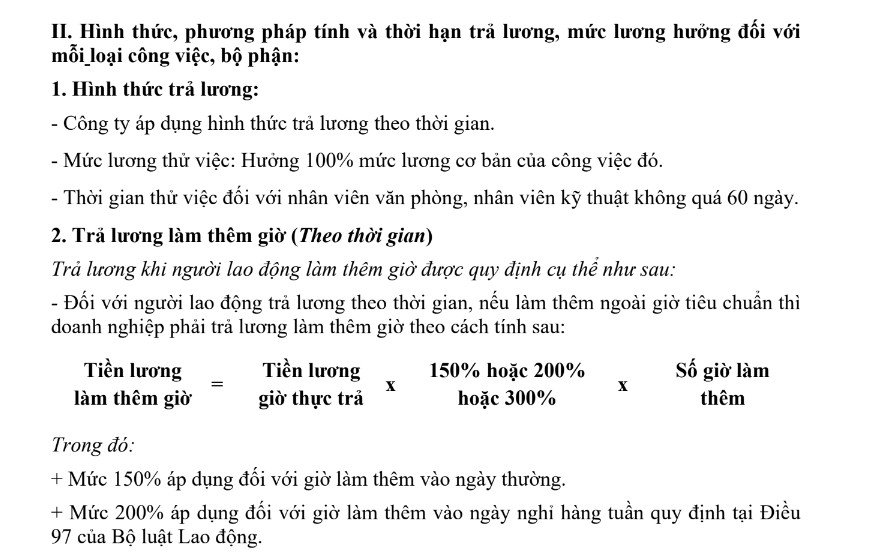
Another quite common form of payment is piece-rate salary. Piece-rate salary can be applied based on the volume of products or direct revenue generated by an individual or a team; or applied based on a coefficient or score by job title, for direct or indirect production departments. However, when paying a piece-rate salary, managers need to determine an appropriate unit price that is encouraging and ensures a decent standard of living for employees.
Additionally, the business also needs to set different performance indicators to measure job completion levels. At each higher level, the bonus rate will be supplemented to maximize potential and encourage employees to strive harder in their work.
5. Define the payroll process and other policies
The next step to implement is to decide on the payroll calculation process and the monthly salary payment date in the company’s 2026 salary and bonus policy template.
In addition, when creating the salary and bonus policy template, managers need to clearly define the payroll process for special cases. Specifically:
- Employees sent for training
- Employees working overtime
- Salary during maternity leave
A transparent and clear payroll process and policy will enhance the company’s reputation not only with employees but also in the market.
6. Monitor implementation for improvement
As mentioned above, the clearer and more transparent the salary and bonus policy, the higher the morale and enthusiasm of the employees will be. As a manager, remember to never keep the salary and bonus policy or the salary calculation method a secret from employees in the company.
After issuing the 2026 salary and bonus policy template, managers need to continuously measure and evaluate its reasonableness and effectiveness. The salary mechanism and policy cannot be static; it needs to be constantly reviewed and adjusted to suit the business context and new requirements.
| See also: 3 steps to building the most reasonable and optimal salary and bonus policy for sales staff |
V. Free download of the latest 2026 salary and bonus regulation template
Managers can download the detailed 2026 salary and bonus regulation template for free HERE!
From the article above, we can see that the 2026 salary and bonus regulation template plays an important role for businesses. Hopefully, the guidance on building the 2026 salary and bonus regulations shared here will help businesses make sound and informed decisions when creating a salary and bonus regulation template for their employees.
Additionally, businesses today can turn to software solutions to effectively manage employee salaries and bonuses. The 1Office payroll management software has been the choice of over 5,000 businesses.
The 1Office automated payroll management feature has provided a solution flexible enough to meet the constantly changing salary and bonus policies of a business. With a system that links data between modules, the software automatically calculates and pays salaries via bank accounts. This completely eliminates the process of compiling leave requests, fingerprint logs, etc., as well as complicated manual calculations, saving significant time and costs for the business.
For more details, please contact:
- Hotline: 083 483 8888
- Fanpage 1Office: https://www.facebook.com/1officevn
- Youtube Channel: https://www.youtube.com/c/1OfficeNềntảngquảnlýtổngthểDoanhNghiệp
















