


 13/05/2026
  277 views
How to sell effectively and close deals successfully is what salespeople care about most. Selling is an art, and the salesperson is considered an artist because it requires skills that not everyone can easily acquire.
Sales methods are becoming more diverse depending on the product, customer, and industry market. To improve your skills as a salesperson, you should consider many possible techniques. In this article, let’s explore sales knowledge and some effective selling methods that salespeople will definitely need.

Mục lục
I. What is a sales methodology?
Sales methodologies (also known as sales techniques) are strategies that salespeople use to sell more effectively, close deals quickly, and increase revenue.
There are many different sales methodologies. The most suitable method will depend on your skills as a salesperson, the product you are selling, and the audience you are selling to. Many successful salespeople can flexibly use various sales methods depending on the situation. You should experiment with different sales methods to determine which one yields the best results for you.
II. The importance of sales methodologies
The core of every effective selling method is to support and facilitate employees in developing the best possible business operations.
This is achieved by using customer-centric approaches to identify and solve their problems. These approaches are often based on proven psychological principles, as well as tested tactics implemented by the experts who developed them.
III. Effective selling methods for salespeople
Below are four effective sales techniques that salespeople can apply to both in-store and online sales.
1. Don’t talk too much, listen
Today, customers no longer like to hear too many sales pitches and they certainly dislike manipulative, cookie-cutter approaches. Instead of just focusing on selling, you need to talk less and start listening. Good sales skills are not a one-way street; it must be a two-way conversation between you and the customer.
Let’s compare Hard Sell & Soft Sell approaches:
- Hard Sell: gets straight to the point that both the seller and buyer understand and expect, intended for customers who are ready to buy and don’t need to look around or compare with other stores.
- Soft sell: is based on building relationships. The salesperson uses a passive method to show potential customers what they offer; this is an indirect approach.
| Hard Sell | Soft Sell |
| Sell immediately | Listen, help, ask questions |
| Aims for an immediate increase in sales | Focuses on building long-term relationships with customers |
| Sells to everyone | Nurtures trust with existing customers |
| For their own benefit | For the customer |
| Facts and product features | Tells stories and the benefits customers receive |
Soft Sell will focus more on the customer’s “pain points” — understanding what customers need, why they need it, and how you can help them solve it. This is also a way to help you gather more customer information to gain a deep understanding of their needs, thereby having an appropriate approach and adjusting the product accordingly.
To make it easier to visualize, let’s look at an example of two ways to sell perfume:
Case 1 (Hard Sell):
- You smell a perfume you don’t really like
- Salesperson: You’ll smell like roses every day if you use Romance perfume. It’s completely hypoallergenic and costs only $14.99. Buy it today!
Case 2 (Soft Sell):
- Salesperson: Hello, you must have had a busy day? Are you on your way home? We have a free gift for you. Enjoy!
- You ask about the gift.
- Salesperson: Yes, it’s the new fragrance from X. You can try a spritz right here.
In the first case, the customer is forced to make an immediate decision — this sales method is often very difficult to close. A more effective way to approach customers is to start a casual conversation. The salesperson gives the customer something, which helps elicit questions and creates an opportunity to build a relationship with the customer, thereby increasing the likelihood of closing the deal.
Before “bombarding” the customer with how great your product is, listen first. The customer will tell you what they need or provide feedback that will help you sell to the next customer.
2. Connect with customers through stories
One of the most effective Soft Sell skills is STORYTELLING.
When you connect with your customers through stories, they will feel more engaged and it makes the process of buying a product/service an enjoyable experience.
That means, instead of going straight to the features or benefits of the product, you can use sales tactics that sell an idea, an experience, or a moment related to the product.

Experts say that telling a good story can beat most other sales strategies. It captures the customer’s attention, builds rapport and trust naturally, and makes your product more memorable. Above all, it is closely related to the first skill – listening.
| Sell stories, and you’ll never run out of customers.
One of the storytelling methods that both small sellers and large business owners should learn is SCQA, which is built on McKinsey’s classic pyramid principle.
- S: Situation
The specific time, place, and circumstances of the event must be described factually, without need for debate or explanation to the customer.
Through this part, we will put ourselves in the customer’s shoes. This is also the first step to building trust, making the customer feel understood when both sides share a common ground.
For example: Two years ago, I met a client who wanted a product with a high level of protection and sufficient power capacity.
- C: Complication
Something could happen that suggests the described context might change, and these changes contain potential problems or dangers.
For example: However, with a high level of protection, the product’s heat dissipation would be affected, so the power capacity shouldn’t be too large. This is a difficult technical problem.
- Q: Question
Use a phrase to ease the situation, then lead to the question: How can this conflict be resolved?
- A: Answer
This is the issue you want to address, or the solution you want to propose to the customer.
For example: Some of our company’s clients have faced a similar problem. At that time, we specifically helped them develop a specialized product that solved this issue.
As you enhance your sales technique through storytelling, you will learn to leverage emotions to fully exploit the effectiveness of sales methods. While facts and figures are important, they don’t have a place in the modern sales process. Because customers will ask you directly when they want to know this information.
3. Research common questions & objections beforehand
The most effective way to learn about the questions and objections of regular customers is to: Be helpful to the customer.

One of the important rules that contribute to an excellent sales strategy that business owners need to know is: Help your customers. When you approach someone in the store, listen first, then share. That’s when you find out the customer’s questions about your product.
| The more helpful you are, the more you will sell.
Based on this information, you can give them useful advice — whether it’s related to your product or not — to solve their problem. All sales begin with a problem (or a desire) and end with a solution (or an attractive deal). The most effective sales tactics all revolve around solving problems and helping customers first.
4. Be ready to close the deal
When shopping in retail stores, buyers can easily move from one product to another without making any decisions. You don’t want to rush them into a purchase or interfere too much with their buying process.
At the same time, you still want them to buy the product that has caught their attention.
So how do you close the sale when a customer is already interested in your product?
- Tell them it’s the last item in stock.
- Or let them know it’s the last day of the sale.
- Mention the option to return it at any time (they rarely do).
- Ask if they would like to try the product.
These are examples of how you can successfully close a sale. Every customer needs an (indirect) push to make a purchasing decision. If you see a customer hesitating, encourage them to make a decision with a question or a sincere piece of advice.
Additionally, salespeople can apply the art of up-selling. With this sales method, the seller will advise and persuade customers to buy additional items alongside their initial intended purchases, instead of just buying what they originally planned. The goal of up-selling is to increase sales and introduce customers to options that better suit their needs. To do this, tell customers how the product meets their long-term goals and expectations.
IV. Notes on Applying Sales Methods
Besides effective sales tactics, a standard Sales pipeline is equally important for a business. Because you can only improve what you can measure.
Research by Harvard Business Review shows that companies with a standard sales process experience 18% higher revenue growth than companies without a defined sales process.
One of the leading Made-in-Vietnam software solutions today – 1Office – helps businesses manage the entire customer lifecycle, optimize sales opportunities, and increase the Lead conversion rate in the sales process by:
- Improving & standardizing the sales process
- Analyzing different sales strategies for your business
- Managing and allocating sales staff resources to optimize transaction efficiency
- Tracking business progress and knowing how far you are from your revenue goals
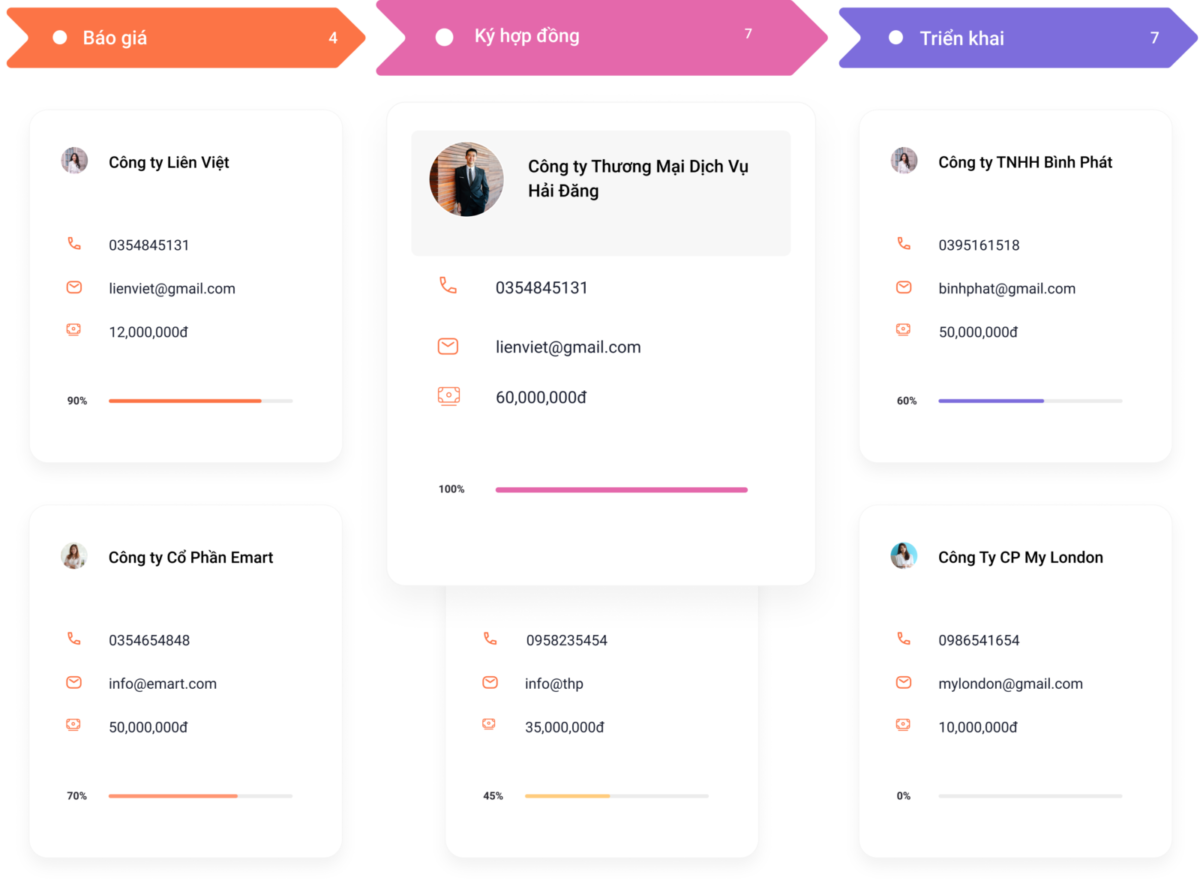
In addition, 1Office also integrates features like Email marketing, Call center… to support automated and professional customer care, while improving the work efficiency of the Telesales team.
See more: Professional Sales Process: Steps for Building and Practical Application
If you are struggling with building a sales process or customer care system, register with us now for a trial experience. 1Office will help you solve your difficulties quickly
















