


 13/05/2026
  233 views
Amidst a sea of ever-growing businesses, we constantly ponder how to elevate our own company to new heights, create significant changes and progress, and be competitive enough to race against rivals in the market. For this reason, modern managers are turning to a “digital” solution, also known as work management software, to help them continuously enhance their business’s development. Let’s explore the benefits this software brings after implementation.
Mục lục
What is work management and why do businesses need it?
According to Gartner—the world’s leading information technology research and advisory company—Work Management is defined as a “system of services that applies a ‘workflow’ structure to the movement of information and the interaction between business processes and human-created processes that serve the information flow.”
In simpler terms: Work management is applied to manage the progress and workload of individuals and teams, whether within the scope of a project or related to business operations.

Work management is managing the workload, progress, and performance of personnel
Popular Work Management Methods
Understanding the importance of work management, people have long sought various methods to carry out this task. There are 3 popular management methods for businesses today:
Traditional Paper-Based Management Method
When using this method, company employees must be assigned to record and organize all work processes or information about the progress of ongoing projects.

The traditional paper-based management method is extremely costly
The advantage of this method is that tools like pens and paper are easily found in places like bookstores and offices. Anyone can create and record necessary information and data. However, its disadvantages are that it is extremely costly in terms of money, time, and effort, and is prone to errors because most of these tasks must be performed manually.
Management Method Using Separate Applications
The race to keep up with the digital age has led software developers to create online document “digitization” applications like Google Drive and Google Docs. This is an effort to reduce paper usage, but in essence, it is not much different from the traditional management method.

Using online applications only provides basic storage support for management
At the end of each month, the HR department still has to compile information and link data to create reports for superiors. Essentially, the digitization method using such applications only helps with document storage and does not offer an optimal solution for work management.
Management Method Using Comprehensive Work Management Software
Applying work management software can be likened to a tool that integrates both of the above methods but is more optimal in many aspects, such as saving time, effort, and manpower, and reducing costs for paper and storage devices. In addition, instead of spending days or weeks compiling detailed reports from separate applications, management software helps leaders and departments easily assign tasks, evaluate quality and output performance, and then quickly generate accurate summary reports.
Using work management software saves time on compiling and reporting
Benefits of “digitizing” work management
When applying the “digitization” method to business management processes, all issues regarding information security and data storage will be strictly ensured. Previously, management often encountered errors, confusion in timing and schedules, and employees not grasping necessary information. Now, with just a few simple steps, all important events and milestones are communicated to everyone in the company, and situations like forgetting tasks or negligence will be “eliminated”.

Work management software will reduce the “forgetting tasks” situation among employees
Additionally, managing work with software can enhance the professionalism of monitoring and management by leadership, minimizing costs and the volume of backlogged work.
Therefore, to create significant changes and quickly resolve concerns affecting the business’s development, leaders should carefully consider choosing digital management methods over traditional ones.
Read more: 5 ways to manage underperforming employees
The most effective work management software today – 1Office
When businesses face difficulties in accurately assessing employee performance, 1Office, with its outstanding features, can directly monitor and recognize those who complete their work well. It allows administrators to clearly grasp the project’s status and progress, making timely corrections if any issues arise.
When a business needs to create a workflow with fewer errors and high accuracy, instead of using traditional “manual” methods, now with 1Office, any deviation in the process is easily detected and quickly addressed. Projects will also be completed smoothly without interruption.
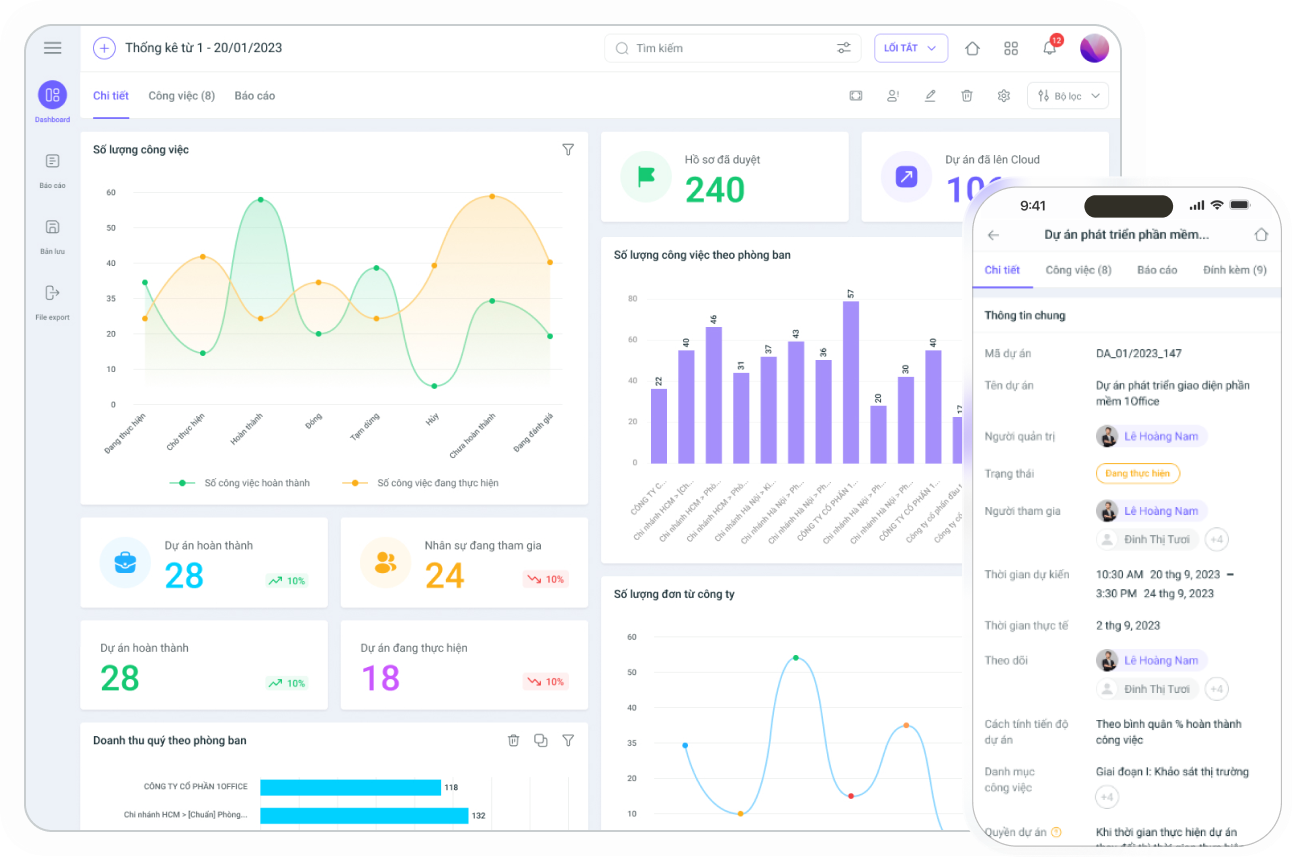
The most important aspect of applying 1Office to work management is the ability to reduce input costs and increase output efficiency. Gone are the days of struggling and tirelessly recruiting personnel. Above all, superiors can personally participate in closely monitoring progress, motivating employees, and contributing ideas to ongoing projects.
















