


 13/05/2026
  230 views
After overcoming countless hardships to build products and services and creating hundreds of plans to win over customers, Vietnamese small and medium-sized enterprises (SMEs) are now facing the challenges of the 4.0 revolution: digital transformation.
The 4.0 revolution has just begun. It’s a world where businesses operate leanly and efficiently—where artificial intelligence will replace 60% of human labor, yet productivity will increase more than threefold. Business owners may not yet see the clear changes of this industrial revolution, but the risks are ever-present.
Let’s look back at the battles of the 3rd industrial revolution, where new ideas and new products conquered customers and turned “former giants into relics of the past”:
- The iPod conquered the $100 billion digital music market and relegated Sony’s giant, the Walkman, to collectors’ shelves.
- Facebook, starting as a social network exclusively for Harvard University students, won over 1.8 billion users and turned Yahoo into just a memory.
- Apple and Samsung dealt painful blows to Nokia, Motorola, and HTC. Ultimately, Nokia, Motorola, and HTC became mere “nostalgic heroes” in the smartphone market.
So, have you ever thought about what will happen to your business in the 4.0 era? What will you do to continue steering your corporate ship towards your dream of “building a business empire”? Let’s explore digital transformation with 1Office—and learn how the “small fish can swallow the big fish.”
See more: What is Digital Transformation: The Future Path for Businesses
Mục lục
The Concept of Digital Transformation
Digital transformation (Digital Transformation) is the change associated with the application of digital technology in all aspects of society and human behavior. In a narrower sense, digital transformation refers to a “paperless management” world.
Distinguishing Between: Digital Transformation and Digitization
Digitization and Digital Transformation are two completely different concepts.
“Digitization” is the process of converting real-world values into a digital format. “Digital transformation,” on the other hand, occurs after data has been digitized. It involves using technologies like AI (Artificial Intelligence), Big Data, and IoT (Internet of Things) to analyze and transform that data to create new value.

Take Grab’s ride-hailing app as an example. What users see on their phone screen is a simple process of booking a ride and completing the trip for both the customer and the driver, but behind it lies a complex system.
The company must analyze large volumes of data related to drivers’ habits, user demand, pre-set route creation features, real-time navigation, and more. From its ride-hailing service, the company has expanded to offer many other products like delivery, food ordering, and more.
See more: Digital Transformation in Recruitment and Human Resource Management
Challenges for Businesses in Digital Transformation
According to research by 1Office, there are 4 main obstacles that contribute to the low rate of business digital transformation in Vietnam:
Employees are reluctant to change processes and work culture
Many statistical studies show that employees tend to dislike software. The more software they have to use, the more they dislike it. The lack of data synchronization and complex processes make it difficult for employees to adapt, especially long-term and older employees.
The cost of digital solutions is high and time-consuming to implement
Over 95% of businesses in Vietnam are small and medium-sized enterprises (SMEs). This makes many business owners hesitant about the cost and implementation capabilities. Businesses cannot yet envision the total cost they have to invest in digital transformation. Therefore, they only want to apply it partially for testing. The mindset of every business owner is that every penny they spend must be worthwhile.
Potential security issues can harm the company
When digitizing a large amount of data, businesses may face risks related to cybersecurity, security, data loss, etc. These risks not only cause inaccuracies in the management system but also have the potential to make the business vulnerable.
Leaders lack vision or leadership skills
There are many reasons why leaders are not yet aware of the need for digital transformation, such as a lack of competence, limited access to knowledge, and a tendency to wait for others to lead the way before following.

See more: Personal Task Management Tools – The Cure for Employee Inertia
What is the digital transformation solution for SMEs?
Digital transformation is not a short-term goal but a long-term strategy. Successful digital transformation requires consensus and determination from top to bottom, from leadership to employees.
Business owners need to know that technology should be applied to improve work efficiency, not to replace people. Using technology can help an employee work in multiple fields. For example, they can be a data manager and a customer care specialist at the same time.
Currently, Vietnamese businesses still face many difficulties in accessing business management solutions. Foreign software like Salesforce, Zoho, etc., is expensive, has a non-user-friendly interface, and is not easy to implement. Meanwhile, Vietnamese solutions often have to be used separately, causing data overlap and complicating the operational structure.
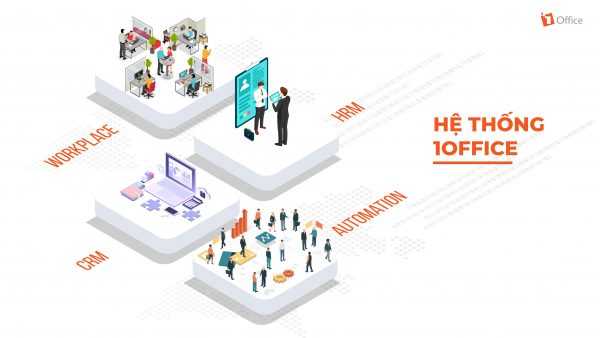
Understanding this urgent need, 1Office has launched an all-in-one management solution that makes achieving ambitious business goals a reality. After many years of research, 1Office is proud of its advantages:
- Synchronized: Integrates three modules: Workplace, HRM, and CRM to help manage all data and business activities comprehensively. Minimizes losses caused by using multiple overlapping solutions.
- Cost-effective: Manage processes, projects, human resources, customers, and retail distribution systems, all in one, for only 50,000 VND/employee/month. For a business with 20 – 50 employees, the cost is about 1 – 2.5 million VND/month.
- Customizable: Suitable for all stages of business development; even businesses with fewer than 10 people can easily implement and use it. It is the only solution in Vietnam and worldwide that allows setting up Excel functions on the automatic timekeeping system to build payroll spreadsheets.
- Simple: User-friendly, familiar interface, easy to implement.
- Secure: Physical data is stored and monitored 24/7 at a reputable, international-standard data center with absolute security and high availability (HA), operating 24/24.
- Fast: Applies the best technologies and techniques. Additionally, the solution’s cloud computing infrastructure is modern and invested in at reputable data centers.
Transform your business before your business is changed by the world.
If you are facing challenges with digital transformation, work and personnel management, sign up for a trial to receive a consultation. 1Office will help you resolve these difficulties quickly!
Read more:
Positive and Strong Corporate Culture Factors: 8 Things You Need to Know
7 Mistakes CEOs Make in Business Management and How to Avoid Them
Launch of the 1Office Business Management Platform at the Ministry of Information and Communications
















