


 10/05/2026
  159 views
Business leverage is an effective tool that helps businesses achieve breakthrough growth. However, increased profits also come with potential risks. If not used correctly, business leverage can become a double-edged sword, affecting the business in many ways. To help business owners and investors clearly understand the operating principles and how to use business leverage for the best results, 1Office will provide the necessary information in the following article.
Mục lục
- 1. What is business leverage?
- 2. Types of business leverage
- 3. Diagram of the relationship between the 3 types of business leverage
- 4. How to use business leverage effectively
- 5. Strategic benefits of applying business leverage
- 6. Risks of Using Business Leverage and How to Mitigate Them
- 7. Frequently Asked Questions about Business Leverage (FAQ)
- 8. 1Office Business Management Software – The “Leverage” for Breakthrough Growth
1. What is business leverage?
In financial management, the term “business leverage” refers to a company’s use of assets with fixed operating costs or debt with fixed financial costs to increase profits for its owners.
Business leverage operates on the principle that a small change in the use of cost sources and financing sources will lead to a large change in the company’s business results.
2. Types of business leverage
In business, leverage is not just a financial concept but also encompasses many tools and strategies that help companies increase profits, optimize costs, and scale effectively. Depending on their goals and specific operations, businesses can apply different types of leverage to enhance their competitive strength. A clear understanding of each type of leverage will help managers choose the right tools, consider risks, align with business principles, and maximize the company’s potential.
2.1. Operating leverage
Concept
Operating leverage, also known as business leverage, reflects how a company uses fixed operating costs (fixed costs) relative to variable costs.
Where:
- Fixed costs are expenses that remain constant regardless of changes in the company’s production and business activities. These costs include depreciation, insurance, a portion of utility costs, and administrative expenses.
- Variable costs are expenses that change when the company adjusts its production and business activities. These include costs for raw materials, direct labor, selling expenses, a portion of utility costs, and administrative expenses.
Degree of Operating Leverage
The effect of business leverage is that a change in revenue can amplify into a larger change in operating profit (EBIT). This amplification is called the degree of operating leverage (DOL).
Formula

Where
- EBIT: Operating profit (Earnings Before Interest and Taxes) = Total revenue – Total variable costs – Total fixed costs
- Q: Quantity of units sold
- V: Variable cost per unit
- F: Fixed costs
DOL represents the rate of change in operating profit when revenue changes. The higher the DOL, the greater the amplification effect of a change in revenue on operating profit.
Example
Company ABC wants to determine its degree of operating leverage at a sales volume of 70,000 products, given that fixed costs are 120 million, the variable cost is 21 thousand/product, and the selling price is 54 thousand/product.
DOL = 70000. (54000 – 21000) / 70000. (54000 – 21000) – 120000000 = 1.05%
This means that a 1% change in revenue will lead to a 1.05% change in EBIT in the same direction (If revenue increases by 1%, EBIT will increase by 1.05% – if revenue decreases by 1%, EBIT will decrease by 1.05%).
Significance of operating leverage
- Operating leverage is a tool used by managers to predict the level of profit earned when boosting revenue. From there, managers can devise plans to use different types of costs reasonably to increase operating profit.
- The cost structure greatly affects operating leverage. Business leverage is higher when a company has a higher ratio of fixed costs to variable costs. Conversely, in companies with a lower proportion of fixed costs than variable costs, business leverage will be lower.
- However, businesses also need to be aware of the dual nature of operating leverage. A small change in revenue can lead to a very large amplification of operating profit. Therefore, when revenue decreases, profit will decrease by an amount equal to the degree of leverage. For this reason, companies always strive to reach the break-even point, because at that point, operating leverage will always be positive and have a positive impact on profit changes.
Relationship between business risk and operating leverage
There are many factors that lead to business risk for a company, including:
- Product sales volume
- Market competition
- Production and business cost structure
- Product diversity
- Product demand in the market
- The degree to which the company uses operating leverage
It can be seen that operating leverage is an effective tool to increase profits, but it also contains business risks for the company. As mentioned above, when using operating leverage, earnings before interest and taxes will be very sensitive to changes in product sales volume.
Therefore, if not used correctly, operating leverage will lead to a serious decline in the company’s profits. To apply business leverage effectively, building a detailed business plan is an extremely important task. Let’s read the article guiding how to create a professional business plan that is most applied by many businesses.
See more: 5+ steps to build a business model [Most effective in 2026]
2.2. Financial Leverage
Concept
Financial leverage is a term that describes how a company uses a combination of debt financing and equity financing.
Degree of Financial Leverage
The principle of financial leverage is: a small change in operating profit will lead to a larger change in the company’s EPS (earnings per share). This amplification is called the degree of financial leverage (DFL).
Formula

Where
- EPS: Earnings Per Share = (Net Income – Preferred Dividends) / Total Common Shares Outstanding
- I: Interest expense
- Q: Quantity of units sold
- V: Variable cost per unit
- F: Fixed costs
Example
Company ABC wants to determine the degree of financial leverage at a sales level of 300,000 products, given that fixed costs are 280 million, variable cost is 84 thousand/product, and the selling price is 100 thousand/product. The company’s interest expense is 60 million and the tax rate is 20%.
- EBIT = 30,000 x (100,000 – 84,000) – 280,000,000 = 200,000,000
- DFL = 200,000,000/ (200,000,000 – 60,000,000) = 1.43%
This means that a 1% change in profit will lead to a 1.43% change in the same direction in earnings per share (If profit increases by 1%, EPS will increase by 1.43% – if profit decreases by 1%, EPS will decrease by 1.43%)
The Significance of Financial Leverage
- Financial leverage is an effective tool used by businesses to amplify the return on equity.
- The degree of financial leverage used is reflected in the company’s debt ratio. Companies with a high debt ratio have a high degree of financial leverage, and vice versa.
- However, like operating leverage, financial leverage is also a double-edged sword. This is because just a small change in earnings before interest and taxes will lead to larger changes in the after-tax profit margin. If the profit generated from total assets is not large enough to cover interest expenses, the earnings per share will decline.
Relationship Between Financial Risk and Financial Leverage
Financial risk is the risk that shareholders bear due to the variability or uncertainty in earnings per share when the company uses debt. As mentioned above, if not used wisely, financial leverage can become a factor that hinders the growth of the company’s after-tax profit.
See more: What is Financial Risk? Solutions for Prevention and Management
2.3. Combined Leverage
Concept
Combined leverage is the use of both operating leverage and financial leverage to increase shareholder income.
Degree of Combined Leverage
By combining operating leverage and financial leverage, a small change in revenue will be amplified into a larger change in EPS (earnings per share). This amplification is called the degree of combined leverage (DCL – Degree of Combined Leverage)
Formula for calculating the degree of combined leverage

- EBIT: Earnings Before Interest and Taxes
- EPS: Earnings Per Share
- I: Interest
- Q: Quantity of units sold
- V: Variable cost per unit
- F: Fixed costs
Example
If DCL = 2, a 1% change in revenue will lead to a 2% change in EPS in the same direction (If revenue increases by 1%, EPS will increase by 2% – if revenue decreases by 1%, EPS will decrease by 2%).
The significance of combined leverage
The degree of combined leverage shows how the owner’s equity changes with a change in revenue when a business invests in fixed assets using borrowed capital.
3. Diagram of the relationship between the 3 types of business leverage
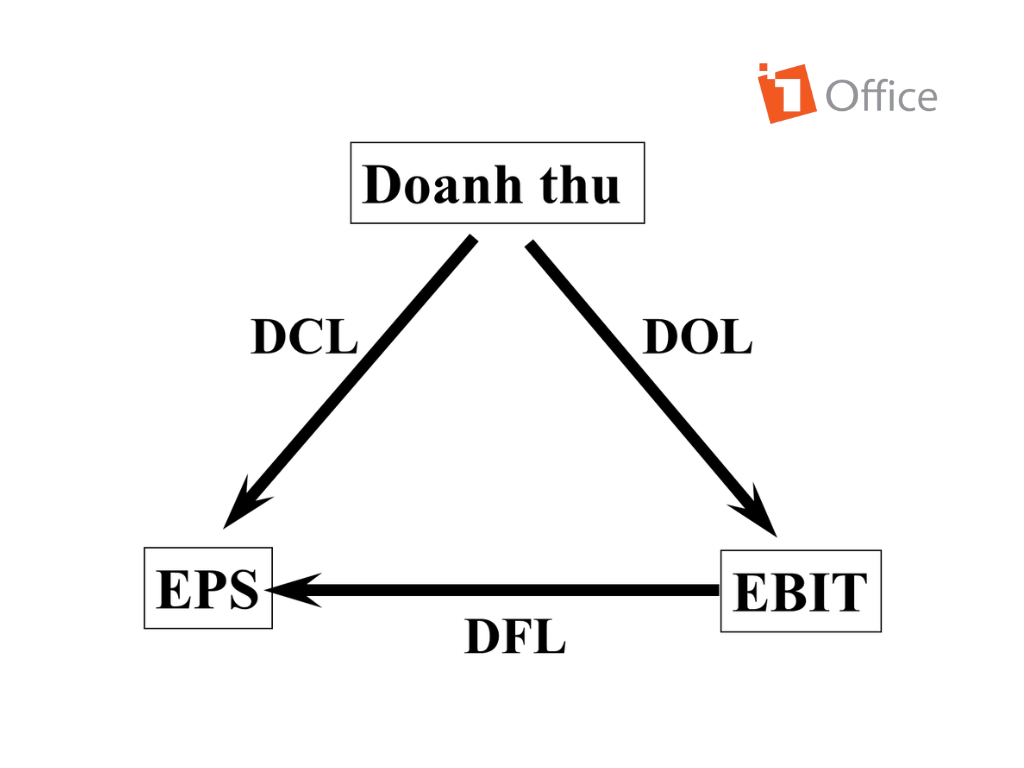
The diagram above clearly illustrates the operating mechanism and the impact of the 3 types of business leverage on 3 factors: revenue – operating profit (EBIT) – earnings per share. Managers need to understand this model clearly to avoid confusing the functions of the different types of leverage and to apply them reasonably, for the right purpose, and to the right target.
4. How to use business leverage effectively
To leverage business for growth, the first factor managers need to consider is cash flow. The principle of leverage is how a business effectively uses costs and borrowed capital. For leverage to be effective, focus on using the levers that generate the greatest net profit for the business.
Note that using different types of leverage greatly affects how a business operates. Therefore, as a business owner, you must calculate carefully and anticipate possible scenarios to respond to risks in a timely manner. For example, if a business uses financial leverage but does not use the borrowed capital effectively, and the earnings before interest and taxes are less than the interest payable, it will cause the return on equity to decline more rapidly. Without a contingency plan, this could very likely lead to heavy losses.
In summary, if used wisely, business leverage can be a great tool to create development momentum for a business. But if the potential risks are not recognized and there is no crisis management plan for the effects of business leverage, the business will suffer severe consequences.
Read more: TOP 10 Best Business Management Software, ERP Solutions in 2025
5. Strategic benefits of applying business leverage
Business Leverage not only helps businesses increase profits but is also a strategic tool for scaling up without a corresponding increase in resources. When applied correctly, leverage allows a business to accelerate growth, optimize productivity, improve profit margins, and enhance its competitive position in the market. Here are the specific benefits:
-
Optimize operating costs:
Using operating leverage helps businesses take advantage of invested fixed costs, thereby reducing the average cost as production or revenue increases. -
Increase profits rapidly:
A small increase in revenue can generate outstanding profit growth thanks to a high leverage ratio. -
Scale up without a significant increase in personnel or assets:
Technology, processes, and management systems act as “soft leverage” to help businesses grow quickly at a low cost. -
Enhance competitiveness:
Businesses that use leverage effectively have a better cost structure, faster decision-making speed, and can react to the market more nimbly. -
Accelerate decision-making:
When tools and data become “information leverage,” managers can make decisions based on analysis rather than intuition.
6. Risks of Using Business Leverage and How to Mitigate Them
Although leverage offers significant benefits, misusing it or choosing the wrong type can create serious risks for a business. Therefore, organizations need to clearly understand the nature of each type of leverage to use it safely and effectively.
6.1 Financial Risks
Financial Leverage comes with periodic debt repayment obligations. Businesses may face:
-
Risk of insolvency when revenue declines.
-
The burden of increased interest costs when market interest rates fluctuate.
-
Risk of negative cash flow if capital planning is not tightly controlled.
How to mitigate:
-
Only use financial leverage when cash flow is stable.
-
Maintain a safe debt ratio according to industry standards.
-
Forecast revenue in a worst-case scenario before borrowing.
-
Choose a loan term that aligns with the business cycle.
6.2 Operational Risks
Operating leverage increases fixed costs, which also means increased risk if revenue does not meet expectations.
Potential risks:
-
High operating costs that are difficult to cut flexibly.
-
Significant investments in systems, machinery, and technology that are not utilized to full capacity.
-
Risks of dependency on individuals or weak processes.
How to mitigate:
-
Monitor operational KPIs in real-time.
-
Invest in technology in phases, avoiding spreading resources too thin.
-
Standardize processes to limit errors and reduce losses.
6.3 Cash Flow Risks
Cash flow is the “lifeblood” of a business. Using leverage without considering cash flow can lead to collapse.
Common risks:
-
Slow cash inflow while fixed costs are high.
-
Insufficient cash flow to pay interest, suppliers, or maintain operations.
-
Forecasting inaccuracies leading to a shortage of working capital.
How to mitigate:
-
Establish a 3-6-12 month cash flow forecasting model.
-
Focus on faster accounts receivable collection.
-
Optimize inventory and capital turnover.
-
Maintain a financial contingency fund.
7. Frequently Asked Questions about Business Leverage (FAQ)
Business leverage is a strategic tool that helps businesses grow quickly and optimize profits. However, if not understood correctly and used appropriately, leverage can also become a risk-increasing factor. Below are the most common questions to help businesses understand and apply business leverage safely and effectively.
Is business leverage the same as financial leverage?
Not exactly the same, but they are closely related.
Business Leverage is a broad concept that reflects the extent to which a company uses fixed cost factors to amplify profits as revenue increases. Meanwhile, financial leverage is just one part of business leverage, focusing on using debt and external capital to increase return on equity.
Specifically:
-
Operating leverage relates to the cost structure (fixed costs – variable costs)
-
Financial leverage relates to the capital structure (debt – equity)
-
Total leverage is the combination of both
Therefore, financial leverage is a tool within the overall business leverage strategy, not a complete replacement for the concept.
Should small businesses use business leverage?
Yes, but with caution and step-by-step implementation.
Small and medium-sized enterprises (SMEs) often have limited resources, so using business leverage can help:
-
Accelerate growth without expanding staff too quickly
-
Optimize operating costs
-
Increase profits on the same level of revenue
However, SMEs are also vulnerable to risks if:
-
Cash flow is not stable
-
They lack a good cost management and control system
-
They lack data for forecasting and decision-making
The appropriate solution is to start with operating leverage by standardizing processes, digitizing operations, and improving productivity before considering high levels of financial leverage.
How much leverage is safe to use?
There is no fixed number for every business, as the safety level of leverage depends on many factors such as industry, business model, profit margin, and cash flow generation capability.
However, businesses can refer to some general principles:
-
Cash flow from business operations must be stable and sufficient to cover fixed costs
-
The debt-to-equity ratio (D/E) needs to be controlled at a reasonable level
-
The break-even point is not too high compared to current revenue
-
Have a financial scenario for a decrease in revenue
The use of leverage is considered safe when profits increase faster than the level of risk incurred, and the business can still maintain financial control in worst-case scenarios.
When should a business stop or reduce the use of leverage?
A business should consider reducing or stopping the use of leverage when the following warning signs appear:
-
Prolonged or sharply fluctuating revenue decline
-
Cash flow is insufficient to cover fixed costs and interest expenses
-
Financial costs are increasing faster than profits
-
The market is entering a recession or a period of unpredictable volatility
-
The business loses control over costs and operational efficiency
In these cases, continuing to maintain high leverage can expose the business to liquidity risks and financial instability. Reducing leverage at the right time helps the business preserve resources and better prepare for the next growth cycle.
8. 1Office Business Management Software – The “Leverage” for Breakthrough Growth
In addition to using business leverage, companies also need to apply software technology to their operations and management if they want to achieve outstanding growth. With the 1Office all-in-one business management software, managers can directly monitor the company’s operational status through various detailed and visual reports:
- Personnel fluctuation and information reports
- Work/project progress reports
- Business situation and performance reports
Furthermore, when using the 1Office CRM module, business operations will become simpler and smoother than ever because:
- It standardizes all business processes
- The process of monitoring implementation progress is easier
- It allows for more proactivity in work
- Revenues and expenditures are stored on the system, making them easy to consolidate
- Customer information and data are available 24/7
In the article above, 1Office has provided readers with knowledge about what business leverage is, examples of business leverage, and how to utilize leverage in business to promote growth. For a free consultation and a trial of the 1Office sales management software, please contact us using the information below.
For more detailed information, please see:
Hotline: 083 483 8888
Website: https://1office.vn/
Fanpage: https://www.facebook.com/1officevn/
Youtube: https://www.youtube.com/channel/UCeTIRNqxaTwk0_kcTw6SxmA
















