09/05/2026
  1010 views
During the process of establishing a business or entering a business partnership, recording capital contributions is essential. A capital contribution minutes template helps confirm the contribution and serves as a legal basis to protect the rights and obligations of all parties in case of disputes. In this article, 1Office will compile 5+ standard, easily editable capital contribution minutes templates, complete with Word files for flexible application in various situations.
Mục lục
- 1. What is a Capital Contribution Minutes?
- 2. Legal Regulations on Capital Contribution and Capital Contribution Minutes
- 3. Hướng dẫn chi tiết cách lập biên bản góp vốn chuẩn
- 4. Các mẫu biên bản góp vốn phổ biến (tải về miễn phí)
- 4.1. Mẫu Biên bản thỏa thuận góp vốn thành lập Công ty TNHH 1 thành viên
- 4.2. Template for Minutes of Capital Contribution Agreement for Establishing a Limited Liability Company with 2 or More Members
- 4.3. Template for Minutes of Capital Contribution Agreement for Establishing a Joint Stock Company
- 4.4. Template for Minutes of Capital Contribution Confirmation (after contribution is made)
- 4.5. Template for Minutes of Capital Contribution for a Business Cooperation (without establishing a legal entity)
- 5.2. Valuation process for non-cash contributed assets
- 5.3. Notes for specific types of contributed assets
- 5.4. Legal validity and the issue of notarization and certification
- 5.5. Storage and utilization of the capital contribution record
- 5.6. Mitigating risks and disputes
- 6. Frequently Asked Questions about Capital Contribution Records (FAQs)
1. What is a Capital Contribution Minutes?
A capital contribution minutes (or minutes of agreement/handover of contributed assets) is a legal document that records the voluntary agreement among members or founding shareholders to contribute assets to form the company’s charter capital. This document is usually prepared in multiple copies of equal value, accompanied by an asset valuation report if the contribution is non-cash, and signed by all participating parties, possibly with witnesses.
According to the Law on Enterprises 2020 (amended 2025): Capital contribution is the act of contributing assets to create charter capital, including cash, foreign currency, gold, land use rights, intellectual property rights, technology, technical know-how, and other assets that can be valued in VND.
Distinction from a Capital Contribution Agreement:
- Capital Contribution Minutes: Records specific commitments (capital amount, asset type, deadline, contribution ratio), typically used internally when establishing or increasing a company’s capital. Notarization is not required, except for special assets like land use rights.
- Capital Contribution Agreement: A civil agreement between parties for business cooperation, which may not involve forming a legal entity. It must be in writing and notarized if contributing land use rights, and is used for capital transfers or external business collaborations.
A capital contribution minutes is not mandatory in all cases but is encouraged for transparency, especially when contributing assets.

1.1. Purpose and Legal Significance
A capital contribution minutes serves as civil evidence, helping to:
- Confirm the capital contribution obligation: Clearly states the capital amount, asset type, and deadline, preventing disputes over “whether the contribution was made.” Failure to contribute the full amount results in joint liability according to the committed ratio.
- Provide a legal basis for establishment/capital increase: It is an accompanying document for business registration and charter capital amendment applications.
- Resolve disputes: It serves as evidence in court in cases of contribution violations or incorrect asset valuation leading to compensation claims.
- Ensure transparent accounting: Records capital in the books, allows for VAT deduction where applicable, ensures accurate financial statements, and avoids tax risks.
1.2. Cases Requiring a Capital Contribution Minutes
The 2020 Law on Enterprises does not mandate a minutes in all situations, but it is advisable to use one when:
- Establishing a new enterprise: To record the founding members’ capital contribution commitments. A handover minutes is mandatory if contributing assets.
- Increasing the charter capital of an existing company: To record additional capital contributions, especially when new members join or assets are contributed.
- Contributing capital under a Business Cooperation Contract (BCC): To serve as a basis for profit/product sharing and separate accounting.
- Other joint capital contributions: For collaborations between individuals/organizations (business households, joint projects) to ensure transparency and avoid disputes.
General Notes (2026):
- Contribution deadline: 90 days for establishment; flexible for capital increases, but the change must be registered.
- Asset valuation: By consensus or by an appraiser if it accounts for >50% of the value.
- Failure to contribute fully: A fine of 10-20 million VND and joint liability.
- Notarization: Mandatory for land use rights, recommended for large assets.
A capital contribution minutes is a crucial legal tool that ensures transparency, compliance with the 2020 Law on Enterprises, and helps avoid financial risks and disputes. It is advisable to consult a lawyer when contributing high-value or complex assets.
2. Legal Regulations on Capital Contribution and Capital Contribution Minutes
The 2020 Law on Enterprises (No. 59/2020/QH14, effective from January 1, 2021), partially amended and supplemented by Law No. 76/2025/QH15, still maintains the core regulations on capital contribution. This is the primary legal document governing capital contribution, establishment, and operation of enterprises, in conjunction with guiding documents such as Decree 01/2021/ND-CP on business registration and other related decrees.
2.1. Regulations on Types of Contributed Assets
According to Article 34 of the 2020 Law on Enterprises, contributed assets can be:
- Vietnamese Dong
- Freely convertible foreign currency
- Gold
- Land use rights
- Intellectual property rights (including copyrights, copyright-related rights, industrial property rights, and rights to plant varieties)
- Technology, technical know-how
- Other assets that can be valued in Vietnamese Dong
Note:
- Only individuals or organizations that are the legal owners or have the legal right to use an asset are permitted to contribute it as capital.
- The 2020 Law on Enterprises has removed the provision for contributing capital through labor, so contributions in the form of labor or services are not accepted.
2.2. Regulations on Valuation of Contributed Assets (Article 36)
- Contributed assets that are not cash, freely convertible foreign currency, or gold must be valued in Vietnamese Dong.
- Valuation principle: Members/founding shareholders shall value the assets by consensus or hire a professional valuation organization.
- If a valuation organization is hired, the asset’s value must be approved by a majority of members/shareholders (over 50%).
- In case of overvaluation compared to the actual value: The contributor and members of the Members’ Council/Board of Directors must jointly contribute the difference and be liable for any damages resulting from intentional overvaluation.
This principle aims to ensure transparency, prevent “virtual” capital, and protect the interests of all related parties.
2.3. Capital Contribution Deadline
- Limited Liability Company (LLC): Members must contribute the full amount and correct type of assets as committed within 90 days from the date of issuance of the Enterprise Registration Certificate (excluding time for transportation, import, or ownership transfer procedures).
- Joint Stock Company (JSC): Shareholders must fully pay for the subscribed shares within 90 days from the date of issuance of the Enterprise Registration Certificate, or within a shorter period as stipulated in the company’s charter/share purchase agreement, excluding time for transportation, import, or asset ownership transfer procedures.
During this period, the rights and obligations of members/shareholders are determined based on the proportion of capital they have committed to contribute.
2.4. Legal Consequences of Insufficient or Late Contribution
| Limited Liability Company (Clauses 3, 4, Article 47) | Joint Stock Company (Clause 3, Article 113, Clause 3, Article 117) |
|
|
Ngoài ra, hành vi kê khai khống vốn hoặc không góp đủ có thể bị xử phạt hành chính theo Nghị định 122/2021/NĐ-CP.
2.5. Các quy định bổ sung liên quan
Ngoài các quy định chính của Luật Doanh nghiệp, một số văn bản pháp luật liên quan khác cũng cần được lưu ý để việc góp vốn thực hiện đúng và đầy đủ:
- Góp vốn bằng quyền sử dụng đất: Phải tuân thủ Luật Đất đai 2024, chuyển quyền sử dụng đất cho công ty và đăng ký biến động đất đai.
- Góp vốn bằng quyền sở hữu trí tuệ: Phải tuân thủ Luật Sở hữu trí tuệ 2022, chuyển giao quyền sở hữu hoặc quyền sử dụng, đăng ký tại Cục Sở hữu trí tuệ nếu cần.
- Biên bản góp vốn: Không bắt buộc theo luật nhưng nên lập biên bản giao nhận tài sản góp vốn, ghi rõ loại tài sản, giá trị, ngày giao nhận, chữ ký các bên, nhằm làm chứng cứ chuyển quyền sở hữu và tránh tranh chấp (liên quan Điều 35 về chuyển quyền sở hữu tài sản góp vốn).
Các quy định này nhằm đảm bảo minh bạch, rõ ràng về trách nhiệm của thành viên/cổ đông, đồng thời bảo vệ quyền lợi doanh nghiệp và bên thứ ba. Doanh nghiệp cần lưu trữ đầy đủ hồ sơ góp vốn để phục vụ kiểm tra, thanh tra.

3. Hướng dẫn chi tiết cách lập biên bản góp vốn chuẩn
Theo Luật Doanh nghiệp 2020 (đã được sửa đổi, bổ sung và vẫn áp dụng đến năm 2025 – 2026), biên bản góp vốn không phải hồ sơ bắt buộc nộp khi đăng ký doanh nghiệp, do các nội dung cốt lõi đã được thể hiện trong Điều lệ công ty. Tuy nhiên, đây là tài liệu nội bộ có ý nghĩa pháp lý quan trọng, giúp xác lập quyền và nghĩa vụ của thành viên/cổ đông, đồng thời là căn cứ để phòng ngừa và giải quyết tranh chấp phát sinh trong quá trình hoạt động.
3.1. Cấu trúc chung của Biên bản góp vốn
Trên thực tế, biên bản góp vốn thường được lập dưới hình thức biên bản họp (đối với công ty TNHH hai thành viên trở lên hoặc công ty cổ phần). Nội dung cần được trình bày rõ ràng, logic để đảm bảo giá trị pháp lý:
(1) Tiêu đề biên bản: Ghi đầy đủ và chính xác, ví dụ:
- “BIÊN BẢN HỌP THỎA THUẬN GÓP VỐN THÀNH LẬP CÔNG TY [Tên công ty]”
- “BIÊN BẢN THỎA THUẬN GÓP VỐN KINH DOANH”
Phía trên tiêu đề cần có quốc hiệu – tiêu ngữ theo đúng thể thức văn bản hành chính.
(2) Thời gian, địa điểm lập biên bản: Ghi cụ thể ngày, tháng, năm; giờ họp và địa điểm họp. Thông tin này giúp xác định thời điểm cam kết và hiệu lực thỏa thuận giữa các bên.
(3) Thành phần tham dự
- Chủ tọa cuộc họp (người được bầu hoặc người đại diện chính)
- Thư ký biên bản
- Các bên góp vốn (thành viên/cổ đông sáng lập, người đại diện theo ủy quyền nếu có)
Cần liệt kê đầy đủ họ tên, tư cách tham gia, tỷ lệ vốn góp dự kiến và tình trạng tham dự (có mặt/vắng mặt).
(4) Nội dung cuộc họp: Ghi nhận mục đích góp vốn (thành lập doanh nghiệp, tăng vốn điều lệ, hợp tác đầu tư dự án…) và các nội dung đã được các bên thảo luận, thống nhất.
(5) Phần kết thúc và chữ ký
- Thời điểm kết thúc cuộc họp
- Xác nhận biên bản đã được đọc lại và thống nhất
- Chữ ký của Chủ tọa, Thư ký và tất cả các bên tham dự
Biên bản thường được lập thành nhiều bản, tối thiểu tương ứng với số lượng thành viên/cổ đông, mỗi bản có giá trị pháp lý như nhau và được lưu giữ tại công ty.
3.2. Nội dung cốt lõi cần có trong Biên bản góp vốn
Để đảm bảo giá trị pháp lý và hạn chế tranh chấp, biên bản góp vốn cần thể hiện đầy đủ các nội dung theo quy định tại Điều 34, 36 và 47 Luật Doanh nghiệp 2020:
(1) Thông tin các bên góp vốn
- Đối với cá nhân: Họ tên, ngày sinh, quốc tịch, số CCCD/CMND/Hộ chiếu (ngày cấp, nơi cấp), địa chỉ thường trú và chỗ ở hiện tại.
- Đối với tổ chức: Tên doanh nghiệp, mã số thuế, địa chỉ trụ sở chính, thông tin người đại diện theo pháp luật (họ tên, chức vụ, thông tin cá nhân).
(2) Mục đích góp vốn: Xác định rõ ràng, cụ thể, ví dụ:
- Thành lập công ty mới
- Tăng vốn điều lệ để mở rộng hoạt động
- Hợp tác thực hiện dự án đầu tư cụ thể
(3) Tổng vốn điều lệ hoặc tổng vốn góp: Ghi rõ bằng số và bằng chữ, làm căn cứ cho việc đăng ký kinh doanh và phân chia quyền lợi.
(4) Chi tiết từng phần vốn góp
- Giá trị vốn góp của từng thành viên/cổ đông
- Tỷ lệ vốn góp trên tổng vốn điều lệ
- Loại tài sản góp vốn, có thể bao gồm:
- Tiền mặt hoặc chuyển khoản
- Máy móc, thiết bị (mô tả chi tiết, kèm hóa đơn hoặc biên bản định giá)
- Nhà xưởng, quyền sử dụng đất (bắt buộc công chứng, chứng thực theo quy định)
- Quyền sở hữu trí tuệ
- Giá trị công sức, bí quyết kỹ thuật (chỉ nên áp dụng khi có sự đồng thuận rõ ràng về cách định giá)
Tài sản góp vốn không phải tiền mặt cần được định giá theo thỏa thuận hoặc thông qua tổ chức thẩm định giá, đồng thời thực hiện thủ tục chuyển quyền sở hữu cho công ty.
(5) Phương thức và thời hạn góp vốn
- Phương thức: giao tiền mặt, chuyển khoản, bàn giao tài sản
- Thời hạn góp đủ vốn: thường trong vòng 90 ngày kể từ ngày cấp Giấy chứng nhận đăng ký doanh nghiệp
(6) Cam kết của các bên: Các bên cam kết góp đủ và đúng hạn; tài sản góp vốn thuộc quyền sở hữu hợp pháp, không tranh chấp; chấp thuận Điều lệ công ty và chịu trách nhiệm nếu vi phạm cam kết.
(7) Nguyên tắc phân chia lợi nhuận và xử lý lỗ
- Lợi nhuận thường phân chia theo tỷ lệ vốn góp, trừ khi Điều lệ quy định khác
- Lỗ được xử lý theo thỏa thuận: bù từ quỹ dự phòng, giảm vốn hoặc phân bổ theo tỷ lệ vốn góp
(8) Chuyển nhượng vốn góp (nếu có): Quy định rõ điều kiện, thủ tục chuyển nhượng, quyền ưu tiên mua của thành viên hiện hữu và nghĩa vụ thông báo cho công ty.
(9) Giải quyết tranh chấp: Ưu tiên thương lượng nội bộ; nếu không đạt được thỏa thuận thì giải quyết tại trọng tài hoặc Tòa án có thẩm quyền.
3.3. Lưu ý khi lập Biên bản góp vốn
Khi soạn thảo biên bản góp vốn, doanh nghiệp và các bên tham gia cần chú ý một số điểm quan trọng để đảm bảo giá trị pháp lý và hạn chế rủi ro phát sinh:
- Sử dụng ngôn ngữ rõ ràng, chính xác, tránh diễn đạt chung chung
- Các tài sản đặc biệt như bất động sản, quyền sở hữu trí tuệ cần tuân thủ yêu cầu công chứng, chứng thực
- Có thể kèm theo phụ lục như danh mục tài sản, biên bản định giá
- Nên tham khảo mẫu từ cơ quan chuyên môn hoặc ý kiến luật sư để phù hợp với từng loại hình doanh nghiệp
Việc lập biên bản góp vốn đầy đủ và chặt chẽ không chỉ giúp tuân thủ pháp luật mà còn là cơ sở quan trọng bảo vệ quyền lợi của các bên, hạn chế rủi ro và tranh chấp trong quá trình hoạt động doanh nghiệp.
Hướng dẫn chi tiết cách lập biên bản góp vốn chuẩn
4. Các mẫu biên bản góp vốn phổ biến (tải về miễn phí)
Dưới đây là các mẫu biên bản góp vốn thông dụng, được tổng hợp theo từng trường hợp cụ thể để bạn dễ dàng tham khảo và sử dụng:
4.1. Mẫu Biên bản thỏa thuận góp vốn thành lập Công ty TNHH 1 thành viên
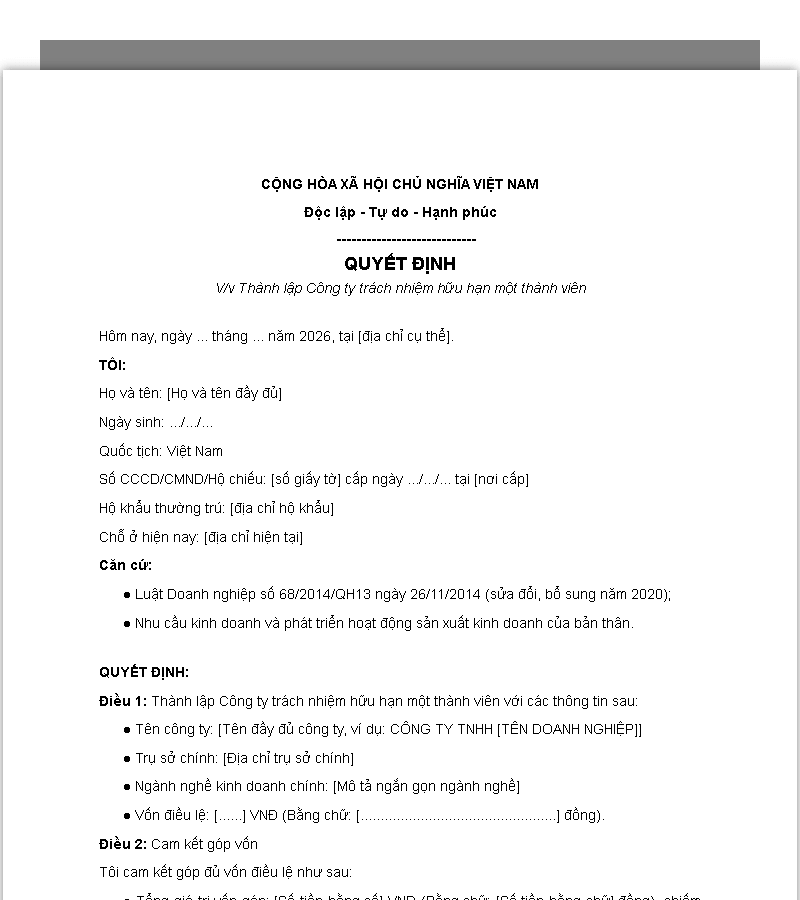
>>> Tải ngay Mẫu Biên bản thỏa thuận góp vốn thành lập Công ty TNHH 1 thành viên
Lưu ý khi áp dụng mẫu
- Trường hợp chủ sở hữu là tổ chức (ví dụ: công ty mẹ thành lập công ty con), cần thay cách xưng hô “TÔI” bằng thông tin pháp nhân gồm: tên doanh nghiệp, mã số thuế, người đại diện theo pháp luật; đồng thời đính kèm Quyết định của Hội đồng thành viên hoặc Hội đồng quản trị theo đúng thẩm quyền.
- Khi tài sản góp vốn có tính chất phức tạp, nên bổ sung phụ lục kèm theo như biên bản định giá, biên bản bàn giao tài sản để làm rõ giá trị và tình trạng tài sản.
- Văn bản này không bắt buộc công chứng, ngoại trừ trường hợp góp vốn bằng quyền sử dụng đất hoặc tài sản phải đăng ký quyền sở hữu theo quy định pháp luật.
- Các nội dung cam kết về góp vốn cũng cần được thể hiện đầy đủ trong Điều lệ công ty – đây là hồ sơ bắt buộc khi thực hiện thủ tục đăng ký doanh nghiệp.
- Trong trường hợp cần điều chỉnh theo tình huống cụ thể hoặc phát sinh vấn đề pháp lý, nên tham vấn luật sư chuyên ngành hoặc liên hệ Sở Kế hoạch và Đầu tư nơi doanh nghiệp đặt trụ sở để được hướng dẫn chính xác.
4.2. Template for Minutes of Capital Contribution Agreement for Establishing a Limited Liability Company with 2 or More Members
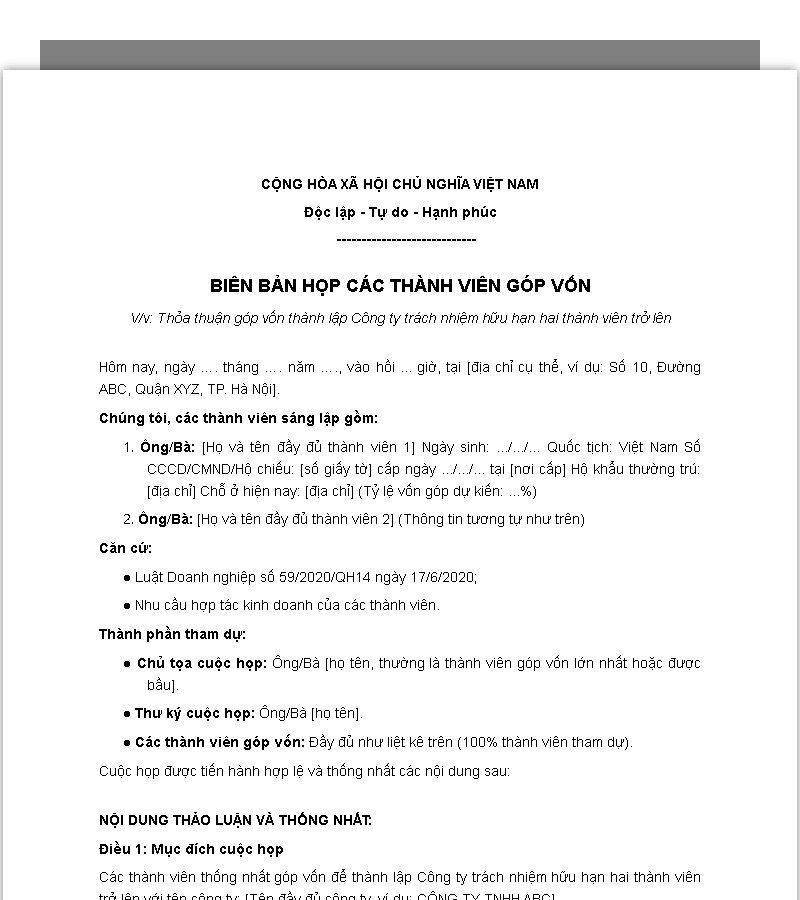
Some points to note when using the template
- In cases of special contributed assets such as real estate or intellectual property rights, an independent valuation and notarization/authentication should be carried out as required by specialized laws.
- Appendices can be attached if necessary, including: a list of contributed assets, valuation minutes, and asset handover minutes.
- The capital contribution minutes do not require notarization, except in cases specifically stipulated by law.
- The information in the minutes must be consistent and aligned with the company’s Charter and the List of Members/Shareholders submitted with the business registration application.
- If the company has three or more members, the full information of each member must be added to the list and the signature confirmation section.
- To ensure suitability for specific situations and to mitigate legal risks, businesses should consult with a lawyer or contact the Department of Planning and Investment where the head office is registered.
4.3. Template for Minutes of Capital Contribution Agreement for Establishing a Joint Stock Company
For a Joint Stock Company, the capital contribution agreement is often documented through the Minutes of the Founding Shareholders’ General Meeting (also known as the Minutes of the Company Establishment Shareholders’ Meeting). This is an important internal document that records the consensus of the founding shareholders on capital contribution, the adoption of the company’s Charter, and the election of necessary management bodies for the official establishment of the business.
According to the provisions of the Law on Enterprises 2020 (which continues to apply until 2026) and Decree 01/2021/ND-CP, these minutes are not required to be submitted in the business registration application, as the core contents are already reflected in the company’s Charter, the List of Founding Shareholders, and the Share Certificate. However, preparing the minutes is still essential as an internal legal basis to ensure transparency of shareholders’ rights and obligations and to mitigate the risk of future disputes.
Below is a template for the Minutes of the Founding Shareholders’ General Meeting for establishing a Joint Stock Company (illustrated with an example of 03 founding shareholders – the minimum required by law). Users can flexibly adjust the information, add the appropriate number of shareholders, and print the document for signature and confirmation.
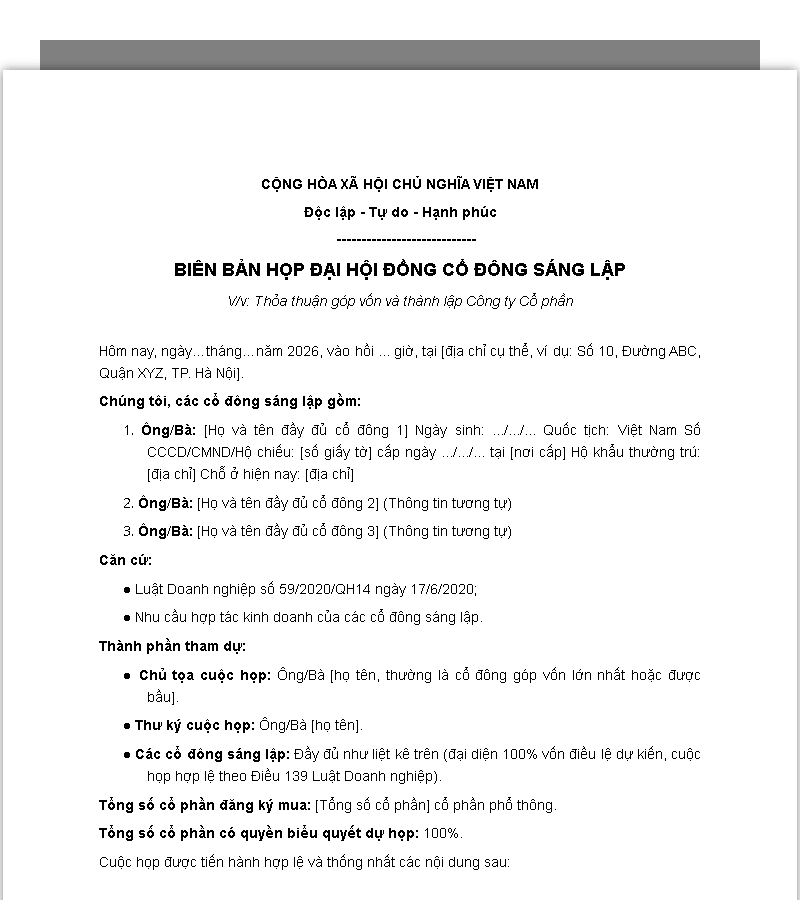
Notes on using the template:
- A joint stock company must have at least 03 founding shareholders, who can be individuals or organizations.
- In cases of contributing special assets such as real estate, intellectual property rights, etc., an independent valuation and notarization/authentication must be carried out according to relevant regulations.
- Appendices can be attached if necessary, including: a list of contributed assets, valuation minutes, and asset handover minutes.
- The minutes do not require notarization; however, the content must be consistent with the company’s Charter and the List of Founding Shareholders submitted with the business registration application.
- If a shareholder is an organization, full information about the authorized representative must be included.
- To ensure suitability for specific cases and to mitigate legal risks, it is advisable to consult a lawyer or the local Department of Planning and Investment.
4.4. Template for Minutes of Capital Contribution Confirmation (after contribution is made)
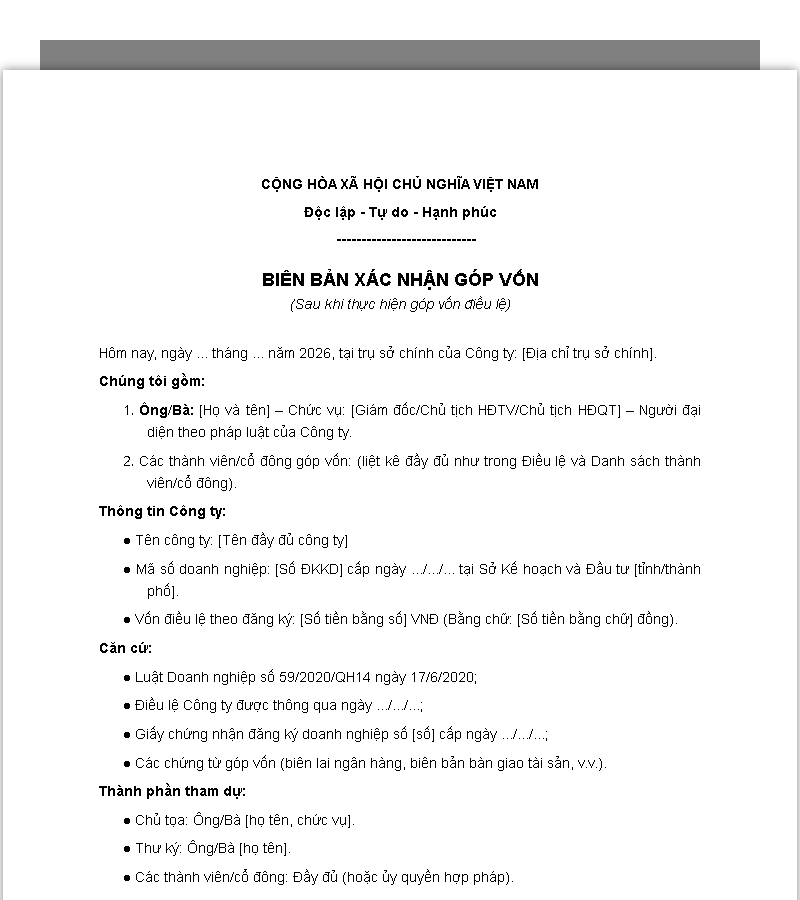
>>> Download the Template for Minutes of Capital Contribution Confirmation Now
Notes on using the template:
- Full supporting documents proving the capital contribution must be attached, which can be originals or certified copies, such as: payment orders/bank transfer slips, cash receipts, asset handover minutes, asset valuation minutes (in case of contribution by assets).
- If the capital has not been fully contributed, the minutes must clearly state the remaining amount and the deadline for completing the additional contribution, ensuring it does not exceed 90 days from the date the Certificate of Business Registration is issued.
- For a single-member LLC, this content is presented in the form of a Decision by the owner confirming the full contribution of charter capital, requiring only the signature of the company owner.
- The company seal should be affixed (if available) to increase the authenticity and legal validity of the document.
- The minutes should be kept with the register of members/shareholders at the company’s head office for internal management and inspection purposes when necessary.
4.5. Template for Minutes of Capital Contribution for a Business Cooperation (without establishing a legal entity)
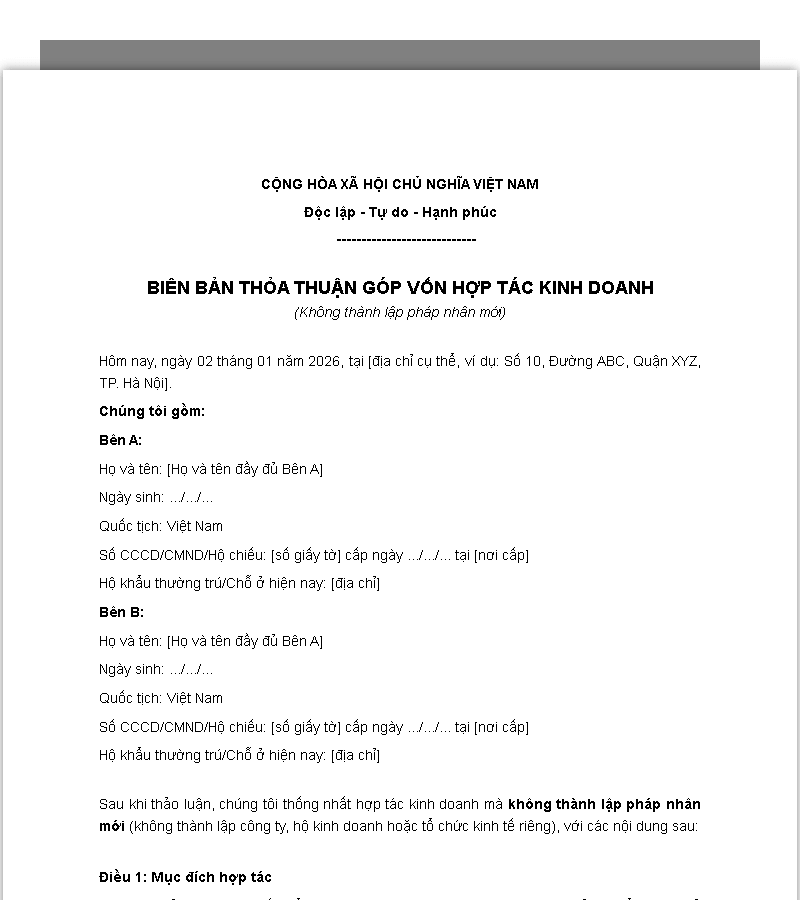
When individuals or organizations choose to cooperate by contributing capital for business without establishing a new enterprise or legal entity, the parties often use a Minutes of Capital Contribution Agreement or a Business Cooperation Contract. This form is primarily governed by the Civil Code 2015 and the Law on Investment 2020 (in the case of cooperation under a BCC model if there are investment elements).
The above document is a civil agreement intended to clearly record contents such as: the amount of capital contribution, the method of contribution, the mechanism for profit and risk sharing, and the rights and obligations of each party. The signing does not create an independent economic organization but plays a crucial role as an internal legal basis and in preventing disputes. The document becomes effective upon signing by the parties and does not require notarization, except in cases of capital contribution with real estate or land use rights.
Below is a reference template for a Minutes of Capital Contribution Agreement for a business cooperation, illustrated for a case where two individuals contribute capital to open a coffee shop. Users can flexibly edit the information and add more parties according to their actual needs.
Notes on using the template:
- In cases involving foreign elements or large-scale projects, it is necessary to carry out investment registration procedures in the form of a BCC contract under the Law on Investment 2020 and establish a project coordination board.
- It is advisable to attach appendices when necessary, such as: asset valuation minutes, asset handover minutes, and capital contribution transfer documents.
- If contributing capital with real estate or land use rights, the contract must be notarized/authenticated as required by law.
- Regarding tax obligations, each party is responsible for declaring and paying personal income tax on their share of the profitsRecommendation: It is advisable to attach supporting appendices such as bank transfer slips, asset ownership documents, and require all parties to sign for full confirmation.
5.2. Valuation process for non-cash contributed assets
According to Article 36 of the Law on Enterprises 2020 (applicable until 2026):
- Non-cash contributed assets must be valued in Vietnamese Dong, based on the consensus of the founding members/shareholders or through a professional valuation organization.
- Hiring a valuation organization is not mandatory, but it is recommended for assets of high value, complex nature (real estate, specialized machinery, intellectual property rights), when parties cannot agree on a price, or to enhance objectivity and reduce the risk of joint liability.
- In case of a valuation, the result must be approved by a majority (over 50%) of the founding members/shareholders.
The asset valuation record should be prepared separately or integrated into the capital contribution record, clearly stating the valuation method, the basis for application (market price, valuation certificate, etc.), confirmation signatures, and the responsibilities of the parties if the valuation is higher than the actual value. According to Clause 3, Article 36, the relevant parties must jointly contribute the difference and compensate for any damages.
5.3. Notes for specific types of contributed assets
For contributed assets of a special nature, parties must comply with additional specific requirements regarding valuation, procedures, and transfer of ownership:
- Land use rights: Must comply with the Land Law 2024. Capital contribution contracts involving land use rights must be notarized/certified, and procedures for registering changes must be carried out at the Land Registration Office. This case is exempt from registration fees but may incur tax obligations as prescribed.
- Intellectual property rights: Must comply with the Law on Intellectual Property 2022 (amended 2025), including the transfer of ownership or use rights and registration with the Intellectual Property Office if the subject matter requires registration. Due to the inherent difficulty in valuation, it is preferable to hire a professional valuation firm.
- Labor/Effort: Not recognized by law as a contributed asset under the Law on Enterprises 2020.
5.4. Legal validity and the issue of notarization and certification
Depending on the type of asset and form of capital contribution, the capital contribution record may require notarization or certification to ensure legal validity:
- A standard capital contribution record (for cash or assets not requiring ownership registration) does not require notarization.
- However, notarization is mandatory when contributing capital with land use rights, houses, or assets attached to land as stipulated by the Land Law and the Civil Code.
- In practice, notarizing the capital contribution record is still encouraged, especially for large capital values or when multiple parties are involved, to enhance its evidentiary value in case of disputes.
5.5. Storage and utilization of the capital contribution record
The capital contribution record needs to be properly stored and used for its intended purpose, not only for internal governance but also as a basis for accounting, tax, and other legal activities:
- Serves as a basis in the enterprise establishment or charter capital amendment dossier, accompanied by the asset valuation and handover records according to Decree 01/2021/ND-CP.
- Serves accounting and tax purposes: recording owner’s equity, depreciating fixed assets, and determining tax liabilities.
- Is an important internal document that needs to be stored long-term for inspections, audits, and reporting to members/shareholders.
- A new or supplementary record must be created when there are changes such as a capital increase/decrease, transfer of contributed capital, or a change in the type of contributed asset.
5.6. Mitigating risks and disputes
Creating a meticulous capital contribution record from the outset is a crucial foundation for preventing disputes and protecting the long-term interests of all parties:
- The record should clearly state the rights and obligations of the parties, including voting rights, profit-loss sharing, conditions for capital withdrawal, or transfer of contributed capital.
- A dispute resolution mechanism should be pre-defined, such as mediation, arbitration, or litigation in a competent court.
- For complex cases or large values, consulting a lawyer from the drafting stage is necessary to ensure compliance with the company’s charter and current laws.
The careful creation and use of a capital contribution record not only helps the enterprise comply with the law but also protects the long-term interests of the participating parties. Enterprises should store both the original and electronic versions for convenient lookup and management.

Important notes when using a capital contribution record 6. Frequently Asked Questions about Capital Contribution Records (FAQs)
Question 1: Does a capital contribution record need to be stamped?
Current law does not require a capital contribution record to be stamped. This is an internal document of the enterprise; signatures of the relevant parties (contributing members/shareholders and the company’s legal representative) are sufficient for legal validity. Stamping is merely supplementary and not a mandatory condition for the record to be effective.
Question 2: How to contribute capital with machinery or assets that have no invoices?
An enterprise can still receive capital contributions in the form of used machinery, equipment, or assets without invoices if the contributor can prove legal ownership (origin records, purchase documents, handover records, etc.).
The asset must be valued according to Article 36 of the Law on Enterprises 2020, based on the agreement of the members/shareholders or through a valuation organization.
A VAT invoice is not required for capital contributions made with assets, but a record of asset handover must be created to serve as a basis for transferring ownership and for accounting purposes.
Question 3: What is the deadline for fully contributing the charter capital?
According to the Law on Enterprises 2020, members/shareholders must contribute their committed capital in full within 90 days from the date the company is issued its Enterprise Registration Certificate (excluding time for transportation, import