7+ Members’ Council Meeting Minutes (Word File Download)
Vương Huy
09/05/2026
969 views
Featured Articles
In this article, we compile all the latest regulations of 2026 regarding the minutes of a Members’ Council meeting, provide detailed step-by-step instructions on how to create them, and offer standard templates for all practical situations such as changing business registration, increasing or decreasing capital, appointing personnel, distributing profits, or dissolving the enterprise. The content is presented clearly, is easy to apply, and is suitable for direct use by businesses, accountants, and legal professionals.
1. What are the Minutes of a Members’ Council Meeting?
1.1. What are the Minutes of a Members’ Council Meeting?
The minutes of a Members’ Council meeting (MCM minutes) is a legal document used to record the entire content, proceedings, and results of a Members’ Council meeting in a limited liability company with two or more members. This document fully reflects the unified will of the capital-contributing members regarding important issues related to the organization, governance, and operations of the enterprise.
In essence, the MCM minutes are not merely an internal record but also legal evidence proving that the company’s decisions were passed with the correct authority, in the proper sequence, and with the required voting ratio as stipulated by law and the company’s charter.
A complete and valid minutes of a Members’ Council meeting typically clearly states:
Time, location, and form of the meeting
Attendees and the capital contribution ratio of each member
Content of discussions and opinions of the parties
Voting results for each issue
Final conclusions and resolutions of the Members’ Council
In short: The MCM minutes are the legal basis for all decisions of the Members’ Council to be enforceable in practice.
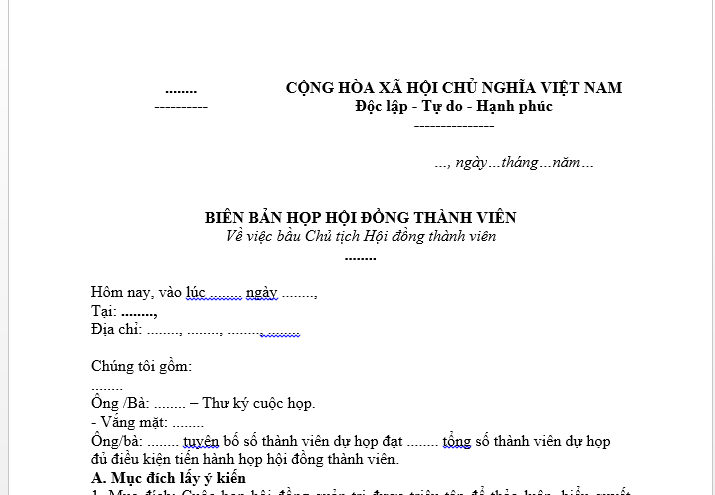
What are the Minutes of a Members’ Council Meeting?
1.2. The Legal Importance of the Minutes of a Members’ Council Meeting
In business operations, the MCM minutes play a crucial legal role. This is a mandatory document when an enterprise carries out many important administrative procedures with state agencies and serves as the basis for determining the legality of internal decisions.
Specifically, the minutes of a Members’ Council meeting serve to:
Serve as the basis for issuing a Resolution of the Members’ Council
Be a component of the application file for procedures such as:
Changing business registration
Increasing or decreasing charter capital
Transferring capital contributions
Appointing or dismissing managerial positions
Serve as important evidence in case of disputes among members or with third parties
In practice, there are many cases where a company’s application is rejected or its decisions are declared invalid simply because the meeting minutes:
Were created without proper authority
Lacked mandatory content
Did not clearly state the voting ratio
Did not have valid signatures
This shows that the MCM minutes are not a mere formality but a legal shield protecting the enterprise from the risks of disputes and procedural errors.
1.3. The Governance Role of the Minutes of a Members’ Council Meeting
Besides their legal value, the minutes of a Members’ Council meeting also play an important role in corporate governance. They are a tool that helps the enterprise control the decision-making process, ensuring transparency and internal consistency.
The MCM minutes help to:
Clearly record the viewpoints and responsibilities of each member
Avoid disputes arising from misunderstanding or misremembering agreed-upon content
Provide a basis for the Board of Directors to implement work in the right direction
Enhance professionalism in business operations
For companies with multiple capital-contributing members, creating systematic meeting minutes also helps maintain trust and governance discipline – a particularly important factor for long-term development.
1.4. Differentiating Between a Single-Member LLC and a Multi-Member LLC
One of the common
In practice, many meeting minutes are deemed invalid or pose a risk of disputes not because the decisions made were wrong, but because mandatory content required by law was missing or incorrectly recorded. Therefore, businesses need to pay special attention to the structure and information in the minutes right from the drafting stage.
3.1. Basic information about the meeting
First and foremost, the meeting minutes must clearly state the legal context of the meeting to prove that it was held validly, at the convened time and place, and for the stated purpose.
The basic information required includes:
Meeting time (date, month, year, start – end time)
Meeting location (company headquarters or other location as per the meeting notice)
Purpose of the meeting
Approved meeting agenda and content
This information may seem simple, but it is critically important, especially when it is necessary to verify:
Whether the meeting was convened in accordance with regulations
Whether the voted content was part of the previously announced meeting agenda
3.2. Information on attending and absent members
According to Article 60 of the 2020 Law on Enterprises, the meeting minutes must fully and accurately record the information of all members or their authorized representatives, whether they attended or not.
For attending members/representatives, the minutes must clearly state:
Full name
Percentage of capital contribution in the charter capital
Number and issuance date of the Certificate of Capital Contribution
For absent members/representatives, the minutes must also fully record:
Full name
Percentage of capital contribution
Number and issuance date of the Certificate of Capital Contribution
Recording both attending and absent members serves as the basis for determining:
The percentage of capital contribution present at the meeting
Whether the meeting met the conditions to proceed
The legal validity of the voting results
If this information is missing or incorrect, the entire resolution may be challenged for its validity.
3.3. Meeting proceedings and results
This is the core and most important part of the Members’ Council meeting minutes. This content must faithfully reflect the entire discussion and voting process of the Members’ Council for each issue raised.
The minutes need to clearly show:
Issues raised for discussion and voting
A summary of each member’s opinions on each issue
Specific voting results, including:
Total number of valid votes
Total number of invalid votes (if any)
Number of ‘for’ votes
Number of ‘against’ votes
Number of abstentions
Based on the voting results, the minutes must clearly record:
The resolutions that were passed
The voting percentage corresponding to each resolution
Recording detailed voting results is not just for ‘completing the paperwork,’ but also serves as a basis for determining:
Whether a resolution achieved the required approval percentage according to the law and the company’s charter
The voting responsibility of each member in the event of a dispute
3.4. Confirmation, dissenting opinions, and signing of the minutes
The final section of the Members’ Council meeting minutes contains the confirmation, which establishes the document’s final legal validity.
By law, the minutes must have:
The full name and signature of the minute-taker
The full name and signature of the meeting chairperson
If an attending member disagrees with the approval of the minutes, the minutes must clearly state:
The full name of the dissenting person
The content of the dissenting opinion
Their signature (if any)
A very important point under Article 60 of the 2020 Law on Enterprises is: The meeting minutes remain legally valid even if the chairperson or the minute-taker refuses to sign, provided that the minutes meet all regulatory content requirements and are signed by a majority of the attending members.
This regulation aims to:
Prevent intentional refusal to sign to invalidate the minutes
Protect the legitimate interests of the remaining members
Ensure continuity in corporate governance
3.5. Practical notes when drafting the content of the Members’ Council Meeting Minutes
From practical application, businesses should note that the clearer and more detailed the content of the meeting minutes, the lower the legal risk. Vague drafting, general notes, or missing mandatory information can render the minutes invalid when needed as a legal basis.
A standard Members’ Council meeting minutes, in accordance with Article 60 of the 2020 Law on Enterprises, must ensure:
All mandatory content groups are included
<p
Thorough preparation of documents and clear assignment of responsibilities help ensure that the minutes accurately reflect the notified content, avoiding disputes over “deciding on matters outside the meeting agenda.”
4.2. Step 2: Conducting the Members’ Council Meeting
During the meeting, the moderation and recording of content must be carried out carefully, honestly, and consistently, as this forms the direct basis for drafting the meeting minutes.
The content to be implemented and recorded includes:
Accurately determine:
Attending members or representatives
Absent members
The ratio of attending capital contribution to determine the conditions for conducting the meeting
Present each item on the agenda, organize discussions, and record:
The opinions of each member
Points of agreement, disagreement, or proposed amendments
Conduct voting on each issue in the correct order:
Vote by a show of hands, ballot, or other forms as stipulated in the Charter
Clearly determine the approval rate required to pass a resolution
Throughout the meeting, the secretary must take complete but selective notes, focusing on the core content, key opinions, and voting results, while avoiding rambling or subjective records.
4.3. Step 3: Drafting and Finalizing the Minutes of the Members’ Council Meeting
After the meeting concludes, the minutes must be finalized immediately based on the proceedings. The drafting must adhere to the legally required structure and content.
A standard Minutes of the Members’ Council Meeting typically includes the following sections:
General information about the meeting
Attendees and absentees
Meeting proceedings
Voting results
Resolutions passed
Confirmation and signature section
When recording opinions and voting results, it is important to note:
Clearly record each issue put to a vote
State the number of votes for, against, and abstentions
Avoid using general phrases like “majority agreed” without specific figures
Regarding the number of copies and storage:
The minutes are usually prepared in 01 to 02 original copies
Stored at the company’s headquarters along with the corporate legal records
Can be scanned and stored electronically for easy retrieval when needed
4.4. Step 4: Approving and Signing the Meeting Minutes
According to legal regulations, the minutes of the Members’ Council meeting must be approved before the meeting concludes. This is a crucial step to confirm the accuracy of the recorded content.
The approval and signing process typically proceeds as follows:
The secretary reads the full or summarized content of the minutes
Members review and confirm the content
Record any dissenting opinions (if any)
Proceed to sign the minutes
The minutes must have:
The signature of the meeting chairperson
The signature of the minute-taker
The signature of any dissenting member (if any)
Complete signing ensures the minutes have clear legal validity and helps limit disputes arising after the meeting.
4.5. Step 5: Storing and Disclosing the Meeting Minutes (if applicable)
After signing is complete, the meeting minutes must be stored in accordance with corporate record management principles. This is an important internal document and can be used in various legal situations.
The enterprise should note:
Store the minutes along with related meeting documents
Ensure they are retrievable when requested by state agencies, auditors, or partners
Only disclose or submit the minutes to state agencies in mandatory cases such as:
Changing the business registration
Adjusting capital or contributing members
Carrying out procedures for dissolution or reorganization of the enterprise
Systematic storage helps the enterprise proactively protect its legal interests and demonstrate professionalism in governance.
5. Members’ Council Meeting Minutes Templates (Downloadable)
In practice, most businesses do not struggle with “holding meetings,” but rather with drafting legally compliant minutes that are complete and ready for administrative filings. Therefore, using a standardized Members’ Council Meeting Minutes template saves a significant amount of time and reduces the risk of errors in form and content.
The Members’ Council Meeting Minutes templates below are developed in accordance with Article 60 of the 2020 Law on Enterprises. They feature a clear layout, neutral legal language, are easy to edit, and are suitable for various real-life situations of limited liability companies with two or more members.
5.1. General Members’ Council Meeting Minutes Template (for all purposes)
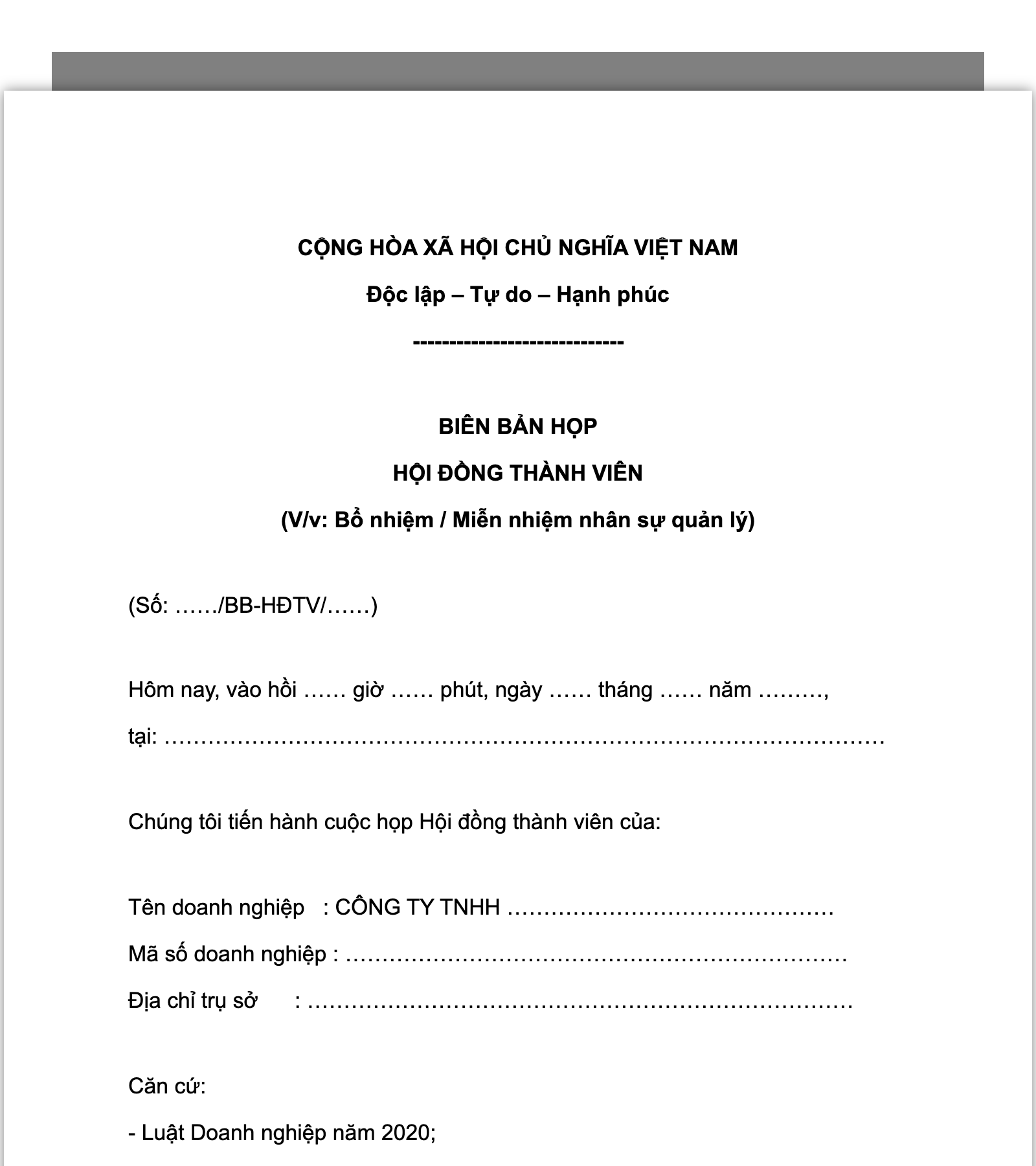
Members’ Council Meeting Minutes template for the appointment or dismissal of management personnel
This is the most basic template, suitable for most internal or routine decision-making meetings of the Members’ Council. The template is designed with a complete structure, allowing the drafter to simply fill in the information without worrying about missing mandatory content.
A general Members’ Council Meeting Minutes template typically includes:
Legal information of the enterprise
Time, location, and form of the meeting
Attendees and capital contribution ratio
Content of discussion and voting
Resolutions passed
Confirmation and signature section
Suitable for: periodic meetings, meetings to agree on business plans, meetings to approve internal matters that do not require state filings.
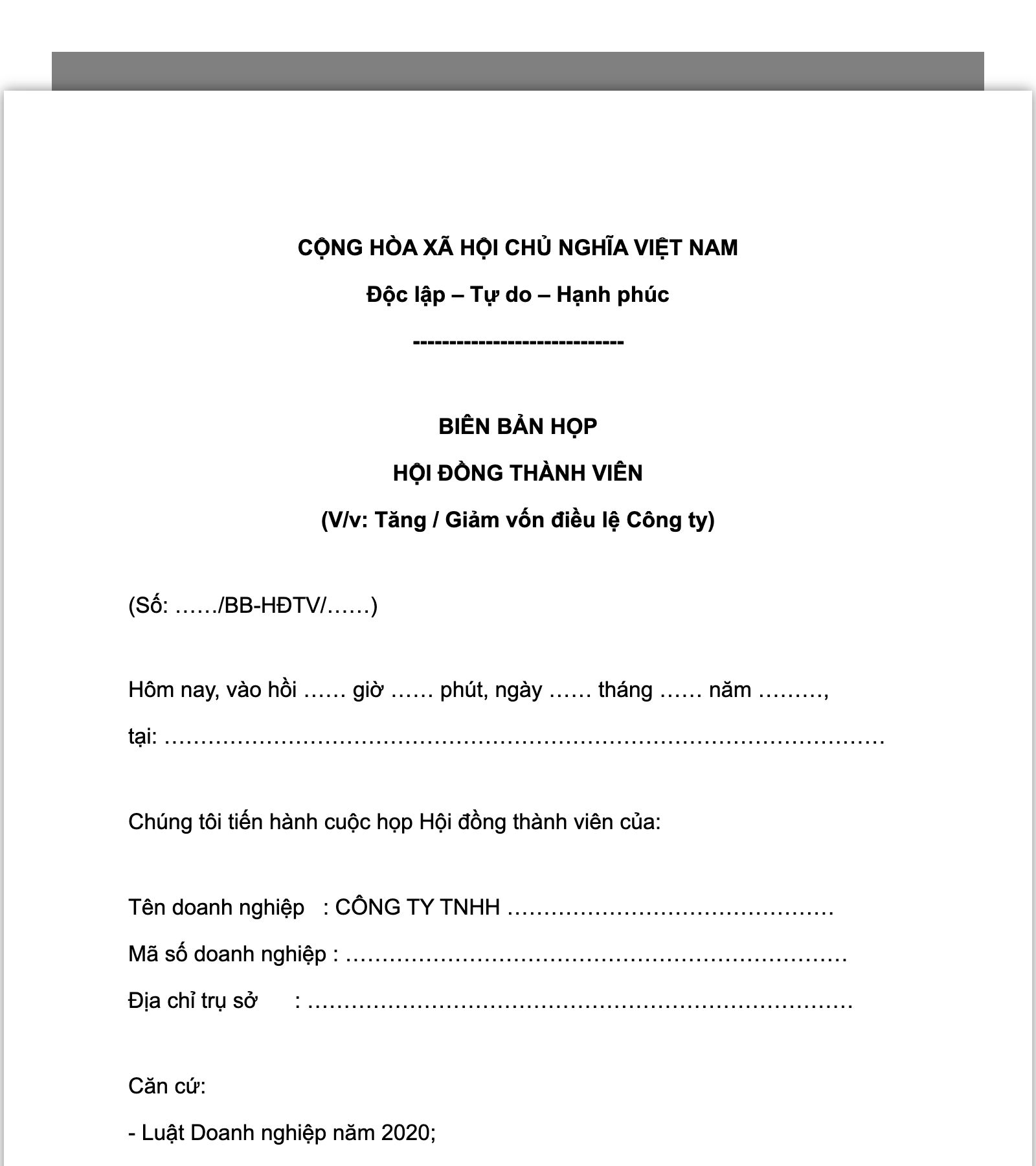
d) Members’ Council Meeting Minutes Template for Profit Distribution or Loss Handling
<img src="https://1office.vn/wp-content/uploads/2026/01/FirstPage_Mẫu-BBHDTV-về-việc-phân-chia-lợi-nhuận-hoặc-xử-lý-lỗ.png" alt="Members' Council Meeting Minutes Template for Profit Distribution or Loss Handling" width="16
Not approving the minutes during the meeting, leading to disputes over the accuracy of the recorded content
The chairperson or secretary refuses to sign the minutes, but the company does not apply a valid alternative solution as prescribed by law
These errors can cause the minutes to be:
Rejected by the business registration office when submitting documents
Challenged by members regarding their validity
Become a disadvantage for the company itself in case of a dispute
6.3. How to prevent errors and reduce legal risks
To mitigate the aforementioned errors, companies should establish a standard procedure for meetings and drafting the Members’ Council minutes, rather than handling them on a case-by-case basis.
Some practical recommendations:
Use a standardized minutes template that adheres to Article 60 of the 2020 Law on Enterprises
Appoint a secretary with legal knowledge or who has been instructed on how to record minutes
Review the minutes during the meeting before they are approved and signed
Archive all related meeting documents (meeting notices, materials, attendance lists)
Investing time and care in the Members’ Council meeting minutes from the outset will help the company avoid significant future risks, especially in situations involving interest disputes or dealings with state agencies.
7. Frequently Asked Questions (FAQs)
In practice, Members’ Council meeting minutes often raise many questions regarding their legal validity, format, and the relationship between the minutes and the resolution. Below are the most common questions and detailed answers according to current legal regulations.
7.1. Do Members’ Council meeting minutes require notarization or certification?
No. The current enterprise law does not require Members’ Council meeting minutes to be notarized or certified to be legally valid.
Meeting minutes are legally valid when:
They are drafted with the content required by law
They are approved following the correct procedure
They have all the required signatures
In practice, minutes only need to be notarized or certified in special cases as required by a third party (banks, partners, foreign agencies), not as a mandatory requirement under the Law on Enterprises.
Companies should not confuse internal legal validity with administrative requirements that may arise.
7.2. What is the difference between a Members’ Council Resolution and the Members’ Council Meeting Minutes?
This is a very common question, as these two documents often go together but are not interchangeable.
The differences can be distinguished as follows:
Members’ Council Meeting Minutes:
Record the entire proceedings of the meeting
Reflect discussion points and voting results
Serve as evidence to prove a valid decision-making process
Members’ Council Resolution:
Record the final decision
Is often extracted from the content of the minutes
Is the document used for implementation and for submitting administrative filings
Simply put: The minutes are the “process,” and the resolution is the “result.” For many legal filings, a company needs both.
7.3. What should be done if a Members’ Council meeting does not meet the conditions to proceed?
A Members’ Council meeting is only valid when it meets the required attendance quorum based on capital contribution, as stipulated by the Law on Enterprises and the company’s charter. If the conditions are not met, the meeting cannot proceed to a vote.
In this case, the company needs to:
Clearly record the failure to meet the conditions in the minutes
Not pass any resolutions
Reconvene the meeting following the correct procedure
Minutes should still be drafted in this case to:
Serve as evidence that the meeting was properly convened
Avoid future disputes regarding the responsibility to convene the meeting
7.4. When do the Members’ Council meeting minutes become effective?
Members’ Council meeting minutes are effective from the moment they are approved at the meeting, regardless of notarization or submission to a state agency.
Typically, the minutes are effective when:
They are approved just before the meeting concludes
They have all the signatures required by law
Note that the effective date of the minutes is different from that of the resolution. A resolution may have its own effective date, which is clearly stated in its content.
7.5. What are the legal consequences of invalid Members’ Council meeting minutes?
Invalid meeting minutes can lead to many serious legal consequences, especially in situations involving disputes or administrative procedures.
Some common consequences include:
The Members’ Council resolution being declared null and void
The application for changes to business registration being rejected by state agencies
Members having the right to file a lawsuit to request the cancellation of the decision
The company facing disadvantages in disputes with partners or regulatory authorities
In many cases, just one small error in the minutes (a missing signature, an incorrect voting ratio, missing mandatory content) is enough to invalidate the entire decision.
Apply management knowledge in practice with the 1Office all-in-one management solution
Thank you for scheduling a consultation!
1Office has received your consultation request. Our consultant will contact you as soon as possible. For any questions, please contact Hotline: 083 483 8888



 09/05/2026
  969 views