11/05/2026
  397 views
A financial statement is one of the most important documents for a business, reflecting its financial position, business performance, and cash flow situation over a specific period. Therefore, preparing accurate and timely financial statements is a mandatory requirement for all types of businesses. In this article, let’s explore the process of the steps to prepare a financial statement with 1Office, along with some reference templates!
Mục lục
- 1. Regulations for Preparing Financial Statements in a Business
- 2. Guide to the standard steps for preparing financial statements
- 3. Reference financial statement templates in Excel Files
- 4. Some notes when preparing financial statements in Excel
- 5. FAQ: Some questions about preparing financial statements
1. Regulations for Preparing Financial Statements in a Business

1.1. What is the deadline for submitting annual financial statements?
The deadline for submitting annual financial statements for domestic and foreign enterprises is regulated as follows:
For non-state-owned enterprises: The annual financial statement must be submitted to the competent state authority within 90 days from the end of the annual accounting period as prescribed by law. For example: If the 2023 accounting period for a non-state-owned enterprise is from January 1, 2023, to December 31, 2023, the deadline for submitting the 2023 annual financial statement will be March 30, 2024.
For State-owned enterprises: The financial statements of state-owned enterprises have separate quarterly and annual submission deadlines, as stipulated in Article 10 of Circular No. 200/2014/TT-BTC, specifically as follows:
- Quarterly financial statements: must be submitted no later than 30 days from the end of the quarter.
- Annual financial statements: must be submitted no later than 90 days from the end of the fiscal year.
1.2. What regulations must financial statements comply with?

Depending on the size of the business, the regulations for preparing financial statements will differ, specifically as follows:
- Micro-enterprises: The accounting regime for micro-enterprises can be applied according to Circular 132/2018/TT-BTC or Circular 133/2016/TT-BTC.
- Small and medium-sized enterprises (including micro-enterprises): The accounting and financial statement preparation regime for these enterprises will be applied according to Circular 133/2016/TT-BTC.
- Large-scale enterprises: For large enterprises, the preparation of annual financial statements must comply with the provisions of Circular 200/2014/TT-BTC.
1.3. What types of reports are included in a financial statement?
According to legal regulations, a company’s financial statements include the following four reports:
- Balance Sheet: Shows the total assets, total liabilities, and owner’s equity of the business at a specific point in time (usually at the end of the year). This statement reflects the balance between the company’s assets and sources of capital, indicating where the company’s investment capital is being used.
- Income Statement: This report shows the financial performance of the business over a specific period (about one year). It includes revenue, gross profit, operating profit, pre-tax and after-tax profit, and other related indicators such as earnings per share and dividends.
- Cash Flow Statement: Shows the sources of cash and how cash is used in operating, investing, and financing activities. The cash flow statement helps readers understand how the business manages its cash, its ability to repay debt, and its future investment capacity.
- Notes to the Financial Statements: The notes to the financial statements are an important part of the financial reporting package that helps the business explain, supplement detailed information, and provide additional information about other revenues and expenditures. This report helps ensure transparency and a better understanding of the figures in the three reports above.
2. Guide to the standard steps for preparing financial statements
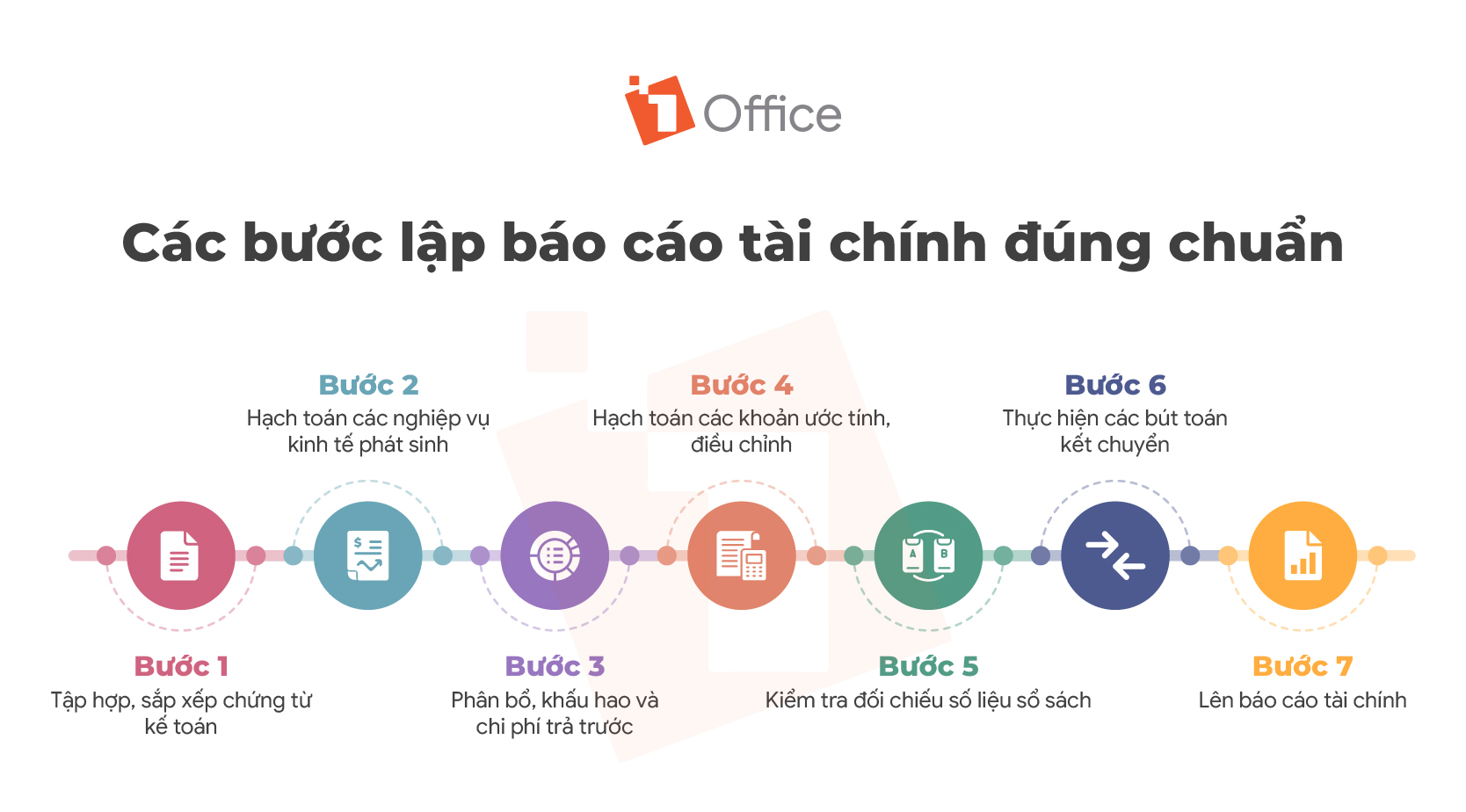
Step 1: Compile and organize accounting documents
The first step in the process of preparing financial statements is for the business to gather, classify, and organize accounting documents clearly. These include invoices, receipts, payment/receipt vouchers, accounting books, and other related documents.
Classifying them in chronological order will make the process of checking and declaring reports easier and faster. In addition, the accountant needs to simultaneously check the reasonableness, validity, and legality of these documents during the organization process.
Step 2: Record arising economic transactions
Based on the organized accounting documents, the manager proceeds to record the economic transactions that arose during the annual accounting period. This process includes checking and completing documents to ensure their legality according to the laws on accounting and taxation. This task can be done in parallel with Step 1 above.
Step 3: Allocate depreciation and prepaid expenses

For fixed assets and prepaid expenses, the business needs to record them clearly while allocating the time and monthly incurred costs reasonably and in accordance with regulations.
To prepare financial statements, the accountant needs to classify arising transactions by month and by quarter. This helps the business declare its financial statements accurately. Additionally, you also need to clearly classify prepaid expenses, fixed asset depreciation, and other estimated amounts.
Step 4: Record estimates and adjustments
At the end of the accounting period, administrators need to check and adjust estimated amounts on accounting documents. This ensures that the figures in the financial statements accurately reflect the company’s actual situation and comply with current accounting regulations. Some items that need to be recorded include:
- Entries for revaluing foreign exchange differences at the end of the period
- Provisions for bad debts, provision for inventory devaluation, provision for decline in value of trading securities, etc.
- Accrued expenses for the year, including 13th-month salary, Lunar New Year bonuses, audit fees, and other recurring expenses, etc.
- Reclassification entries for investments, bank overdrafts, reclassification of short-term and long-term liabilities, short-term and long-term loans, etc.
- Entries to correct errors (if any)
Step 5: Check and reconcile book figures
This is a crucial step in the process of preparing financial statements. The accountant must check, reconcile, and review the figures in the books. If the recorded data is incorrect, leading to inaccurate financial statements, it will waste time and effort on reviewing, adjusting, and redoing the reports.

Therefore, the business needs to review and consolidate transactions by account group, such as inventory, accounts receivable, accounts payable, investments, prepaid expenses, and fixed assets.
- Check the transfer of the previous period’s closing balances to this period’s opening balances for all accounts with balances.
- Re-check the balances for each group of customers, partners, suppliers, etc.
- Check the quantity and value of each type of goods.
- Check the reconciliation between the subsidiary ledger and the general ledger.
Step 6: Make closing entries
After completing the checking and reviewing of figures, the accountant needs to make closing entries for profits/losses for the year. This process includes recording revenues, expenses, losses, and profits, and ensuring that accounts from type 5 to type 9 have no closing balance.
For businesses with income tax liabilities, the administrator needs to perform the first closing to determine the profit and calculate the tax payable. Then, they must record additional entries for tax recognition and tax expenses before performing the final closing to arrive at the final profit figure.
See more: A 6-step guide to reading financial statements effectively
Step 7: Prepare the financial statements
After completing the above steps, the accountant can proceed to prepare the financial statements. You need to carefully study the regulations for preparing financial statements mentioned in Part 1 to ensure the most complete and accurate reflection. By following this process correctly, the business can prepare standard-compliant financial statements, thereby making financial management more effective and reliable.
3. Reference financial statement templates in Excel Files
To help businesses prepare financial statements more easily and accurately, 1Office has compiled some financial statement templates in Excel. These templates are designed to be simple, user-friendly, and customizable to the needs of each business.
>> Reference: DOWNLOAD 6 latest corporate financial management Excel files for 2023
4. Some notes when preparing financial statements in Excel
Below are some specific notes for preparing each type of financial statement in Excel:

4.1. Notes on preparing the balance sheet
Assets and liabilities must be classified as short-term and long-term, based on their recoverability or settlement within 12 months after the reporting date. If the business does not clearly distinguish between short-term and long-term assets and liabilities, the chief accountant can present them in order of decreasing liquidity.
4.2. Notes on preparing the income statement
Exclude revenues, incomes, and expenses arising from internal transactions when preparing the income statement between the parent company and its subsidiaries. Use information from the previous year’s income statement, the general ledger, and subsidiary ledgers for accounts from type 5 to type 9.
4.3. Notes on preparing the statement of cash flows:
For items with no data, they do not need to be presented in the report, and the preparer must ensure that the code numbers of the items are not changed.
4.4. Notes on preparing the notes to the financial statements:
The notes to the financial statements include information about the basis of preparation and presentation of the financial statements, as well as the accounting policies applied. The business must present information as required by accounting standards and provide additional information not yet included in other financial statements.
See more: A guide to reading & analyzing basic financial statements
5. FAQ: Some questions about preparing financial statements
| 1. Who receives a company’s financial statements? | – Offline: A company’s financial statements are submitted to tax authorities, business registration agencies, or statistics offices.
– Online: The Electronic Tax Portal of the General Department of Taxation at the link: https://thuedientu.gdt.gov.vn/. |
| 2. Who uses financial statements? | Financial statements are used by the following parties: business owners, investors, banks, state management agencies, or business partners. |
| 3. What is the deadline for submitting financial statements? | Businesses must submit their financial statements no later than 90 days from the end of the fiscal year and publish them within 120 days from the end of the fiscal year. |
| 4. How many types of financial statements are there? | According to Vietnamese law, a company’s financial statements include the following types:
|
| 5. Should financial management software be used? | – Yes, businesses should use financial management software to enhance accuracy, minimize errors, and automate accounting, finance tasks, etc.
– Some of today’s leading financial management software include: 1Office, Money Ex, Accounting Seed, etc. |
Frequently Asked Questions about Preparing Financial Statements
Preparing financial statements is an important task that helps businesses control and manage their finances. With the 7 simple steps for preparing financial statements that 1Office has shared in this article, we hope to help businesses in general and chief accountants in particular perform this task more easily.
If your business is interested in the 1Office financial management software, please contact us via our Hotline: 083 483 8888 for a consultation and to receive a free feature demo.