


7 Simple Steps to Build a Career Path for Employees


According to a recent Gallup survey, up to 73% of employees say they would leave a company because they see no future in their job. In a fiercely competitive landscape, building a career path for employees is not just a way to retain talent but also a strategy to enhance team capabilities and optimize business performance.
But how can you establish a clear path that both motivates employees to advance and aligns with the company’s long-term vision? This article by 1Office will provide CEOs and managers with a systematic formula and method for building a career path in a structured and professional manner.
Mục lục
- 1. What is a career path?
- 2. The importance of building a career path for employees
- 3. 6 Steps in the process of building a career path for employees
- 4. Methods for Managers to Build Effective Career Paths for Employees
- 5. Key Considerations When Building a Career Path for Employees
- 6. Examples of Employee Career Paths by Industry
- 7. Software to Support Building Employee Career Paths
- 8. Conclusion
1. What is a career path?
A career path is a detailed and strategic plan designed to guide the professional development of employees within an organization. This path acts as a roadmap, helping employees identify the steps they need to take to reach higher positions or take on greater responsibilities within the organization.
Moreover, a career path ensures that an employee’s personal goals are aligned with the organization’s overall objectives, fostering engagement and sustainable growth.
2. The importance of building a career path for employees
Building a career path for employees not only helps guide their personal development but also brings significant benefits to the organization.
Retain and motivate employees
When employees see clear opportunities for advancement, they feel valued and are motivated to stay with the organization long-term. This is especially important for reducing turnover, particularly among highly skilled and competent employees.
Improve work performance
A well-structured career path helps employees clearly understand the goals and specific requirements needed to achieve career milestones. This encourages them to enhance their skills, improve their job performance, and contribute more to the organization.
Attract talent
In a competitive labor market, having a clear career path is a major advantage in the eyes of potential candidates. It shows that the organization is not just looking for employees but is also investing in their development and future.
Develop employee skills and capabilities
When a career path is established, employees are guided to develop the skills needed for higher positions. This not only helps individuals improve their skills but also enhances the overall quality of the organization’s workforce.
Increase transparency and fairness in the organization
A career path built on clear criteria helps eliminate ambiguity in evaluations and promotions. This promotes fairness and minimizes internal conflicts.
Shape and maintain a positive corporate culture
A career path demonstrates the company’s commitment to employee development, helping to build a supportive culture, a positive work environment, and encouraging engagement and sustainable growth.
Enhance adaptability to change
Having employees ready to take on new roles when needed helps the business be more flexible in dealing with changes in personnel or business strategy.
3. 6 Steps in the process of building a career path for employees
Step 1: Assess the current capabilities of employees
First, the business needs to accurately assess the current skills, capabilities, and achievements of employees to identify their strengths, weaknesses, and development potential. This helps the business build a realistic path tailored to each individual.
- Use performance assessment tools such as: KPIs, OKRs, or 360-degree feedback
- Organize regular meetings to listen to employees’ aspirations and opinions
>>> See more: What is a performance appraisal? 7 detailed evaluation criteria templates
Step 2: Define clear promotion goals

Promotion goals must be specific, measurable, and aligned with the company’s development strategy. This serves as a guide for employees to know what to do and for the organization to provide clear direction.
- Divide promotion goals into stages: short-term, mid-term, and long-term.
- Ensure goals are measurable (SMART: Specific, Measurable, Achievable, Relevant, Time-bound).
Step 3: Determine the requirements and criteria for each position
Each position in the career path needs to have clear criteria regarding skills, experience, and performance. This will ensure transparency and fairness in the evaluation process.
- Define and analyze the details (Job Description) of each position
- Create a list of necessary skills for each stage of advancement
Step 4: Design a specific development path
The career path should be designed specifically for each individual, with clear milestones and timelines. This helps employees have a clear roadmap to achieve their goals.
- Build a career pathway map for each employee.
- Incorporate training, coaching, and skill development plans.
Step 5: Integrate training and skill development programs
Training and development are crucial factors that help employees enhance their skills and professional knowledge for higher positions
- Organize courses on soft skills, management skills, or professional expertise.
- Combine on-the-job training with mentoring.
>>> Read more: HR training process and steps to build a standard training process for businesses
Step 6: Regular Evaluation and Feedback
The process of building a career path cannot be complete if the business and managers lack continuous evaluation and adjustment. This allows for monitoring the effectiveness of each process and optimizing it to suit the specific needs of each individual.
- Organize periodic evaluation sessions monthly or quarterly.
- Provide detailed feedback and encourage employees to improve.
4. Methods for Managers to Build Effective Career Paths for Employees
To build a suitable career path, managers need to apply scientific methods and focus on personalization, while ensuring alignment with the company’s development goals. Here are some methods you can apply in your organization:
Surveying Employee Needs and Aspirations
Before building a career path, managers need to clearly understand the needs, aspirations, and current challenges of their employees. This helps managers shape the career goals of each individual and identify the factors that motivate them.
- Use surveys or questionnaires focusing on personal goals, current competencies, and future development aspirations.
- Learn more about work-related challenges to propose suitable solutions.
Organizing 1-on-1 Meetings and Sharing Sessions

Organizing 1-on-1 meetings and sharing sessions is an opportunity for managers to listen directly to employees and discuss in detail their career orientation, job goals, and the necessary steps to achieve them.
Through this, the company helps employees feel supported and ensures that the career path is designed based on detailed and specific information.
- Schedule regular 1-on-1 meetings (monthly or quarterly).
- Create an open environment for employees to comfortably share their aspirations and challenges.
Creating Alignment Between Employees and the Company
A company cannot fully meet every employee’s wishes. However, through exchange and discussion, both parties can reach a mutual agreement and build a feasible path that aligns with both individual goals and company resources.
- Organize open discussions to jointly adjust the career path.
- Clearly explain resource limitations and factors related to the overall development strategy.
Sharing the Company’s Goals and Development Philosophy
Being transparent about the company’s goals, strategy, and development philosophy helps employees understand their role in the bigger picture. This not only creates motivation but also builds employee loyalty.
- Organize meetings or workshops to share the long-term vision and development strategy.
- Combine communicating the career development philosophy with each individual’s specific career path.
Supporting Skill and Competency Development
A career path is only valuable when employees are fully equipped with the skills and competencies to take on higher positions. Therefore, integrating training and development is an essential element that helps employees enhance their capabilities and become more confident in achieving their goals.
- Organize soft skill and professional training courses suitable for each position.
- Implement mentorship or on-the-job training programs.
Periodically Reviewing and Adjusting the Path
The career path needs to be reviewed regularly to ensure it remains relevant to changes in employee competencies as well as the company’s development strategy and resources.
This will ensure flexibility and the ability to respond to real-world changes, thereby increasing the effectiveness of the career path.
- Set specific milestones to evaluate progress (usually quarterly).
- Provide detailed feedback and adjust the path as necessary.
5. Key Considerations When Building a Career Path for Employees
Ensure Transparency and Clarity
The career path must be described in detail, including specific criteria, goals, and requirements. This helps employees understand exactly what they need to do to achieve their promotion goals. Conversely, a lack of transparency can lead to misunderstandings, dissatisfaction, and a decrease in employee trust in the company.
Personalize the Path for Each Employee
Each employee has unique abilities and aspirations. Therefore, the career path should be tailored to suit each individual. Applying a one-size-fits-all plan can make employees feel undervalued or that the path does not meet their expectations.
Ensure Realism and Feasibility
An effective career path must be based on assessments and analyses of the company’s actual resources and opportunities. Setting unattainable goals not only creates pressure but also erodes employee trust when the company cannot fulfill its commitments.
Don’t Focus Solely on the End Result
Instead of only focusing on the final destination or outcome, encourage employees to develop individual skills and achieve small milestones along the way. This not only helps them feel confident but also boosts their motivation.
Consider Competitive Factors and the Labor Market
To attract and retain talent, a company needs to compare its promotion policies with those of its competitors. If the career path is not attractive or competitive with the market, the company risks losing key personnel.
Focus on Long-Term Development
An effective path is not just designed to meet short-term needs but must also prepare for the sustainable development of both the employee and the organization. Training and building a pipeline of future leaders will help the company be ready to face future challenges and risks.
6. Examples of Employee Career Paths by Industry
6.1. Marketing Career Path
- Intern/Junior Marketing Executive: Employees start with basic tasks such as brainstorming content ideas and assisting with event organization. This position typically lasts from 6 months to 1 year.
- Marketing Executive: Proficient in basic skills, assigned additional tasks such as managing small projects or taking responsibility for a specific area.
- Senior Marketing Executive: This level requires the ability to create strategic plans, monitor campaigns, and manage small teams.
- Marketing Manager: Manages the entire marketing team, develops long-term plans, and coordinates with other departments to achieve goals.
- Marketing Director, CMO: Heads the Marketing department, responsible for directing brand strategy and business development.
6.2. Sales Career Path
- Sales Representative: Responsible for finding potential customers, making sales calls, and handling basic transactions.
- Senior Sales Executive: Handles more complex transactions, is responsible for achieving higher sales targets, and assists in training staff.
- Sales Team Leader: Manages a small team, sets goals, and supports staff in achieving targets.
- Sales Manager: Creates business strategies, manages a larger team, and works closely with other departments to boost sales.
- Sales Director/CSO: In charge of long-term business strategy, establishing key partnerships, and monitoring business performance across the entire system.
6.3. Information Technology (IT) Career Path
- IT Support/Junior Developer: Handles basic technical issues, supports users, or participates in small programming projects.
- Developer/IT Specialist: Takes on more complex projects, improves processes, and specializes in a specific area such as security, data, or application development.
- Senior Developer/Team Leader: Leads a team, proposes innovative solutions, and optimizes work performance.
- IT Manager/Project Manager: Manages large projects and coordinates between departments.
- IT Director/CTO: Sets the long-term technology direction, ensuring the business keeps up with trends and improves operational efficiency.
6.4. Human Resources Career Path
- HR Assistant: An entry-level position focused on administrative tasks such as updating employee records, assisting with recruitment and training organization, and managing related documents.
- HR Specialist: Employees begin to take on more specialized tasks, for example: recruitment, C&B, Training & Development Specialist, etc.
- Senior HR Specialist: This position requires employees to manage more complex projects: building performance appraisal systems (KPIs), analyzing HR data, advising senior management, etc.
- HR Manager: The person responsible for leading the entire HR team, building HR strategies aligned with business goals, and managing areas such as recruitment, training, benefits, and personnel development.
- HR Director/CHRO: A position in the HR field responsible for building corporate culture, directing comprehensive HR strategy, and ensuring the company’s workforce meets sustainable development needs.
7. Software to Support Building Employee Career Paths
Building an effective career path involves more than just designing specific steps; it also requires support tools to accurately assess employee capabilities and performance. Therefore, 1Office’s employee evaluation software has become a comprehensive solution for modern businesses.
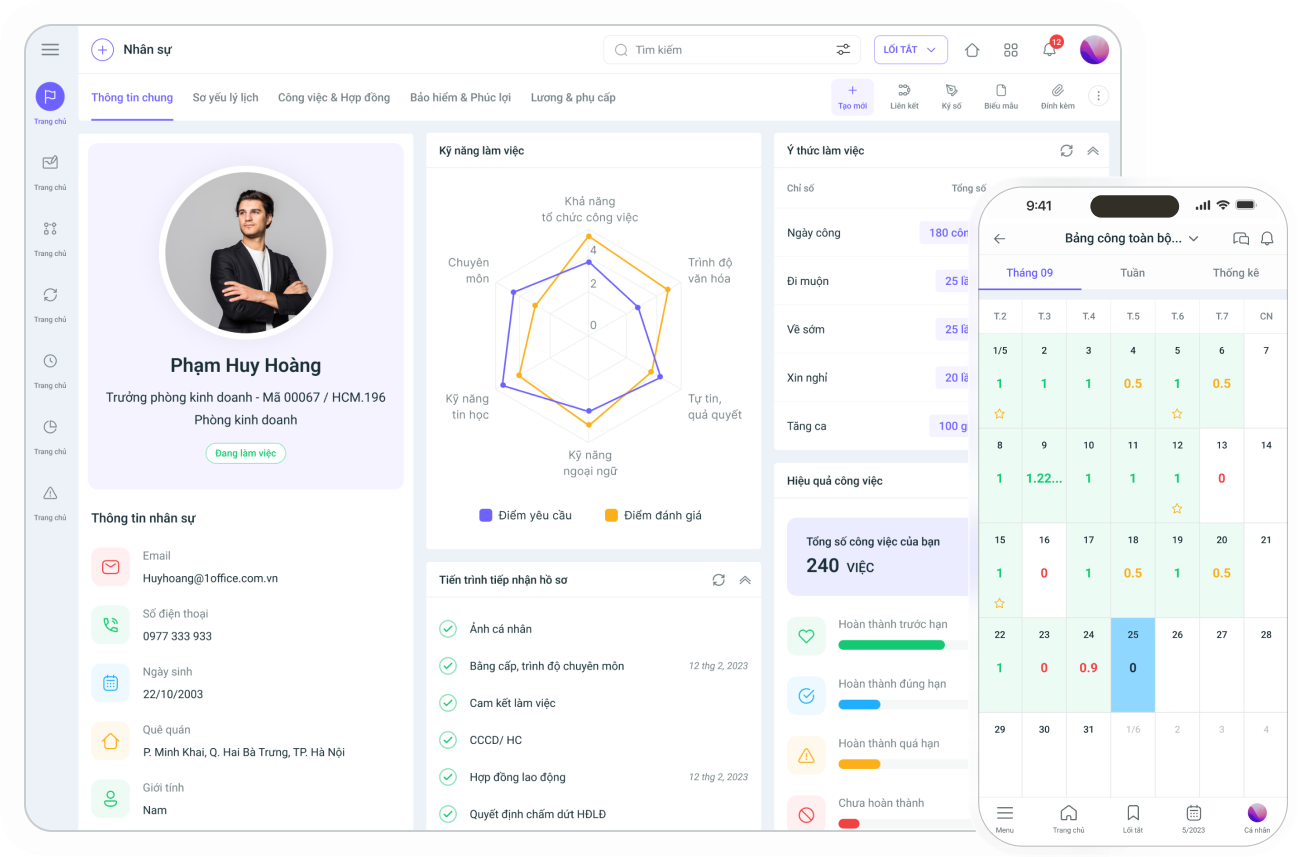
With the KPI Evaluation feature, 1Office helps businesses build a transparent and accurate competency assessment system, thereby:
- Fair Evaluation: The system supports setting clear evaluation criteria (KPIs) tailored to each position, department, and business goal.
- Continuous Monitoring: Manage employee performance in real-time, helping managers easily identify strengths, weaknesses, and development potential.
- Personalized Career Paths: Based on evaluation results, businesses can design career paths that align with the capabilities and personal goals of each employee.
Applying the software to build career paths:
- Early Stage (HR Assistant, Marketing Executive, Sales Junior): The software provides a goal and task management system, helping employees focus on necessary skills.
- Promotion Stage (Senior Specialist, Manager): The KPI evaluation feature helps clearly define criteria so employees understand expectations and development direction.
- Senior Management Stage (Manager, C-Level): 1Office’s automated reporting system helps managers accurately and promptly analyze team performance, thereby making strategic personnel decisions.
8. Conclusion
A career path must be designed in detail and tailored to each industry to not only help employees develop but also to create a competitive advantage for the business. This shows that the business is seriously investing in its human resources and promoting employee engagement and loyalty to the organization.




