


 13/05/2026
  192 views
In business management, problems and malfunctions are inevitable. These issues are collectively known as “bottlenecks.” So, how can you identify bottlenecks in your business? Where are they, and how can you resolve them? Let’s find out in the article below.
Mục lục
I. Understanding Bottlenecks
1.1 What is a bottleneck?
“Bottleneck” is a term inspired by the shape of a bottle. The neck of the bottle is the narrowest point, where blockages are most likely to occur. In business, this term is used to refer to a point of congestion in production, work, projects, etc.
A bottleneck occurs when a large volume of work piles up at once, preventing employees from processing it in time, thus causing delays. If this problem is not resolved quickly, it will eventually lead to work delays and additional costs.

1.2 Types of bottlenecks
Based on duration, bottlenecks are divided into 2 types:
– Short-term bottlenecks: These are temporary issues that arise for a short period and are easy to resolve. For example, a team member takes a few days off. Their work is specialized, and only they have the skills and expertise to handle it. During their absence, tasks related to their expertise will pile up and wait for their return.
– Long-term bottlenecks: These are bottlenecks that occur frequently or have been unresolved for a long time. They cause significant financial damage and are a major concern for business owners. For example, a department that performs poorly, but whose personnel or work quality cannot yet be changed.
Thus, a bottleneck can be any task within the business, an individual, a department, or any factor affecting the company where its overall interests are impacted because it cannot operate smoothly as usual. Examples include: machinery that frequently breaks down during production and has not been replaced; slow, time-consuming payroll processing causing delays; an inefficient department in the company; or a cumbersome and lengthy administrative process.
II. The impact of bottlenecks on business operations
As mentioned above, bottlenecks arise when work piles up, increases, and exceeds processing capacity. Therefore, there are two major problems that occur in business operations when a bottleneck emerges:
– Work backlog: “One task isn’t finished, and another one arrives” is a common problem when a business faces a “bottleneck.” The accumulation of tasks will cause other tasks and processes to be delayed as well because they are not resolved sequentially. As one task piles up, the next one cannot be processed. This leads to reduced labor productivity and disrupts the initial plan set by the business.
For a simple example, if a business’s bottleneck is a cumbersome, manual work process where forms, official letters, and payment/receipt vouchers must be hand-delivered to a manager for a “wet” signature. If the manager is away, has an emergency, or is on a long business trip, the pile of paperwork will remain untouched and unresolved. This problem could be solved very quickly with digital signatures. These features are available in company management software.
– Increased costs: In the manufacturing and service sectors, this impact is more visible. When machinery breaks down, or there is a shortage of labor or unskilled workers, this is also considered a “bottleneck.” This situation will lead to additional labor costs due to extended workdays (a job that should take 5 days now takes 10), extra costs for renting workshops and warehouses, or product spoilage. For example, in fresh produce production, a company harvests 200 kg of green vegetables daily, but due to a small workforce, they can only pack 150 kg per day. The remaining 50 kg must be discarded due to spoilage or incur additional costs for freezer storage.
In addition, there are a series of other negative impacts, such as:
– Causing delays in work progress, leading the business to miss other opportunities or the “golden” timing in its plan.
– Product surplus or shortage, creating an imbalance between supply and demand.
– A passive workforce that cannot proactively handle tasks, experiencing periods of being overloaded with work followed by periods of being idle with nothing to do.
– Difficulty in estimating the necessary resources (time, manpower, materials, etc.) to create a reasonable plan.
– Arising conflicts and a blame culture among colleagues and within departments.

III. How to quickly identify and resolve “bottlenecks”
3.1 How to Quickly Identify a “Bottleneck”
A “bottleneck” is a problem that arises during a company’s operations, and it’s not difficult to identify these conflicts. Here are a few ways to quickly spot a bottleneck:
– Pay attention to emerging signs: Short-term bottlenecks can be seen immediately and resolved quickly. However, long-term bottlenecks have often been occurring for a long time and are repetitive, sometimes causing serious consequences that are a major headache for business owners.
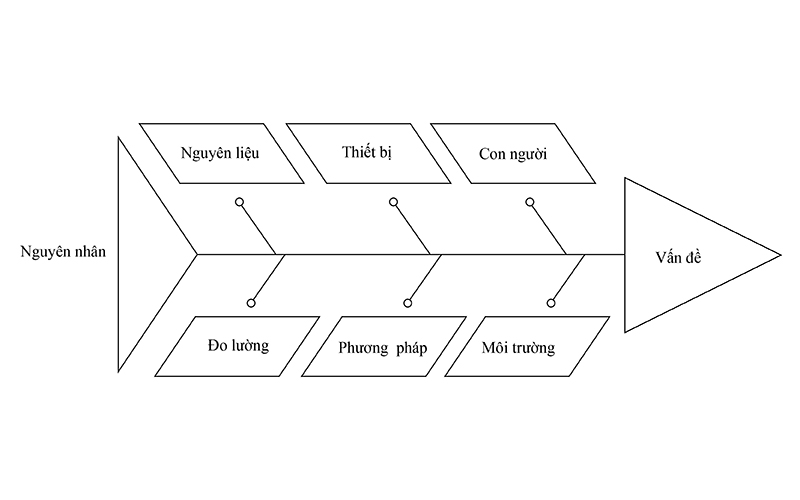
– Use the 5M1E model: When an incident occurs in production, leaders can draw a 5M1E model to check where the problem lies. This fishbone diagram is quite effective for quickly finding the “bottleneck” in the business.
– Listen to feedback from business partners: This feedback is directly related to the company’s revenue, so it is essential to handle it quickly and promptly to avoid affecting the partnership. For example, if a partner reports a shortage of goods or a recent decline in quality, you must investigate the cause of the shortage or poor quality. What is the company’s bottleneck at this point that is preventing work from flowing smoothly?
– Measure and analyze data: Through management reports and weekly/monthly statistics on work and labor productivity, business owners can easily identify emerging problems in their company. Charts and figures are undeniable evidence of work results. For example, if a Content Marketing team reports that they needed to complete 120 SEO articles in a month but only finished 100, the manager can see that there is a problem (e.g., staff shortage, suboptimal productivity, or a delay in a specific stage preventing on-time completion).
3.2 Solving the “Bottleneck” Problem in Business
One of the top priorities for increasing productivity, besides creating specific and well-directed plans, is to resolve “bottlenecks” within the business. These are conflicts that, if left unresolved, will affect the company’s performance. Once a business owner identifies where the problem lies, they can consider the following solutions:
– For issues related to customers and partners: While working with partners or providing products and services to customers, it’s important to listen to their feedback. However, you also need to check the sale pipeline to measure whether the customer approach steps are correct. When a customer reports an issue, identify which step it belongs to and how to resolve it. For example, customers might complain about after-sales care, installation and delivery services, consulting, or inflexible payment options. All of these issues are considered bottlenecks.
– For internal business issues: The best approach for a manager is to talk directly with their employees to find a solution together. Listen to the difficulties employees are facing and need help with. For instance, a suggestion to replace machinery to improve work quality is a valid idea for resolving a “bottleneck”.
– Use business operations management software: This is the most reasonable and optimal solution. Through experience, managers will realize the important role of applying company management software. Tasks are performed according to a pre-established scientific process, minimizing backlogs and work congestion. Or, when a problem arises, leaders can quickly see where the backlog is and address it. There is a variety of business management software depending on the company’s needs: CRM is suitable for Sales and Marketing; HRM for company recruitment and HR; and internal network software for workflow management. This approach is very effective for resolving long-term bottlenecks.
Through the useful information above about bottlenecks—the problem and its solutions—1Office hopes that business owners and managers will gain more knowledge and experience to run their business operations most effectively.
















