


 13/05/2026
  89 views
CRM – Customer Relationship Management – the practice of managing customer relationships for every business is becoming increasingly important in today’s competitive market. So, what is the role of CRM in the 4.0 era for businesses in general and for different audiences specifically? Let’s find out with 1Office in the article below!
Mục lục
I. Understanding the Nature and Development of CRM
The concept of CRM generally refers to the activities of managing and promoting customer relationships. This is the process of building customer relationships throughout the entire journey, from Marketing and sales to customer care, in order to attract more customers to the business.
Developing a customer management system means building business operational processes to suit customer needs. The term Customer Relationship Management was coined in the early 1990s, and the first mobile CRM application was developed in 1999.
Today, the role of customer relationship management is no longer just about sales management but also refers to CRM software – a tool that helps businesses manage customer relationships comprehensively by centralizing customer data storage, recording all transaction/interaction history, optimizing sales processes, managing sales teams, automating marketing activities, and connecting customer data across departments.
The true nature of CRM is a tool that helps manage all customer data centrally in one place. When data is stored centrally, relevant departments will have complete information about customers to understand them better and build appropriate care scenarios.
II. Analyzing the 10 Roles of CRM in the 4.0 Business Era
The Role of CRM for Customers
1. Providing Attentive Customer Care
Customer management in general, and CRM sales management software in particular, plays a crucial role in providing customers with the best services based on their preferences and desires. It helps foster long-term relationships between customers and the business, helping customers understand the business better.
With CRM, a business’s customers will feel that the company cares about their specific needs and requests, such as their birthday, preferences, and interests.
Example:
Sales management software collects customer data and then uses that data to implement customer care marketing activities. For example, for female customers, it can schedule reminders to send greetings on March 8th or October 20th. This makes customers feel more valued and better cared for.
See more: What is CRM? Benefits, Functions, and Role of a CRM System
The Role of CRM for Businesses
2. Effective Customer Data Management
Applying CRM software to all business campaigns and product/service promotions has become an indispensable activity for every business. The role of customer relationship management for a business is to provide an effective solution for managing customer data.
- Collect customer information from websites, emails, phone calls, social media data, and more, across multiple sources and channels. It can also automatically retrieve other information, such as recent news about the company’s activities, and store personal details.
- Scientifically manage transaction history with a clear list of order values, contract values, and statuses.
- Store transaction and contract information, and archive sales documents.
- Manage customer interactions: customer interactions on the website/landing page are automatically stored centrally in a single interface, giving the business a comprehensive view of its customers.
3. Managing Business Processes
A customer relationship management platform can also connect with other business applications to help you develop customer relationships. Customer management software can track the progress of opportunities through each stage: building a process and monitoring the development of each opportunity (which stage it’s in, its feasibility).
The role of CRM in sales activities in the 4.0 era doesn’t stop there; the software also simplifies sales procedures: creating quotes from templates, requesting automatic quote approvals, etc.

Manage and store the history of emails, calls, seminars/training sessions, in-person meetings, or social media interactions with customers; score opportunities based on customer interactions, making it easy to control and classify opportunities.
4. Managing and Evaluating Business Performance
By choosing the right timing and diagnosing customer needs, business revenue is boosted. Businesses that successfully implement the system see revenue increases of up to 30-50%.
Customer relationship management software with marketing automation and measurement features helps businesses replace manual, outdated business processes. It saves costs and time, as just one or two employees can easily interact with thousands of customers.
Additionally, CRM helps the sales team accurately evaluate business performance with charts and scoring to devise more suitable future business strategies.
Read more: What is Mobile CRM? How Mobile CRM Applications Help Businesses Skyrocket Revenue
5. Optimize sales team management
Thanks to a professional customer relationship management platform, managers can assign targets and manage detailed sales figures for each employee with monthly/quarterly/yearly goals, and closely monitor work efficiency with automated reports for each individual.
Businesses can also use the software to track work progress, as the customer management software system will remind employees to make calls or transactions that were previously entered based on the completion time of each task.
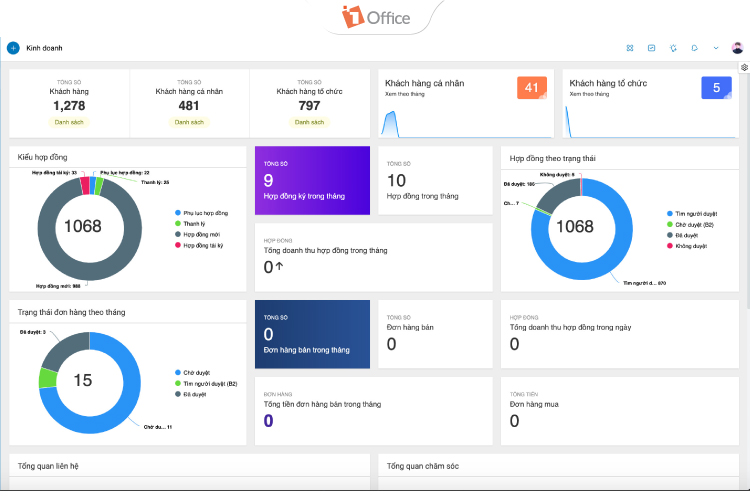
An indispensable role of customer relationship management is evaluating employee productivity and capability with specific statistical data, as shown in the table below.
6. Enhance employee work performance
The automation feature of customer relationship management software helps automatically update and coordinate customer data. The software will complete data fields and provide accurate suggestions based on the information collected.
The role of CRM also includes marketing automation and measurement functions, helping businesses replace manual, outdated business processes. It saves costs and time, as just 1 to 2 employees can easily interact with thousands of customers.
Thanks to this role, CRM enables employee teams to work more effectively and quickly than with previous traditional methods, increasing revenue by 30 – 50%.
7. Help businesses increase potential customers
Beyond its role in managing customer data, the marketing feature of a CRM system also helps businesses optimize promotional activities to effectively increase the number of potential customers.
Thanks to the system of tools for evaluating and reporting sales performance, the software can easily inform the sales team about current customer approach trends, their needs, and which products/services they are most interested in.
8. Help businesses reduce costs and increase profits
CRM is software with a high return on investment. When applying the role of CRM in a business, sales processes are optimized, departments work and coordinate more smoothly, and data is interconnected and synchronized, thereby saving time on manual tasks and reducing costs.
At the same time, implementing a CRM also helps businesses increase sales revenue. Because when customers are better cared for and more satisfied, and the business has a good relationship with them, the company’s brand will improve and revenue will increase. It is clear that the role of CRM in the 4.0 era is very diverse and essential.
Example
Previously, a business needed to spend a large amount on advertising products/services to attract customers and enhance its reputation. However, due to an inadequate customer care process, contracts were not closed, and the costs incurred were many times greater than the profits earned.
Now, with CRM and its role, the sales system and customer care process have been standardized and are closely monitored. As a large number of potential customers are acquired, profits increase accordingly.
| Discover the solution to help your business enhance customer experience with: >> The best customer management software and CRM solution today |
The role of CRM for managers and employees
9. Better tracking and management of the sales team
With CRM, managers can easily assign goals and track the progress of sales targets for each department and employee. It helps compare business performance from the past to the present and forecast the future, making it easy to identify difficulties and potential risks to promptly implement appropriate solutions.
Managers can also monitor the team’s sales activities. CRM software provides a feature that notifies managers of the number of opportunities sales staff have not yet nurtured, making it easy to track which stage an employee is at in the customer care process.
10. CRM creates a professional working system for sales staff
In addition to its roles for managers, customer management software also creates a highly ideal, focused working environment and facilitates good information sharing for the sales team based on stored customer data.
CRM allows employees to manage their time and tasks effectively, while also helping them manage and understand the information of each potential and existing customer. This enables them to provide timely contact and care, building customer trust and ensuring long-term retention.
III. 6 Major Business Pain Points That CRM Can Solve
A software becomes essential when it solves a business’s pressing problems. And CRM is no different. The reason CRM application has become a trend is that, in addition to the customer relationship management roles mentioned above, CRM can also help businesses solve the following 6 “pain points”:
| Business “Pain Points” | Without CRM | With CRM |
| Frequent loss of customer data due to no systematic storage | Stored in Excel, Google Sheets
=> data is often deleted or lost, each employee manages customer data in a separate file, leading to fragmented data and no centralized customer list management. |
CRM helps businesses solve this problem with its feature for centralized, safe, and secure customer data storage and management. |
| No standardized sales process | Sales and consulting do not follow any standardized process
=> unprofessional customer care, managers lack information |
CRM, with its feature for setting up and managing sales processes, will help businesses solve this problem |
| Unable to track transaction history | Large number of customers, up to hundreds of thousands
=> Impossible to track them all |
CRM stores the entire history of care and transactions with customers, helping employees understand customers to create effective care scripts. |
| Cannot monitor contracts, difficulty in tracking orders | Most businesses will face many difficulties in synchronizing data between the Sales and Accounting departments | The role of CRM here is to help businesses resolve difficulties in tracking orders, contracts, debts, deliveries, and sales, helping to synchronize Accounting-Sales data. |
| Problems in achieving sales targets | Managers have difficulty grasping the current status of employees’ sales target achievement
=> Leads to a reactive state |
The role of CRM in this case is to help managers easily assign targets and monitor the target achievement status of employees/departments |
| No multi-dimensional reports that are updated regularly | No evaluation charts or tables, so it’s impossible to know if sales performance is good | Automates the business situation reporting system to be detailed, intuitive, and logical, helping managers make accurate and timely decisions |
IV. Examples of Applying CRM to Enhance Customer Experience
MCDONALD’S has successfully implemented and applied a CRM software solution – customer relationship management.
As a global brand with extensive marketing campaigns, it’s crucial for McDonald’s to segment its marketing and ensure they make the most of every potential customer and every returning customer.
Faced with this situation, MCDONALD’S turned to CRM. The software helps provide data on their restaurant visit frequency and purchasing habits. McDonald’s can use these insights to implement promotions and send personalized rewards to each person’s phone.
Similar to MCDONALD’S, CRM is an essential tool for a company with a wide and global reach like Coca Cola. Coca Cola uses multiple CRM systems, such as Salesforce and Sugar, to manage sales, marketing, and customers in the different regions where the company operates.
V. 6 Steps to Choose the Right Customer Management Software for Your Business
With the current popularity of customer management systems, thanks to the roles of CRM in the 4.0 era as mentioned above, countless CRM software with different features and price points have appeared on the market. Below are 6 steps to help businesses choose the right CRM software.
1. Form a selection team
Form a team that includes both managers and employees who have expertise and can provide multi-dimensional feedback and evaluations.
2. Identify the main needs for using customer management software
The role of CRM is always key when applied. Before approaching CRM vendors, first, clearly identify your needs for using CRM. What problem are you facing? What issues do you want the customer management software to solve?
There are many CRM vendors on the market today. Besides common features, CRM vendors also have their own unique strengths. Therefore, define your needs clearly, then research which CRM vendor best meets your needs.
3. Estimate the software implementation budget
You need to have a clear understanding of the business’s budget for the upcoming CRM implementation plan to search for and select solutions with a corresponding cost.
4. Create a shortlist of reputable vendors
Creating a list of vendors whose products meet the business’s requirements will make it easier for us to plan, discuss, compare, evaluate, and ultimately choose the most optimal vendor.
5. Select top vendors for a demo
At this step, the business will get a view from general to detailed of the solutions from various vendors. Typically, experts from the vendors will consult and clarify the business’s initial requirements, as well as highlight the roles of customer relationship management software for the business to better understand.
6. Make the final decision
After going through the above steps, the selection team needs to discuss and choose the most suitable customer management software solution provider based on the following criteria:
- Meets the business’s requirements
- Reasonable cost, within budget
- Provides detailed and complete guidance and training
- Has a regular support channel
- Can be easily upgraded and expanded in the future
Example:
Your business is deciding between CRM on Cloud and CRM on Premise. You need to clearly determine:
- CRM on Cloud is more convenient in terms of data access, helping departments use the software and care for customers anytime, anywhere
- CRM on Premise will have limited data access, so if your business is not in industries requiring high information security like insurance, banking…
=> If the business prioritizes convenience in use and cost savings, it should choose CRM on Cloud. If it requires high information security, it should choose CRM on Premise.
For medium to large-sized enterprises, the 1Office CRM tool is confidently the most effective solution, the number one choice for the vast majority of businesses today. CRM 1Office can automatically connect and retrieve data from Facebook, Google, etc., to build specific Marketing campaign scenarios. Capture and control profits. Measure Marketing campaigns and evaluate the detailed results of each campaign. This helps businesses improve sales efficiency.
For more details, please contact:
- Hotline: 083 483 8888
- Fanpage: https://www.facebook.com/1officevn/
- Youtube: https://www.youtube.com/channel/UCeTIRNqxaTwk0_kcTw6SxmA
















