


 13/05/2026
  307 views
The modern economy considers human resources a valuable intangible asset, closely linked to the strategic goals of a business. For this reason, the HR strategy map was created to serve as a guide, helping HR professionals and senior managers build an optimal HR strategy structure to create sustainable value for the business. In the following article, 1Office will provide readers with a standard process for building an HR strategy map for their business.
Mục lục
1. What is an HR strategy map? The role of an HR strategy map
The HR strategy map was introduced in 2001 in the book “The Strategy-Focused Organization” by Robert S. Kaplan and David P. Norton – leading experts in business strategy.
The HR strategy map views people as an intangible asset of the organization and shows how human resources create value and contribute to the business strategy. The strategy map demonstrates how the HR department impacts company operations by developing key internal processes to create value for customers, thereby improving financial results.
In today’s highly competitive labor market, the HR strategy map plays a crucial role in many aspects of an organization’s operations, specifically:
- Control HR costs: By planning budgets for internal processes, it allows for control over the maximum cost invested in the HR department to achieve the company’s strategic goals.
- Evaluate HR’s contribution to company profits: The HR strategy map outlines financial goals and sets forth the HR department’s strategic plan to help achieve those goals. This serves as a basis for evaluating the contribution of human resources to the company’s overall results.
- Manage and track strategic goals: As a tool to help managers plan business operations strategy, the HR strategy map helps monitor and closely track the progress of plan implementation to make sound decisions.
| >> Read more: A-Z Guide to Standard Human Resource Planning for Businesses |
2. Elements of an HR Strategy Map
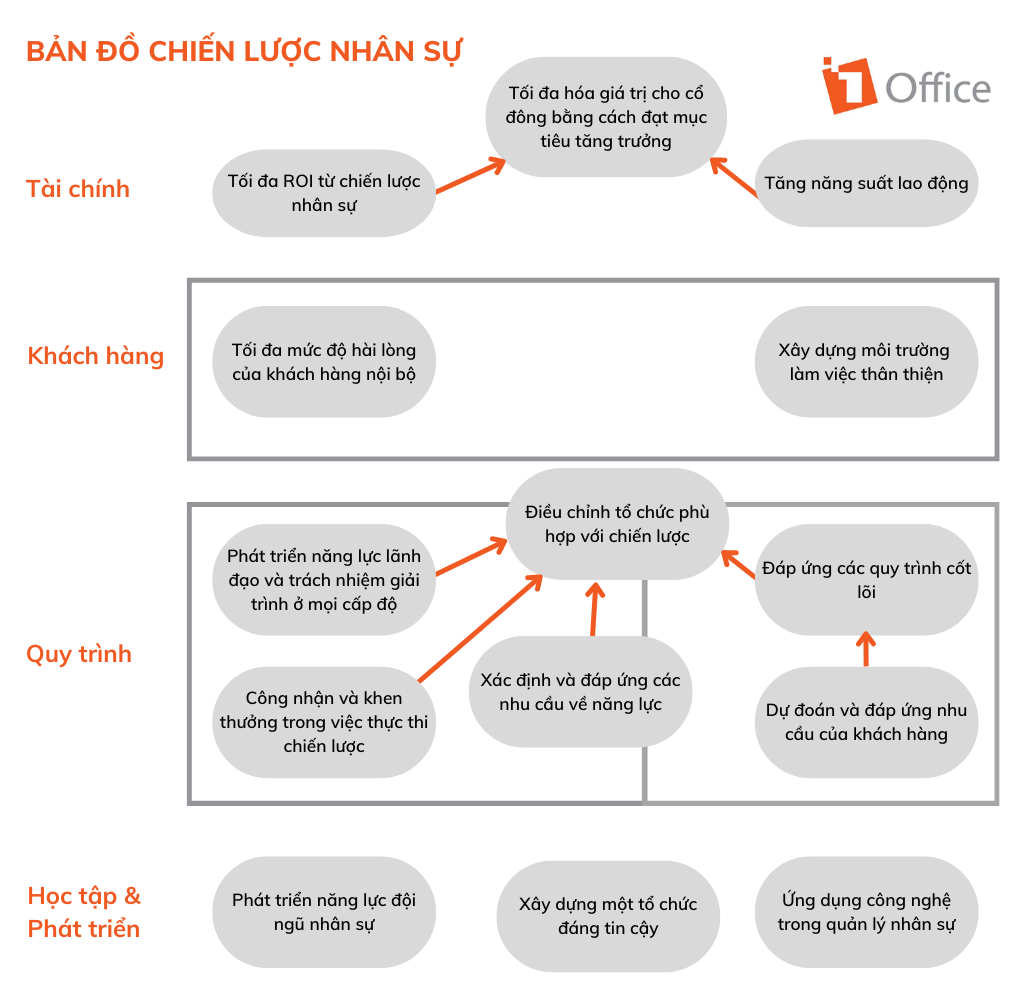
An HR strategy map is built on 4 core elements that directly impact the organization’s business activities and strategies. The first two parts establish the outputs—expectations focused on finance and customers—which align with the company’s goals. The remaining two parts describe the internal inputs and learning & growth, detailing how HR plans to meet the input expectations. The connecting lines on the map define the relationship between input and output objectives.
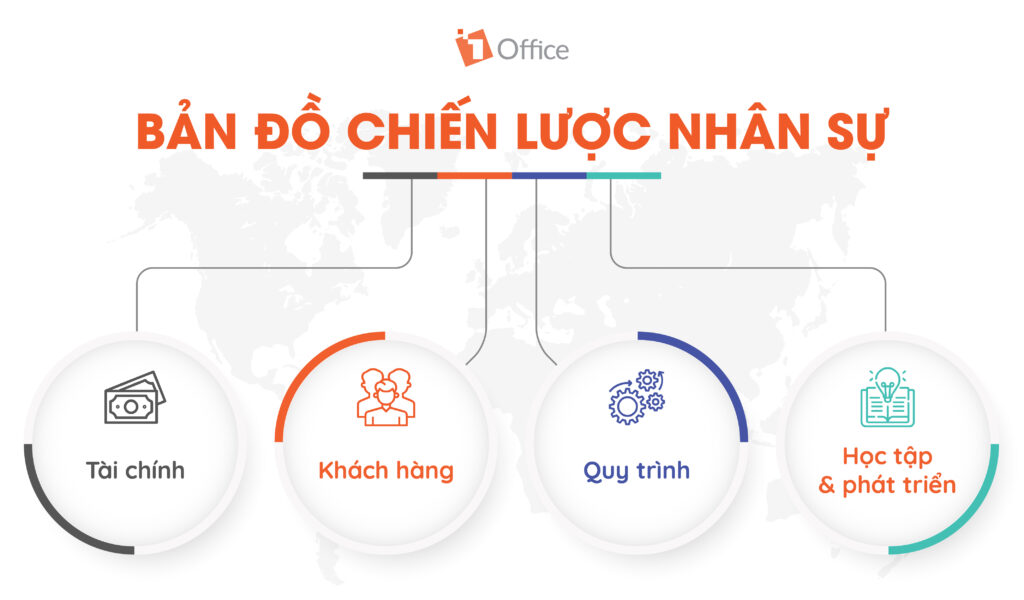
Financial
The financial element represents the financial results and goals the business aims for. Every business, as a commercial entity, strives to achieve the best possible financial outcomes to maximize profits. Some financial goals include increasing productivity, optimizing shareholder value, reducing operating costs, etc.
Customer
The customer element mentioned in the HR strategy map does not refer to typical customers—those who directly generate revenue for the business. In HR strategy, the customer element focuses internally on the organization—meaning the employees who create value for the organization. Therefore, HR strategies are designed to achieve internal customer satisfaction by improving and enhancing factors such as the work environment, job satisfaction, employee engagement, etc.
Process
Process refers to the way HR strategies are executed to meet the needs of internal customers. For example, training programs and recognition and reward initiatives help increase employee engagement, thereby reducing turnover rates. Similarly, a wellness program or a comprehensive benefits package will create a healthier, higher-quality workforce.
Learning and Growth
The final element in the map defines what HR must do to transform internal inputs from goals into reality. Knowledge, skills, and competencies are the “tools” to achieve these goals. Therefore, investing in competency development and professional training for the HR team is essential to help the organization achieve its business objectives.
For example: A leadership development goal may require mentoring programs, management training, and competency-based performance evaluations to develop management expertise, communication skills, and knowledge of business processes.
See more: How to Create an Effective Business Strategy Map for Leaders
3. Process for Creating an HR Strategy Map
Remember that your HR strategy map must have a cause-and-effect relationship between objectives. Arrange the sections in a logical order so that the elements at the bottom explain how you plan to achieve the higher-level goals.
3.1. Define Financial Objectives
To build a standard HR strategy map, you first need to define the financial output objectives in the company’s strategy. Financial objectives should ensure they meet the 5 elements of the SMART model:
- Specific
- Measurable
- Achievable
- Relevant
- Time-bound
For example: The financial objective for Q3 2022 is for the HR department to commit to reducing recruitment costs by 10%, specifically by 5,000,000 VND per month.
3.2. Set Expectations for “Customers”
To achieve the established financial objectives, the next step is to determine what internal customers need to do and how they will do it. For each financial objective, managers need to identify who will be responsible for the goal and describe how they will perform their work to ensure financial results are met.
For example: Increased employee engagement will improve labor quality, thereby enhancing productivity.
3.3. Outline the Strategy Execution Process
To achieve the organization’s goals, HR strategies need to be implemented according to a plan. Measures that can be used to effectively utilize human resources include: optimizing recruitment, developing talent, providing professional training, etc.
Businesses should note that it is necessary to build sub-processes that interact with and support each other to achieve specific common goals.
4. HRM Software – A Tool to Optimize Your HR Strategy Map
Building a well-structured human resource strategy map will help businesses have a clear direction and a specific plan to achieve their goals. However, realizing these plans and implementing the strategy in the right direction requires seamless coordination between individuals and efficient operational processes. To achieve this, using human resource management software is essential if a business wants to optimize its human resources.
Understanding this, 1Office has developed the HRM module – a solution to help businesses solve the challenges of human resource management.
1Office software will help businesses build a well-structured HR strategy, supported by outstanding features such as:
- Transparent and fair employee performance evaluation through a set of KPIs and OKRs built to fit the company’s standards
- Generate payroll automatically and quickly, pay salaries directly on the software linked with MB Bank
- Build corporate culture with an internal network – a bridge between employees and managers
- Intuitive, dynamic, and comprehensive HR reports in various formats: charts, Gantt, Kanban cards, etc.
Our article above has provided you with information about the human resource strategy map and a technology solution to help create effective HR plans to optimize human resources and generate more value for the business.
For more details and inquiries, please contact:
- Hotline: 083 483 8888
- Fanpage: https://www.facebook.com/1officevn/
- Youtube: https://www.youtube.com/channel/UCeTIRNqxaTwk0_kcTw6SxmA
















