


 11/05/2026
  892 views
Overtime is a common situation in many businesses, but not everyone fully understands how to calculate overtime pay according to legal regulations. Incorrect calculations not only affect employee rights but can also create legal risks for the business. In this article, 1Office will provide a detailed guide on the formula for calculating overtime pay according to the latest regulations, complete with examples and an easy-to-use calculation table.
Mục lục
- 1. What is Overtime Pay?
- 2. Latest Legal Regulations on Overtime Pay for 2025
- 3. Detailed Overtime Pay Calculation for Each Case
- 4. Overtime Pay Calculation Templates
- 5. Important Notes When Calculating Overtime Pay
- 5.1. Correctly Apply Legal Regulations on Overtime Pay
- 5.2. Use the correct salary as the basis for calculating overtime
- 5.3. Accurate and transparent timekeeping and management of overtime data
- 5.4. Control overtime limits according to regulations
- 5.5. Transparency in communication and overtime pay notification
- 5.6. Complete storage and reconciliation of overtime pay records
- 6. 1Office – The solution for fast and accurate overtime pay calculation
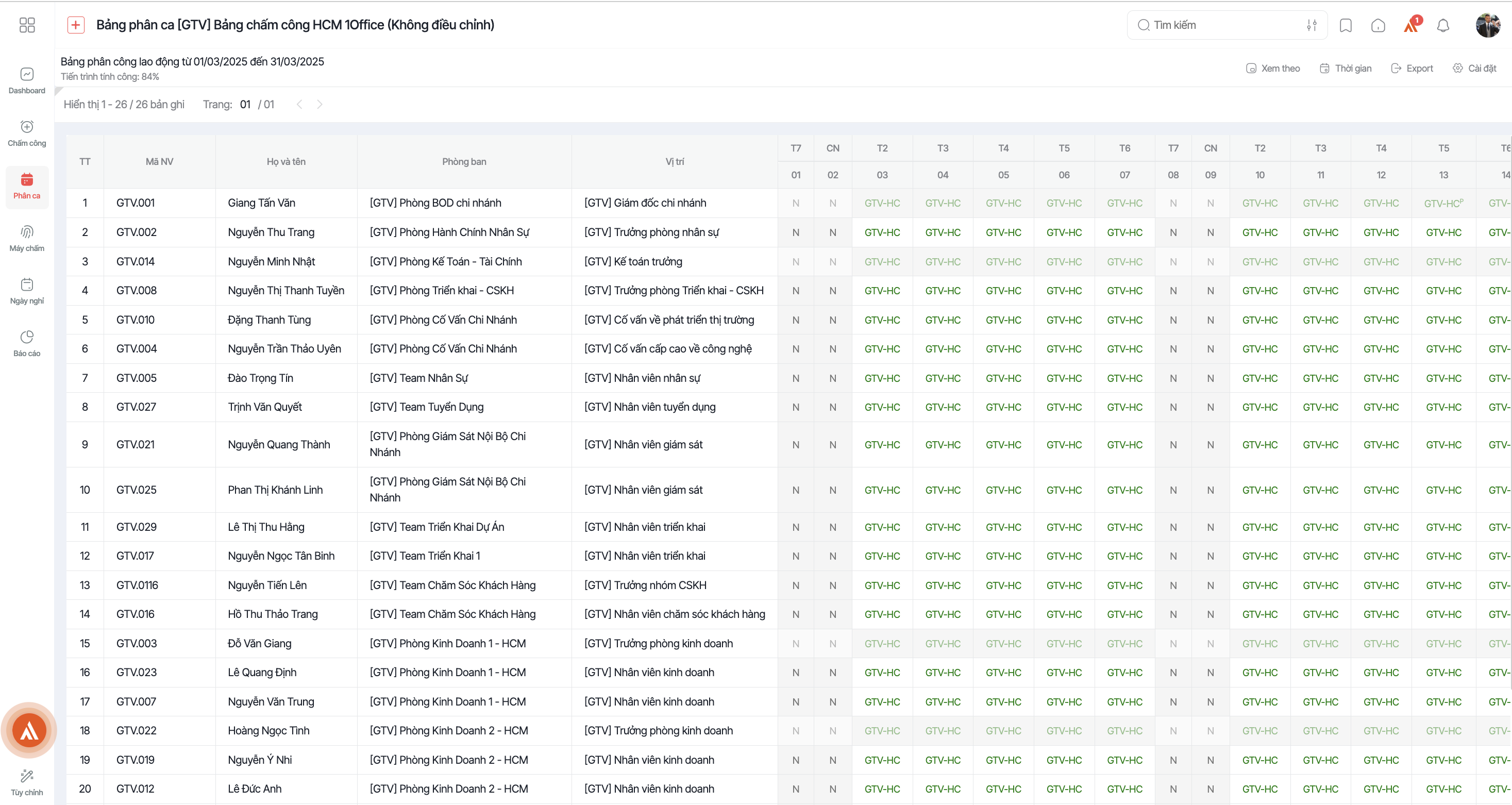
- 6.1. Automatic shift scheduling, flexible shift management tailored to business specifics
- 6.2. Diverse and accurate timekeeping – integrated with time clocks
- 6.3. Calculate overtime pay by shift and time frame – in compliance with legal regulations
- 6.4. Comprehensive overtime reports – effective cost control
- 7. 5 Frequently Asked Questions about Overtime Pay (FAQ)
- 7.1. How many extra hours must be worked to qualify for overtime pay?
- 8.2. Can an employee refuse to work overtime?
- 8.3. What are the penalties if a company fails to pay overtime correctly?
- 8.4. Is overtime pay subject to social insurance contributions?
- 8.5. Is it possible to agree on compensatory time off instead of receiving overtime pay?
1. What is Overtime Pay?

Overtime pay (also known as overtime wages) is the amount of money paid to an employee for working beyond the normal working hours as stipulated by law or agreed upon in the labor contract. This overtime work can take place on regular workdays, weekly days off, public holidays, Tet holidays, or at night.
According to the current Labor Code of Vietnam, employees who work overtime are entitled to a higher wage rate than their normal hourly wage, to ensure their rights and compensate for the labor expended outside of standard hours.
2. Latest Legal Regulations on Overtime Pay for 2025
The calculation of overtime pay is currently applied according to the provisions of the 2019 Labor Code (which is still in effect in 2025), along with related guiding documents. The legal regulations on overtime pay aim to protect the rights of employees when working outside of regular hours and help businesses fulfill their wage payment obligations correctly.
2.1. Maximum Overtime Hour Limits
According to Article 107 of the 2019 Labor Code:
- Not to exceed 50% of the normal working hours in a day.
- Not to exceed 40 hours/month.
- Not to exceed 200 hours/year, except for certain industries where it can be extended to 300 hours/year (e.g., electricity generation, textiles and garments, agricultural product processing…).
2.2. Principles of Overtime Pay
The employer must reach an agreement with the employee before mobilizing them for overtime work. Overtime wages must be paid at a higher rate than the normal hourly wage, specifically as follows:
| Overtime Period | Minimum Overtime Pay Rate |
| Overtime on weekdays | At least 150% of the actual hourly wage |
| Overtime on weekly days off | At least 200% of the actual hourly wage |
| Overtime on public holidays, Tet, and paid leave days | At least 300% of the actual hourly wage (excluding the salary for that day) |
| Overtime at night | An additional 30% of the actual hourly wage + overtime pay |
Note: If working overtime at night, the employee is entitled to an additional 30% of their salary for each hour of night work, which is added to the overtime pay for that period.
2.3. Basis for Calculating Overtime Pay
- Salary used as the basis for overtime calculation: is the salary based on the job or title, excluding allowances and bonuses.
- The company must clearly specify this in the labor contract or salary payment regulations.
3. Detailed Overtime Pay Calculation for Each Case
3.1. General Formula
Overtime Pay = Actual Hourly Rate × Percentage Rate for each case × Number of Overtime Hours
Actual Hourly Rate: is the salary based on the job or title, calculated on an hourly basis.
Percentage Rate: from 150% – 300% depending on the overtime period (details below).
3.2. How to Calculate the Hourly Rate
Hourly Rate = Monthly Salary / Actual Working Days in the Month / Working Hours per Day
Or apply the standard formula according to Circular 10/2020/TT-BLDTBXH:
Hourly Rate = Monthly Salary / 26 days / 8 hours
Example: Monthly Salary: 8,000,000 VND
Hourly Rate = 8,000,000 / 26 / 8 = 38,462 VND/hour
3.3. How to Calculate Overtime Pay for Weekdays
Applicable Rate: At least 150% of the hourly rate
Overtime Pay = Hourly Rate × 150% × Number of Overtime Hours
Example: Working 2 overtime hours on a weekday →
Overtime Pay = 38,462 × 150% × 2 = 115,386 VND
3.4. How to Calculate Overtime Pay for Weekly Days Off
Applicable Rate: At least 200% of the hourly rate
Overtime Pay = Hourly Rate × 200% × Number of Overtime Hours
Example: Working 4 overtime hours on a Sunday →
Overtime Pay = 38,462 × 200% × 4 = 307,696 VND
3.5. How to Calculate Overtime Pay for Public Holidays
Applicable Rate: At least 300% of the hourly rate (excluding the full salary for the public holiday)
Overtime Pay = Hourly Rate × 300% × Number of Overtime Hours
Example: Working 3 overtime hours on May 1st →
Overtime Pay = 38,462 × 300% × 3 = 346,158 VND
In addition, the employee still receives their full salary for the public holiday.
3.6. How to Calculate Night Overtime Pay
Work from 10 PM to 6 AM the next day.
Night Overtime = Hourly Rate × Overtime % × Number of Overtime Hours + 30% Hourly Rate × Number of Overtime Hours
Total Pay = (Hourly Rate × % for the period + 30%) × Number of Overtime Hours
Example: Working 2 overtime hours at night on a weekday →
Overtime Pay = (38,462 × 150% + 38,462 × 30%) × 2 =
(57,693 + 11,538) × 2 = 138,462 VND
3.7. How to Calculate Daytime Overtime Pay
For daytime overtime, apply the rules in sections 3.3, 3.4, and 3.5 depending on whether the overtime is on a weekday, a day off, or a public holiday.
In summary: Daytime overtime only applies the 150%, 200%, or 300% rates depending on the period, without the additional 30% for night work.
>> Read more: 9 Complete and Easy-to-Use Employee Payroll Templates
4. Overtime Pay Calculation Templates
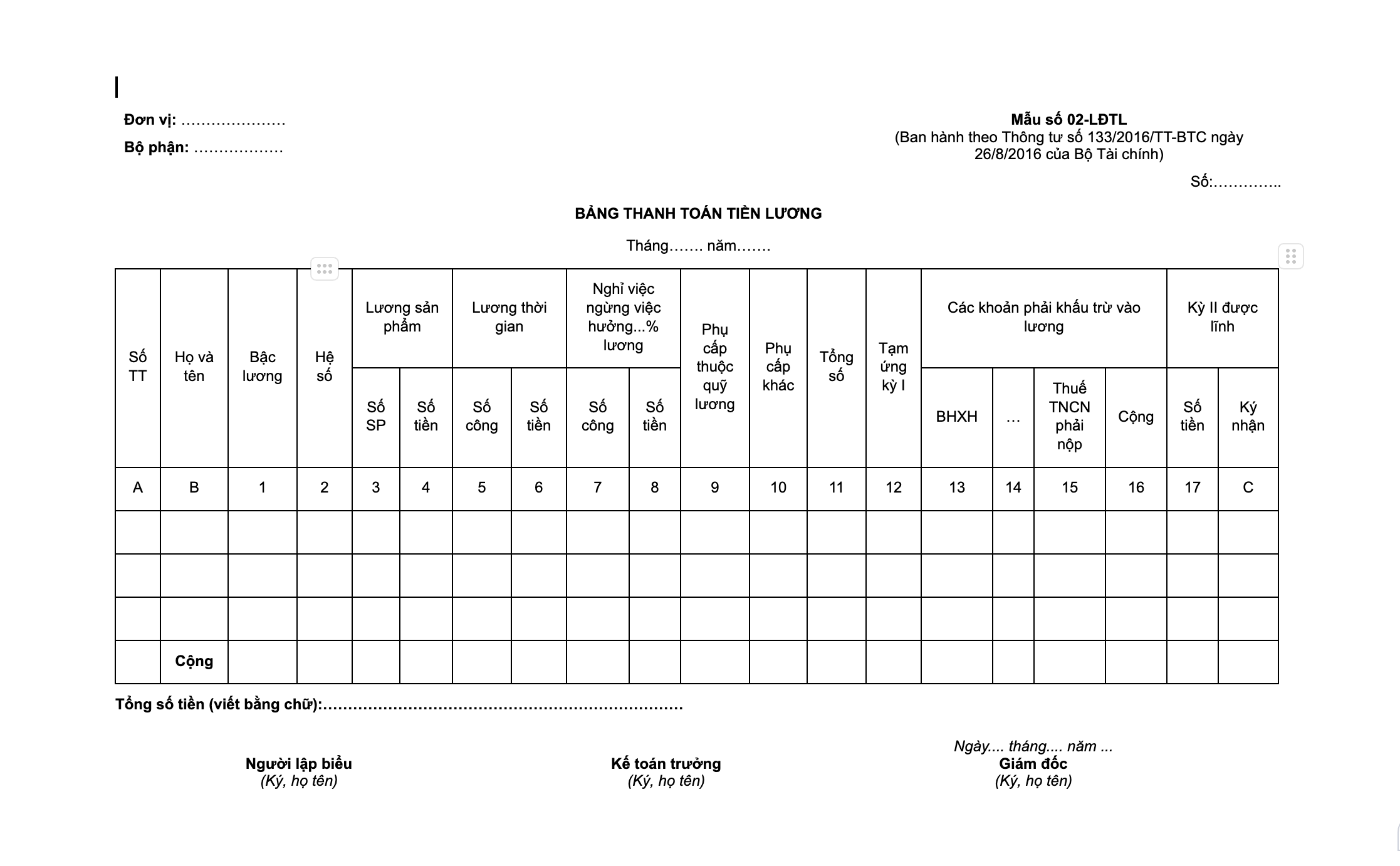
4.1. Overtime Pay Calculation Template according to Circular 133
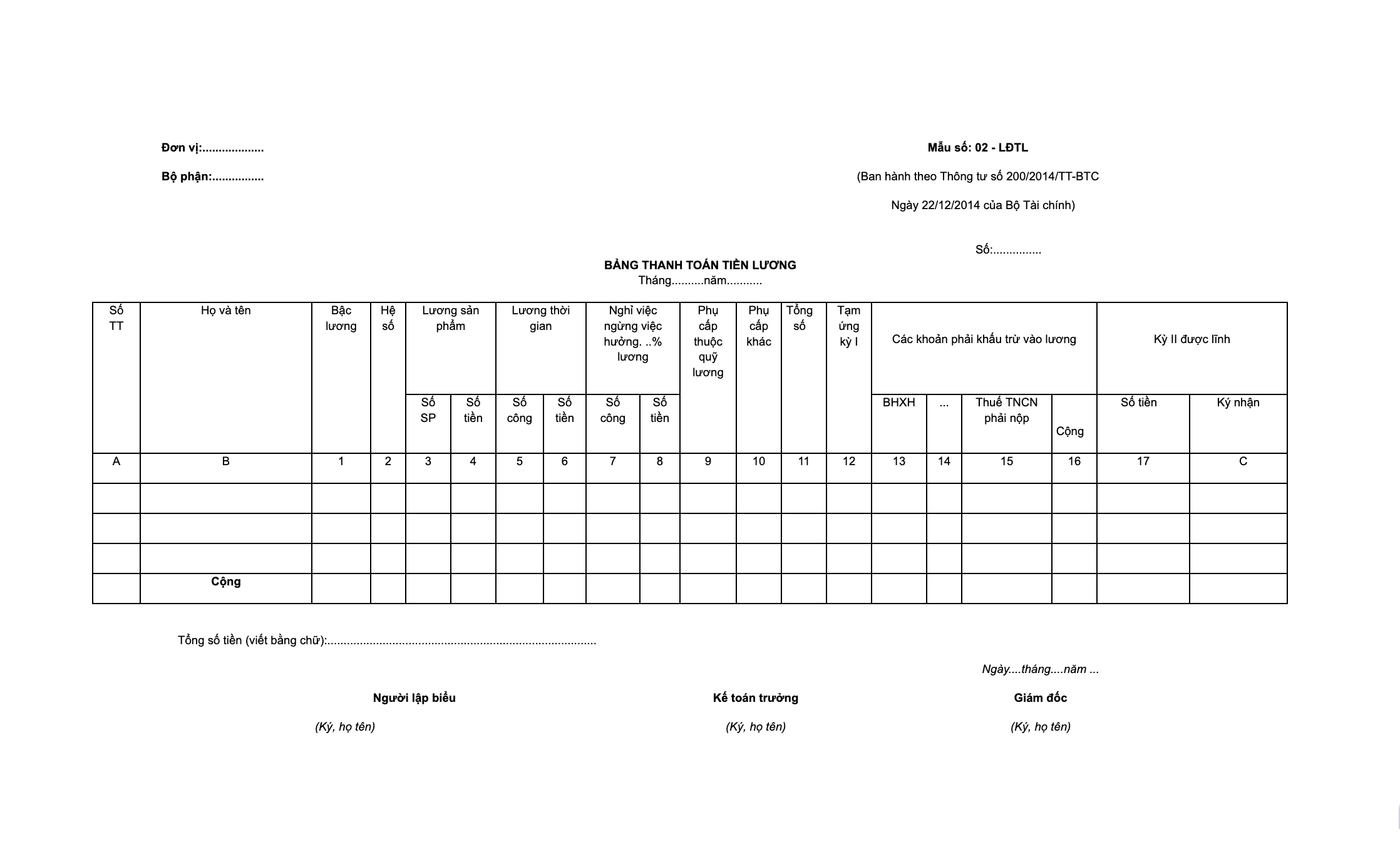
4.2. Overtime Pay Calculation Template according to Circular 200
5. Important Notes When Calculating Overtime Pay
Calculating overtime pay is not just a simple calculation between the hourly rate and the number of overtime hours; it is a process that requires accuracy, legal compliance, and ensuring fair rights for employees. For HR and accountants, understanding and implementing correctly is a crucial factor that helps businesses avoid legal risks and maintain internal credibility. Below are important notes that HR and accountants need to master in the process of calculating overtime pay.
5.1. Correctly Apply Legal Regulations on Overtime Pay
HR and accountants need to clearly understand the overtime pay rates specified in the Labor Code. Each overtime period will have a different additional rate on top of the normal hourly wage:
- Normal working day: At least 150% of the normal hourly wage.
- Weekly day off: At least 200% of the normal hourly wage.
- Public holidays, Tet, paid leave days: At least 300% of the normal hourly wage (excluding the salary already paid for the holiday/Tet).
- Night overtime: Add at least 30% of the hourly wage to the overtime pay.
Note: If an employee works overtime at night on a public holiday or Tet, it is necessary to cumulatively add 300% + 30% + 20% (according to regulations for night work). This is a point that HR/accountants can easily miscalculate if not monitored carefully.
5.2. Use the correct salary as the basis for calculating overtime
Many businesses make the mistake of using the regional minimum wage as the basis for calculating overtime pay. However, according to regulations, overtime hourly pay must be calculated based on the actual salary the employee receives under the labor contract (including basic salary and allowances, if any).
- Accountants need to accurately cross-reference the monthly payroll.
- HR needs to provide accurate salary information for each position to ensure a legal basis for calculation.
Paying overtime at a rate lower than regulated will result in penalties for the business and cause dissatisfaction among employees.
5.3. Accurate and transparent timekeeping and management of overtime data
Lack of verified overtime data is a leading cause of salary complaints, especially in large-scale enterprises.
- HR needs to ensure a clear process for registering and approving overtime shifts, avoiding cases where employees work overtime without authorization or verifiable proof.
- Electronic timekeeping systems or paper forms must be synchronized and fully archived.
- Accountants need to cross-check the timesheet against the actual hours worked before calculation.
Lack of verified overtime data is a leading cause of salary complaints, especially in large-scale enterprises.
5.4. Control overtime limits according to regulations
The law limits the maximum overtime hours as follows:
- Not to exceed 50% of normal working hours in 1 day.
- Not to exceed 40 overtime hours/month.
- Not to exceed 200 hours/year, or a maximum of 300 hours/year for permitted industries.
HR needs to closely monitor the total number of overtime hours for reasonable allocation, ensuring compliance and avoiding penalties for exceeding limits. Accountants should pay attention to month-end/year-end summary data to avoid miscalculations or non-compliance.
Violations regarding overtime hours can result in administrative fines of up to 100 million VND for the business, while also affecting employee health and the company’s image.
5.5. Transparency in communication and overtime pay notification
Transparency helps businesses build trust and minimize labor disputes related to wages.
- HR needs to clearly inform employees about overtime regulations and pay rates, creating transparency in information.
- Accountants should provide detailed payslips with a clear breakdown of the monthly overtime pay amount for easy verification by employees.
5.6. Complete storage and reconciliation of overtime pay records
HR and accounting must coordinate to fully store all related records: timesheets, overtime approval forms, and detailed payrolls.
This data must be preserved for a minimum of 05 years as required by regulations to serve inspections, audits, or in case of disputes. Transparency helps businesses build trust and minimize labor disputes related to wages.
6. 1Office – The solution for fast and accurate overtime pay calculation
For manufacturing businesses, retail chains, factories, enterprises, or organizations with specific shift-based work and frequent overtime, calculating overtime pay is not only complex but also consumes significant time and effort from the HR and accounting departments. Even minor errors in the payroll process can lead to employee dissatisfaction and affect the company’s reputation.
1Office – The comprehensive human resource management software is the solution that supports fast, accurate, and flexible overtime pay calculation, effectively meeting the needs of all business models.
Register for a free feature Demo!
6.1. Automatic shift scheduling, flexible shift management tailored to business specifics
- The system supports setting up unlimited work shifts: fixed shifts, rotating shifts, flexible shifts, night shifts, overtime shifts…
- Allows applying specific work shifts to each department, employee group, or the entire company.
- Easily manage daily, weekly, and monthly shift schedules, helping HR optimize resources and avoid confusion.
6.2. Diverse and accurate timekeeping – integrated with time clocks
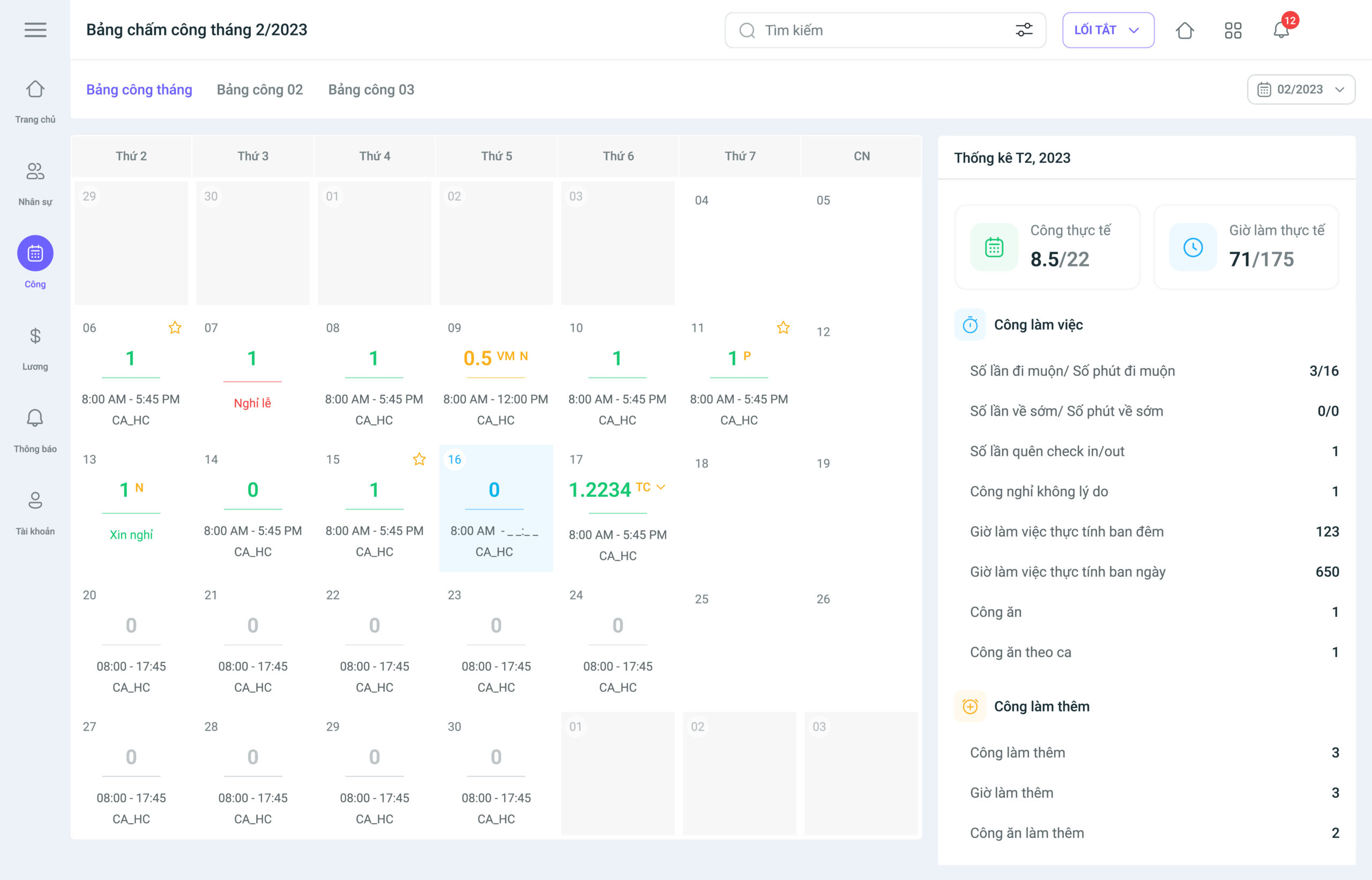
- 1Office supports integration with fingerprint, card, and facial recognition time clocks, with real-time data synchronization.
- It also supports online timekeeping via phone, GPS, Wi-Fi, and QR codes, helping to effectively manage remote and after-hours overtime.
- Automatically identifies shifts, overtime hours, and clearly distinguishes between regular hours, overtime, night shifts, and holidays for accurate overtime pay calculation.
6.3. Calculate overtime pay by shift and time frame – in compliance with legal regulations

- Set up flexible overtime pay formulas for each position, salary level, and overtime frame (weekdays, weekends, holidays, nights, etc.).
- Automatically calculates overtime pay in compliance with legal regulations, ensuring employee benefits are fully protected.
- Supports calculating pay by the hour, by shift, or by product, depending on the business model.
- Generates detailed payslips with itemized amounts, ensuring transparency for employees.
6.4. Comprehensive overtime reports – effective cost control
- The system supports reporting overtime hours by employee, department, and branch, helping businesses effectively control their payroll fund and overtime costs.
- Easily compare overtime costs by month and department to make informed decisions on personnel allocation.
Overtime is more than just paying a few extra dollars per hour. For CEOs and operations departments, it’s a management challenge involving performance, personnel costs, and internal transparency. But when timekeeping data is fragmented and overtime pay calculations are still done manually, the risk of errors and unfairness is inevitable. AI-powered platforms like 1Office are changing that: automatically collecting overtime data in real-time, accurately analyzing each overtime frame, coefficient, and employee – and alerting to any discrepancies. Everything becomes transparent, objective, and automated, just as a modern business should operate.
This is the spirit that 1Office brings to the biggest tech event of the year – 1Office Next | Lowcode Heart – AI Brain – Automation Goal. With the slogan “As you imagine”, the event marks a strategic transformation: from a simple management software to a platform where CEOs can shape how their business operates – more flexibly, more intelligently, and with automation down to the smallest processes like calculating overtime pay.
👉 Learn more about the 1Office Next event here

7. 5 Frequently Asked Questions about Overtime Pay (FAQ)
7.1. How many extra hours must be worked to qualify for overtime pay?
According to Article 97 of the 2019 Labor Code, employees who work beyond their normal working hours are considered to be working overtime and must be paid overtime wages. However, it is important to note:
- Overtime hours cannot exceed 50% of the regular working hours in a single day.
- The maximum is not to exceed 40 hours/month and 200–300 hours/year (depending on the industry).
If overtime is worked within these limits, the employee is entitled to be paid overtime wages as regulated.
8.2. Can an employee refuse to work overtime?
Yes. An employee has the right to refuse to work overtime if they do not agree with the employer’s request, except in emergency cases such as natural disasters, fires, or epidemics, as stipulated in Article 108 of the 2019 Labor Code.
Therefore, working overtime must be based on mutual agreement and is not mandatory.
8.3. What are the penalties if a company fails to pay overtime correctly?
If a business fails to pay overtime wages or pays an incorrect amount, it will be penalized according to Article 17 of Decree 12/2022/ND-CP:
- A fine ranging from 5 to 50 million VND, depending on the severity of the violation.
- Required to pay the full amount of overdue overtime wages to the employee.
Therefore, businesses must strictly adhere to overtime pay regulations to avoid legal risks.
No. Overtime pay is not considered income subject to compulsory social insurance contributions. According to Circular 06/2021/TT-BLDTBXH, only the salary specified in the labor contract is used to calculate social insurance contributions.
Therefore, employees receive their full overtime pay without deductions for social insurance, health insurance, or unemployment insurance.
8.5. Is it possible to agree on compensatory time off instead of receiving overtime pay?
Yes. According to Article 98 of the 2019 Labor Code, the business and the employee can agree on compensatory time off, with the amount of time off corresponding to the number of overtime hours worked, instead of receiving overtime pay.
However, this agreement must be clear and in writing or supported by evidence to avoid disputes.
















