11/05/2026
  729 views
A collaborator contract is one of the increasingly popular types of contracts today. This type of contract is suitable for those who want to work freely, with flexibility in time and location. So, what is a collaborator contract? How does it differ from an employment contract? Let’s find out with 1Office in this article.
Mục lục
- 1. What is a collaborator contract?
- 2. How many types of collaborator contracts are there?
- 3. Common collaborator contract templates today
- 4. Tips for drafting a concise, easy-to-understand, and legally compliant collaborator contract
- 5. Regulations on collaborator contracts that HR should know
- 6. Notes for HR when signing a collaborator contract
- 7. How to terminate a collaborator contract legally?
- 8. Frequently Asked Questions
1. What is a collaborator contract?
A collaborator contract is a type of service contract signed between the service provider, who is the collaborator, and the service user, which is the company. In this contract, the collaborator will perform the work as agreed upon and receive remuneration from the service user.

On the other hand, a contract with a collaborator is considered an employment contract when there is an agreement between the employee and the employer regarding paid work, salary, working conditions, and the rights and obligations of each party.
2. How many types of collaborator contracts are there?
Currently, there are 2 types of collaborator contracts on the market: the employment contract and the service contract. They are as follows:
- Service contract for collaborators
This is the most common type of contract between collaborators and companies. In a service contract, the collaborator performs work as requested by the company and receives payment as agreed. The collaborator is not under the management and supervision of the company and is not entitled to the same welfare benefits as official employees, such as social insurance, health insurance, unemployment insurance, etc.
- Employment contract for collaborators
In this contract, the collaborator is the employee, and the company is the employer. The collaborator will also perform work as requested by the company and receive payment as agreed. However, the collaborator is under the management and supervision of the company and is entitled to the same welfare benefits as official employees.
| >> Read more: How to Build a Potential Collaborator System for Your Business |
3. Common collaborator contract templates today
Businesses should base their choice of collaborator contract on the job description, collaborator benefits, collaborator costs, and the company’s needs to select the appropriate type, ensuring the rights and obligations of all parties.
3.1. Collaborator contract template as an employment contract
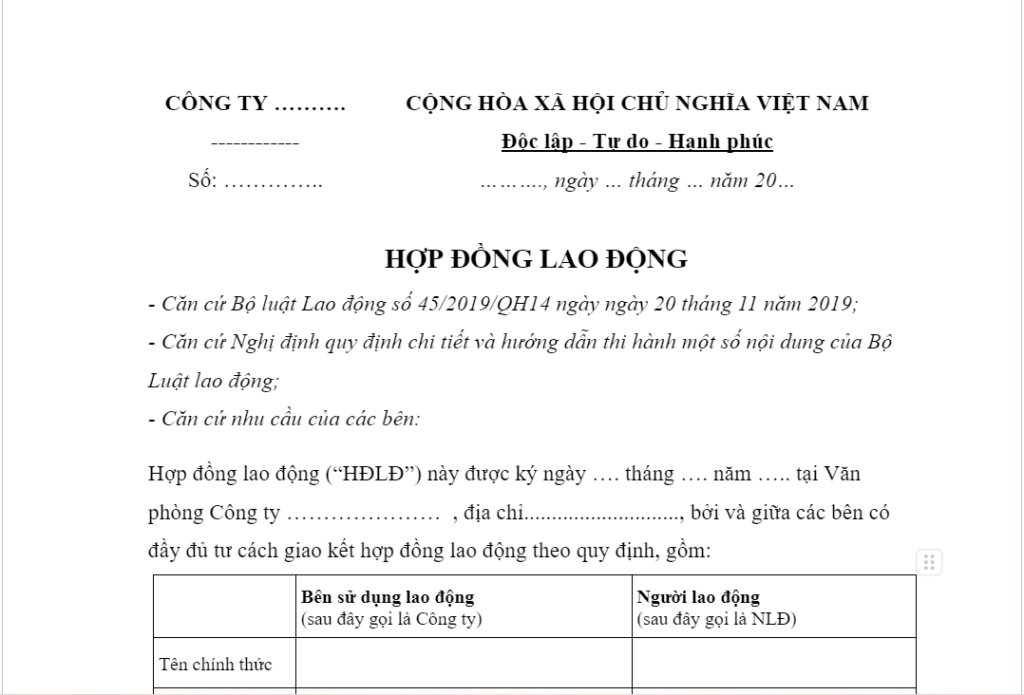
Below are the basic contents of a collaborator contract template as an employment contract:
- Names and addresses of the parties: This is basic information that must be clearly stated in the contract to identify the contracting parties.
- Job and working hours: This is the most important content of the employment contract, clearly defining the work the collaborator will perform and their working hours.
- Salary: The salary amount, payment method, and payment date are important details related to the collaborator’s benefits.
- Rights and obligations of the parties: The rights and obligations of the parties are stipulated in the Labor Code.
- Contract term: The term of the employment contract can be fixed-term or indefinite.
- Dispute resolution: In case of disputes arising during the contract’s execution, the parties will resolve them through mediation. If mediation fails, the dispute will be resolved according to legal regulations.
Download: [1OFFICE] Collaborator Contract Template (Employment Contract).docx
3.2. Collaborator contract template as a service contract
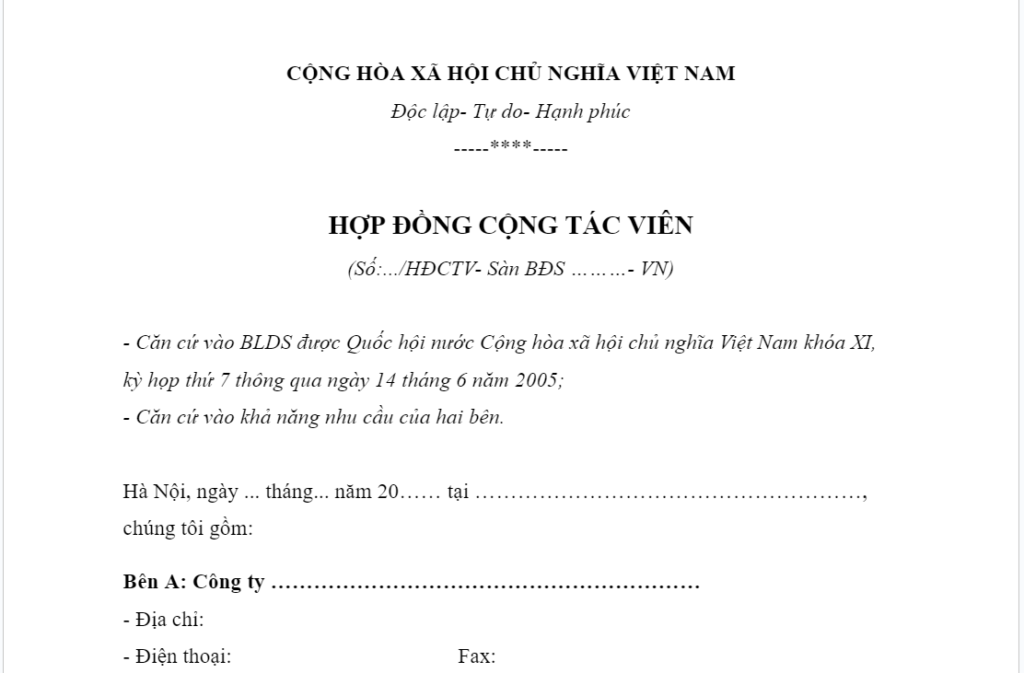
The collaborator contract template as a service contract includes the following basic contents:
- Name and address of the business and the collaborator.
- The work the collaborator will perform.
- The timeframe for the collaborator to complete the work.
- The value of the work the collaborator will perform.
- Payment method for the contract value.
- Rights and obligations of the business and the collaborator.
- Clause for resolving disputes arising during the contract’s execution.
Download: [1OFFICE] Collaborator Contract Template (Service Contract).docx
3.3. Real estate collaborator contract template
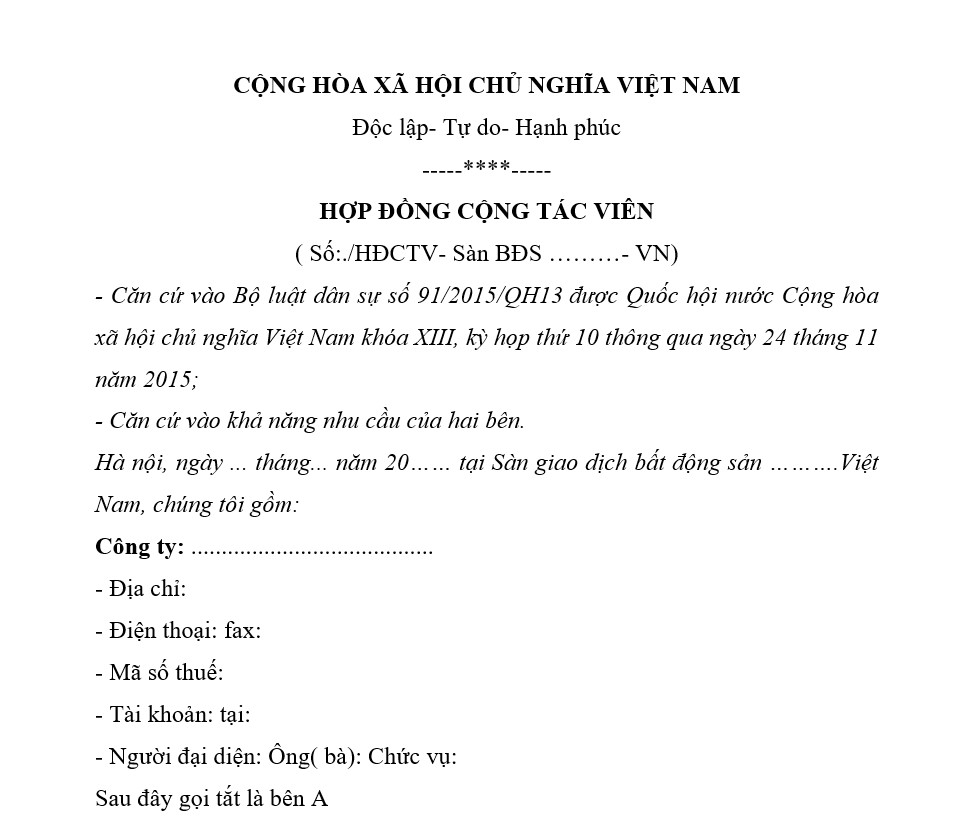
Download: [1OFFICE] Real Estate Collaborator Contract Template
4. Tips for drafting a concise, easy-to-understand, and legally compliant collaborator contract
A contract with a collaborator (CTV) is an important document that helps businesses and collaborators clearly agree on rights, obligations, and legal responsibilities. However, many businesses often make mistakes when drafting contracts: writing them too long, making them difficult to understand, or omitting basic clauses. To avoid this, you can
For the business: the right to require the collaborator to adhere to the schedule, quality standards, information security, and work procedures.
Clearly specify the payment method (cash/bank transfer) and payment schedule (weekly, monthly, or upon completion of work).
4.4 Add clauses on confidentiality & intellectual property
-
In fields like marketing, software, design, content, etc., it’s necessary to clearly state that all data, documents, and products created by the collaborator are the property of the business.
-
A confidentiality clause helps prevent collaborators from disclosing customer information, business strategies, or internal documents.
4.5 Clearly define the contract term and termination
-
Specify the contract’s effective period (by month, project, or task).
-
Define termination cases: expiration, mutual agreement, breach of commitment by one party, or unilateral decision (with a specified number of days’ notice).
-
Add a dispute resolution clause (through negotiation, mediation, or court under Vietnamese law).
4.6 Ensure basic legal elements
A legal contract must include:
-
Full personal or legal entity information (full name, address, ID/Citizen ID number, or Tax ID).
-
Signatures and full names of both parties (and a company seal if it’s a business).
-
Date and place of signing the contract.
5. Regulations on collaborator contracts that HR should know
A collaborator contract is a flexible form of cooperation chosen by many businesses to supplement their workforce for short-term or project-based needs. However, to avoid legal risks and ensure the rights of both the business and the collaborator, HR needs to clearly understand the regulations regarding rights and obligations, insurance policies, and personal income tax.
5.1. Rights and obligations of collaborators towards the business
The rights and obligations of collaborators towards the business are regulations recognized by law to ensure the interests of both signing parties. Specifically:
Collaborators have the following rights:
- To receive remuneration as agreed: The collaborator’s salary is determined based on the agreement between the collaborator and the business. Remuneration can be paid based on time, workload, or work results.
- To be ensured occupational safety and health: Collaborators are entitled to benefits regarding occupational safety and health like employees, as stipulated by law.
- To have rest periods as stipulated by law: Collaborators are entitled to rest periods as stipulated by law, similar to employees, including weekly days off, public holidays, and annual leave.
- To participate in cultural, sports, and entertainment activities organized by the business: Collaborators may participate in cultural, sports, and entertainment activities organized by the business if they wish.
Collaborators have the following obligations:
- To perform work as required by the business: Collaborators are obligated to perform work according to the agreement with the business, including details about the job, time, location, etc.
- To protect the business’s assets: Collaborators are obligated to protect the business’s assets while performing their work.
- To comply with the business’s rules and regulations: Collaborators are obligated to comply with the business’s internal rules and regulations while performing their work.

Collaborators are not subject to compulsory social insurance. They will not have to contribute to social insurance if they only sign a service contract and do not work under a labor contract.
Additionally, if a collaborator signs a labor contract but falls under one of the following conditions, they do not need to contribute to social insurance:
- Average working time is 14 days/month or less
- The monthly salary is below the regional minimum wage
- The labor contract term is less than 1 month.
Therefore, if the worker does not wish to contribute to social insurance, they should opt for a service contract. However, collaborators can also participate in voluntary social insurance if they wish. This is a type of social insurance that individuals join on a voluntary basis to receive social insurance benefits when they meet the conditions.
5.3. Do collaborators have to pay personal income tax?
Pursuant to Point i, Clause 1, Article 25 of Circular 111/2013/TT-BTC, which regulates Tax Deduction and Tax Deduction Vouchers, as follows:
Organizations and individuals paying wages, remuneration, or other payments to resident individuals who do not sign a labor contract or who sign a labor contract of less than three (03) months, with a total income payment of two million (2,000,000) VND or more per payment, must deduct tax at a rate of 10% of the income before paying the individual.
Thus, if a collaborator’s income from remuneration and wages is 2,000,000 VND or more, the business is responsible for deducting personal income tax at a rate of 10% of the income before paying the collaborator. If the collaborator’s income from remuneration and wages is less than 2,000,000 VND, personal income tax does not need to be deducted.
6. Notes for HR when signing a collaborator contract
A collaborator contract is a type of civil contract signed between a business and a collaborator to define the rights and obligations of each party during the work process. HR needs to note the following issues when signing with a collaborator:
- Clearly define the type of contract the business wants to sign, whether it is a labor contract or a service contract.
- Clearly define the work and the time of performance that the collaborator will undertake.
- Clearly define the remuneration the collaborator will receive and the payment method.
- Clearly define the rights and obligations of each party, including the rights and obligations of the business and the rights and obligations of the collaborator.
- Clearly define the dispute resolution clause for any disputes arising during the contract implementation.
7. How to terminate a collaborator contract legally?
Terminating a contract with a collaborator (CTV) is a common situation in the cooperation process between businesses and individuals. If not clearly stipulated from the beginning, both parties can easily encounter conflicts and disputes over rights and obligations. To ensure a legal, transparent, and risk-averse contract termination, you need to note the following points:
7.1 Check the termination clause in the contract
-
Typically, a collaborator contract will have a section specifying the term and conditions for termination.
-
The business and the collaborator should proceed based on these terms: contract expiration, a breach of commitment by one party, or mutual agreement to terminate early.
-
If the contract does not yet have a specific clause, it should be added from the beginning to avoid future disputes.
7.2 Adhere to the principle of prior notice
-
To ensure professionalism, both parties should provide prior notice in writing (email, official letter, or a direct agreement with a confirmation signature).
-
The notice period can be flexible (7 days, 15 days, or 30 days), depending on the nature of the work and the initial agreement.
7.3 Settle all outstanding benefits
-
The business is responsible for paying any remuneration, commissions, or expenses incurred for work completed by the collaborator before the termination date.
-
At the same time, the collaborator must hand over any documents, data, assets, or unfinished work to the business.
7.4 Ensure post-termination confidentiality obligations
-
The confidentiality clause (if any) must still be maintained even after the contract has been terminated.
-
This is especially important in industries such as technology, marketing, finance, design, etc., to avoid the risk of leaking internal information.
7.5 Formalize the contract termination in writing
-
Always create a contract liquidation record to confirm that both parties have fulfilled their obligations.
-
The record should clearly state: the reason for termination, the effective date, remaining benefits that have been paid, and handover responsibilities.
-
This serves as an important legal basis in case of future disputes.
7.6 Dispute resolution (if any)
-
If the two parties cannot negotiate on their own, they can ask a third party (a commercial arbitrator or a lawyer) to mediate.
-
In serious cases, the dispute will be brought to a competent court in Vietnam in accordance with the law.
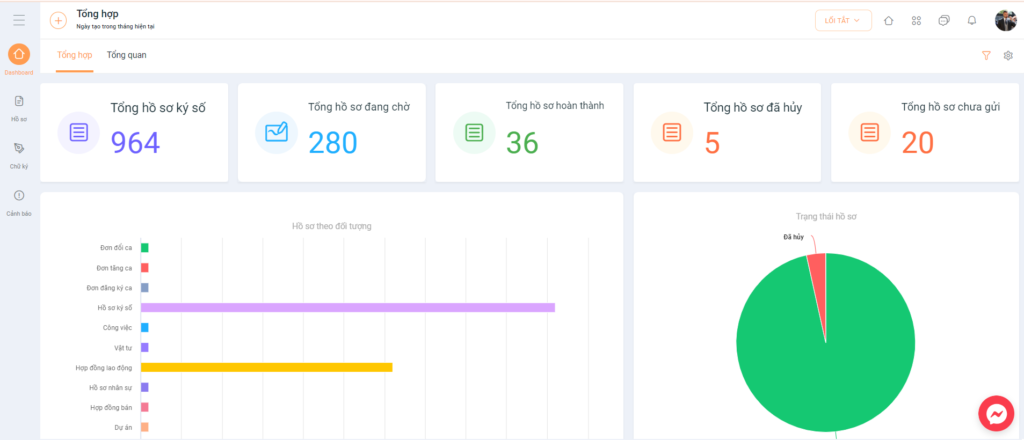
All these notes are to ensure that both parties clearly understand and agree to the terms and conditions of the collaborator contract. Additionally, for businesses with a large number of collaborators and a need to manage various types of contracts, using electronic contract management software is absolutely essential.
Instead of storing and signing paper contracts in the traditional way, 1Office electronic contract management software is a comprehensive solution that helps the HR department digitize and manage all collaborator contracts quickly and accurately right on the system.
8. Frequently Asked Questions
How is a collaborator contract different from an employment contract?
A collaborator contract is usually project-based, focusing on collaboration per task or result, while an employment contract is tied to a relationship of management, operation, salary payment, and supervision by the company.
Does a collaborator contract need a company seal?
It is not mandatory. The legal validity of the contract primarily depends on the signing authority and the valid agreement of the parties; the seal is only used when the company has internal regulations or wants to enhance the formality of the records. However, many businesses still use a seal for easier storage and future reference.
Do collaborators have to contribute to social insurance?
Not always. If a collaborator works under a service/project-based contract, they are usually not subject to mandatory social insurance contributions; however, if the agreement is essentially an employment contract as defined by law, they must participate in social insurance.
Do collaborators have to pay personal income tax?
Possibly. For individuals without an employment contract or with a contract of less than 3 months, if the payment is 2 million VND or more per instance, the paying party must usually withhold 10% before payment, unless the individual is eligible to make a commitment as per regulations.
Do collaborators need to give advance notice before quitting?
This depends on the terms signed in the contract. For a service/project-based collaborator contract, both parties usually follow the agreement on duration, termination, and advance notice; however, if it is essentially an employment contract, the obligation to give advance notice will follow labor law regulations.
If your business has any further questions or needs consultation on the 1Office electronic contract management software, please contact us via our Hotline at 083 483 8888 for the fastest support.