


 12/05/2026
  299 views
How to effectively manage employee performance? This is a question that every manager is concerned about. Because performance management is a crucial process that helps businesses increase labor productivity, achieve goals, and develop sustainably in the 4.0 era. In this article, let’s explore with 1Office what performance management is, its importance, and the steps for an effective implementation process.
Mục lục
- 1. What is Performance Management?
- 2. The Importance of Performance Management in Business
- 3. The Standard 5-Step Performance Management Process
- 4. Some successful performance management methods
- 5. Examples of performance management in Vietnamese corporations
- 6. The Leading Performance Management Solution for Businesses
1. What is Performance Management?
Performance Management is the continuous process of monitoring, evaluating, and improving employee work performance based on set goals. This is a crucial process that helps businesses maximize the potential of their human resources while promoting the sustainable development of the organization.

To manage employee work performance effectively, businesses need to build a management process that aligns with the organization’s culture and goals. This process needs to be continuous, implemented consistently, and involve the participation of all employees.
2. The Importance of Performance Management in Business
In an increasingly competitive landscape, businesses must optimize all their resources to achieve goals and maintain a competitive edge. Among these, human resources are the most important. Below are the benefits of performance management:
For businesses, performance management brings the following benefits:
- Effective resource optimization: When businesses know the performance of each employee, they can identify high-performing employees and those who need support. From there, businesses can make appropriate resource allocation decisions such as job assignments, training, promotions, etc.
- Easier to achieve business goals: Performance management helps businesses identify areas for improvement to achieve business goals. This allows them to create suitable plans and actions to improve employee work performance.
- Increased labor productivity: Good performance management ensures that employees are working effectively and achieving organizational goals, thereby increasing labor productivity and reducing operational costs.
- Promotes employee development: When employees can identify their strengths, weaknesses, and development opportunities within the company, they will be more inclined to cultivate and enhance their professional skills and knowledge to meet job requirements.
- Improves corporate culture: Performance management helps managers build a corporate culture based on transparency, fairness, and accountability. This creates a positive and effective work environment where all employees are aligned towards a common goal.

For employees, performance management offers the following benefits:
- Receive regular and timely feedback: Feedback from managers helps employees clearly understand what is expected of them and identify areas for improvement.
- Clear opportunities for development and advancement: Performance management helps businesses identify employees with potential and create opportunities for them to develop and advance.
- Increased job engagement: When employees feel they are evaluated fairly and have opportunities for development, they tend to be more engaged with their work.
Thus, performance management is a crucial process that brings many benefits to both the business and its employees. To implement performance management effectively, businesses need to build a performance management process that aligns with their culture and goals.
3. The Standard 5-Step Performance Management Process
Depending on the specific business, leaders will apply different performance management processes. Below are 5 performance management steps that managers can refer to:
Step 1: Plan for Performance Management
Building a plan is the first step in the performance management process. The performance management plan needs to be carefully and meticulously established for each step, from data collection to ensuring the participation and contribution of all employees. An effective management plan needs to clearly define goals, content, and implementation steps.
Some notes for businesses when creating a performance management plan:
- Close collaboration between managers and employees: Managers need to regularly communicate and discuss with employees about the goals, content, and implementation steps of the performance management process. This will help ensure that the plan is developed in line with the needs and desires of both parties.
- Flexibility: The performance management plan needs to be flexible so it can be adjusted to suit the actual situation.
Step 2: Set goals for the performance management process
Setting clear, measurable goals that reflect the organization’s strategy is crucial. Goals should be established with relevant stakeholders to ensure understanding and commitment. Goals for the performance management process can relate to work productivity, job quality, individual contributions, and personal development objectives.
Here are some notes when setting performance management goals:
- Proactiveness: Managers and employees need to proactively set goals and participate in discussions to align on them.
- Discipline: Goal setting should be based on clear standards and rules to motivate employees to develop and improve performance.
- Focus on results: Goals should focus on work outcomes, not just on activities.
Step 3: Build a performance evaluation system
In this step, the business needs to build a rigorous and fair evaluation system, including defining key performance indicators and evaluation criteria agreed upon by the organization. This system should be based on consensus from both managers and employees and should be closely linked to organizational goals and strategies.

Criteria needed in a performance evaluation system:
- Evaluation criteria should be related to the goals of the performance management process to ensure that employees are working in the right direction.
- Evaluation criteria must be developed objectively and fairly to ensure that employees are assessed accurately.
- Evaluation criteria should be presented clearly and understandably so that employees can comprehend and apply them in practice.
Step 4: Track progress, manage performance continuously
Performance management is a continuous process that requires close monitoring and regular feedback. Businesses should establish mechanisms to track progress against goals and evaluate performance. Dialogues between managers and employees can be held to discuss progress and address any issues that arise.
- Ensure regularity: Managers need to monitor employee progress and performance regularly to detect problems early and provide timely support.
- Build trust: The business should build trust with employees so they feel comfortable discussing their work progress and performance.
- Encourage employee participation: Involve employees in the process of monitoring and evaluating their performance, helping them better understand their performance and make appropriate adjustments.
Step 5: Evaluate and recognize results
Finally, after each performance management period, the business needs to conduct periodic reviews. The evaluation of the performance management process should not only focus on the final results but also on the work process itself. Additionally, managers should organize sessions to recognize the efforts and positive contributions of each individual, while encouraging contributions and feedback to support employees in achieving maximum performance.
4. Some successful performance management methods
4.1. Don’t rely solely on periodic reviews
Periodic performance reviews are an important task, but they are not the only method for managing employee work performance. Businesses need to build a comprehensive performance management system that includes tools such as: work progress tracking, regular feedback, employee training and development, etc.
4.2. Pair goals with a performance management plan
Goals are the foundation of performance management. Businesses need to clearly define their goals and then pair them with established performance management plans. This helps employees understand what they need to do to achieve success.
4.3. Monitor work progress closely and clearly
Businesses need to regularly monitor employee work progress to detect problems early and provide timely support. This monitoring should be done closely and clearly so that employees understand what is expected of them.
4.4. Regularly train and evaluate personnel performance
Businesses need to regularly train and evaluate personnel performance to ensure they have the necessary skills and knowledge to achieve their goals. Training and evaluation should be conducted regularly and continuously so that employees can develop and improve their performance.
4.5. Build a culture that values work performance
Corporate culture has a significant impact on employee work performance. Businesses need to build a culture that values work performance, where employees are encouraged to reach their full potential.

4.6. It’s not just new employees who need training
Training is not just for new employees, but for all employees, including experienced ones. Businesses need to build a comprehensive training program that meets the needs of all employees.
4.7. Be open and transparent in communication
Communication is a key factor in performance management. Businesses need to communicate openly and transparently with employees about goals, standards, and performance evaluation results. This will help employees clearly understand what is expected of them and make appropriate adjustments.
4.8. Actively cultivate skills for employees
Work skills are a crucial factor determining employee performance. Managers need to have solutions to cultivate skills for employees, such as through training and development programs.
4.9. Evaluate objectively and transparently
The process of evaluating employee work performance needs to be conducted objectively, fairly, and professionally. Businesses should build a performance evaluation system based on clear and transparent criteria.
4.10. Acknowledge results and employee feedback
Acknowledging results and employee feedback is a way to encourage them to continue developing and contributing to the business. Businesses need to regularly recognize employee achievements and listen to their feedback to improve the performance management system.
5. Examples of performance management in Vietnamese corporations
5.1. Vinamilk’s Performance Management Method
Vinamilk is a leading dairy corporation in Vietnam. The brand has built an effective employee performance management system, helping the business achieve its goals. Specifically, Vinamilk builds its performance management system based on the following principles:
- Evaluate employee performance based on work results, thereby ensuring that employees are focusing on important and measurable tasks.
- Build a transparent performance evaluation system so that employees can clearly understand what is expected of them.
- Evaluate employee performance fairly and transparently. The evaluation results are used to make decisions related to salary, bonuses, promotions, training, etc.
5.2. Vingroup’s Performance Management Method
Vingroup is a leading multi-industry corporation in Vietnam. To build an effective performance management system that helps the business achieve its goals while also helping employees develop and reach their full potential, Vingroup has implemented policies such as:
- Regularly train and develop employees to ensure they have the necessary skills and knowledge to achieve their goals.
- Provide regular feedback to employees on their performance. This helps employees clearly understand their performance and make appropriate adjustments.
- Recognize employee achievements to encourage them to continue developing and contributing to the business.
6. The Leading Performance Management Solution for Businesses
In recent years, KPI and OKR management software has become a leading performance management solution for businesses, offering many outstanding benefits compared to traditional performance management methods.
1Office – Proud to be one of the most effective KPI performance management and OKR software solutions. The software helps managers evaluate employee work performance accurately, fairly, and transparently. Through manually entered or automatically aggregated data from the system in real-time, it contributes to improving operational efficiency and human resource development.
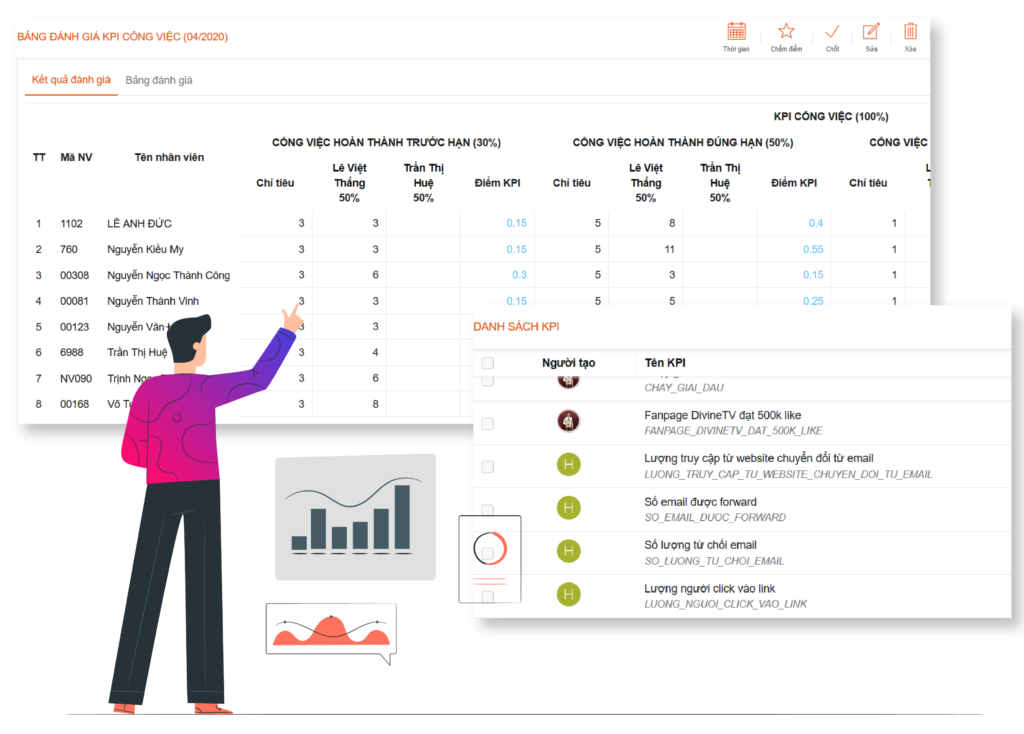
Some outstanding features of the KPI evaluation management software and OKR management include:
- Build, measure, and evaluate KPIs for each position and department in the business
- Automatically aggregate KPI evaluation results and link them to the Payroll Module
- Set up and manage goals using the modern OKR method on a monthly, quarterly, or yearly basis suitable for the business
- Define the key results needed to achieve objectives, including calculation methods, reporting frequency, weight, and KR type
- A clear and transparent reporting system helps managers monitor work performance anytime, anywhere, while also providing data to help leaders make decisions easily
Experience the performance management features of 1Office software today
to receive a free Demo!
If your business needs further consultation on 1Office’s KPI and OKR management software, please contact us via:
- Hotline: 083 483 8888
- Facebook: https://www.facebook.com/1officevn/
- Youtube: https://www.youtube.com/@1office-chuyendoisodn
















