


 10/05/2026
  13185 views
Employee training cost is one of the important factors for the training activities of businesses. To ensure the employer’s responsibility towards the employee, businesses need to clearly understand the regulations related to taxes, cases requiring compensation, and the reimbursement level for this training cost. In addition, developing an employee training plan and budgeting are also essential factors to optimize costs for the business. Let’s explore each issue in detail with 1Office in the article below.
Mục lục
- 1. What is employee training cost?
- 2. Regulations on employee training costs in businesses
- 3. When must employees reimburse training costs?
- 4. Planning Employee Training: How to Determine and Estimate Costs
- 5. Long-term benefits when businesses invest in employee training costs
- 6. Optimize employee training costs for businesses with 1Office
- 7. Frequently Asked Questions about employee training costs
- 8. Conclusion
1. What is employee training cost?
Employee training cost is the total expenditure that a business spends to train and enhance the skills and knowledge of its employees, including tuition fees, materials, instructors, and other related expenses.
According to the provisions in Clause 3, Article 62 of the 2021 Labor Code, the training contract between the employer, the employee, and the vocational training costs is stipulated as follows:
“The two parties must sign a vocational training contract in case the employee is trained to improve their qualifications, vocational skills, or retrained domestically or abroad at the employer’s expense, including funds sponsored by a partner for the employer.
[…]
Training costs include expenditures with valid proof for payments to instructors, learning materials, schools, classes, machinery, equipment, practical materials, other expenses supporting the learner, and the salary, social insurance, health insurance, and unemployment insurance contributions for the learner during the training period. In cases where the employee is sent for training abroad, the training costs also include travel and living expenses during the training period.”
| >> Read more: Employee Training Policy Template for Businesses |
2. Regulations on employee training costs in businesses
To optimize employee training costs and avoid violating tax regulations, businesses need to clearly understand the legal provisions and fully implement all procedures related to employee training.

2.1 Are training costs deductible when calculating Corporate Income Tax (CIT)?
According to the provisions in Circular 96/2015/TT-BTC guiding Corporate Income Tax under Decree No. 12/2015/ND-CP, vocational training costs are included in production and business expenses and are DEDUCTIBLE for calculating corporate income tax. However, to be deductible for CIT, employee training costs must meet the following conditions:
- There must be a contract or other legally valid proof of payment for the training costs of the employee.
- Training costs must be recorded fully, accurately, at the correct time, of the correct type, in the correct quantity, and at the correct value.
- Training costs must comply with legal regulations on vocational training, state management guidelines on vocational training, labor regulations, environmental protection, and other legal provisions.
- Training costs must not be recorded twice in accounting.
- Training costs must be paid to units authorized for vocational training, or to organizations and individuals registered for vocational training business in accordance with the law.
2.2 Are training costs eligible for VAT deduction?
According to the provisions in Clause 2, Article 2 of Circular 111/2013/TT-BTC, to be ELIGIBLE FOR DEDUCTION of input VAT, employee training costs must meet the conditions specified in the Law on VAT:
- There must be a legal value-added tax invoice, a document for payment of import value-added tax, or a document for payment of value-added tax on behalf of a foreign party.
- Purchased goods and services valued at 20 million VND or more must have non-cash payment documents, except for cases where the value of imported goods and services per transaction is less than 20 million VND, and goods and services are purchased per invoice for less than 20 million VND at a price inclusive of VAT.
- In cases of multiple purchases on the same day with a total value of 20 million VND or more, tax deduction is only allowed if there are bank payment documents.
2.3 Are training costs subject to Personal Income Tax (PIT)?
According to the provisions in Point dd, Clause 2, Article 2 of Circular 111/2013/TT-BTC, the cost of implementing an employee training process is NOT INCLUDED in the employee’s personal income for tax purposes.
“Monetary or non-monetary benefits other than salaries and wages paid by the employer that the taxpayer receives in any form
[…]
For payments made on behalf of employees for training to improve their qualifications and skills that are relevant to their professional work or in accordance with the employer’s plan, these amounts are not included in the employee’s income.”
However, these costs may be deductible for CIT or VAT depending on the conditions specified in the relevant tax guidance documents.
>> See more: Detailed Review of the TOP 10 Most Effective Employee Training Management Software
3. When must employees reimburse training costs?
Employees must reimburse training costs when they breach their commitment to the post-training work period or unilaterally terminate the labor contract unlawfully, except in cases of force majeure or faults on the part of the employer.
Below are the detailed regulations regarding the reimbursement of training costs:

3.1 Cases where employees do not have to reimburse employee training costs
According to Article 62 of the 2019 Labor Code, employees are not required to reimburse training costs in the following cases:
- The training is for the employee’s personal purposes, with their consent.
- Due to a change in job position or a job transfer within the same employer, which the employee does not agree to for health reasons or personal preferences.
- Due to the division, merger, consolidation, dissolution, or transfer of ownership of the employer, or the restructuring or change in ownership status of the employing organization or individual.
- The training is provided to ensure safety, fire prevention, environmental protection, and health protection for employees during their work.
- The employee is trained according to the employer’s training program or plan but cannot continue or transfer to the job position at the company due to health reasons or personal preferences.
3.2 Cases where employees must reimburse training costs
According to Article 36 of the 2019 Vietnam Labor Code, an employee must reimburse training costs if one of the following cases occurs:
- The employee resigns or terminates the labor contract before the agreed-upon training period is completed.
- The employee resigns or terminates the labor contract after completing the training but before fulfilling the required commitment period with the employer.
- The employee goes to work for another company immediately after completing the training.
- The employee is dismissed by the employer for violating internal labor regulations or labor laws during the training period.
Specifically, when employees must reimburse training costs, they must repay part or all of the training expenses paid by the employer. However, this reimbursement amount cannot exceed the total wages paid to the employee during their employment with the company.
3.3 How to calculate the training cost reimbursement amount
The reimbursement amount for personnel training costs is determined by the following formula:
| S = F/T1 x (T1 – T2) |
Where:
- S: compensation cost
- F: total actual cost paid by the organization for one employee to attend the training courses
- T1: The required time to work at the enterprise or organization after completing the courses, calculated in rounded months
- T2: the time served after training, calculated in rounded months.
4. Planning Employee Training: How to Determine and Estimate Costs
Employee training is one of the most effective ways to improve productivity and enhance employee skills within a business. However, to carry out this training process, management needs a comprehensive cost plan to ensure the budget is used reasonably and delivers the highest efficiency.

Step 1. Define training objectives: enhance professional skills, practice soft skills, or improve employee work performance.
Step 2. Determine the number of employees to be trained: based on the defined training objectives, management needs to decide on the number of employees to be trained to achieve the set goals.
Step 3. Choose the training method: depending on the objectives and financial capacity of the business, management can choose methods such as internal training, outsourcing training, or online training.
Step 4: Find instructors and training providers: depending on the training method chosen above, the manager will select internal instructors from the company or training service providers.
Step 5. Determine other associated costs: equipment, software, transportation fees, meal costs, and accommodation costs (if necessary). Calculating these costs will help you estimate the training budget more accurately.
Step 6. Create a budget plan: based on the information gathered from the steps above, you can create a budget plan for the training process. You should calculate the total necessary costs and compare them with the available budget to make an appropriate decision.
| >> Read more: 7 Effective and Easy-to-Implement Employee Evaluation Methods |
5. Long-term benefits when businesses invest in employee training costs
Many businesses still view training costs as a “mandatory expense” rather than a strategic investment. However, reality shows that businesses that focus on investing methodically in training activities often have more sustainable competitive advantages, more engaged staff, and more stable business performance.
Here are three outstanding long-term benefits when businesses proactively invest in employee training:
5.1. Increase labor productivity, reduce errors in work
When properly trained, employees clearly understand the processes, standards, and necessary skills to complete their work more effectively.
-
Training helps them update their knowledge and shorten the trial-and-error period.
-
Minimize risks and errors during operations or customer service.
-
As a result, labor productivity increases significantly, contributing to improved business production efficiency.
5.2. Retain talent, reduce new recruitment costs
Well-trained employees often feel valued and see long-term development opportunities. This helps the business:
-
Increase employee engagement and loyalty.
-
Reduce turnover rates, thereby saving significant costs on recruitment, retraining, and adaptation time.
-
Develop a competent succession team ready to take on higher positions.
5.3. Enhance the professional image of the business, foster a learning culture
A business that invests in employee training is not only highly regarded by its employees but also makes a good impression on partners and customers.
-
The business demonstrates a commitment to human development and aims for sustainability.
-
Build an image of an organization with a learning culture – always innovating and creating.
-
Create an advantage in attracting talent and maintaining a reputation in the labor market.

6. Optimize employee training costs for businesses with 1Office
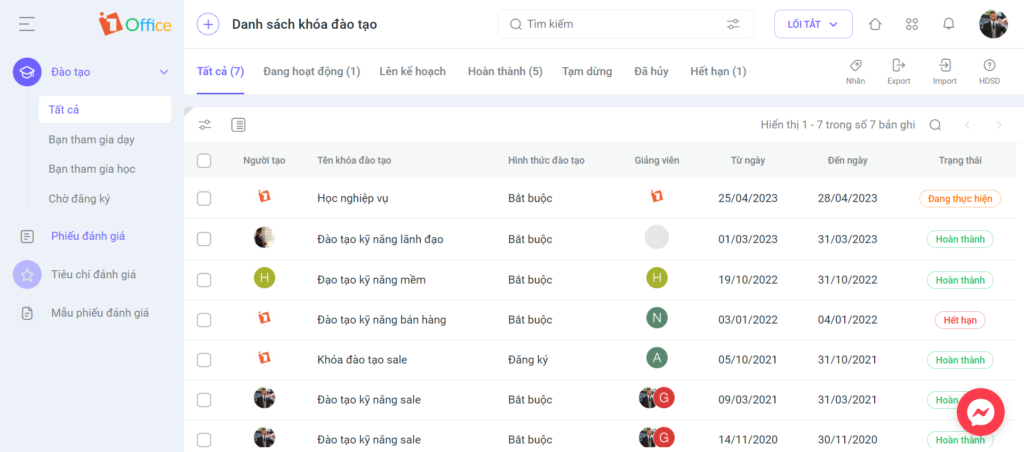
The 1Office training management software provides an internal training feature for businesses to enhance employee capabilities. This feature allows businesses to create online courses to teach employees the necessary skills and knowledge for their jobs. Here are the main features of the 1Office software’s internal training function:
- Create and manage courses: 1Office allows businesses to create online courses with flexible and diverse content. Managers can add chapters, lessons, and tests for each course. Additionally, they can track the learning progress of each employee and update course content according to the changing needs of the business.
- Assessment testing: The 1Office software provides assessment tools to ensure that employees have understood and completed the course. Tests can be set up to be automatically graded and provide results immediately after an employee finishes.
- Interaction and sharing: The internal training feature of the 1Office software provides interaction functionality between instructors and trainees. Employees can ask questions and receive feedback from teachers or colleagues. They can also share experiences and knowledge with each other through the social network features within the software.
- Integration with other tools: The 1Office software integrates with other business tools such as email, work calendars, and documents to help employees learn and work more effectively.
7. Frequently Asked Questions about employee training costs
Are training costs considered an employee benefit?
No. This is considered a business production cost aimed at improving professional competence, so it is not included in personal taxable income and is deductible when calculating corporate income tax.
Can a business charge training fees before an employee starts working?
No. According to regulations, employers are not allowed to collect money from employees for training and coaching activities to perform the job for the recruited position.
Is it mandatory to sign a separate training contract from the employment contract?
Yes. The two parties must sign a separate vocational training contract when using the company’s funds for advanced training or retraining.
How to optimize the training budget for a small business?
Use internal training (skilled staff training new staff) or apply technology platforms like 1Office HR management to digitize lectures, helping to reduce the costs of hiring experts and renting venues.
Does the training cost reimbursement include salary during the study period?
Yes. Training costs include salary, social insurance and health insurance contributions, and other allowances that the company paid while the employee was studying.
8. Conclusion
Training and developing employee capabilities are always activities that go hand in hand with the company’s development process. The information above is about personnel training costs. We hope this information will help you plan costs more effectively when implementing human resource training strategies for your business.
- Hotline: 083 483 8888
- Fanpage: https://www.facebook.com/1officevn/
- Youtube: https://www.youtube.com/channel/UCeTIRNqxaTw6SxmA
















