


 12/05/2026
  99 views
Today, with the remarkable development of technology and the context of the digital economy, a customer relationship management system has become a powerful assistant helping businesses conquer the market and achieve breakthrough growth. However, not all businesses fully understand the system’s structure or can choose the right customer management software to apply to their operational processes, leading to underutilized features, which wastes budget and resources. To address this issue, 1Office will share insights on the structure of a CRMS (Customer Relationship Management System) in the following article.
Mục lục
- 1. The Structure of an Effective Customer Relationship Management System
- 2. Types of CRMS (Customer Relationship Management Systems)
- 4. Experience in choosing a customer relationship management system (CRMS)
- 5. 1Office – A professional CRM solution to optimize customer relationship management efficiency
1. The Structure of an Effective Customer Relationship Management System
A CRMS (Customer Relationship Management System) – or CRM system (Customer Relationship Management) is a tool that helps businesses manage all customer-centric operations by analyzing and understanding consumer needs, wants, and behaviors. This allows them to build appropriate outreach and care strategies to foster long-term, positive customer relationships.
Basically, the structure of a complete CRMS consists of the following 3 main components:
Sales
A customer relationship management system allows businesses to manage sales activities professionally and systematically by:
- Managing Sales Opportunities: Based on the customer data management stored on the platform, the sales team gets a comprehensive view and overall assessment of customer needs and behaviors. They can then classify customers into different status groups such as: Has Need, Potential, Researching, etc. This helps in developing suitable sales strategies to accelerate the closing process.
- Managing Orders, Invoices & Contracts: Storing and controlling documents is a critical task in a business’s sales process because errors can lead to data discrepancies and loss of customer information. The system’s role is to digitize and centrally store customer-related paperwork and documents, making them easy to manage, search, and retrieve when needed.
- Tracking Sales Performance: The customer relationship management system allows managers to monitor the sales team’s performance and track business results in detail, visually, and in real-time. This helps identify which departments are performing effectively and which need support, enabling timely solutions.
Marketing
Building a customer management system helps businesses nurture customer relationships by closely following the customer journey at every touchpoint, expanding the customer funnel, and optimizing conversion rates. Specifically:
- Managing Marketing Campaigns: The customer management system provides a superior toolset that allows businesses to build, implement, and evaluate marketing campaigns comprehensively, from data analysis and planning to collecting multi-channel response rates to determine campaign effectiveness.
- Personalizing Marketing: The CRMS database provides all the necessary information on needs, wants, behaviors, and demographics, helping businesses easily build customer personas. This enables the development of personalized marketing content for each target group, hitting the right customer insights and thereby increasing customer engagement.
Service
A CRM system helps businesses improve service quality by optimizing the customer experience at every stage: before, during, and after the sale.
- Managing Contacts & Customer Profiles: The customer management system provides a massive database that helps businesses build and store detailed customer contact profiles. This allows the sales team to grasp all customer-related information thoroughly, understand user needs to provide suitable advice and care, thereby increasing satisfaction rates and improving customer retention.
- Managing Customer Service: Build automated, multi-channel care scripts for different customer groups to meet all customer needs promptly, effectively retaining customers. It also includes tools for assigning tasks and sending reminders to customer service staff, ensuring the sales team remembers appointments and takes appropriate care actions.
See more: Review of the 10 Best Customer Care Management Software Today
2. Types of CRMS (Customer Relationship Management Systems)
2.1 Operational CRM
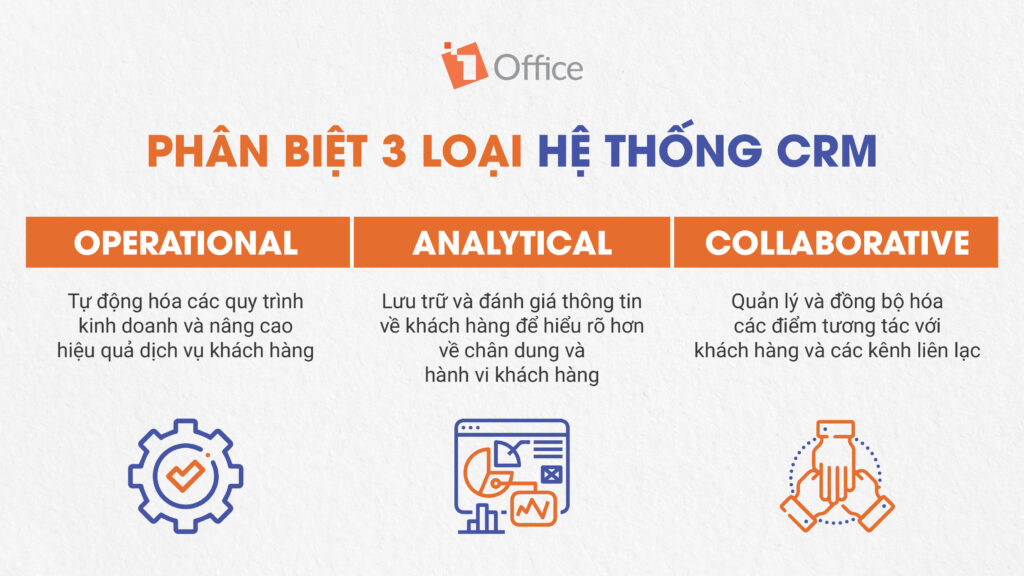
Operational CRM is the most common type and includes the broadest range of functions. It combines all business processes, including customer service, marketing, and sales, on a single, tightly integrated platform.
Objective
The main objective of an operational customer management system is to automate key components of a company’s business process, including sales, marketing, and customer service, thereby improving work efficiency, increasing customer touchpoints, and helping to maintain and drive sales growth.
Components
- Marketing Automation: The marketing automation feature helps businesses find the best way to offer products and reach potential customers using campaign management modules. Automation also helps businesses identify the most effective marketing channels that attract the most potential customers – email, hotline, Facebook, or Google Ads.
- Sales Automation: Sales automation organizes information to help businesses respond quickly and promptly to customer needs and drive revenue growth. This feature includes modules that support sales tasks such as lead management, contact management, and sales forecasting.
- Customer Service Automation: This feature acts as a direct bridge between the business and its target customers. Customer service automation functions include managing incoming customer emails, coordinating live chats, and setting up chatbots.
Advantages and Disadvantages
| Advantages | Disadvantages |
|
|
The operational customer management system model suitable for businesses:
An operational CRM system is the ideal choice for businesses that want to automate their sales force, minimize manual processes to focus resources on improving service quality, and effectively nurture customer relationships.
2.2 Analytical CRM
Objective
The main objective of an analytical CRM system is to leverage customer data and transform it into useful trends and information that the organization can use to improve the customer experience. Data from an analytical CRM can include customer preferences, popular interaction channels, touchpoints, market trends, and behavioral forecasts.
Components
- Data Warehouse: is a type of database used to collect, integrate, and prepare customer data.
- Data Mining System: is a set of tools for analyzing customer data information and finding correlations between factors that influence customer behavior. From there, it builds hypotheses related to customers’ purchasing decisions.
- OLAP (Online Analytical Processing): is an advanced analytical tool used to validate hypotheses derived from previously collected information.
Advantages and limitations
| Advantages | Disadvantages |
|
|
Businesses suited for Analytical CRM:
Analytical CRM systems are the right choice for medium to large-sized organizations that need to collect vast amounts of data and want to refine it into useful trends and insights to inform their strategy development.
2.3 Collaborative CRM
A collaborative CRM system, also known as a strategic CRM, allows different teams or functional departments within an organization to share and use customer data seamlessly and consistently.
Objective
Collaborative CRM provides a synchronized customer database to support decision-making, creating a holistic approach to managing customer relationships.
Components
- Interaction Management: tracks touchpoints between the business and customers across various communication channels.
- Channel Management: uses information gathered from interaction management to help identify the best communication channel to reach customers.
Advantages and Disadvantages
| Advantages | Limitations |
|
|
When do businesses need to apply a collaborative CRM system
Organizations with multiple branches or operating over a large area can use a collaborative customer management system to connect more effectively.
2.4 Differentiating between customer relationship management models
Below is a table analyzing the differences between the 3 effective customer relationship management systems available today. You can refer to it to choose the most suitable CRMS for your needs.
4. Experience in choosing a customer relationship management system (CRMS)
In each stage of a business’s development, a customer relationship management system will be needed for different requirements. A small business or startup may only need a contact/interaction management system to track potential customers. However, as the business scales, the customer relationship management system also needs to be improved to meet development needs.
Perhaps in the next year or two, the company may need to automate its sales and customer service activities. After that, a customer data management solution can be added to refine information, study customer behavior, and store records.
However, in the long run, a comprehensive customer relationship management system is the most complete solution. Not only does it provide a full suite of tools capable of handling all business process-related problems, but a comprehensive customer management system is also customizable and scalable to meet all of a business’s operational needs.
| Read more: Which CRM solution is suitable for small and medium-sized businesses? |
5. 1Office – A professional CRM solution to optimize customer relationship management efficiency
1Office CRM is a leading customer relationship management system on the market today. With 7 years of experience in digital transformation consulting and implementing comprehensive business management systems, 1Office is a platform that provides a quality, professional CRM solution trusted by over 5,000 corporate clients.
Key features
- Manage all customer data centrally on a single platform, making it easy to classify, search, and track customer transaction history
- Automatically compile real-time reports and statistics based on updated data, helping business owners grasp the business situation anytime, anywhere, without waiting for reports from subordinates
- Well-structured sales, marketing, and customer care processes are standardized with detailed steps for employees to follow and for managers to easily monitor
- Sales force automation, helping to save time and improve employee performance
- Control all revenue/expenditure, customer and supplier debts, as well as approve contracts and purchase/receipt orders directly on the system
This article from 1Office has provided readers with an understanding of the structure of a customer relationship management system and shared insights on choosing the right system for your business. For a free consultation and a demo of the 1Office sales management software, please contact us using the information below.
For more details, please see:
- Hotline: 083 483 8888
- Fanpage: https://www.facebook.com/1officevn/
- Youtube: https://www.youtube.com/channel/UCeTIRNqxaTwk0_kcTw6SxmA
















