


 10/05/2026
  145 views
Understanding the Tet bonus regulations is crucial for employees to know their rights and for businesses to implement appropriate policies. The Tet bonus is not mandatory but reflects the company’s welfare culture and business performance. In this article, let’s explore the detailed regulations and how to calculate the 2026 Tet bonus with 1Office.
Mục lục
- 1. 2026 Tet Bonus Regulations
- 1.1. Businesses are not required to give a 2026 Tet bonus
- 1.2. Bonuses can be given in-kind instead of cash
- 1.3. The 2026 Tet bonus is not subject to Social Insurance contributions
- 1.4. The 2026 Tet bonus is still subject to PIT if income reaches the threshold
- 1.5. The 2026 Tet bonus is considered a reasonable expense when meeting Corporate Income Tax regulations
- 2. How to Calculate Year-End Bonuses & Specific Examples
- 3. Smart Payroll and HR Management Solution with 1Office HRM
- 4. Frequently Asked Questions about Tet Bonus Regulations
- Are the Tet bonus and the 13th-month salary the same?
- Are employees who have worked for less than 1 year (e.g., 6 months) eligible for a Tet bonus?
- If I resign before Tet, am I still entitled to the bonus?
- Are probationary employees eligible for a Tet bonus?
- Can employees receive a salary advance for Tet?
1. 2026 Tet Bonus Regulations
The Tet bonus is a sum of money, an asset, or another form of reward that a business pays to its employees at the end of the year, according to the company’s Tet bonus regulations, based on business results and job performance. Each business will have its own policy, which may include seniority or be combined with the 13th-month salary.
1.1. Businesses are not required to give a 2026 Tet bonus
According to Article 104 of the 2019 Labor Code, a bonus is a sum of money, an asset, or another benefit that the employer decides on, based on production and business results and the employee’s level of job completion. The bonus policy is also issued and publicly announced by the business after consulting with the employee representative organization (if any).
This means that the 2026 Tet bonus is not a mandatory obligation. Whether or not to give a bonus depends entirely on the internal policies and business situation of each company. In other words, employees may or may not receive a bonus, depending on the company’s decision.
1.2. Bonuses can be given in-kind instead of cash
According to Clause 1, Article 104 of the 2019 Labor Code, a bonus is not limited to cash but can also be an asset or other forms, depending on the business’s Tet bonus regulations. This means that a company can choose to give the Tet bonus in-kind instead of paying in cash.
In practice, many businesses have implemented various forms of bonuses such as home appliances, motorbikes, Tet gift baskets, shopping vouchers, support for train/bus tickets, or even company trips for employees.
However, whether the bonus is in cash or in-kind, the Tet bonus policy must be publicly and transparently disclosed at the workplace. If a business fails to announce its bonus policy as required, it may be fined from 10 to 20 million VND according to Decree 12/2022/ND-CP.

According to Clause 3, Article 30 of Circular 59/2015/TT-BLDTBXH (as amended by Circular 06/2021/TT-BLDTBXH), bonuses are not included in the monthly salary used as the basis for compulsory Social Insurance contributions.
In addition to bonuses, other payments such as initiative bonuses, meal allowances, travel/phone/transportation allowances, housing support, childcare support, gifts for personal events, or allowances for employees facing difficulties are also not subject to Social Insurance contributions.
This means that the 2026 Tet bonus will not be deducted for social insurance contributions. Employees will receive the full bonus amount paid by the business.
1.4. The 2026 Tet bonus is still subject to PIT if income reaches the threshold
According to Circular 111/2013/TT-BTC, bonuses in cash or in-kind (except for some exempt cases under specific regulations) are considered income from wages and salaries. Therefore, the 2026 Tet bonus is classified as income subject to Personal Income Tax (PIT).
However, not all Tet bonuses are taxed. Employees are only required to pay PIT if their total income, after deducting family allowances, exceeds the taxable threshold according to current regulations.
In other words, the Tet bonus is included in taxable income, but the tax liability only arises when the employee’s total income is high enough to reach the tax threshold.

1.5. The 2026 Tet bonus is considered a reasonable expense when meeting Corporate Income Tax regulations
According to corporate income tax regulations, the Tet bonus is not always considered a reasonable expense. To be included as a deductible expense, the bonus must fully meet the conditions stipulated in the Tet bonus regulations and current laws.
First, the Tet bonus payment must satisfy the general conditions in Circular 78/2014/TT-BTC, including:
- The expense is actually incurred and directly related to the business’s production and business activities.
- There are valid invoices and documents as required by regulations.
- For expenses of 20 million VND or more, the business must use non-cash payment methods.
Additionally, to be considered a reasonable expense when determining corporate income tax (CIT) taxable income, the conditions and amount of the 2026 Tet bonus must be specifically stipulated in at least one of the following documents:
- Labor contract.
- Collective labor agreement.
- Financial regulations of the company, corporation, or group.
- Bonus policy issued by the Chairman of the Board, Director, or General Director in accordance with the unit’s financial regulations.
If not clearly stated in the aforementioned documents, the 2026 Tet bonus may not be considered a deductible expense, leading to the company having to pay higher corporate income tax.
2. How to Calculate Year-End Bonuses & Specific Examples
According to Tet bonus regulations and current law, the Tet bonus is not mandatory but depends on the business situation, welfare policies, and actual conditions of each company. Therefore, each company may apply a different method for calculating Tet bonuses. Employees should understand the following points to know how their company calculates bonuses.
Method 1: Calculate the 13th-month salary based on the average salary
Case 1 – If you have worked for a full 12 months:
| 13th-month salary = 12-month average salary. |
Example: Employee A receives 10 million/month for 10 months and 12 million/month for 2 months → 13th-month salary = [(10 × 10) + (12 × 2)] / 12 = 10.3 million VND.
Case 2 – If the employee has worked for less than 12 months:
| 13th-month salary = (Number of months worked/12) × Average salary for the actual time worked. |
Example: Ms. B worked for 7 months with a salary of 8 million → 13th-month salary = (7/12) × 8 = 4.6 million VND.
Method 2: Calculate the 13th-month salary based on the December salary
Many businesses choose this method to ensure employee benefits:
| 13th-month salary = December’s salary |
For example: Employee D receives 10 million from January to November, and it increases to 12 million from December → 13th-month salary = 12 million VND.
Method 3: Regulation for the 13th-month Tet bonus & calculation based on labor productivity % and seniority
The company’s Tet bonus policy:
- Based on business results: If the company is profitable, a portion of the profit will be allocated for Tet bonuses. The specific bonus amount will depend on the annual profit.
- Based on productivity and seniority: Some businesses calculate bonuses based on each employee’s work performance and their years of service with the company.
Formula:
| Bonus Amount = Bonus Rate (% Performance + % Seniority) x Average Monthly Salary |
Illustrative example:
- Employee A has an average salary of 10 million VND/month, a performance rating of 100%, and 5 years of seniority, which adds a 10% bonus.
- If the company applies a bonus rate of 50% of the total percentage → Tet bonus = 10 million × (50% × (100% + 10%)) = 5.5 million VND.
Note: This is just a reference formula; each business may have its own calculation method based on business results, seniority, or internal welfare policies.
>>> Read more: 4 Ways to Calculate the 13th-Month Salary and Important Notes for Employees

3. Smart Payroll and HR Management Solution with 1Office HRM
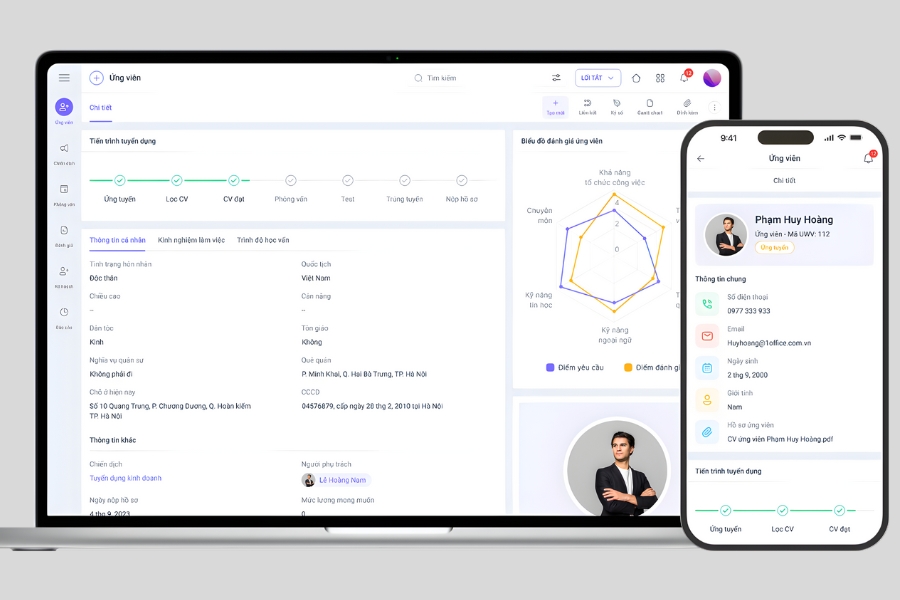
Managing payroll, especially the 2026 Tet bonus, is often a headache for many businesses: from collecting timekeeping data, KPIs, and bonuses/penalties to calculating salaries and taxes, the process is time-consuming and prone to errors. 1Office HRM provides a comprehensive solution to all these challenges with its smart features, helping businesses save time and ensure transparent management.
Key benefits of using 1Office HRM for the 2026 Tet bonus:
- Automated Tet bonus calculation: By inheriting data from timekeeping, KPIs, sales, allowances, etc., 1Office HRM accurately calculates salaries and Tet bonuses, eliminating errors from manual data entry.
- Flexible salary formulas: The system allows businesses to set up Tet bonus calculation formulas according to their own policies, including 13th-month salary, bonuses based on seniority, performance, or business results.
- Fast online bonus approval: The approval process is automated, allowing all management levels to approve bonuses online, ensuring transparency and easy tracking of change history.
- Transparency for employees: Employees can look up their payslips and Tet bonuses online, view detailed bonus amounts, reduce complaints, and increase satisfaction.
- Optimized HR budget: 1Office HRM provides reports on the total salary fund, bonus fund, insurance, etc., helping leaders forecast Tet expenses, balance the budget, and compare labor productivity with salary costs.
- Integrated automatic payments: The system connects directly with banks to process mass Tet bonus transfers, ensuring speed, accuracy, and time savings.
With 1Office HRM, CEOs and managers can easily control and optimize 2026 Tet bonus costs while ensuring transparency and fairness. All data on the 2026 Tet bonus is compiled and analyzed instantly, helping leaders make quick and accurate decisions
4. Frequently Asked Questions about Tet Bonus Regulations
Are the Tet bonus and the 13th-month salary the same?
In fact, the Tet bonus and the 13th-month salary are two different payments:
- The Tet bonus is a monetary or in-kind payment that a business provides based on its profits and business results. It is decided by the CEO or management board, does not require prior agreement, but must be publicly disclosed to employees.
- The 13th-month salary is a payment made according to an agreement between the business and the employee, often based on the final month’s salary or the average salary for the year.
Thus, depending on the company, these two payments may be separate or combined.
Are employees who have worked for less than 1 year (e.g., 6 months) eligible for a Tet bonus?
Current law does not specify a minimum working period to be eligible for a Tet bonus. Therefore, an employee who has worked for less than 1 year can still receive a Tet bonus if the company has a policy for it. The bonus amount will depend on performance, seniority, and the company’s business results.
If I resign before Tet, am I still entitled to the bonus?
If the employment contract includes an agreement on the Tet bonus, an employee who resigns before Tet may still receive the bonus as per the agreement. If there is no such agreement, the business is not obligated to pay it.
Are probationary employees eligible for a Tet bonus?
The law does not mandate Tet bonuses, so probationary employees are often not eligible for them due to their short working period and lack of long-term contributions. However, some businesses may still offer bonuses to encourage and motivate probationary staff.
Can employees receive a salary advance for Tet?
According to Article 101 of the 2019 Labor Code, employees can request a salary advance if needed, and the business will consider and approve it if the request is reasonable. There is no specific regulation on the advance amount, so it will be based on the agreement between the employee and the business.

Understanding Tet bonus regulations helps businesses pay transparently and legally, giving employees peace of mind. Using 1Office HRM software, managing salaries and bonuses, especially for the 2026 Tet bonus, becomes fast, accurate, and transparent. If your business is interested in learning more about our solution, please leave your contact information HERE, and the 1Office team of experts will connect with you for a consultation as soon as possible.
















