


 13/05/2026
  16758 views
A pain point is one of the most important factors that helps businesses understand the real problems customers are facing and what solutions they need. But what is a pain point, what types are there, and how can you identify them accurately instead of just guessing based on intuition? This article will help you understand everything from the concept to its application in marketing.
Mục lục
- 1. What is a pain point? Why do businesses need to identify customer pain points?
- 2. Common Types of Customer Pain Points
- 3. 3 Ways to Accurately Identify Customer Pain Points
- 4. Leveraging Pain Points to Build an Effective Marketing Strategy
- 5. Effectively solve customer pain points with the 1Office CRM module
1. What is a pain point? Why do businesses need to identify customer pain points?
1.1. What is a pain point?
Customer pain points are a common marketing term describing the difficulties, challenges, and pressing issues that customers face on their journey. A business’s mission is to identify these “pain points” and alleviate them with its products and services.
1.2. What are the benefits of using pain points in marketing?
Understanding what a pain point is equips businesses with a useful tool to win over customers and enhance their competitive edge. Specifically:
- Developing products/services that truly meet customer needs.
- Making it easier to market content that resonates with consumer psychology, thereby improving the effectiveness of attracting potential customers.
- Gaining a competitive advantage over rivals by effectively solving customer problems.
| Read more: What is Customer Insight? The most effective and accurate way to determine customer insights |
2. Common Types of Customer Pain Points
2.1. Pain Points of Individual Customers
Since these are “hidden pains,” not everyone’s “inner voice” is the same. Therefore, just like customer personas, pain points come in countless forms with many diverse and complex issues. However, based on behavioral psychology, the pain points of individual customers can be classified into 4 main groups:
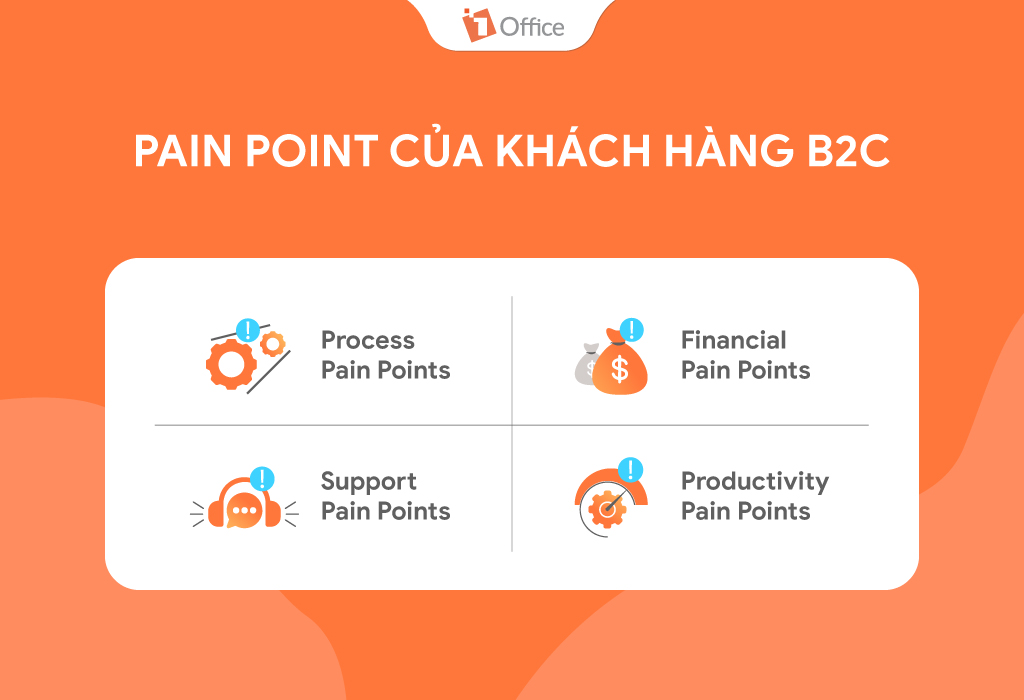
Financial Pain Points
These are difficulties or barriers that cause financial stress when customers access a product/service. This stems from consumers having to pay too high a price to receive the value they desire. Therefore, when facing their pain points, consumers often have the following tendencies:
- Product lifespan: Many customers save money by investing in high-quality products and services with a long lifespan. Others prefer to buy a lower-quality product at a cheaper price, despite its shorter usage time.
- Payment options: Some customers prefer periodic payments over paying a large fee all at once.
- Repeat purchases: Many consumers like to buy items they use frequently in bulk to save time and money. On the other hand, convenience-focused consumers may prefer single-use options, while those worried about recurring fees often look for reusable products.
Productivity Pain Points
This pain point stems from the feeling that the customer’s time is not being used effectively. Therefore, during the purchasing process, they always want solutions that save time and offer comfort and convenience. For this reason, more and more consumers tend to avoid complex solutions.
Pain point example: Most people are aware that fast food is unhealthy, but choosing fast food is a more convenient option than cooking at home and helps them save a significant amount of time.
Process Pain Points
Process pain points indicate that your customers are having trouble accessing your business’s products/services. Complicated and cumbersome procedures and processes are obstacles that prevent them from making a purchase decision.
A typical example of a process pain point is when customers easily lose patience and switch to more convenient options if they have to perform too many steps or contact multiple departments to get the information they want.
Support Pain Points
This pain point relates to a business’s potential customers not receiving the support they need at critical stages of the customer journey. Some common issues consumers often face are:
- Not receiving timely responses
- Consultants lacking product knowledge
- The product is not available on the customer’s preferred channels
Read more: Mastering Customer Psychology – The Key to Top-Tier Sales
2.2. Business Pain Points
Business pain points is a term used in the B2B model where the target customers are organizations and businesses. B2B customer pain points are the “pains” in an organization’s operational process that directly affect business efficiency, profits, budget, etc., requiring timely solutions for the organization to operate effectively. Business pain points are divided into 6 groups:
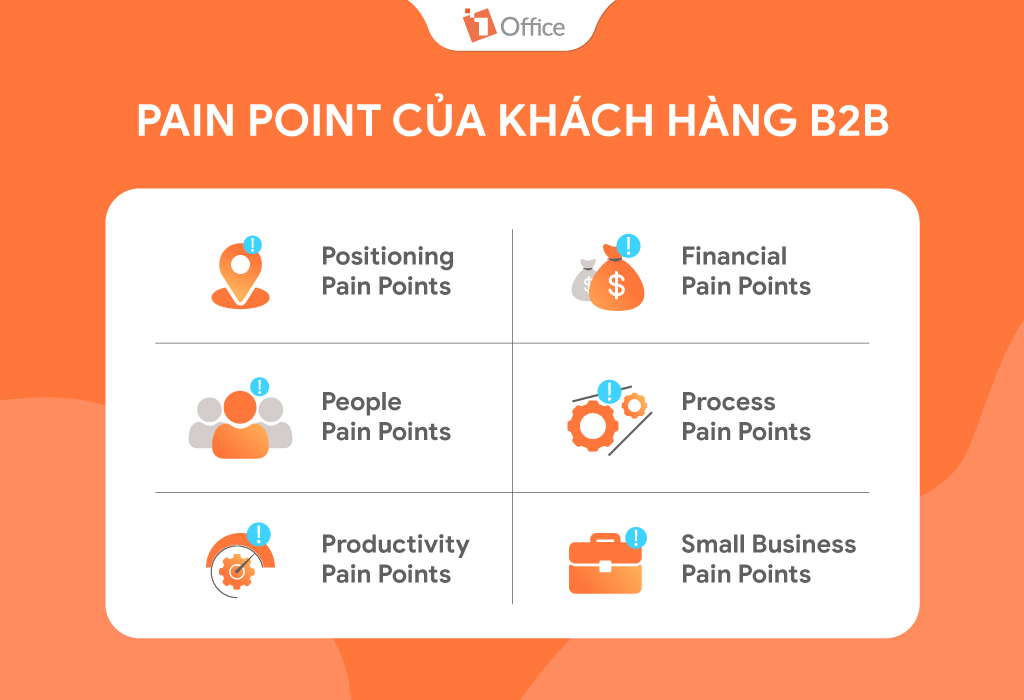
Positioning Pain Points
These are difficulties and challenges that hinder a business’s efforts to grow and improve its competitiveness. The company faces issues related to maintaining its market position, brand positioning in the minds of customers, competitive ability, etc. Some issues you might hear from your business customers include:
- “Nobody knows who our company is.”
- “Our competitors are leaving us behind.”
- “The market is changing, and we are falling behind.”
- “Our competitors are present on almost every channel.”
Financial Pain Point
Financial problems can be considered the biggest “pain point” for a business. Issues with budget, cash flow, operating costs, etc., are pressing questions that challenge business owners in their management. The financial pain points of business customers are often expressed through concerns like:
- “Revenue is increasing, but profits are low.”
- “We don’t know which costs to cut.”
- “We don’t have a source of capital to support our business operations.”
- “Cash flow is slow due to late payments from partners.”
People Pain Point
These are issues revolving around the personnel within the organization. Currently, many business customers are looking for solutions that can help them optimize their human resource management processes. People-related pain points that a business might encounter include:
- “Employee morale is low.”
- “We are losing our best employees to higher-paying positions.”
- “A lack of diversity in our organizational structure leads to a lack of innovation.”
- “Our actual company culture doesn’t align with what we’ve stated.”
Process Pain Point
These are the “bottlenecks” in operations that prevent the business from running smoothly. Your potential business customers may be facing obstacles such as:
- “We don’t have a system in place to manage customer information.”
- “There are conflicts in the workflow between departments, leading to a lack of organization and inconsistent performance.”
- “Our processes have too many repetitive tasks, which wastes time.”
- “The software we are currently using is outdated, but we are concerned that switching to new software will be very expensive.”
Productivity Pain Point
The biggest concern for business owners is teams operating inefficiently. Here are some examples of productivity pain points in business:
- “We constantly miss customer deadlines.”
- “We spend too much time in meetings.”
- “Our employees do not have adequate support to complete their assigned tasks.”
Small Business Pain Points
If your target audience is small businesses, they will likely experience pain points such as:
- “Finding the right talent for the business is not easy.”
- “We don’t have enough resources to operate.”
- “Our employees always have to take on multiple roles at once.”
3. 3 Ways to Accurately Identify Customer Pain Points
Conduct Qualitative Market Research
One of the most common methods to decipher customer pain points is market research. Conducting qualitative customer research will give you deep insight into the “pain points” of potential customers.
A viable method for this type of research is to conduct large-scale customer surveys. Survey questions should delve into demographics, preferences, purchasing behavior, and more. Customer feedback will be a valuable resource for you to effectively identify pain points.
Next, build a customer journey map to identify their “pain points” through these stages:
- Awareness of need
- Information search
- Evaluation of alternatives
- Purchase action
Listen to Your Customers
The best way to find customer pain points is to listen directly to them. Feedback, suggestions, or questions during the purchasing process are the very “pains” they are facing. Therefore, pay close attention when customers talk about their problems to decipher their pain points as accurately as possible.
An effective approach is to proactively ask customer care questions. Explore their thoughts on your company’s product as well as the experiences they desire when using it. Customers’ answers will provide you with deep insights into their pain points. You can then use this information to improve your sales process.
Work with the Sales & Customer Care Department
Sales staff are the ones who directly interact and work with customers every day. This makes them an invaluable source of information for identifying customer pain points. Therefore, leverage this potential from your colleagues! Talking and exchanging information with the sales department can help you discover valuable “pain points” that customers themselves may not even be aware of.
4. Leveraging Pain Points to Build an Effective Marketing Strategy
Accurately identifying a pain point is not a simple task. However, once you have “unlocked” the key factor that determines consumer buying behavior, the journey to win over customers becomes much easier. Once you understand your customers’ “pain points,” leverage them thoroughly in your marketing to maximize its effectiveness.
Use the Customer’s Language When Talking About Their “Pain”
Every customer wants to feel understood. Therefore, you need to focus on emotion when creating advertising content to effectively address customer pain points. Instead of using industry jargon, speak the “inner voice” of potential customers by using language familiar to your target audience. An advertisement that successfully leverages a customer’s pain point with a relatable approach will be more influential than ever.
Sell Solutions, Not Products
The reality is that when customers buy a product, they aren’t anticipating the value the product itself brings. What customers care about is the solution to their problems. Therefore, instead of focusing on the outstanding features of your product, show customers how your company can solve their “pain.”
Use Case Studies
Don’t expect potential customers to pay for your product just because you say it can solve their pain points—provide concrete proof. Using case studies is the most effective method. A case study helps present the customer’s pain in a vivid, visual way and increases their ability to connect with their existing problems. From there, you can describe how your business alleviates that “pain” by showcasing successfully implemented cases.
| To create a compelling case study that resonates with customers, refer to this article:
|
Customers often use search engines to find solutions for their “pain points.” Therefore, when creating marketing content, focus on topics related to customer pain points. You should create a list of keywords centered around customer problems and develop corresponding articles to attract organic traffic. Optimizing search keywords related to pain points will help attract potential customers to your website and bring them closer to your product.
Provide solutions for customers on all platforms
Once you have clearly shown customers the value your business can offer to solve their problems, your next task is to increase your presence with them. Provide solutions on all platforms so that customers can easily find a solution to their problem on any of their preferred channels.
5. Effectively solve customer pain points with the 1Office CRM module
To succeed in winning over customers, businesses not only need to focus on understanding customer psychology but also must apply technology to optimize the customer experience. 1Office CRM is the most optimal customer care software on the market today.
1Office helps businesses capture pain points and retain customers effectively with smart customer care solutions:
- Easily create new profiles and automatically classify customers into groups to help identify customer pain points
- Store data such as invoices, purchase contracts, complaints, tickets, etc., to support the timely resolution of customer issues
- Build professional, personalized customer care processes to match the needs and characteristics of each customer group with automatically configured scenarios
- Send automatic reminder alerts to the person in charge for scheduled customer care activities.
Through the article above, 1Office has provided readers with a comprehensive view of what a pain point is as well as skills for effectively leveraging pain points in marketing. For a free consultation and a trial of the most professional customer management & care software available today, please contact us using the information below:
For more details, please see:
- Hotline: 083 483 8888
- Fanpage: https://www.facebook.com/1officevn/
- Youtube: https://www.youtube.com/channel/UCeTIRNqxaTwk0_kcTw6SxmA
Secondary keywords: what is a pain point, pain point in marketing
















