


 10/05/2026
  1122 views
ChatGPT is one of the most prominent applications of conversational artificial intelligence, running on OpenAI’s generative pre-trained transformer (GPT) models. As of now, ChatGPT is based on the multimodal AI model GPT-4o, which allows it to generate images and conduct audio conversations in addition to text generation.
ChatGPT has garnered significant media attention since its initial launch in 2022. Its popularity has been a major contributor to the current AI boom, which includes the development of competing products like Google Gemini (formerly Bard) and Anthropic’s Claude.
However, ChatGPT has also sparked concerns related to large language model (LLM) technology, such as plagiarism and the use of generative artificial intelligence to produce misinformation or replace human labor.
Mục lục
What is ChatGPT?
ChatGPT is a generative artificial intelligence (AI) chatbot developed by OpenAI that operates on their proprietary line of GPT generative AI models. It uses natural language processing (NLP) to conduct lifelike conversations with users and generate content including articles, text summaries, advice, and more.
ChatGPT was developed by OpenAI, a machine learning and artificial intelligence startup founded by CEO Sam Altman, President Greg Brockman, and other associates including Elon Musk and Ilya Sutskever. In addition to ChatGPT and the GPT model series, OpenAI also created the image generation model DALL-E and the text-to-video model Sora.
OpenAI was originally founded as a non-profit organization but now exists as a hybrid model: the 501(c)(3) non-profit OpenAI, Inc. controls a holding company that is the primary owner of the for-profit subsidiary OpenAI Global LLC. Since its inception, OpenAI has received significant investment from Microsoft, totaling at least $13 billion since 2019.
The majority of Microsoft’s investment in OpenAI comes in the form of Azure cloud computing credits. In return, Microsoft provides access to the OpenAI API—which other developers can use to create their own generative artificial intelligence tools—through its Azure cloud computing platform and shares in OpenAI’s profits. The Microsoft Copilot and Bing AI services are also powered by GPT models.
How ChatGPT Works
ChatGPT works by using generative pre-trained transformers (GPTs), a type of large language model (LLM) developed by OpenAI. A transformer is a type of deep learning neural network architecture that specializes in maintaining context across large inputs thanks to a self-attention mechanism, which helps models identify the most relevant parts of an input sequence.
Broadly speaking, ChatGPT generates responses through a two-stage process:
- Language understanding: The model converts the user’s input into a numerical representation through an embedding process. Embedding allows ChatGPT to capture and process the user’s intent as well as semantic and syntactic meaning.
- Response generation: GPT models combine the input sequence with the larger context of the user interaction to formulate a response. The response is shaped by the knowledge the model gained through its training. The model predicts a response based on similar content in its training data.
AI-powered chatbots like ChatGPT work by using complex machine learning algorithms that compare user input with content in their datasets. During training, GPTs identify patterns and relationships in the training data and then use those findings to predict realistic outcomes—such as the next word in a sentence. ChatGPT’s output represents its predictions based on the patterns in the training data.
GPT-3.5, the model that powered the first version of ChatGPT, is part of the third generation in the GPT model series, with the first generation introduced in 2018. Now with access to GPT-4o, users can use ChatGPT to generate audio and visual content. Users can access ChatGPT via an internet browser or through apps on macOS, Windows, iOS, and Android.

How is ChatGPT trained?
ChatGPT is trained on massive datasets sourced from the internet, including forum posts, news articles, images, and websites. For example, GPT-3 was trained on over 45 terabytes of text data, which included the entirety of Wikipedia at the time. This allows it to understand the patterns of human-generated language and the relationships between different topics.
GPT models are trained using a combination of techniques including supervised learning, unsupervised learning, and reinforcement learning from human feedback (RLHF), where human trainers rank the model’s responses and create a reward mechanism for optimal performance. The initial pre-training stages are unsupervised, with RLHF used later for fine-tuning.
ChatGPT is further fine-tuned from the base GPT models with additional conversational datasets, such as a collection of movie dialogue snippets. The unsupervised training process forces the model to digest large amounts of unstructured data and draw its own conclusions about the patterns and meanings within that content.
ChatGPT responds with human feedback. Users can instruct ChatGPT to behave in a specific way, such as a therapist or career counselor. User feedback also extends to like and dislike buttons, which help further refine ChatGPT’s responses.
What can ChatGPT do?
ChatGPT is a versatile example of AI technology that can handle a wide variety of tasks. While the free version of ChatGPT offers significant utility, users who subscribe to one of ChatGPT’s paid tiers with an OpenAI account gain access to more powerful GPT models.
ChatGPT’s use cases include:
- Content creation: ChatGPT can help draft emails, outline and write articles, write podcast and video scripts, create social media posts, and more.
- Summarization: ChatGPT can process and summarize long articles and reports in a user’s desired format. Users can also ask it to create simple explanations of complex topics.
- Web search: With access to a search engine as of October 2024, ChatGPT can include real-time search results in its generated text and audio responses.
- Job applications: With access to a search engine as of October 2024, ChatGPT can research companies, find relevant job opportunities, and tailor resumes and cover letters for specific positions.
- Business planning: Users can ask ChatGPT to act as a business analyst and conduct market research, then create business plans and reports.
- SEO: ChatGPT can return a list of relevant keywords for a query. Users can then ask it to outline and write corresponding article or website content.
- E-commerce: ChatGPT can draft product descriptions for use on e-commerce websites.
- Language translation: ChatGPT supports over 80 languages and can provide machine translation between them.
- Content marketing: ChatGPT can repurpose content from one channel to another, such as creating a series of social media posts from an article or white paper.
- Advice: Users can describe a real or hypothetical situation and ask ChatGPT for advice on how to handle or respond to it. ChatGPT can be instructed to behave in a specific way, such as a therapist or coach. However, because ChatGPT is a machine learning algorithm and not a trained human expert, its responses should never be considered true expertise—especially with high-stakes topics like legal or medical matters.
- Image generation: A new feature of ChatGPT is the ability to create AI-generated images. While ChatGPT could previously create images with OpenAI’s DALL-E model, it can now do so on its own.
- Programming and code debugging: Programmers and developers can ask ChatGPT to review code and potentially find errors or provide missing code snippets.
Custom GPTs
In 2023, OpenAI introduced the option to create custom GPTs: ChatGPT-based chatbots that users can edit for specific purposes. Instead of prompting ChatGPT each time with detailed instructions on how to behave, users can fine-tune a custom GPT for a specific use case.
The benefits of custom GPTs include the ability to upload knowledge files into the GPT builder and share the GPT with other users. With custom GPTs, users can create their own AI systems, adding functionality beyond the default capabilities of standard ChatGPT. The ability to create custom GPTs is restricted to premium users, although free users can use them.

Is ChatGPT free? ChatGPT tiers and plans
ChatGPT is available with a free OpenAI account or through several paid tiers. As of the time of publication, ChatGPT plans include:
- ChatGPT Free: Free users default to GPT-4o-mini with limited access to GPT-4o and GPT-o3 mini, a new small model released in January 2025. Users can ask ChatGPT to search the web to find and include real-time data in its responses. Voice mode and file uploads are limited.
- ChatGPT Plus: This tier offers higher usage limits as well as access to OpenAI’s “deep research” and reasoning models, voice mode, and a preview of GPT-4.5. Users have the option to create custom GPTs and limited access to Sora, OpenAI’s video generation model.
- ChatGPT Pro: ChatGPT Pro provides unlimited access to all reasoning models and GPT-4o alongside an enhanced voice mode. Users receive increased limits for video and screen sharing, deep research models, and Sora video generation. ChatGPT Pro users can also access the “pro” mode of o1, which OpenAI describes as providing “more computation for the best answers to the hardest questions.”
- ChatGPT Teams: Teams is the first of two ChatGPT plans for the workplace. Organizations can connect internal Google Drive storage for personalized output while providing all Plus features to employees, with higher message limits for GPT-4o.
- ChatGPT Enterprise: The organization-wide ChatGPT plan offers a larger context window for GPT-4o, allowing users to create larger input strings with more content and data. Access to OpenAI’s reasoning models is included, while Enterprise data is excluded from model training (OpenAI reserves the right to train models on user data by default).
- ChatGPT Edu: ChatGPT’s education-focused plan is similar to ChatGPT Enterprise, but for universities and colleges. This includes a training waiver for input data from ChatGPT Edu users.
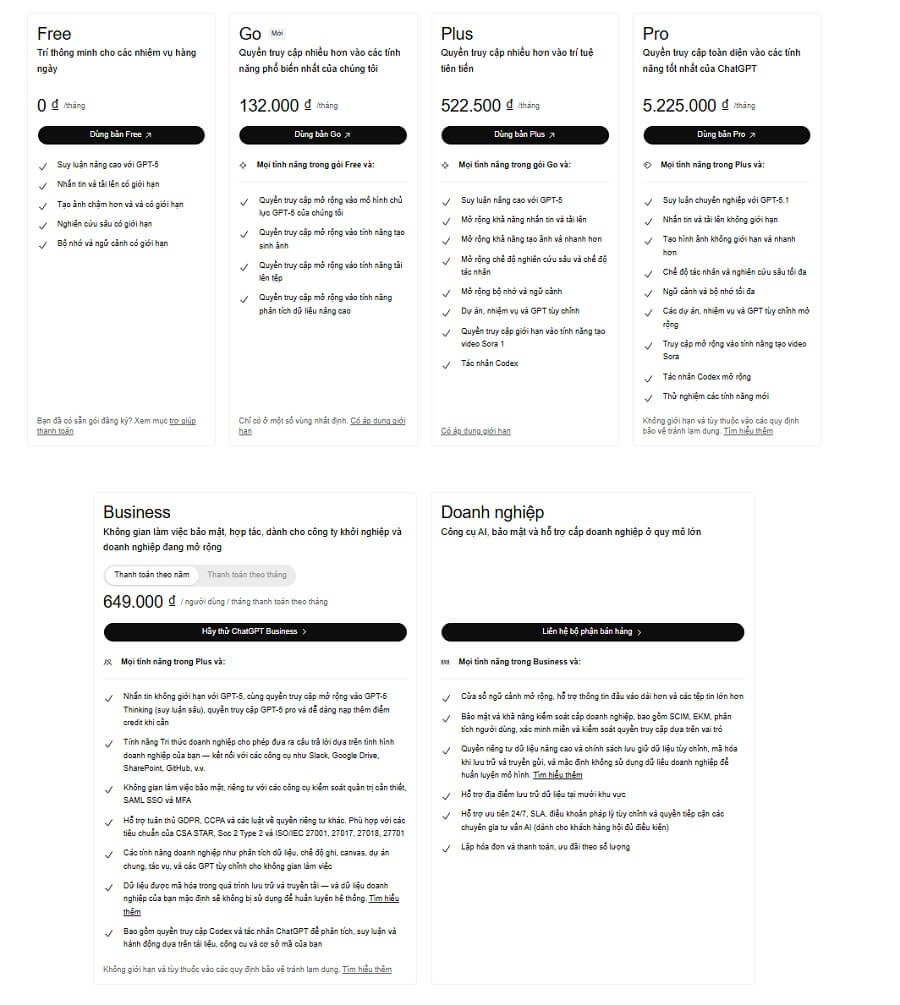
ChatGPT Pricing in Vietnam
| Plan | Price (USD/month) | Estimated Price (VND/month) | Key Features | Suitable For |
|---|---|---|---|---|
| Free | 0 | 0 | – Advanced reasoning with GPT-5 – Limited messages, file uploads, image generation – No support for in-depth research or video | Individual users just starting out |
| Plus | 20 | ~522,500 | – Full access to GPT-5 – Image generation, real-time web search – Custom GPTs, advanced voice – Access to Sora | Individuals, freelancers needing powerful tools |
| Pro | 200 | ~5,225,000 | – Unlimited messages, file uploads, image/video generation (Sora) – Access to GPT-5 Pro, Pro Mode for complex analysis – High priority, new feature previews | Experts, developers, data analysts |
| Team (Business) | 25/user (annually) / 30/user (monthly) | ~649,000/user (annually) / ~750,000/user (monthly) | – Everything in Plus + unlimited GPT-5.1 – Google Drive/Slack integration, no training on company data – Admin management, GDPR/CCPA security | Small teams, medium-sized businesses |
| Enterprise | Custom | Custom | – Everything in Team + large context window, enterprise security (SCIM, EKM) – 24/7 support, SLA, custom contracts – Volume discounts for large enterprises | Large enterprises, organizations |
| Go | Special Offer | 132,000 | – Expanded access to GPT-5 – Access to file upload and image generation features – Advanced data analysis | Universities, students/faculty |
Limitations of ChatGPT
ChatGPT, and generative artificial intelligence in general, is an impressive technology. Users can create content and automate routine tasks that might otherwise take a long time. But some people see drawbacks in the software. The limitations of ChatGPT include:
- Reliability: Of ChatGPT’s 400 million weekly active users, only 15.5 million are paid subscribers. Some users have reported a decline in performance since early 2025, citing reduced intelligence, memory errors, and shorter responses, among other issues.
- Accuracy: ChatGPT does not cite sources when answering questions. Users can prompt ChatGPT to provide sources, but those sources are not verified. It is best to verify all information provided by ChatGPT before using it.
- Transparency: ChatGPT, like all OpenAI products, is closed-source, meaning its internal workings cannot be verified or audited by third parties. ChatGPT also does not provide citations in its responses.
- Hallucinations: All generative AI tools are prone to hallucinations or fabrications, where they produce output that does not correspond to real-world results. This is due to the underlying algorithm identifying patterns in the training data that do not exist in reality.
Generative artificial intelligence models do not “know” things the way humans do. They are sophisticated pattern recognition tools, and the best they can do in any situation is make an educated guess.
- Reasoning: A 2025 study found that ChatGPT sometimes makes logical errors similar to humans. It is affected by bias, which is logical since it was trained on human-generated content. It struggles to perform well on subjective reasoning tasks as it does with simple logic challenges. ChatGPT also readily overestimates its own intelligence—another human-like quality.
Ethical Concerns about ChatGPT
Although ChatGPT has gained significant popularity since its initial launch, the chatbot and its parent company have raised many ethical concerns, such as:
- Copyright Infringement: OpenAI has been sued by many publishers, including The New York Times and The Chicago Tribune, for training its model on copyrighted content. In response, OpenAI published an open letter arguing that allowing it and other American AI developers is crucial to overcoming competition from China.
- Plagiarism: AI content detection tools have emerged following the advent of generative AI applications like ChatGPT, but they are not always reliable. A user can ask ChatGPT to generate an essay and edit it enough to bypass detection. ChatGPT itself can also output copyrighted content in its responses, the use of which also constitutes plagiarism.
- Potential for Abuse: Like any generative artificial intelligence tool, ChatGPT can be used for malicious purposes. AI-generated deepfakes and misinformation have been deployed worldwide to influence election outcomes.
- Privacy Violations: With some exceptions, such as the Teams and Enterprise plans, OpenAI collects input data and uses it to further train its model. If a user submits a prompt that includes confidential or sensitive information, that data could appear in the output for other users.
- Environmental Impact: A single ChatGPT query uses 10 times more electricity than an internet search. As more users choose to search with ChatGPT instead of traditional search engines, this energy demand continues to grow. OpenAI’s new o3 reasoning model can consume over $1,000 in computation per task. A 2021 paper estimated that the training process for GPT-3 produced about 552 tons of carbon dioxide—and OpenAI’s models have become more sophisticated since then.

The A-Z Guide to Using ChatGPT (Updated 2025)
ChatGPT has become an indispensable tool for hundreds of millions of users worldwide. Whether you are a beginner or an experienced user, this article will help you harness the full power of ChatGPT – from basic tips to advanced techniques that few people know.
Step 1: How to Access ChatGPT?
There are 3 main ways to use ChatGPT:
- Free (recommended to start here) Access: https://chat.openai.com or https://chatgpt.com → Sign up/log in with a Google, Microsoft, or email account. → Currently, you can use the GPT-4o mini model (very powerful) for free and have limited use of the full GPT-4o.
- Mobile App Download the official “ChatGPT” app on iOS or Android → supports extremely smooth two-way voice.
- ChatGPT Plus/Pro (paid) Price: see details at https://openai.com/chatgpt/pricing Advantages: unlimited use of GPT-4o, o1-preview (deep reasoning model), image generation, real-time web search, custom GPTs, etc.
Step 2: 10 basic tips everyone should know
- Write clear and specific prompts Instead of: “Write an ad” Try writing: “Write a 150–200 word Facebook ad for wireless headphones priced at 1.5 million VND, targeting students aged 18–24, emphasizing noise cancellation and a 40-hour battery life.”
- Use an ellipsis (…) or “continue” when it gets cut off ChatGPT sometimes stops mid-sentence due to length limits → just type “continue” or “…” and it will pick up right where it left off.
- Request a specific format Example: “Reply in a comparison table with 4 columns: Feature – iPhone 16 – Samsung S24 – Google Pixel 9 – Price in Vietnam.”
- Use the command “STEP BY STEP” or “think step by step” Very effective for solving math problems, planning, and analyzing complex issues.
- Assign it a role (role-playing) “From now on, you are a copywriter with 10 years of experience specializing in high-converting landing pages.”
- Request multiple versions “Write 3 different versions of an email subject line, each with a different style: humorous – serious – intriguing.”
- Use the “Custom Instructions” feature Go to Settings → Custom instructions → fill in information about yourself (profession, writing style, desired tone). ChatGPT will remember this for all future conversations.
- Upload files for analysis You can upload PDFs, Excel files, Word documents, images, etc., and then ask: – “Summarize this 50-page PDF file in 300 words” – “Analyze the revenue data in this Excel file and describe a chart for it”
- Use Voice Mode Only available on the mobile app → press and hold the microphone button → talk to it as naturally as you would with a virtual assistant on a call.
- Generate images directly Type: “Draw a girl in an ao dai standing by Hoan Kiem Lake at sunset, in the style of an oil painting.”

Step 3: Advanced techniques (pro tips)
- Chain of Thought (CoT) “Solve this problem step-by-step and explain the reasoning for each step.”
- Few-shot prompting Provide examples before making the request: “Example 1: Apple → Quả táo Example 2: Banana → Quả chuối Now translate: Orange → ?”
- Self-Consistency “Provide 3 different solutions to this problem, then choose the most accurate one.”
- Tree of Thoughts “Explore 3 different approaches to this marketing problem, evaluate the pros and cons of each, and then recommend the best one.”
- Create a Custom GPT Only for Plus/Pro users: Go to “Explore GPTs” → Create a GPT → give it a name, upload documents, provide behavioral instructions → share the link for the world to use (you can earn money if you enable monetization).
- Use ChatGPT as a smart search engine Since late 2024, ChatGPT can browse the web in real-time: “Find the official price of the iPhone 16 Pro Max at FPT Shop and Thế Giới Di Động today.”
Step 4: Some powerful prompts you can copy-paste right away
- Content writing: “You are a TikTok content expert. Write a 60-second video script in a storytelling format about a journey of losing 10kg in 3 months, with a friendly style, and include 5 different opening hooks.”
- Planning: “Create a detailed 30-day plan to learn English from A2 to B1 level, with no more than 90 minutes of study per day.”
- Competitor analysis: “Analyze the 3 main competitors of Shopee in Vietnam in 2025: their strengths, weaknesses, and recent strategies.”
- Writing a professional email: “Write an email to a foreign manager requesting 3 days of leave for family reasons, in a polite and professional tone.”
- Brainstorming ideas: “Provide 10 online business ideas in Vietnam for 2025 with a starting capital of under 50 million VND, including an estimated profit for the first month.”
ChatGPT is not just a chatbot – it’s a personal assistant, copywriter, programmer, teacher, strategist… as long as you know how to give it the right “commands”.
Try it today, starting with simple prompts and gradually upgrading your prompting skills. After just 1–2 weeks of practice, you’ll be amazed at how many times faster your work becomes!
















