


 11/05/2026
  772 views
ROI (Return on Investment) is a crucial metric that helps measure the effectiveness of an investment in business. In Marketing and Sales, ROI indicates the profit earned relative to the cost spent on each campaign. In this article, 1Office will help you understand what ROI is, the formula for calculating ROI, and how to apply it in practice with easy-to-understand examples.
Mục lục
- 1. What is ROI? How to Calculate ROI, Formula, and Practical Examples
- 2. What is the significance of the ROI metric?
- 3. How is the ROI metric calculated?
- 4. How does ROI differ from other financial metrics?
- 5. What is a good ROI?
- 6. Examples of ROI in Real-World Business
- 7. How to Effectively Calculate ROI in Marketing
- 8. How to improve the ROI index in a business?
- 9. FAQ – Frequently Asked Questions about ROI
- 10. Conclusion
1. What is ROI? How to Calculate ROI, Formula, and Practical Examples
ROI (Return on Investment) is a metric that measures investment return or rate of return on investment. It is a financial metric used to measure the efficiency or profit gained from an investment project compared to the cost incurred, using the formula: ROI = Net Profit / Total Investment Cost. This metric is commonly applied in activities evaluating business performance or marketing campaigns.
For example: If you spend 100 million to run a marketing campaign and generate 150 million in revenue, ROI will tell you the investment efficiency in %. In this case, ROI = 50%

2. What is the significance of the ROI metric?
Based on the definition of ROI, we can partially understand the significance of this metric.
2.1. Determining Direction
ROI is calculated by dividing the growth by the investment, so it reflects whether the costs incurred have yielded good results.
A higher ROI indicates higher cost-effectiveness, which also signifies the success of that investment.
An ROI > 0 means the investment is effective and generating good profit. However, if ROI < 0, it means the profit has decreased, indicating a flawed investment.
Therefore, we have 2 points to note when using ROI to calculate investment effectiveness:
- The higher the ROI, the more effective the investment.
- You should choose projects or stocks with a positive ROI for investment and avoid those with a negative ROI.
Additionally, in Marketing, ROI also evaluates the success of campaigns.
Example 1: Company A spends $1,000 on a Facebook advertising campaign and conducts no other marketing campaigns during the year, and its revenue increases by $3,000 compared to the previous year.
The calculated ROI for this campaign is 300%, meaning for every $1 spent on advertising, Company A earns $3 in profit. Thus, this is a successful campaign, providing a basis for the company to continue investing in similar campaigns in the future.
Example 2: Company B invests $500 to run a TVC campaign on the company’s platforms; however, the result is a profit decrease of $300 compared to the same period.
Thus, the ROI is negative, confirming that this is a flawed strategy that should be stopped immediately.
2.2. Easy Comparison
In the course of investment and business, you will certainly not deploy just one campaign, so we need to compare campaigns with each other to choose the best one.
And ROI is one of the most important metrics that helps do this.
For each campaign, we will obtain a different ROI value, which helps determine which campaign is yielding the highest benefit and which is yielding the lowest, thereby allowing for an appropriate choice.
2.3. Adjusting Budgets
It doesn’t just stop at telling us the direction to take with two answers, “continue” or “stop”; the data provided by ROI gives us a solid basis to balance the budget for campaigns.
3. How is the ROI metric calculated?
To calculate the ROI metric, businesses can apply the common formula below:
ROI = Net Profit / Investment Cost * 100%
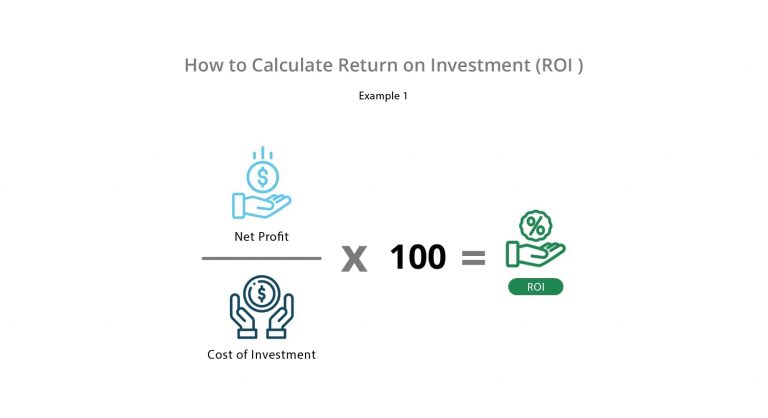
Where:
Net Profit (also known as profit after tax) = Total Revenue – Investment Cost.
Investment Cost = Fixed Costs + Variable Costs
See also: Metrics for Measuring Business Marketing Effectiveness
4. How does ROI differ from other financial metrics?
4.1 What is the difference between IRR and ROI?
IRR considers the time value of money, while ROI does not.
ROI (Return on Investment) tells you how much profit is returned for every dollar spent, but it does not account for the “time value of money”.
In other words, ROI treats a profit of 100 million earned after 1 year or 5 years as… the same, as long as the amount is equal.
IRR (Internal Rate of Return) is different:
-
IRR calculates the annual rate of return based on the cash flow through each phase of the project.
-
An investment that returns 100 million after 1 year will have a much higher IRR than one that returns 100 million after 5 years.
In marketing, ROI is often used when reporting the effectiveness of short-term campaigns (1–3 months). IRR, on the other hand, is useful for evaluating long-term marketing projects such as brand building, product development, or investing in marketing technology platforms (MarTech), as these projects generate returns gradually over time.
4.2 What is the difference between ROCE and ROI?
ROI measures the efficiency of a specific investment, which could be a marketing campaign, a partnership agreement, or the purchase of a new asset.
ROCE (Return on Capital Employed), on the other hand, evaluates the efficiency of using all capital employed in the business – including both equity and debt.
Key differences:
-
ROI answers the question: “Is this campaign profitable?”
-
ROCE answers the question: “Is the company using its capital effectively?”
In marketing practice, ROI is a campaign-level KPI, while ROCE is a metric that CEOs or CFOs are concerned with when considering whether to continue funding the marketing department. If ROCE is low, even with a high campaign ROI, the business may still cut the marketing budget to optimize resources.
4.3 ROI vs. ROAS:
ROAS (Return on Ad Spend) only applies to advertising.
ROI measures the net profit after deducting all costs related to an investment activity or project.
ROAS (Return on Ad Spend) focuses only on the revenue generated for every dollar spent on advertising, ignoring other costs such as production, operations, and personnel.
For example:
-
A Facebook Ads campaign spends 100 million, generating 500 million in revenue → ROAS = 5:1.
-
But if you add costs for personnel, production, rent, etc., the net profit is 200 million → ROI = 200%.
In marketing, ROAS is used to measure the effectiveness of advertising channels (Google Ads, Facebook Ads, etc.), while ROI is used to evaluate overall business performance. An advertising channel with a high ROAS does not necessarily guarantee a good ROI if other operating costs are too high.
5. What is a good ROI?
F&B: An ROI > 20% is generally considered stable
- In general, this rate is reasonable if the ROI is calculated after deducting all operating costs (personnel, raw materials, rent, etc.).
- Some large F&B chains set an ROI target of around 25–30% to offset seasonal risks.
E-commerce: An ROI > 10% is already a success due to high competition
- This benchmark is reasonable because e-commerce often has low profit margins and high marketing and logistics costs.
- However, many platforms and shops also use ROAS to track advertising effectiveness in parallel with ROI.
Real Estate: An ROI of 8–12%/year is an attractive rate
- This is the annual net profit after deducting operating costs, taxes, maintenance, etc.
- Some high-end or commercial rental projects can achieve >15%/year, but come with liquidity risks.
Marketing: An ROI > 5:1 (5 units of revenue for 1 unit of cost) is considered “excellent”
- It should be noted here: Marketing ROI is often expressed as a revenue-to-cost ratio.
- 5:1 means that 1 unit of marketing cost generates 5 units of revenue. This is a rare level in highly competitive industries.
6. Examples of ROI in Real-World Business
Example 1:
An investor puts $90 into a business project and spends an additional $10 on venture research.
Thus, the investor’s total cost is $100. If it generates $300 in revenue but has $100 in personnel and administrative costs, the net profit will be $200. From the formula above, the ROI metric will be $200 divided by $100 for a quotient, or answer, of 2. Because ROI is usually expressed as a percentage, this quotient is converted to a percentage by multiplying it by 100
Therefore, this specific investment’s ROI value is 2 multiplied by 100, or 200%.
Example 2:
In this example, suppose a t-shirt company pays a podcast $500/month for two ad reads. They can track their traffic and see that the ads drove 62 potential customers to the website, and of those 62 prospects, 7 customers made purchases of $80, bringing in revenue of $560. The calculation would be (7 x $80) – 500 = 60.
Applying these numbers to the marketing ROI formula cited above, we get (560-500) / 500 for a marketing return on investment of 12%. It doesn’t have to stop there, either. What if 3 of the 7 buyers signed up for the newsletter, potentially making them long-term customers? Their future sales could also be factored into this ROI formula.
See more: What is Data-Driven Marketing? 5 Latest Data-Driven Marketing Trends
7. How to Effectively Calculate ROI in Marketing
In a context where marketing budgets are increasingly scrutinized, ROI (Return on Investment) has become a crucial metric for evaluating the effectiveness of each campaign. This index not only helps businesses know how much profit their invested capital generates but also serves as a basis for optimizing promotional channels, allocating resources, and making strategic decisions.
In this section, we will explore how to calculate marketing ROI in detail, including key considerations for effective real-world application to help businesses maximize their profits.
7.1. Marketing ROI Formula
There are many ways to calculate marketing ROI today; however, the core high-level formula is: (Profit – Cost) / Cost = Marketing ROI. If you earn $100,000 from a $1,000 investment, your ROI is 0.99 or 99%.
Marketing costs include:
- Search advertising costs
- Costs for media and marketing channels
- Content costs
- Costs for external marketing activities
- Personnel costs
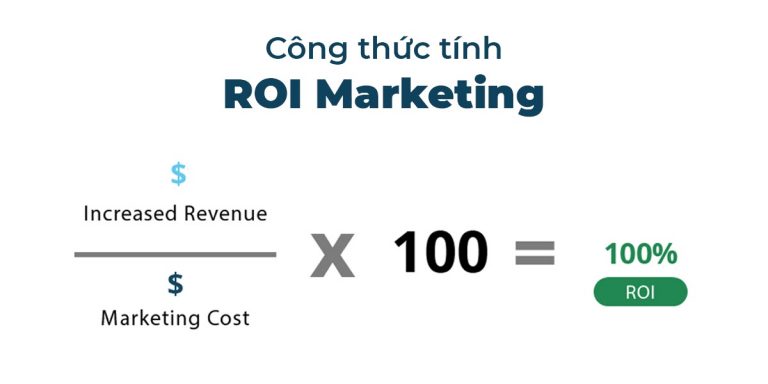
To get a comprehensive view of the Marketing ROI calculation, you will factor in sales revenue using the following formula:
Marketing ROI = (Profit – Cost) / Marketing Cost * 100%
To evaluate long-term ROI, the customer lifetime value (CLV) is calculated using the following formula:
CLV = (Retention Rate) / (1 + Discount Rate / Retention Rate)
| Read more: How to build Marketing KPIs for the Digital Marketing department to achieve the highest effectiveness? |
7.2. How to Calculate ROI for Google and Facebook Ads
The formula above can be applied to almost all marketing campaigns, including Google Ads and Facebook Ads.
For example, company A runs two campaigns, Google Ads and Facebook Ads. The Google campaign generated 75,000,000 in revenue, while the Facebook campaign only brought in 9,000,000, with the implementation cost for both being the same at 10,000,000.
Google Ads:
Google Ads ROI calculation = (75,000,000 – 10,000,000) / 10,000,000 X 100% = 650%
Facebook Ads:
Facebook Ads ROI calculation = (9,000,000 – 10,000,000) / 10,000,000 X 100% = -10%
From this, we can see that the ROI for Facebook Ads is negative because the revenue was not enough to cover the costs. Therefore, company A decided to stop or reduce the budget for the Facebook Ads campaign and reallocate those funds to invest in Google Ads.
7.3. Formula for Calculating ROI in Website SEO
To calculate the ROI for Website SEO, we apply the following formula:
ROI SEO = (LTV – CAC) / CAC * 100%
Where:
- LTV: Lifetime Value of a new customer
- CAC: Cost to acquire a new customer
How to calculate LTV
LTV is understood as the estimated total long-term profit generated from each customer, both currently and in the future. The formula for calculating LTV is illustrated as follows:
| Total purchase time (years) | 5 |
| Average purchase value (VND) | |
| Number of purchases per year | 4 |
| % profit per order | 50% |
| Lifetime value | 5,000,000 |
Example:
LIFETIME VALUE(LTV) = 5 X 500.000 X 4 X 50%= 5.000.000
How to calculate the CAC index
The CAC index helps businesses calculate the cost they have to spend to acquire a new customer, which is essential for effective business planning. Through the CAC index, we can evaluate what is most effective for our business and determine what to invest in to bring the best profit and the most effective ROI.
Note: The CAC index used in offline advertising differs from the CAC in SEO. The most general CAC index does not include investments in categories like Ads, website SEO, and Social. Furthermore, obtaining the most comprehensive index involves other costs that significantly contribute to acquiring new customers.
CAC formula:
CAC = Total SEO cost / Number of new customers
8. How to improve the ROI index in a business?
How to improve the ROI for marketing campaigns is a problem many businesses face. If your business is unsure how to improve its ROI, let’s explore the following methods together.
8.1. Allocate the budget appropriately
First, businesses need to allocate their budget appropriately for different projects and marketing campaigns. To do this, they must balance the budget and decide which areas to invest in to yield the highest profit. Therefore, it’s crucial to invest smartly and strategically.

8.2. Experiment with different marketing channels
To find the best marketing channel, you should always experiment with different campaign channels to maximize your ROI. Some popular channels you can test include: email, direct response marketing, social media, video marketing, and paid advertising. The performance of these campaigns will reveal which channels your target customers respond to best, allowing you to provide a better customer experience and increase customer lifetime value.
| Read more: What is Customer Experience? Metrics and Optimization Strategies |
8.3. Create a plan to track ROI
This is an important way to increase your ROI that you should note to achieve the best goals. Creating a plan will help you track your ROI and evaluate whether your campaign is successful. From that data, you can measure and balance the budget reasonably for ongoing campaigns.
For example, if you are launching an email marketing campaign, the metrics to focus on will typically include open rate, click-through rate, and bounce rate. If you have a high open rate but a low click-through rate, you may need to make changes to your email content or improve your targeting. On the other hand, if you see high open and click-through rates, but the bounce rate on the corresponding landing page is also high, you will need to make changes to the landing page. During this process, these metrics allow you to effectively track the campaign’s ROI.
8.4. Focus on the key metrics of ROI
With your existing business goals and ROI targets, you can select the metrics to measure your campaign’s success. It is important that the numbers reflect growth towards your objectives.
For example: If your goal is to increase website traffic and boost overall conversions, seeing thousands of impressions for those ads might be impressive. However, that number will not reflect the ad’s ability to generate traffic or conversions.
8.5. Use analytical tools to improve ROI
In addition to the 5 methods above, using tools to support and analyze marketing campaigns is extremely important for businesses to save maximum time, effort, and resources. To improve ROI in marketing, leveraging support tools in marketing campaigns is essential for businesses to save time, optimize costs, and resources. The right tools can help increase the efficiency and accuracy of your marketing campaigns to further boost ROI.
Marketing support tools can help:
- Handle repetitive tasks
- Personalize content
- Track potential customers
- Segment audiences
- Analyze data
One of the smart and effective marketing solutions that businesses can apply today to optimize costs, resources, and increase sales revenue is the Marketing Campaign Management software, part of the 1Office CRM toolkit.
<iframe title="
With the customer management software CRM, businesses can implement professional and effective marketing automation in just a few minutes with many features such as:
- Easily update the operational status of campaigns, helping to control progress effectively
- Easily update campaign operational status and control progress
- Diversify customer care methods by sending Emails and SMS according to pre-set workflows
- Customize the time to send emails to customers, allowing for recipient filtering directly within the software
- Categorize email and SMS campaigns sent to customers to compile statistics on the results of each format
- Track the number of customers who open Emails and SMS to optimize content
- Evaluate the detailed situation of campaigns to create the best plans
9. FAQ – Frequently Asked Questions about ROI
What is a negative ROI?
A negative ROI means the investment is at a loss — the amount returned is less than the cost spent. For example: investing 100 million but only getting back 80 million results in an ROI of -20%.
When should IRR be used instead of ROI?
IRR is suitable for projects that span multiple years with uneven cash flows per period. Unlike ROI, IRR accounts for the time value of money, helping to more accurately assess the actual rate of return.
Can ROI be “window-dressed”?
Yes. ROI can be embellished if certain hidden costs (maintenance, management, depreciation, etc.) are ignored or if the net profit is not calculated accurately. This can make the on-paper ROI higher than the actual figure.
10. Conclusion
ROI is a core metric that helps businesses evaluate investment efficiency and optimize their Marketing and Sales strategies. By understanding and tracking ROI correctly, businesses can allocate their budget reasonably, improve revenue, and better control risks.
To make ROI measurement more accurate and synchronized, businesses can apply the management solutions from 1Office to track costs, revenue, and campaign effectiveness in real-time.
















