


 11/05/2026
  566 views
The procurement process plays a crucial role in production activities and shaping the long-term development of a business. Besides establishing a process to optimize purchasing costs, businesses need to pay special attention to potential risks that may arise. So, what are these vulnerabilities? What are the solutions to these risk-related challenges? Let’s find out with 1Office in the article below!
Mục lục
- 1. What is a Procurement Process?
- 2. 8 Steps in a Business’s Procurement Process
- 3. Potential risks in the purchasing process
- 4. What metrics should be tracked to evaluate procurement process efficiency?
- 5. Eliminate purchasing process loopholes immediately with 1Office
- 6. Frequently Asked Questions about the business purchasing process
- 7. Conclusion
1. What is a Procurement Process?
A procurement process is a set of pre-established steps a business must follow when purchasing any product or service. The goal of the process is to ensure the selection of suitable suppliers, optimize the value of goods, save costs, and enhance purchasing efficiency.
By applying a standardized process, purchasing activities are conducted more professionally, minimizing risks and errors. Additionally, this process can be reused for subsequent purchases, helping the business maintain consistency and save time.

What is a procurement process?
2. 8 Steps in a Business’s Procurement Process
In the course of business, production, and overall strategy development, businesses often have purchasing needs arise. After identifying the needs for goods, the business can then make a purchasing decision. The process includes the following 8 basic steps:
| Step | Task | Tools/Supporting Documents |
|---|---|---|
| 1. Confirm Need | Check inventory, forecast demand | Inventory report, sales data |
| 2. Create Purchase Requisition | Specify item type, quantity, quality standards | Purchase requisition form |
| 3. Find & Evaluate Suppliers | Compare price, quality, payment terms | Supplier comparison sheet |
| 4. Negotiate & Sign Contract | Finalize price, delivery schedule, warranty terms | Purchase agreement |
| 5. Create Purchase Order | Reconfirm information with the supplier | ERP System/Email |
| 6. Track Delivery | Update progress, handle incidents | Delivery schedule, tracking software |
| 7. Inspect & Receive Goods | Check against invoice, inspect quality | Goods receipt note, QC checklist |
| 8. Payment & Record Keeping | Pay on time, store contracts & invoices | Accounting software |
Specifically, the processes are as follows:
2.1 Create a purchase request
After identifying the purchasing needs from departments, leaders, managers, etc., the first step to make a purchase is to send a request to the department responsible for procurement in the company.
Typically, these requests will be reviewed by department heads or other relevant personnel. Once the request is approved, the procurement department will proceed to assign purchasing staff and search for suppliers.
2.2 Create a request for quotation
Next, a request for quotation will be sent to suppliers for the items your business needs. Usually, the business will send the request for quotation to a large number of suppliers to compare and evaluate them based on the company’s criteria.
2.3 Track supplier quotations
Supplier quotations will be sent to the business and recorded. The purchasing staff will select the supplier that meets the business’s conditions and criteria. Then, the responsible employee may use the quotation to draft and monitor the contract in accordance with the specific nature of the business’s purchasing activities.

2.4 Approve the quotation
As mentioned above, the purchase request can be approved by company leadership or the head of the procurement department. The approval of quotations in the purchasing process can be based on criteria such as: Price, promotions; Brand reputation; Warranty service; Suitability for business operations.
2.5 Create a purchase contract
After evaluating and selecting a suitable supplier, we can move on to the next stage: creating the purchase contract.
Depending on the nature of the goods and the business, the contract may be signed multiple times (based on the number of orders per purchase). Therefore, the business needs to ensure the content of the contract is accurate and transparent. The order will also be forwarded to specialized departments such as accounting and warehouse for tracking and direct execution.
2.6 Create a goods receipt request and inspection request
This is one of the most important steps before receiving goods into the warehouse. To ensure there are no errors in this step, the relevant departments will receive a goods receipt and inspection request to be responsible for monitoring and execution.
There are two possible scenarios in this process: goods that meet standards and goods that do not. Each case will be handled differently as follows:
- Case of goods meeting standards: Inspection => Goods meet standards => Receive into warehouse => Create payment documents => Accounting department receives and re-verifies information => Proceed with payment to the supplier.
- Case of goods not meeting standards: Inspection => Goods do not meet standards => Report to the purchasing department => Contact the supplier again => Receive standard-compliant goods into warehouse => Provide feedback to the purchasing department for additions/changes.

2.7 Receive goods into warehouse
After inspection, the goods will be received into the company’s warehouse. Some criteria used for inspection are: quantity, technical specifications, product specifications, etc.
If the delivered goods meet the previously established criteria, they will be received into the warehouse. Conversely, products that do not meet the standards will be reported to the purchasing department to initiate the return or exchange process.
During the receiving process, the warehouse department needs to record the quantity, product information, and pricing provided by the purchasing department.
2.8 Pay the supplier and complete the purchasing process
Based on the supplier’s invoice and contract terms, the purchasing department will send the information to the accounting department. If the documents are approved, the accounting department is responsible for paying the supplier.
Conversely, the accounting department can send feedback to the purchasing department to edit or add information to the order. Afterward, they will re-confirm and proceed with the payment.
3. Potential risks in the purchasing process
Since the purchasing process involves multiple steps and is often quite complex, the occurrence of risks is almost inevitable. Some common risks that businesses often encounter include:
Risks in the purchase/service request stage
- Purchasing duplicate products when there is still stock in the warehouse.
- Using company funds for personal purposes.
- Purchasing the wrong type of goods needed, leading to waste when they cannot be used.
Risks in supplier selection
- Choosing suppliers with insufficient capacity or reputation.
- Purchasing low-quality or counterfeit goods.
- Failing to thoroughly evaluate important criteria such as delivery time, warranty policies, and the ability to fulfill large orders.
Risks when goods/services are delivered before approval
- Orders sent to suppliers without prior approval.
- Discrepancies in quantity, delivery time, and payment terms.
- Differences between the initial quote and the actual price.
Risks in the goods inspection and receiving stage
- Accepting goods that do not meet quantity or quality requirements.
- Lack of inspection records, making dispute resolution difficult.
- Warehousing goods without an objective evaluation from the specialized department.
4. What metrics should be tracked to evaluate procurement process efficiency?
To accurately assess procurement efficiency, businesses need to track key performance indicators (KPIs) focusing on four core factors: Cost, Time, Quality, and Supplier Reliability. Monitoring these metrics helps managers eliminate subjective decisions, optimize budgets, and minimize the risk of supply chain disruptions.
Specifically, the key metrics include:
4.1 Purchase Order Cycle Time
-
Meaning: Measures the average number of days from receiving a Purchase Requisition to the completion of the order.
-
Formula:
-
Target: 3 – 5 days (depending on the industry).
-
Example: If company A takes an average of 10 days, but after implementing management software, reduces it to 4 days → a 60% increase in efficiency.
4.2 On-time Delivery Rate
-
Meaning: Indicates the extent to which suppliers adhere to their committed delivery times.
-
Formula:
On-time Delivery Rate (%) = (Number of on-time orders / Total number of orders) × 100%
-
Target: ≥ 95%.
-
Example: Out of 100 orders, 92 were delivered on time → a 92% rate, which needs improvement by selecting more reliable suppliers.
4.3 Purchase Cost Savings Rate
-
Meaning: Measures the effectiveness of negotiation and budget optimization.
-
Formula:
Savings Rate (%) = (Initial estimated price – Actual price paid) / Initial estimated price × 100%
-
Target: 5 – 10% depending on the industry.
-
Example: The estimated purchase cost was 500 million, but after negotiation, it was reduced to 460 million → an 8% saving.
4.4 Quality Compliance Rate
-
Meaning: Measures the percentage of goods and services that meet the standards specified in the contract.
-
Formula:
Quality Compliance Rate (%) = (Number of compliant orders / Total number of inspected orders) × 100%
-
Target: ≥ 98%.
-
Example: Out of 200 inspected orders, 196 met quality standards → 98% (compliant).
4.5 Internal Satisfaction Score
-
Meaning: Reflects the satisfaction level of the requesting department/division regarding the speed, cost, and quality of procurement.
-
How to measure:
Average internal satisfaction score = Total survey score / Total number of survey participants
-
Target: ≥ 4/5.
-
Example: After a survey, the production department gives an average score of 3.2/5 → a sign that delivery speed needs improvement.
4.6 Supplier Dependency Ratio
-
Meaning: Measures the level of dependency on a single supplier.
-
Formula:
Dependency Ratio (%) = (Purchase value from the largest supplier / Total purchase value) × 100%
-
Target: Not to exceed 40%.
-
Example: A business spends 70% of its purchasing budget on a single supplier → high risk if this supplier encounters problems.
4.7 Cost per Purchase Order
-
Meaning: The total average cost to process one purchase order (including personnel, documents, and approvals).
-
Formula:
Cost per Purchase Order = Total purchasing operation costs / Total number of purchase orders
-
Target: Gradually decrease over the years through digitalization.
-
Example: Currently, it costs the business 200,000 VND/order. After implementing management software, it drops to 80,000 VND/order → a 60% saving.

KPI indicators for evaluating the effectiveness of the purchasing process
5. Eliminate purchasing process loopholes immediately with 1Office
1Office is a comprehensive business management solution software. Built and designed with an All-in-one mindset, your business’s workspace will be digitized and data unified on a single software platform.
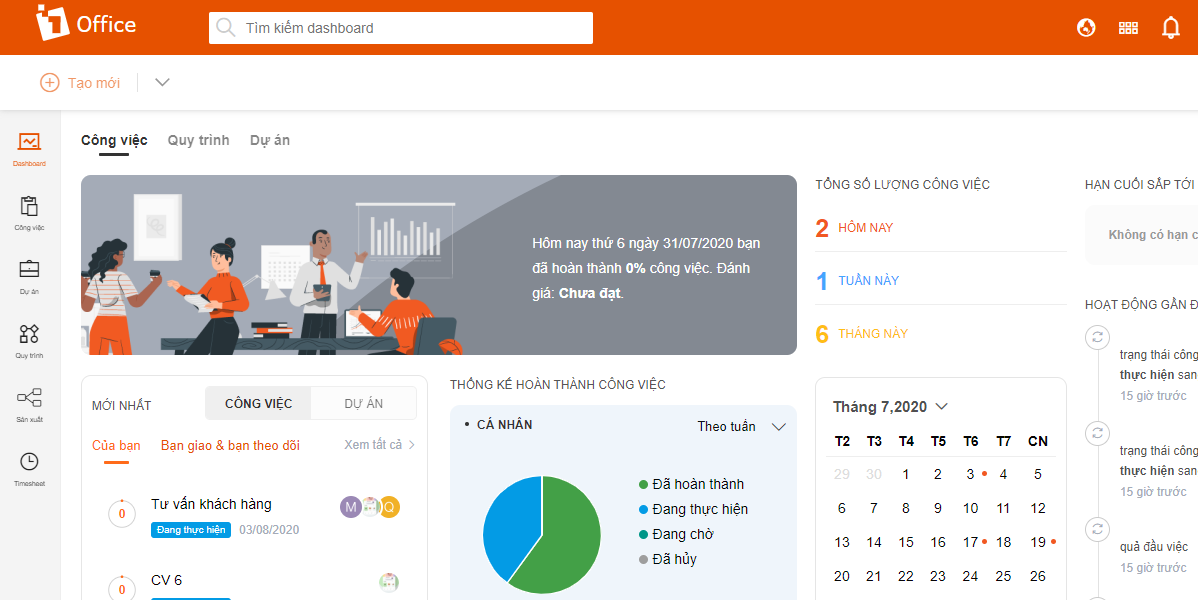
- With the 1CRM module, businesses can eliminate concerns about errors in import/export quantities; No more worries about being unable to track order statuses or unclear manual invoices; Responsible departments can easily monitor the work progress of each individual; Easily issue payment invoices to suppliers.
- In particular, 1Office offers the opportunity to digitize your business processes. With BPA 1Office, businesses can easily automate 90% of their processes, minimize manual work, and save time. 1Office grows with your business. Register now to experience a free demo!
6. Frequently Asked Questions about the business purchasing process
How to control “emergency purchases” that bypass the process?
Emergency purchases often lead to waste and legal risks. Businesses should establish a small budget limit for special cases and require retroactive approval within 24 hours. The best way is to use 1Office 1Process to digitize request submissions via phone, allowing managers to approve instantly, anytime, anywhere.
Register for a free feature Demo!
Should a single purchasing process be applied to all types of goods?
No. Businesses should classify goods according to their value and importance (Kraljic matrix).
- For office supplies (low value), the process should be simplified to save time.
- For strategic raw materials (high value), the process needs to be strict with multiple steps for supplier evaluation and contract negotiation.
How to detect early signs of fraud in the purchasing department?
Signs of fraud often include familiar suppliers repeatedly winning bids or purchase prices being higher than the market rate. Businesses should implement a cross-approval mechanism between the purchasing, accounting, and warehouse departments. Storing transaction history on a centralized platform like 1Office makes it easy for managers to cross-check and detect anomalies.
What is the role of periodic post-purchase supplier evaluation?
The process doesn’t end once the purchase is complete. Periodic evaluations based on defect rates and actual delivery times help businesses filter for high-quality partners. This serves as a basis for negotiating better discounts on long-term contracts or deciding to remove suppliers who do not meet standards.
What is the solution for optimizing the procurement process for businesses without a specialized IT team?
Businesses should choose comprehensive management platforms like 1Office that integrate AI Agents and No-code. This feature allows purchasing staff or managers to set up approval workflows and process diagrams themselves using simple drag-and-drop actions, enabling the system to operate flexibly according to the company’s specific characteristics without requiring complex technical knowledge.
7. Conclusion
In the article above, 1Office has provided you with knowledge on the topic of the procurement process. We have also shared 8 steps to implement an effective process for your business. To effectively digitize your procurement process, sign up for 1Office today!
For more detailed information, please contact:
- Hotline: 083 483 8888
- Zalo: https://zalo.me/nentang1office
- Facebook: https://www.facebook.com/1officevn/
- Youtube: https://www.youtube.com/@1office-chuyendoisodn
















