09/05/2026
  1782 views
When an incident requiring verification occurs, an incident report helps the involved parties clearly present the sequence of events, causes, time, location, and responsibilities of each party. If the report lacks information or is presented incoherently, the process of resolving the incident can become difficult. The article below provides the latest incident report template, along with instructions on how to write one and important notes for its use.
Mục lục
- 1. General Information about Incident Reports
- 3. Các lưu ý quan trọng khi viết biên bản tường trình
- 4. Tổng hợp 8+ Mẫu biên bản tường trình phổ biến (Tải Miễn Phí File Word/PDF)
- Mẫu 1: Mẫu tường trình sự việc xảy ra trong công ty/cơ quan
- Mẫu 2: Mẫu tường trình sự việc cá nhân (mất tài sản, nhầm lẫn,…)
- Mẫu 3: Mẫu tường trình tai nạn giao thông
- Mẫu 4: Mẫu tường trình tai nạn lao động
- Mẫu 5: Mẫu tường trình vi phạm nội quy công ty
- Mẫu 6: Mẫu tường trình mất mát tài sản công ty
- Mẫu 7: Mẫu tường trình về sự cố kỹ thuật, hư hỏng thiết bị
- Mẫu 8: Mẫu tường trình chậm trễ tiến độ công việc
- 5. Câu hỏi thường gặp về biên bản tường trình (FAQ)
1. General Information about Incident Reports
Below is basic information to help you understand the nature, purpose, and legal value of an incident report in practice:
1.1. Definition and Nature of an Incident Report
An incident report (often simply called a report) is a common type of administrative document, prepared by an individual or a group directly involved to clearly and truthfully present the details of a specific event, mostly for incidents involving violations, accidents, or those with certain consequences.

Regarding the definition:
This is a document that reflects the incident from the perspective of the person who directly participated in or witnessed it, fully detailing elements such as the time, location, sequence of events, causes, consequences, and the writer’s level of responsibility.
Regarding its legal and administrative nature:
An incident report is not a legal normative document but belongs to the category of ordinary administrative documents, prepared according to the format specified in Decree 30/2020/ND-CP on clerical work. The document is a self-narrative, and the writer is fully responsible for the content presented. It is often used as initial evidence in administrative, labor, educational, or legal proceedings to serve the purposes of review, investigation, disciplinary action, or dispute resolution.
1.2. Differentiating Between “Biên bản tường trình” and “Bản tường trình”
In practice in Vietnam, the two terms “biên bản tường trình” and “bản tường trình” are often used interchangeably and both refer to a type of self-narrated document by an individual.
- Bản tường trình: This is the most common term, emphasizing that the directly involved individual writes it themselves to present their perspective, accept responsibility, and commit to rectifying the consequences.
- Biên bản tường trình: Sometimes used to emphasize a formal, recording nature. However, there is no clear difference in substance. The term “biên bản” (record/minutes) is typically associated with documents created by an authority or authorized person to objectively record an event (e.g., an administrative violation record), whereas a “bản tường trình” is a document created by an individual.
In administrative, labor, and educational practice, the phrase “biên bản tường trình” is still commonly used to refer to an individual’s self-narrated document, and this does not change its value or legal nature.
Current law does not stipulate a rigid distinction between the two names; both are understood as documents created by an individual to report an incident as a basis for review and action.
1.3. Purpose and Role of an Incident Report
An incident report plays a crucial role in ensuring that the process of handling an incident is objective, transparent, and evidence-based.
- Provide truthful information about the incident: It helps to fully reconstruct the sequence of events, clarify subjective and objective causes, and determine the resulting consequences.
- Serve as a basis for review and action by agencies and organizations: It is the initial document for management, state agencies, or legal authorities to assess the severity of the violation and make appropriate decisions regarding discipline, compensation, or penalties.
- Demonstrate the writer’s responsibility and attitude: <span style="
Full reference template for Part 1 (Introduction): SOCIALIST REPUBLIC OF VIETNAM
Independence – Freedom – Happiness
—————–
Hanoi, December 31, 2025
INCIDENT REPORT
Subject: Late arrival for work on December 30, 2025
To: The Board of Directors of ABC Co., Ltd.
(Or: Mr. Nguyen Van B – Director)
Part 2: Main Content
This is the most important section and should be presented in a detailed, logical, objective, and chronological manner.
(1) Reporter’s Information (left-aligned, clearly listed):
- Full name: ………………………………
- Date of birth: ………………………………
- Position/Class: ……………………….
- Department/Place of study: ………………
- Permanent address: ……………………..
- Phone number: …………………………..
(2) Information about the incident (start with the introductory sentence: “I am writing this report to present the incident as follows:”):
- Time and location of the incident: State the exact hour, minute, date, and specific location.
- Detailed and objective account of events: Narrate in chronological order, use the first person, and clearly describe “who – what – where – when – how”. Avoid personal emotions or blaming.
- Cause of the incident: Analyze subjective (personal) and objective causes (if any).
- Consequences and extent of damage: Describe specific damages to property, health, morale, or impact on work (if any).
- People involved: List the names, positions, and roles of witnesses or other participants (if any).
Reference template for Part 2 (Main Content) My name is: ………
Date of birth: ……..
Position: ……..
Department/Unit: ……..
Permanent address: ……..
Phone number: ……..
I am writing this report to clearly and truthfully present the incident of violating labor regulations (arriving late for work) as follows:
1. Time and location of the incident:
– Time: 08:30 AM, December 30, 2025.
– Location: Office of ABC Co., Ltd., address …………
2. Detailed account of the incident:
– I left home at 07:30 AM to go to work, with the official start time being 08:00 AM.
– At approximately 08:15 AM, I was stuck in a severe traffic jam at …… due to a traffic accident (a motorcycle collision).
– I arrived at the office at 08:30 AM, 30 minutes late, and immediately reported to my direct manager (Mr. Tran Van B).
3. Cause of the incident:
– Subjective cause: I left 10 minutes later than planned because I overslept (lack of personal responsibility).
– Objective cause: Traffic jam due to an unexpected traffic accident (confirmed by traffic cameras and witnesses).
4. Consequences and extent of damage:
– No property or financial damage was caused.
– Affected the morning department meeting schedule (delayed by 15 minutes), reducing individual and team productivity for the morning.
5. Individuals involved:
– Mr. Tran Van B (Sales Department Manager): Witnessed my late arrival and issued a reminder.
– Ms. Le Thi C (colleague): Confirmed the traffic situation when I called to report at 08:20 AM.
I am fully aware that my lateness violated Article 5, Clause 2 of the Company’s Labor Regulations (regarding working hours). This is my first violation in 2025, and I sincerely acknowledge my mistake and deeply regret this lack of responsibility.
Part 3: Commitment and Conclusion
This section demonstrates a responsible attitude and increases the legal validity of the document.
(1) Personal Responsibility:
- Clearly acknowledge the violation (if any) and which internal rule or regulation it violates.
- Show remorse and sincerely admit fault.
(2) Pledges and Suggestions:
- Commit to rectifying the consequences (if any), learn from the experience, and not repeat the offense.
- Pledge of honesty: “I hereby declare that the entire content of the above report is true and I take full legal responsibility for this content.”
- Suggestion (if appropriate): “I respectfully request that the Agency/Board of Directors consider a lenient form of disciplinary action…”
(3) Signature and Full Name (right-aligned): Reporter – Sign and write full name)
Sample for the entire Part 3 (Commitment and Conclusion) I will seriously learn from this incident and commit to managing my time more reasonably, leaving earlier to ensure I arrive on time as per the Company’s regulations. I promise not to repeat a similar violation in the future.
I hereby affirm that the entire content of this report is true, without any additions, omissions, or distortion of information. I take full responsibility before the law and the Company for the content presented.
I respectfully request the Board of Directors and the Department Manager to consider this as a first-time offense with partially objective reasons, in order to mitigate the disciplinary action and allow me the opportunity to continue striving and completing my assigned tasks well.
Thank you sincerely!
Reporter (Sign and print full name)
Nguyen Van A
Hướng dẫn chi tiết cấu trúc & cách viết biên bản tường trình đầy đủ, chuẩn xác
3. Các lưu ý quan trọng khi viết biên bản tường trình
Dưới đây là những lưu ý then chốt cần nắm rõ để biên bản tường trình được trình bày đúng chuẩn, có giá trị pháp lý và hỗ trợ tốt cho quá trình xử lý sự việc:
Lưu ý 1: Bảo đảm tính trung thực và khách quan
Nội dung tường trình phải phản ánh đúng sự thật, tuyệt đối không bóp méo, thêm bớt, suy diễn hoặc che giấu thông tin. Người viết không nên né tránh trách nhiệm hoặc quy toàn bộ lỗi cho người khác hay yếu tố khách quan nếu bản thân có liên quan.
Việc cố tình khai báo không đúng sự thật có thể khiến vụ việc trở nên nghiêm trọng hơn, dẫn đến hình thức xử lý nặng hơn và trong một số trường hợp còn có thể phát sinh trách nhiệm pháp lý theo quy định của pháp luật (điển hình là hành vi khai báo gian dối).

Các lưu ý quan trọng khi viết biên bản tường trình Lưu ý 2: Sử dụng ngôn ngữ chuẩn mực, rõ ràng
Bản tường trình cần được viết bằng tiếng Việt chuẩn, văn phong hành chính nghiêm túc, lịch sự và súc tích. Nên trình bày ở ngôi thứ nhất với thái độ cầu thị, hợp tác. Tránh dùng từ ngữ cảm tính, tiếng lóng, cách diễn đạt thiếu chuẩn mực hoặc câu văn quá dài, rườm rà. Các ý cần được sắp xếp mạch lạc, theo trình tự thời gian để người đọc dễ dàng nắm bắt diễn biến sự việc.
Lưu ý 3: Trình bày đầy đủ thông tin liên quan
Nội dung cần bao quát các yếu tố quan trọng như: thời gian, địa điểm, diễn biến cụ thể, cá nhân liên quan hoặc nhân chứng (nếu có), nguyên nhân dẫn đến sự việc và hậu quả phát sinh.
Không nên bỏ qua những chi tiết có ảnh hưởng đến việc xác định trách nhiệm, mức độ vi phạm hay thiệt hại. Trường hợp có tài liệu, hình ảnh, biên bản hoặc giấy tờ liên quan, cần nêu rõ và đính kèm theo yêu cầu của cơ quan tiếp nhận.
Lưu ý 4: Rà soát kỹ nội dung trước khi nộp
Trước khi gửi bản tường trình, người viết nên đọc lại toàn bộ văn bản để kiểm tra lỗi chính tả, ngữ pháp và tính chính xác của các mốc thời gian, số liệu. Đồng thời, cần đảm bảo các tình tiết được trình bày thống nhất, không mâu thuẫn. Nếu viết tay, chữ viết phải rõ ràng, sạch sẽ; nếu đánh máy, cần trình bày đúng thể thức văn bản hành chính.
Lưu ý 5: Nộp bản tường trình đúng thời hạn
Thông thường, bản tường trình được yêu cầu nộp trong thời gian ngắn sau khi xảy ra sự việc hoặc sau khi nhận được yêu cầu (thường từ 24-48 giờ). Việc chậm trễ có thể bị đánh giá là thiếu hợp tác và ảnh hưởng bất lợi đến quá trình xử lý. Trong trường hợp có lý do chính đáng không thể nộp đúng hạn, người viết cần chủ động thông báo hoặc xin gia hạn theo đúng quy định.
Lưu ý 6: Cam đoan và chịu trách nhiệm về nội dung
Cuối bản tường trình cần có lời cam đoan rõ ràng, khẳng định toàn bộ nội dung trình bày là đúng sự thật và người viết hoàn toàn chịu trách nhiệm trước pháp luật. Phần cam đoan này thể hiện sự nhận thức đầy đủ về trách nhiệm pháp lý, đồng thời làm tăng độ tin cậy và giá trị chứng minh của văn bản.
Các lưu ý quan trọng khi viết biên bản tường trình để đảm bảo hiệu quả & pháp lý
4. Tổng hợp 8+ Mẫu biên bản tường trình phổ biến (Tải Miễn Phí File Word/PDF)
Dưới đây là tổng hợp các mẫu biên bản tường trình phổ biến mà cá nhân, doanh nghiệp và tổ chức thường sử dụng. Các mẫu này được thiết kế sẵn theo thể thức hành chính chuẩn, có thể tải về miễn phí dưới dạng Word hoặc PDF và điền trực tiếp thông tin thực tế.
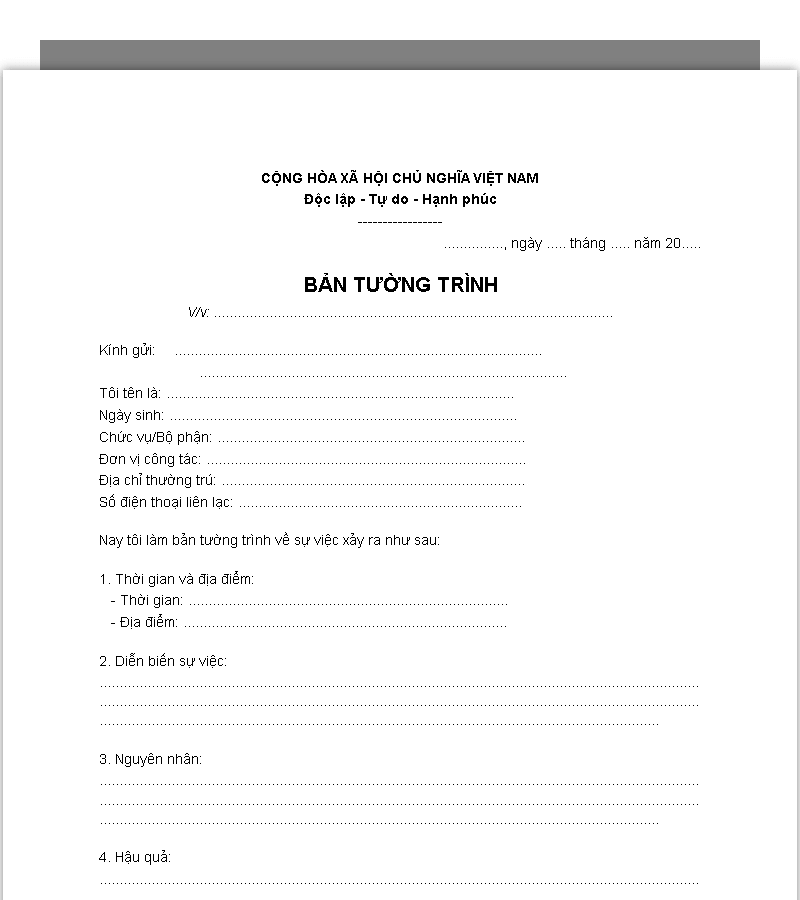
Mẫu 1: Mẫu tường trình sự việc xảy ra trong công ty/cơ quan
Mẫu tường trình sự việc xảy ra trong công ty hoặc cơ quan phù hợp với các tình huống phát sinh tại nơi làm việc như xung đột nội bộ, sự cố công việc hoặc nhầm lẫn. Văn bản ghi rõ thời gian, địa điểm, diễn biến, nguyên nhân, hậu quả và những người liên quan.

Mẫu tường trình sự việc xảy ra trong công ty >>> Tải ngay file Mẫu tường trình sự việc xảy ra trong công ty/cơ quan
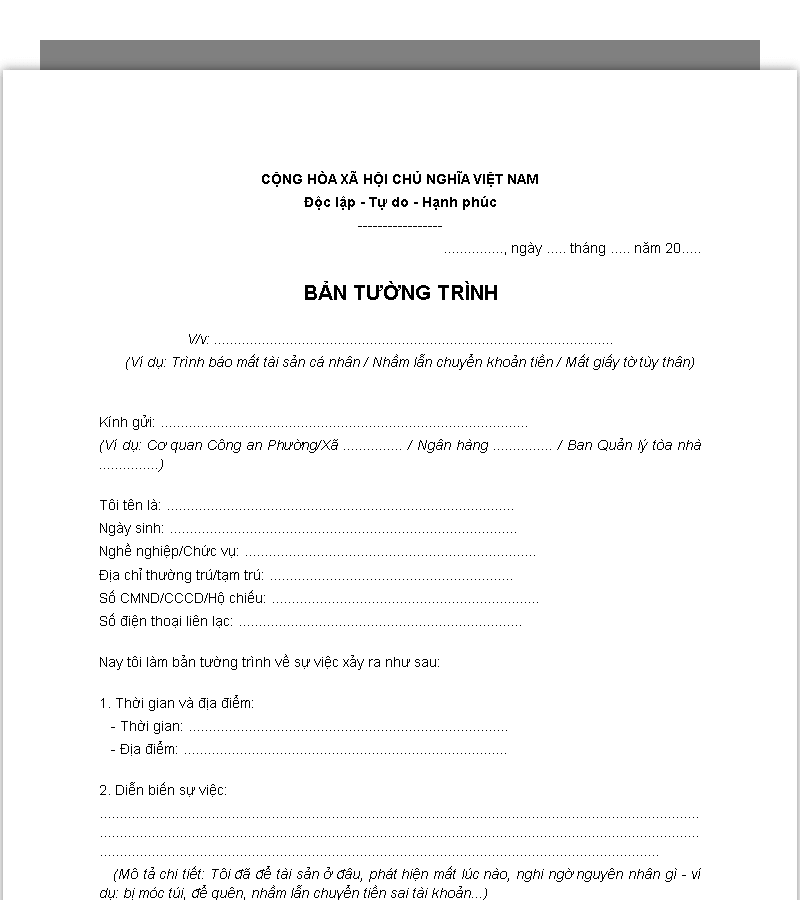
Mẫu 2: Mẫu tường trình sự việc cá nhân (mất tài sản, nhầm lẫn,…)
Mẫu tường trình sự việc cá nhân được sử dụng khi xảy ra mất tài sản, nhầm lẫn giấy tờ, thất lạc hồ sơ hoặc các sự việc cá nhân liên quan đến cơ quan, tổ chức. Nội dung cần thể hiện đầy đủ thông tin người tường trình và quá trình xảy ra sự việc.
Mẫu tường trình sự việc cá nhân, mất tài sản, nhầm lẫn >>> Tải ngay file Mẫu tường trình sự việc cá nhân
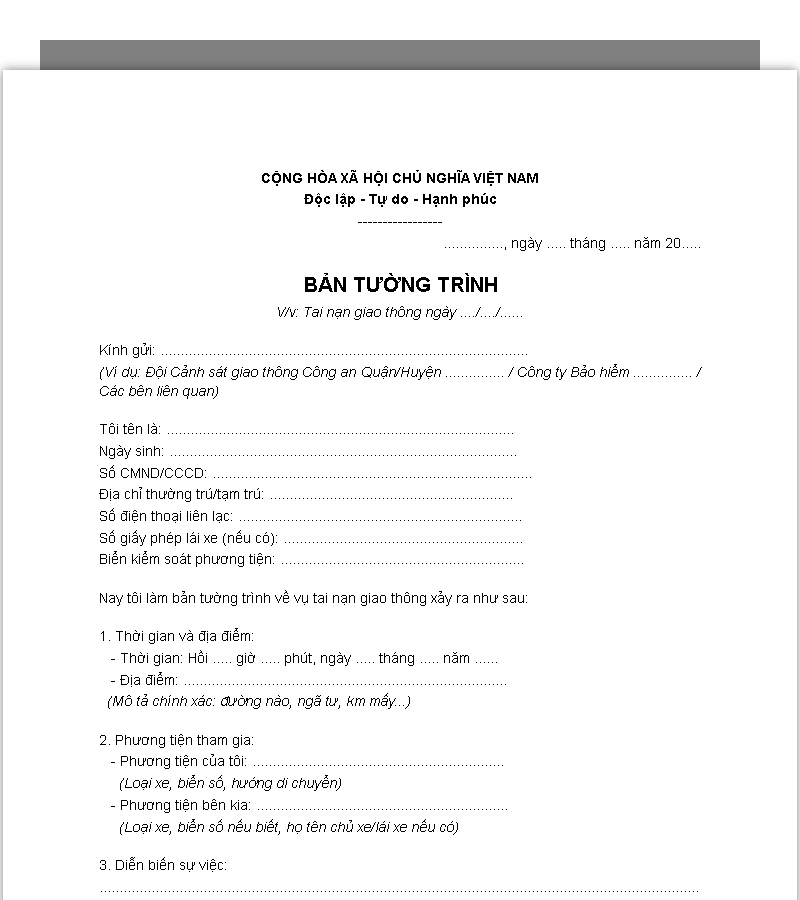
Mẫu 3: Mẫu tường trình tai nạn giao thông
Mẫu tường trình tai nạn giao thông thích hợp khi gặp tai nạn cần lập tường trình cho cơ quan công an hoặc bảo hiểm. Nội dung ghi rõ thông tin các bên liên quan, diễn biến sự việc, nguyên nhân và hậu quả.
Mẫu tường trình tai nạn giao thông >>> Tải ngay file Mẫu tường trình tai nạn giao thông
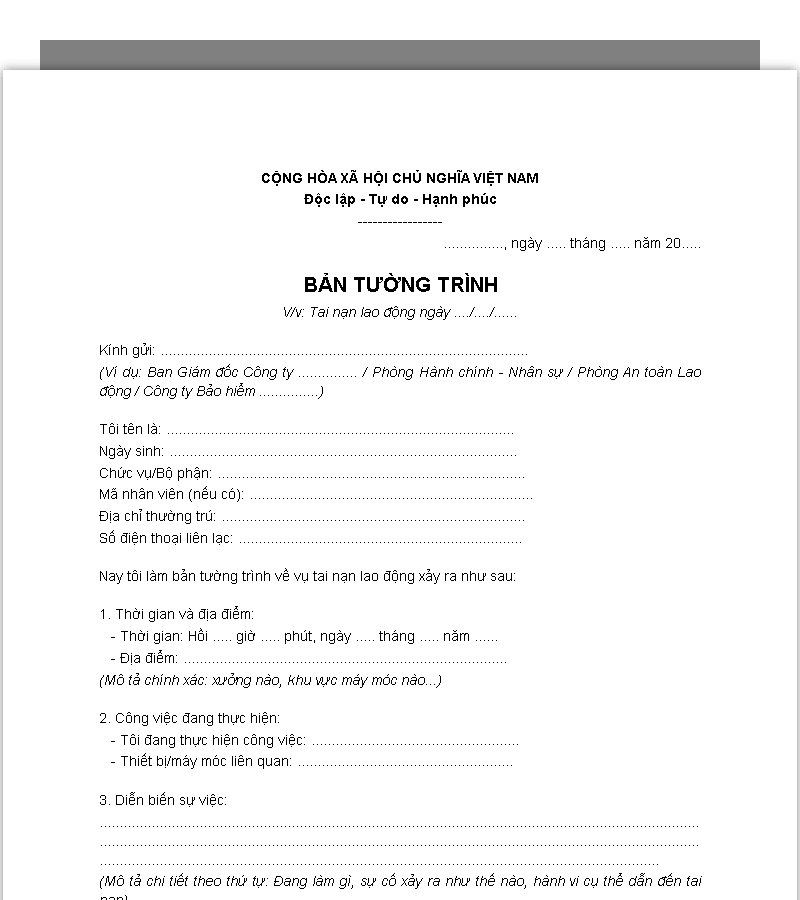
Mẫu 4: Mẫu tường trình tai nạn lao động
Mẫu tường trình tai nạn lao động dành cho môi trường công nghiệp, xây dựng hoặc văn phòng khi xảy ra tai nạn lao động cần ghi nhận. Văn bản bao gồm thông tin nạn nhân, thời gian, địa điểm, nguyên nhân, hậu quả và người chứng kiến.
Mẫu tường trình tai nạn lao động >>> Tải ngay file Mẫu tường trình tai nạn lao động
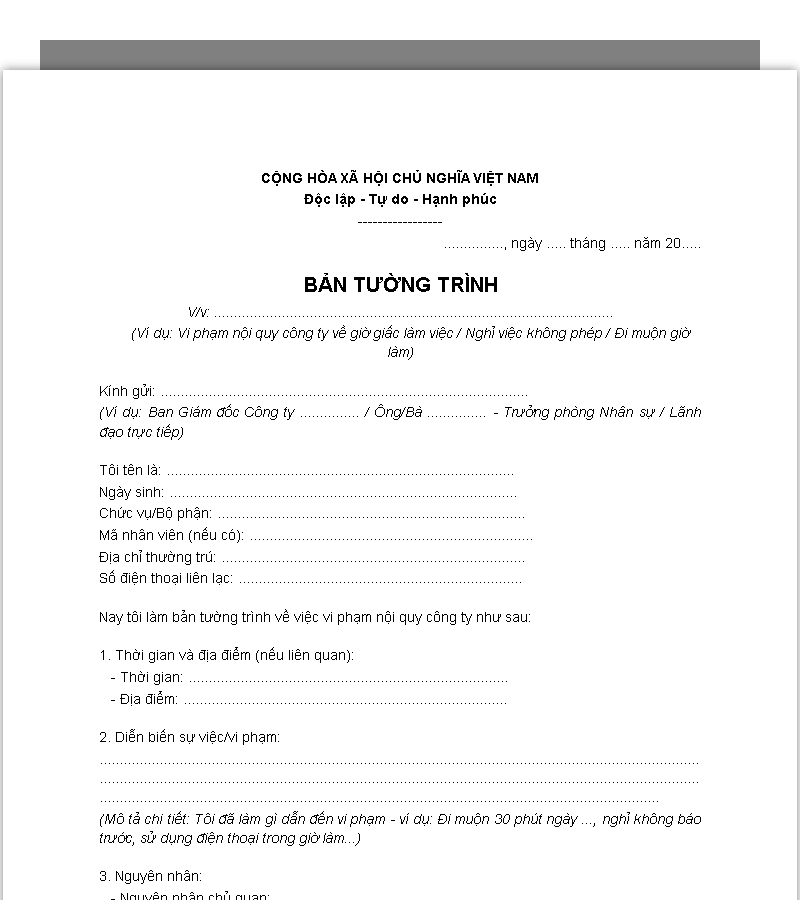
Mẫu 5: Mẫu tường trình vi phạm nội quy công ty
Mẫu tường trình vi phạm nội quy công ty áp dụng khi nhân viên vi phạm nội quy, quy định công ty như đi muộn, nghỉ không phép, vi phạm an toàn lao động hoặc gây thiệt hại tài sản. Văn bản trình bày rõ hành vi vi phạm, diễn biến, hậu quả và nhận trách nhiệm.
Mẫu tường trình vi phạm nội quy công ty >>> Tải ngay file Mẫu tường trình vi phạm nội quy công ty
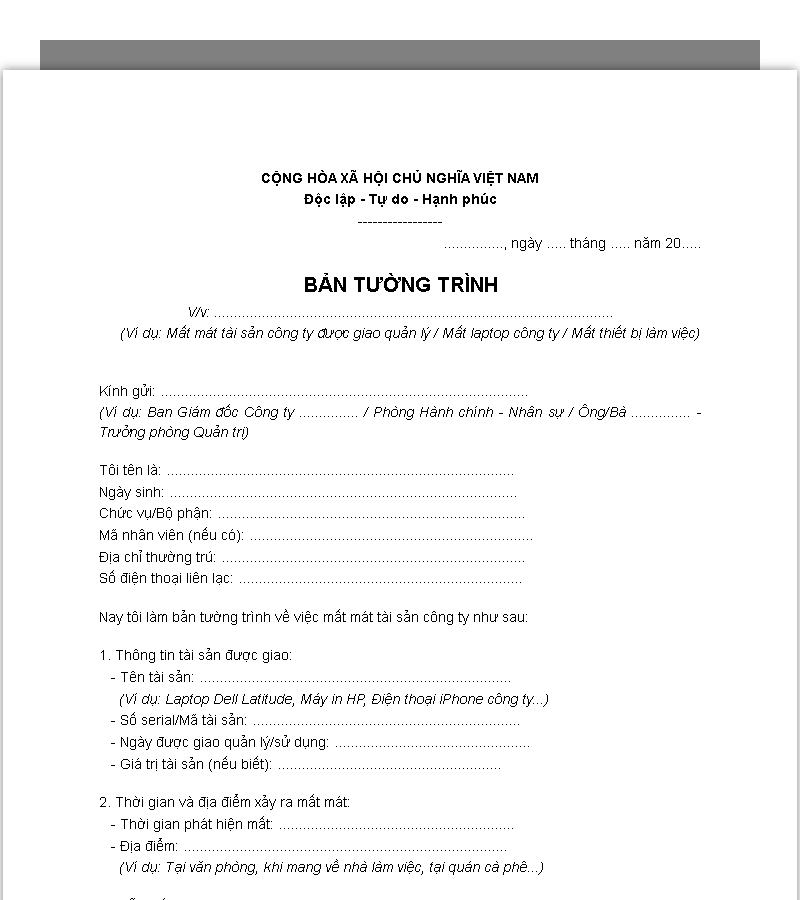
Mẫu 6: Mẫu tường trình mất mát tài sản công ty
Mẫu tường trình mất mát tài sản công ty dùng trong các trường hợp hư hỏng hoặc mất mát tài sản, thiết bị của công ty. Nội dung cần ghi rõ loại tài sản, thời gian, diễn biến sự việc và những người liên quan.
Mẫu tường trình mất mát tài sản công ty >>> Tải ngay file PDF Mẫu tường trình mất mát tài sản công ty
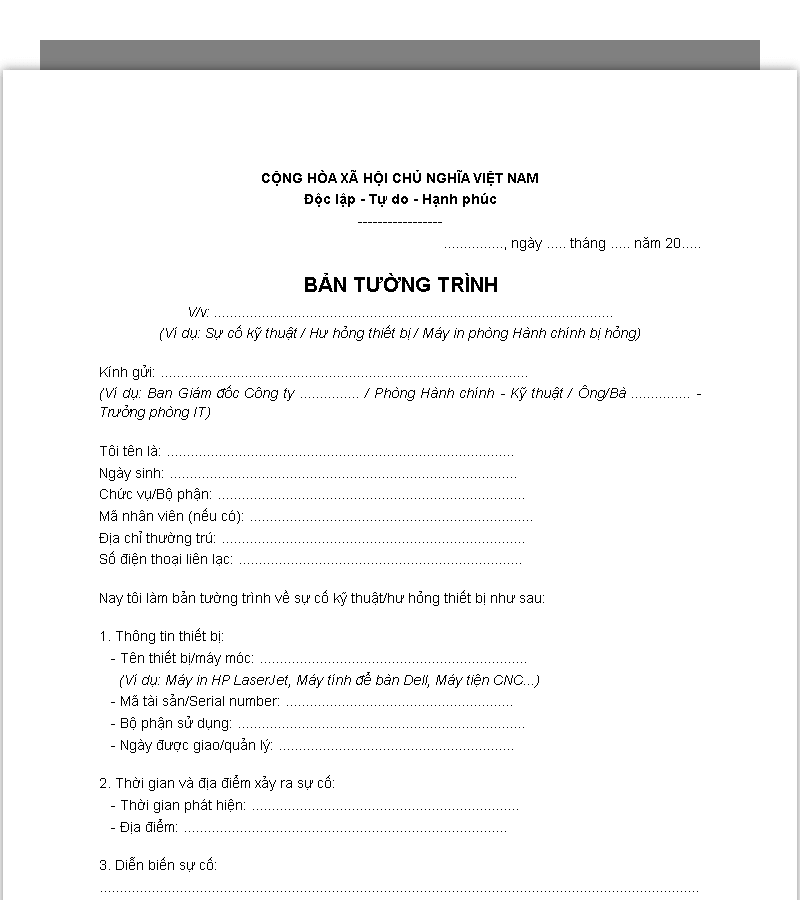
Mẫu 7: Mẫu tường trình về sự cố kỹ thuật, hư hỏng thiết bị
Mẫu tường trình về sự cố kỹ thuật, hư hỏng thiết bị áp dụng khi thiết bị, máy móc hoặc hệ thống gặp sự cố. Văn bản cần thông tin chi tiết về loại thiết bị, thời gian xảy ra sự cố, nguyên nhân, mức độ thiệt hại và biện pháp khắc phục tạm thời.
Mẫu tường trình sự cố kỹ thuật hư hỏng thiết bị >>> Tải ngay file PDF Mẫu tường trình về sự cố kỹ thuật, hư hỏng thiết bị
Mẫu 8: Mẫu tường trình chậm trễ tiến độ công việc
Mẫu tường trình chậm trễ tiến độ công việc được sử dụng khi công việc, dự án hoặc nhiệm vụ bị chậm tiến độ. Văn bản ghi rõ công việc, lý do chậm trễ, ảnh hưởng đến tiến độ chung và các biện pháp khắc phục.
Mẫu tường trình chậm trễ tiến độ công việc >>> Tải ngay file PDF Mẫu tường trình chậm trễ tiến độ công việc
5. Câu hỏi thường gặp về biên bản tường trình (FAQ)
Question 1: Is it mandatory for an incident report to be stamped?
No. An incident report is a document created by an individual, not an administrative document issued by an agency or organization. According to regulations on clerical work, stamping only applies to official documents such as official letters, decisions, and notices from the unit. For an incident report, the full signature and name of the writer are the elements that confirm its value and legal responsibility; a stamp from the agency or organization is not required.
Question 2: Can an incident report be handwritten?
Yes. The writer can choose to handwrite or type the report, depending on the requirements of the receiving unit. In practice, in many cases at schools, businesses, or police agencies, handwriting is even encouraged to show a serious, voluntary attitude and to make handwriting verification easier. If typed, it must be formatted according to administrative document standards, then printed and signed directly.
Question 3: What happens if incorrect information is written in an incident report?
Depending on the nature and extent of the error, the consequences may vary:
- Unintentional errors (such as mistaken times, missing minor details): you will usually be asked to correct, supplement, or rewrite the report for clarification.
- Dishonest reporting, intentionally concealing or distorting the facts: may lead to stricter disciplinary actions, from internal discipline to legal liability according to regulations on fraudulent declaration.
Therefore, the end of the incident report should always include a statement affirming the truthfulness of the content presented.
Question 4: Who should the incident report be submitted to?
The incident report should be submitted to the person or authority responsible for requesting and resolving the matter, specifically:
- In a business: your direct manager, the HR department, or the Board of Directors.
- At a school: the homeroom teacher, the school board, or the disciplinary council.
- For administrative or judicial matters: the police, local authorities, or an investigative agency.
The “To” section at the beginning of the document should clearly state the receiving unit or individual.
Question 5: What is the legal value of an incident report?
An incident report is not a legal normative document, but rather a personal administrative document of a declarative and narrative nature.
Legally, this document is considered initial evidence, used as a basis for competent agencies or organizations to review, verify, impose disciplinary action, or resolve disputes. In some cases, an incident report can be used as a statement or supporting evidence in legal proceedings, but it does not have independent decisive value and must be corroborated with other evidence.
We hope the incident report templates shared in this article will help you easily choose and apply the right one for each specific situation. Using a standard template, providing truthful content, and following the correct format not only improves processing efficiency but also protects the legal rights of the person writing the report.