


Retirement Decision Form 2026: Detailed Guide & Latest Procedures


Mục lục
- 1. What is a retirement decision template?
- 2. What is the difference between a retirement notice and a retirement decision?
- 3. Standard and Latest Retirement Decision Templates (2026)
- 4. Legal Regulations on Retirement Age & Conditions, Updated 2026
- 5. Process and procedures for retirement settlement and issuance of the Retirement Decision
- 6. Frequently Asked Questions about Retirement Procedures (FAQ)
- 7. Conclusion
1. What is a retirement decision template?
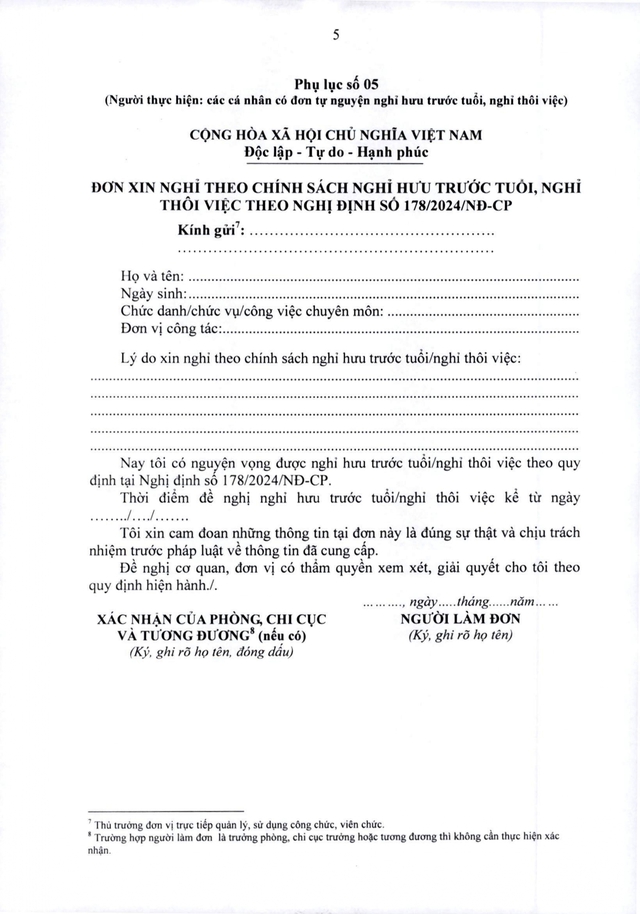
The retirement decision template is an administrative document issued by an agency, organization, business, or authorized person to confirm the time when an official, civil servant, public employee, or employee officially terminates their working relationship (or employment contract) and begins to receive retirement benefits in accordance with the social insurance law. This document is a mandatory basis for the Social Insurance agency to process pensions, issue books, and related benefits.
Legally, this document serves to accurately determine the retirement date for calculating pension benefits. Therefore, all information such as full name, date, and Social Insurance number must be absolutely accurate to avoid errors that could lead to delays or affect the employee’s rights.
The authority to issue the decision depends on the type of organization.
- For businesses, companies (private sector): The legal representative or Director/General Director signs the decision.
- For state agencies: The head of the unit (Chairman, Director, Minister depending on the level); for officials, civil servants, and public employees, there are also templates and procedures according to the regulations of the Ministry of Home Affairs and relevant sectoral decrees.
2. What is the difference between a retirement notice and a retirement decision?
The core difference lies in their legal nature: a retirement notice is a preparatory document that helps the business and the individual proactively arrange for personnel; while a retirement decision is an official, binding document used to process Social Insurance benefits and terminate the employment relationship.
| Criteria | Retirement Notice | Retirement Decision |
| Purpose | To provide early information about the retirement plan so that the employee and department can prepare for the work handover. | To officially terminate the employment relationship and serve as a basis for settling policies and benefits. |
| Legal Validity | An internal administrative document, serving an organizational preparatory purpose. | The highest legal document, bearing the signature and seal of the authorized person. |
| Insurance Dossier | Not a mandatory document when preparing the dossier to receive Social Insurance benefits. | Mandatory for the Social Insurance agency and related units to implement the benefits. |
| Issuance Time | Usually sent a certain period before the retirement date (according to internal regulations or labor law). | Issued close to the retirement date and effective from the date stated in the decision. |
| Nature | Informational, a reminder, and for personnel preparation. | An order, for execution, and to finalize legal benefits. |
3. Standard and Latest Retirement Decision Templates (2026)
3.1 Retirement Decision Template for Employees (Corporate/Private Sector)
The retirement decision template for employees in the corporate/private sector is drafted in accordance with official administrative document formats, ensuring full legal compliance with the Labor Code and the Law on Social Insurance.
This template helps businesses easily complete procedures for employees reaching retirement age, while ensuring transparency and accuracy when submitting documents to the Social Insurance agency. The document is presented in a clear, organized manner and can be applied to any business in any field.
Download the retirement decision template for employees HERE
3.2 Retirement Decision Template for Cadres, Civil Servants, and Public Employees (Public Sector)
This is a template specifically designed for cadres, civil servants, and public employees working in state agencies and public service units. The template’s content fully complies with the provisions of the Law on Cadres and Civil Servants, the Law on Public Employees, and related decrees, ensuring a strict format and adherence to proper procedures.
This decision template assists agencies and units in issuing retirement documents in a standardized, clear, and consistent manner in line with the state management system.
3.3 Early Retirement Decision Template (due to staff downsizing, health decline, etc.)
The early retirement decision template applies to special cases such as staff downsizing, reduced work capacity, or a conclusion from the Medical Assessment Council.
The document is designed based on the regulations in Decree 108/2014/ND-CP, Decree 143/2020/ND-CP, and the Law on Social Insurance, helping to ensure that early retirement considerations are carried out in accordance with regulations, with a full legal basis, and to avoid errors when preparing documents for the Social Insurance agency.
Download the Early Retirement Decision Template (due to staff downsizing, health decline, etc.) HERE
4. Legal Regulations on Retirement Age & Conditions, Updated 2026
This is the most critical legal section — all age figures and roadmaps must be cross-referenced with Decree 135/2020/ND-CP and the retirement age lookup table published on government portals/legal websites.
4.1 Retirement Age According to Current Regulations (2019 Labor Code & Decree 135/2020/ND-CP)
Decree 135/2020 stipulates that starting from 2021, a roadmap to increase the retirement age will begin: for regular employees, the retirement age will gradually increase each year (3 months/year for men, 4 months/year for women) until it reaches the specified maximum.
Selected Roadmap (Milestones 2021 → 2028/2035):
- 2021: Men 60 years and 3 months; Women 55 years and 4 months.
- 2022: Men 60 years and 6 months; Women 55 years and 8 months.
- 2023: Men 60 years and 9 months; Women 56 years and 0 months.
- 2024: Men 61 years and 0 months; Women 56 years and 4 months.
- 2025: Men 61 years and 3 months; Women 56 years and 8 months.
- 2026: Men 61 years and 6 months; Women 57 years and 0 months.
- 2027: Men 61 years and 9 months; Women 57 years and 6 months.
- 2028: Men 62 years (completion milestone for men); Women will continue to increase to 60 years by 2035 according to the roadmap.
Minimum Social Insurance Contribution Period:
- To receive a pension under the prescribed regime, employees need to have contributed to social insurance for at least 20 years (Law on Social Insurance 2014 and guidelines). If they do not have 20 years of contributions, employees can choose to continue contributing or receive a one-time payout (according to regulations on one-time benefits) — but a one-time payout means they will not receive a monthly pension.
>> See more: Latest Power of Attorney Template 2026 for Businesses
>> See more: Latest Resignation Decision Template 2026 [Professional, easy to use]
4.2 Cases Eligible for Retirement Earlier Than the Prescribed Age
The Decree and guiding documents list cases eligible for early retirement (up to 05 years earlier) or early retirement without pension reduction, depending on the case:
- Heavy, hazardous, or dangerous labor: if the job is on the specified list and the employee has worked long enough in the profession (usually ≥15 years in heavy labor), they may retire earlier than the standard age.
- Working in regions with particularly difficult socio-economic conditions: some areas have early retirement policies.
- Reduced work capacity: when work capacity is reduced to a legally specified level (e.g., ≥61%), they can proceed with retirement procedures and receive corresponding benefits.
- Staff downsizing (public sector): according to Decree 108/2014 and its amendment 143/2020, cadres, civil servants, and public employees subject to downsizing who meet the social insurance contribution requirements are eligible for early retirement and will receive benefits as regulated.
4.3 Cases of retirement later than the prescribed age (extended retirement)
Retirement later than the prescribed age (extending the working period) is a policy that allows employees to continue working after reaching the retirement age according to the roadmap in Decree 135/2020/ND-CP. This policy applies in special cases, based on the needs of the unit and the consent of the employee.
Cases where late retirement is applicable
- Employees with high professional qualifications who hold important roles in the unit.
- Cadres, civil servants, and public employees holding key positions that are difficult to replace immediately.
- Employees who are still in good health as concluded by a competent medical authority.
- The unit needs to extend the working period to ensure the stability and continuity of professional activities.
Conditions to be met
- There must be a written agreement between the employee and the employer.
- Not in an occupation or position where retirement at the prescribed age is mandatory.
- The maximum extension period varies by occupational group, as guided by the competent authority.
- There is an assessment of capacity, health, and job position needs.
5. Process and procedures for retirement settlement and issuance of the Retirement Decision
To avoid delays, businesses/units need to follow a systematic process. Below is a detailed checklist & reference timeline.
5.1 Overall process (from the employer’s / management agency’s side)
Step 1: Review & Notification
- Identify subjects: review the list of people approaching retirement age according to the roadmap table.
- Check the social insurance book: ensure data (book number, contribution years, social insurance contribution salary) is accurate.
- Internal notification: issue a retirement notice to the employee, departments, and accounting to prepare the documents.
Step 2: Issue the Retirement Decision
- Draft the decision according to the template (see part II) — sign & stamp.
- Send the original to the employee, save the file in the personnel record.
- Note: if there are corrections (e.g., errors), issue an adjustment decision (Decision on amendments and supplements).
Step 3: Complete the social insurance benefit application
- Standard documents include: Original social insurance book, Retirement Decision (original), ID card/Citizen ID card/Passport, Pension application form (Form 14-HSB or a form provided by the Social Insurance agency), copies of related documents (notarized if required).
- Attached: a copy of the downsizing decision/medical assessment certificate if retiring early.
Step 4: Submit the application to the Social Insurance agency
- Submit in person or through the public service portal (if the business is integrated).
- Submission location: Provincial/city Social Insurance or District Social Insurance where contributions were made.
Step 5: Social Insurance benefit processing
- The Social Insurance agency reviews, cross-references, finalizes the book, and issues a decision on pension entitlement; this usually takes 7–30 working days depending on the workload and completeness of the documents. If additional documents are required, the time may be extended.
- Note: in case of errors, the Social Insurance agency will request corrections; the business/employee needs to coordinate quickly to avoid delays in receiving benefits.
5.2 Documents to prepare for retirement benefits (details)
The standard documents (for employees) to prepare for retirement benefits include:
- Original social insurance book.
- Retirement Decision (original with a valid stamp/signature).
- Pension application form (template from the Social Insurance agency; will be provided at the submission location if needed).
- ID card/Citizen ID card/Passport (a certified copy or bring the original for comparison).
- Documents proving social insurance contributions elsewhere (if consolidating).
- Documents proving entitlement to allowances (if any): downsizing decision, medical assessment certificate, disability recognition document…
Requirements for copies & notarization:
- Some documents require certified copies as requested by the Social Insurance agency (each province has specific guidelines).
- If submitting in person, the Social Insurance agency usually compares it with the original; if submitting a copy, certification is required.
6. Frequently Asked Questions about Retirement Procedures (FAQ)
Does the retirement decision need an official red seal?
Yes. For decisions submitted to the Social Insurance agency, a valid signature and an official seal (physical stamp) or a legal digital signature are required by regulation. A missing seal will invalidate the application. (Especially for state agencies/public sector units, the seal is mandatory).
Can an employee retire if they have not contributed to social insurance for the required number of years?
Regarding termination of employment: They can stop working (by agreement or for personal reasons), but they will not receive a monthly pension if they have not met the social insurance contribution requirement (20 years) — unless otherwise specified in special cases. The employee can continue to make voluntary social insurance contributions to qualify for a pension later.
What should be done if there are errors in the Retirement Decision?
If discovered before submitting to the Social Insurance agency: Issue an adjusted/amended Decision (clearly stating the reason for the correction, with a signature and seal).
If discovered after the Social Insurance agency has processed it: It is necessary to coordinate with the Social Insurance agency to carry out procedures for adjustment and supplementation of the file; depending on the error, a written explanation or a correction record may be required. Important: do not use a temporary “fix-it” document — there must be an official amendment to avoid complaints.
When does the retirement decision take effect?
The decision takes effect from the date stated in the decision (if the decision specifies a retirement start date). If no other effective date is specified, it defaults to the signing date (but organizations usually specify a concrete retirement date). The effective date of the decision is the date the Social Insurance agency uses as a basis to begin processing pension benefits.
7. Conclusion
Issuing a correct, timely, and compliant Retirement Decision Form not only ensures the rights of employees but also helps agencies and businesses comply with the law and limit potential risks. We hope the sample decisions, procedural guides, and important notes in this article have helped you apply them easily in practice. During implementation, businesses should regularly update themselves on new regulations to ensure accuracy and consistency in personnel management.




