In every business, KPI templates for sales staff are considered a measure of each individual’s work performance. Setting KPIs not only helps business owners easily track work progress but also helps employees work more responsibly. Join 1Office in exploring the latest KPI templates for the sales department in the following article!
A KPI template for sales staff is a set of criteria for evaluating the performance of the Sales department, built based on the business goals of the company in each period.
KPIs (Key Performance Indicators) help measure the work completion level of sales staff through specific metrics such as: revenue, number of new contracts, conversion rate, number of calls, number of potential customers, customer care level, customer retention rate, etc.
KPI templates are used to:
Quantitatively track sales performance
Accurately measure the capabilities of each employee
Optimize business operations on a monthly/quarterly/yearly basis
Serve as a basis for transparent and fair salary and bonus payments
Motivate employees to achieve revenue targets
Thanks to clear KPI templates, businesses can easily standardize the evaluation process and ensure transparency in human resource management.
II. Key indicators in KPIs for sales staff
1. Number of new contacts (New Leads/Opportunities)
The number of new contacts is a top priority indicator in the KPI template for the sales department. This is an important KPI indicator that managers need to monitor regularly.
By looking at these indicators, managers can grasp the weekly/monthly conversion rate, whether the number has increased or decreased compared to the previous period, whether the staff has contacted customers, etc.
From there, they can evaluate sales effectiveness and the reasons for increases or decreases in sales revenue to provide timely solutions. Most managers will need to have a full grasp of this data to make appropriate adjustments.
Current KPI indicators for sales staff
2. Cost to acquire new customers
One of the indispensable indicators in sales staff KPIs is the cost to acquire a new customer. Managers will use this cost to adjust and change their approach to customers.
Through KPI indicators for sales staff, managers will know which employees are performing well by comparing conversion rates among them. From there, they can devise solutions for adjustments and new personnel replacements.
3. Sales revenue by location
Comparing sales revenue in different locations during the same period will help managers identify potential areas for business development.
In some specific cases, directors and CEOs will use the KPI form for sales staff as a basis for controlling demand and finding solutions for sales discrepancies between different periods.
In reality, business owners should not track the activities and products of competitors, because each business has a different business strategy.
However, if you pay attention, you will see that comparing and researching competitors also helps you identify the “golden” time to launch promotional programs to better attract customers.
Building a KPI template for the sales department based on price analysis
5. KPI for evaluating Sales through engagement with existing customers
For business operations, maintaining a good relationship with customers is extremely important. By regularly keeping in touch with customers and proposing solutions to resolve difficulties when using the service, salespeople will gain the trust of many customers.
Retaining existing customers is always easier and simpler than attracting new ones. However, how to keep them with you is not a simple matter.
Evaluating KPIs based on customer satisfaction
If you know how to apply this factor to the KPI template for sales staff, it will help the business better control the level of customer interaction. At the same time, managers will find it easier to retain their customers by requiring staff to schedule follow-up care for these existing customers.
6. Measure customer satisfaction
To “retain customers” as well as expand the market and increase the number of customers, a business needs to strengthen and increase the level of customer satisfaction.
By measuring customer satisfaction, businesses can understand the needs and desires of their existing customer base. In addition, they can continue to build on this and bring the company’s products to new customers.
KPI evaluation criteria
In the KPI template for sales staff, the most important indicator is the level of customer satisfaction. The manager can suggest sending small survey forms to customers to assess their satisfaction level on a scale from 1 to 10.
Once they have grasped the above metrics, managers can build KPIs for sales staff. From these metrics, reasonable adjustments can be made to the company’s business strategy.
>> Refer to the solution for setting up and managing employee KPIs automatically with visual reports:
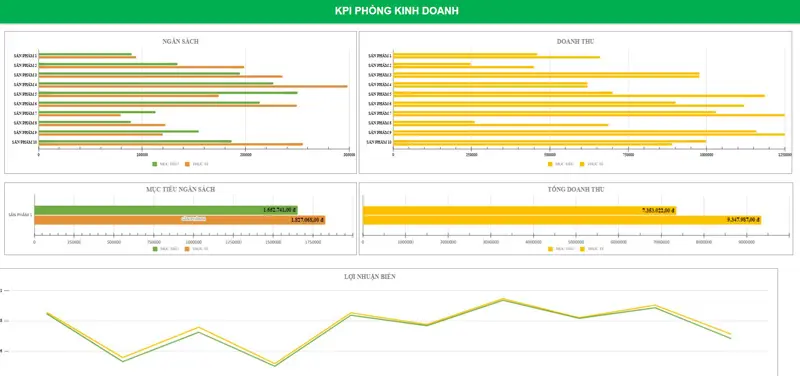
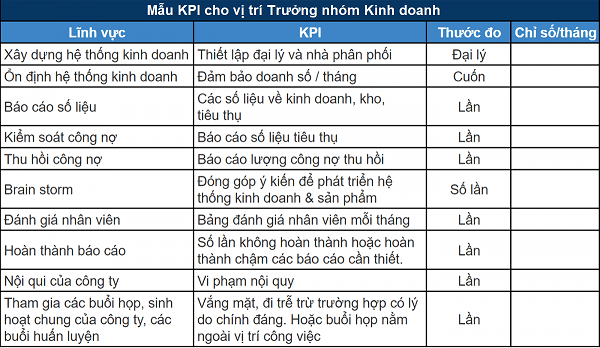
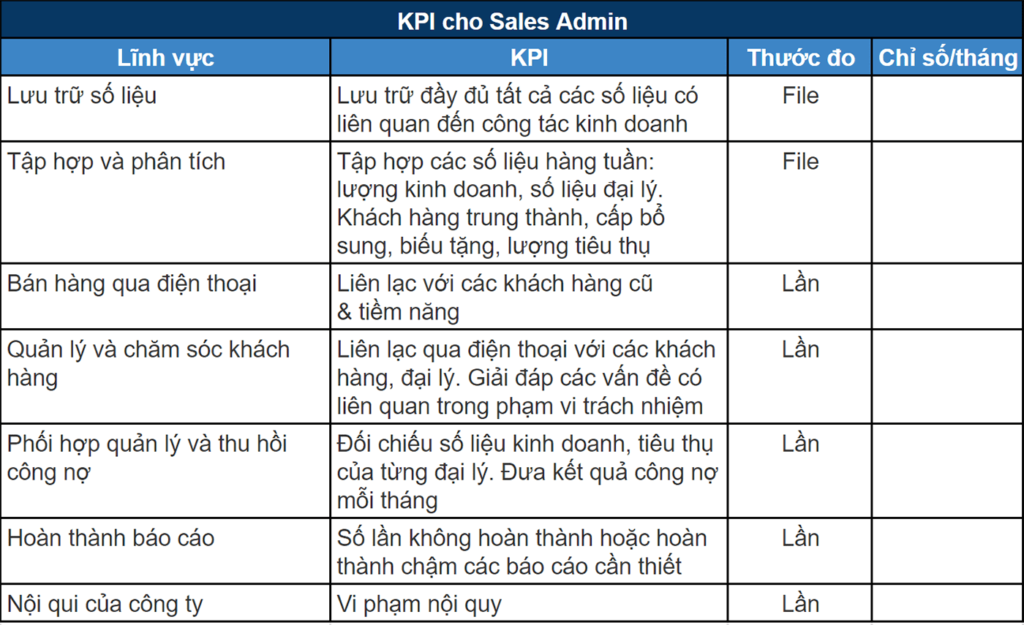
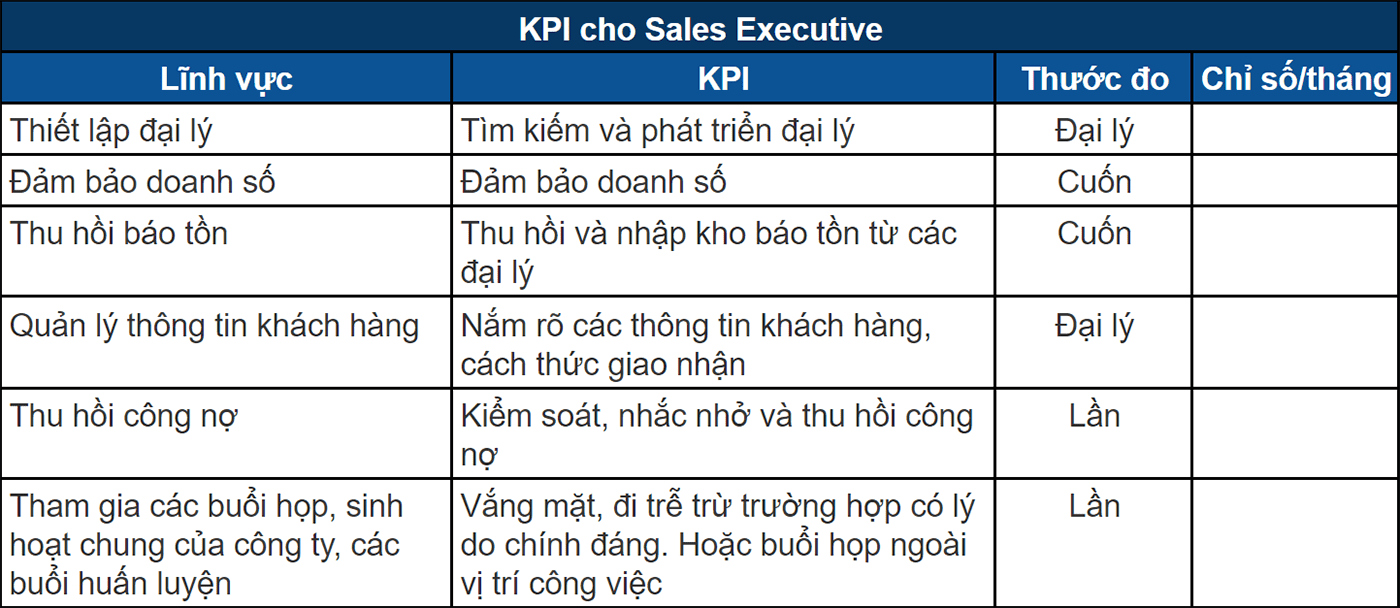
To build the most methodical and professional KPIs for the sales department, businesses can refer to the 3 KPI templates for the sales staff position suggested by 1Office below.
IV. The Process of Building an Effective KPI Template for the Sales Department
Almost every business has its own sales department, making it not easy to create a common KPI template for all industries. Currently, the process of building KPIs for sales staff will go through 5 stages as follows:
Stage 1: Building the KPI Template for the Sales Department
Head of the Sales Department
The head of the sales department is the one who clearly understands the capabilities, well-being, and personality of each person in the department. Therefore, they are also the ones who directly guide, adjust, and urge employees to work according to the set schedule.
During the KPI implementation process, if the leader sets targets that are too low or too high, making it impossible for employees to complete them, the department head will be the one to directly discuss with the leadership and employees to adjust the KPIs to be as reasonable as possible.
Sales Admin Department
Setting up KPIs for the Sales Admin department aims to ensure objectivity, fairness, and avoid internal conflicts between related departments in the company.
Stage 2: Building the Foundation of the KPI Template for the Sales Department
The KPIs for the sales department are approved based on employee feedback and the nature of the job to establish criteria. But regardless of the format, it must meet the following criteria:
Ensure stable sales revenue.
Build good relationships and maintain care for existing customers.
Find a stable number of new customers.
Building KPIs for sales staff
Stage 3: Establishing Salary and Bonus Policies for the Sales Department
After reviewing the sales staff KPIs, managers must establish an appropriate salary and bonus policy. Depending on performance, managers will have a feedback and reward policy for individuals who achieve excellent results.
An appropriate salary and bonus structure will not only ensure that business activities are carried out as planned but also foster satisfaction and trust among employees.
This will help encourage sales staff to perform well in their roles and contribute to increasing the company’s revenue.
Phase 4: Develop an implementation plan for each sales employee
In a KPI template for sales staff, developing an implementation plan is essential. Managers often build this plan based on factors such as:
Implement communication steps: People tend to grasp and react quickly to change. Work is no exception; when their job directly affects their benefits, they will gradually adapt to meet the manager’s requirements.
Sales: In reality, the work of a sales employee can span many industries and fields, requiring different skill levels.
To motivate employees, businesses need to have appropriate reward and training policies. Additionally, there should be policies to support potential employees in learning and enhancing their professional skills.
KPI implementation plan for sales staff
Motivate through business policies: At different times, business owners should have policies to adjust salaries, bonuses, and allowances appropriately for each employee.
Implement the roadmap: Each business will have its own ways of calculating KPIs for sales, which will change depending on the company’s scale and future development.
Phase 5: Monitor the KPI template for sales staff
Typically, to manage the sales department, managers will use a KPI management software toolkit. These solutions ensure greater accuracy and transparency compared to manual record-keeping and verbal agreements.
No matter how good a KPI template for a Sales employee is, it cannot be evaluated without a monitoring tool. Therefore, managers need a tool to track and supervise work, and 1Office can help you solve this problem.
KPI evaluation template for Sales staff
With 1Office, you can set up KPI evaluation criteria according to the manager’s preferences. Additionally, you can easily digitize all evaluation criteria, managing and storing them clearly and in detail on the software.
KPI evaluation is a separate module in 1Office due to its importance. This feature allows businesses to manage a library of criteria, targets, and monthly KPI results for employees. This KPI table can be linked to the payroll table to calculate salaries.
1Office KPI management software
In addition, the KPI evaluation feature of 1Office helps assign and manage employees’ daily tasks easily and conveniently, saving time for managers and improving employee performance.
This helps projects run on schedule, or even ahead of schedule. Managers can identify outstanding or underperforming employees for rewards or disciplinary action.
V. Common mistakes when building KPIs for sales
In the process of setting KPIs for sales staff, many businesses—especially SMEs or those new to implementing performance measurement systems—often make serious mistakes that render KPIs useless or counterproductive. Below are the common mistakes to avoid:
1. Setting KPIs that are too high or unsuitable for the market
This is a mistake many businesses make when they have excessive expectations for their sales team’s performance, leading to the imposition of unrealistic KPIs that do not accurately reflect market reality, product capabilities, or current sales capacity.
For example:
A new company entering the market sets a sales target double that of a long-established competitor.
Requiring each salesperson to close 30 contracts/month when the industry average is only 10–15.
Consequences:
Employees feel pressured and lose motivation due to unrealistic goals.
Leads to “fake reports” and dishonesty to meet targets.
High turnover rate, especially among talented employees who are overworked.
Solution:
Analyze historical sales data, team capabilities, and market characteristics before setting KPIs.
Organize internal discussions to establish feasible and agreed-upon targets.
2. Infrequent measurement and lack of tracking tools
No matter how well KPIs are set, they cannot deliver practical value without a transparent and regular tracking system.
Many businesses only evaluate KPIs at the end of the month or quarter, leading to:
Failure to promptly detect deviations for adjustment.
Employees don’t know if they are “on the right track” or not.
Managers lose control over the entire sales team’s progress.
Automatically compile reports and performance charts for each employee
3. Assigning KPIs without training on how to achieve them
This is a “fatal” mistake in the KPI implementation process. Many businesses assign targets without providing the necessary guidance, tools, or skills to achieve them.
For example:
Assigning upsell KPIs without training on cross-selling skills.
Requiring an increase in call volume without providing a suitable CRM system.
Consequences:
Employees become confused and act on instinct.
Performance declines due to a lack of skills and tools.
Creates a mentality of “burdening” rather than “supporting”.
The right approach:
Organize regular training for the sales team on sales skills, consulting techniques, and time management.
Provide support tools like CRM software and KPI evaluation software like 1Office to optimize efficiency.
4. Ignoring non-financial metrics
Businesses often focus only on financial targets (revenue, number of contracts) and forget that non-financial metrics are also extremely important, especially in a competitive landscape with increasingly demanding customers.
A satisfied customer is 2.5 times more likely to refer new customers.
Repeat purchases help reduce marketing costs and increase LTV (customer lifetime value).
Solution:
Combine financial and non-financial KPIs for a comprehensive view of employee performance.
Use software like 1Office to automatically collect and analyze customer data, helping to accurately assess not only the quantity but also the quality of an employee’s work.
Building effective KPIs is not just about setting goals, but also an entire system that includes:
Regular measurement
Continuous training
Combining financial and non-financial metrics
Using technology tools like 1Office to ensure transparency, efficiency, and accuracy
Avoiding these mistakes is the first step to building a professional – effective – sustainable sales team.
VI. Conclusion
Building a KPI template for sales positions is a new step for businesses in managing and promoting their growth.
1Office hopes this article will be helpful in building and applying KPIs for the sales department at your business. Additionally, 1Office continuously updates articles with useful knowledge in business administration, so don’t forget to follow us!
Additionally, if you are interested in and learning about building KPIs for your employees, sign up for a trial of 1Office software to better understand the KPI evaluation solution in work management!
Apply management knowledge in practice with the 1Office all-in-one management solution
Thank you for scheduling a consultation!
1Office has received your consultation request. Our consultant will contact you as soon as possible. For any questions, please contact Hotline: 083 483 8888



 10/05/2026
  42426 views