


 10/05/2026
  15405 views
An internal communication plan is the thread that connects members within an organization. However, the sad reality is that many businesses still overlook internal communication in their business management process or implement communication plans intuitively, without a specific roadmap. To help businesses develop a systematic and highly effective internal communication strategy, 1Office provides readers with a detailed process for creating an internal communication plan, along with a specific plan template.
Mục lục
- 1. Why is an internal communication plan necessary?
- 2. The most commonly used internal communication activities today
- 3. 6 Steps to Build a Detailed Internal Communication Plan for Your Business
- 4. The most used internal communication channels
- 5. Golden rules for building a successful internal communication strategy
- 6. The most detailed and complete internal communication plan template for 2025
- 7. 1Office – An effective tool for promoting internal communication culture in businesses
1. Why is an internal communication plan necessary?
An internal communication plan is a detailed plan that guides how internal information is conveyed to members and departments within an organization through various communication channels on a specific schedule.
Many managers still ask the question: Is an internal communication plan really necessary? In fact, internal communication is not just about communication between members. It is a core element that determines the internal culture and the way an organization operates:
Ensure all members clearly understand the goals
According to a Harvard Business Review survey, up to 35% of employees reported that they do not fully grasp work-related announcements, and 25% do not clearly understand the organization’s operational strategies. These figures indicate that many businesses are communicating ineffectively.
An internal communication plan can ensure that everyone is aware of the company’s goals and knows their role in achieving them.
Create alignment within the organization
Implementing an effective internal communication strategy is not easy. Most businesses face challenges in:
- Transmitting information in a top-down flow only
- Collecting employee feedback and implementing solutions based on that feedback
- Interacting with employees at all levels and positions

Therefore, the communication strategy must be methodically planned to ensure a smooth flow of information, so that all members can receive and convey it easily. This increases alignment among members and helps departments coordinate smoothly and harmoniously.
Improve employee productivity
Not having access to necessary internal information significantly affects employee productivity. In fact, it has been shown that an employee spends 2.5 hours per day searching for the information they need to complete their tasks—meaning more than a week is wasted each month.
Thus, the secret to improving employee productivity lies in the internal communication strategy. By improving communication among employees, an internal communication plan can help boost morale and increase work efficiency. The McKinsey Global Institute found that employee productivity increases by 20-25% in organizations where employees are connected.
Increase job satisfaction
It is a clear fact that poor communication in the workplace increases employee frustration. A recent survey of 1,000 employees in the United States showed that only 15% of employees are satisfied with the internal communication they experience at work.
Therefore, an internal communication plan plays a crucial role in improving the employee experience and reducing turnover rates. Once employees clearly understand the culture, people, and their work, they will be motivated to dedicate themselves and contribute to common goals.
2. The most commonly used internal communication activities today
Internal communication within a business can be carried out in many different forms, depending on the specific purpose and communication needs:
- Onboarding training: Helps new employees get acquainted with the work environment, culture, and people of the organization.
- Engagement events (Birthdays, team building, etc.): Create opportunities for members to get to know and understand each other better, thereby building and nurturing relationships within the organization.
- Anniversary and company establishment events: Help employees understand the formation and development process, as well as the company’s vision and mission.
- Competitions: Encourage a spirit of competition within the organization, creating opportunities for employees to be creative and develop their abilities.
- Internal magazines, journals, and newsletters: Provide a means for members to track the company’s monthly development and changes.
| Read more: 5 Steps to Build an Effective Internal Training Process for Businesses |
3. 6 Steps to Build a Detailed Internal Communication Plan for Your Business

Step 1. Assess the Overall Situation
Before developing an internal communication plan, businesses need to assess the current internal communication situation. This will be the basis for building the next strategic objectives. In this step, you will need to perform the following tasks:
Review the internal communication plan
- What are the strengths/weaknesses of the plan?
- What were the successes/limitations when implementing the internal communication strategy?
- If there was no previous internal communication plan, you can start by defining the goals you are trying to achieve in the future.
Assess the internal communication situation – Analyze the current state of communication, information dissemination, and reception among staff by
- Monitoring how members interact
- Internal surveys – Surveying employees through questionnaires, group interviews, etc.
Step 2. Define Desired Outcomes
The objectives to be achieved include:
Organizational goals (business goals)
These are the goals the organization needs to achieve to survive and grow, related to all aspects such as finance, people, operational structure, etc. Be sure to list the desired outcomes specifically and measurably in this section.
Communication goals
The outcomes that internal communication activities need to achieve to support the organization in reaching its business goals. For example: To increase labor productivity for the business, the communication goal to be achieved is to improve employee engagement with their work.
Make sure that the goals you set meet all 5 criteria of the SMART model:
- Specific: Specific, clear
- Measurable: Can be measured
- Attainable: Achievable
- Relevant: Realistic
- Time-Bound: Has a time limit
Step 3. Identify the Target Audience
One of the common mistakes when building an internal communication plan is applying the same strategy and communication method to all audiences, while each group of employees or department has different information needs.
You need to segment the organization into different small groups and analyze the thoughts, feelings, and behaviors of each target group to create a suitable communication plan. The target audience groups within the organization can be classified as:
- Leadership
- Shareholders
- Labor Union
- Departments
- Branches
- Employee-founded groups and clubs
Step 4. Develop the Communication Message
The communication message is the “soul” of the plan. A clear and inspiring message will help members connect with the organization’s vision and strategy and understand their own roles.
An internal communication message needs to include 2 elements:
- The message the business wants to convey
- The information needs of employees
Step 5. Decide on the Communication Strategy and Select Channels
In this step, you will develop communication strategies to reach “internal customers” and convey the message through communication channels. The strategies commonly used in an internal communication plan are:
- Training & human resource development
- Career path
- Recognition & rewards
- Internal communication media
Depending on each strategy, the business will develop suitable communication channels, such as:
- Direct communication is the best choice for creating connections between individuals
- Meetings are often used to convey complex ideas or when discussion and input from members are needed
- Documents are suitable for announcements, official letters, and administrative decisions
- An internal social network is the most effective communication channel for building corporate culture and connecting members within the organization
| Read more: Human resource training and development process that meets business standards |
Step 6. Measure implementation effectiveness
The final step of the communication plan is to define the metrics for measuring the results of the communication campaign. These metrics will help you track progress and understand the outcomes of internal communications.
Engagement metrics
There are many different metrics you can use to measure engagement. A common method is to measure the number of likes, comments, and shares on your posts across internal communication platforms.
Employee productivity and engagement
Common methods for measuring employee productivity and engagement include:
- Turnover rate
- Labor productivity
- Profitability
- Reviews/feedback
See more: The process of successfully building a corporate culture in the digital transformation era
4. The most used internal communication channels
To implement an internal communication plan, businesses must establish suitable communication channels to convey ideas and messages to employees. Today, there are many tools that support easy and effective internal communication activities:
- Direct communication
Direct interaction between individuals is the most encouraged method to optimize communication effectiveness. Direct communication not only helps speed up the flow of information internally but also creates a bond between members.
- Meetings
Internal meetings and briefings are often used to convey complex ideas or when discussion and input from members are needed. Typically, meetings are held for purposes such as: summarizing and evaluating operational performance, planning for new projects, recognizing & rewarding, etc.
This is an online communication channel used for important, work-related announcements, official letters, and decisions. Email can transmit news very quickly to a wide audience.
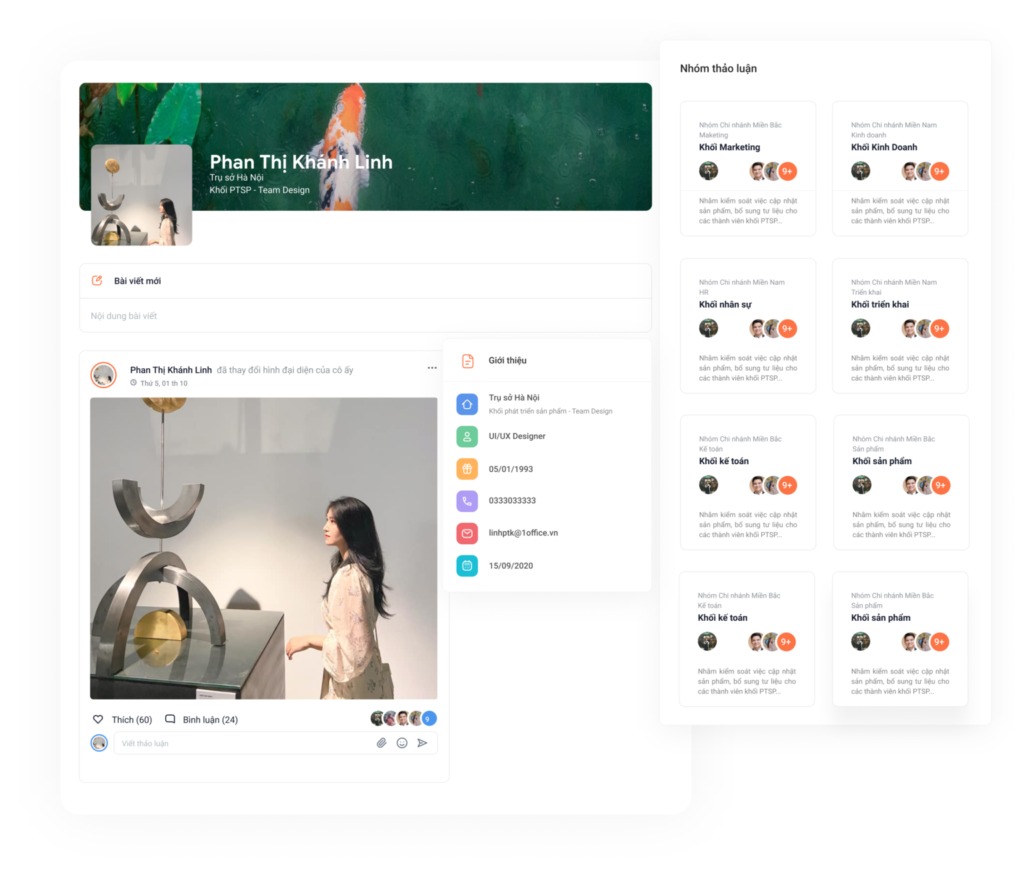
- Internal social network
This is the most effective communication channel for building corporate culture and connecting members within the organization. An internal social network provides an online space for members to interact and share their feelings.
5. Golden rules for building a successful internal communication strategy
Building an effective internal communication strategy is not just about “sending information to employees,” but about creating a system that delivers clear, two-way, consistent messages, helping employees understand, trust, and act correctly. When internal communication is implemented scientifically, businesses will reduce conflict, increase engagement, enhance performance, and build a sustainable culture.
Below are the “golden rules” that every business should follow.
5.1. Simple – clear – consistent messaging
Employees receive information daily from multiple sources: email, group chats, software notifications, documents, meetings, etc. If messages are long, confusing, or constantly changing, they are likely to be ignored or misunderstood, leading to incorrect execution or the spread of inaccurate information.
-
Write concise messages: each core message should be summarized in 1–2 sentences.
-
Avoid complex terminology: if it must be used, explain it clearly the first time.
-
Standardize delivery methods: design a unified “message template” for emails, newsletters, and internal posts.
-
Ensure consistency among management levels: before communicating, all managers must understand the same content.
5.2. Put employees at the center
Internal communication often fails because businesses only “push out information” without considering the needs, context, and “language” of the recipients.
-
Segment employees: production staff – office staff – managers – new employees.
-
Tailor messages to each group:
-
Production staff → visual, short messages, should be communicated during shift meetings.
-
Office staff → email + detailed explanatory documents.
-
-
Design a two-way feedback channel: suggestion forms, Q&A chat groups, suggestion boxes.
-
Listen regularly: short monthly surveys to understand what employees do and do not understand.
5.3. Combine multiple channels and optimize the information journey
A message needs to appear multiple times – on multiple channels – in various formats to ensure employees receive it fully without missing anything.
Choose the right channels for the right purpose
-
Email: policy announcements, important documents.
-
Internal network / HRM software: updates that need long-term storage.
-
Chat groups: quick announcements or reminders.
-
Poster/Infographic: communication in factories, common areas.
-
Team meetings: in-depth explanations, handling questions.
Build a 3–5 step information journey
Example campaign: “New Regulations 2025”:
- Official announcement email.
- Summary infographic.
- Explanatory video from HR.
- Departmental Q&A meetings.
- Survey to check understanding level.
5.4. Maintain a regular communication schedule
Consistency helps employees form a habit of following and trusting the company’s official information channels. This reduces rumors and the situation where “everyone understands it differently”.
-
Create a monthly/quarterly communication schedule: clearly define content, responsible person, channel, and delivery time.
-
Maintain regular features:
-
Weekly newsletter
-
Monthly achievement announcements
-
Beginning-of-month briefing meetings
-
Employee sharing corner
-
-
Periodically check effectiveness: adjust content to suit actual needs.
A company publishes an internal newsletter every Monday: announcing policies, events, achievements, and important reminders. The readership rate increased from 25% to 60% in just 2 months.

6. The most detailed and complete internal communication plan template for 2025
With the desire to help businesses build a methodical internal communication roadmap, 1Office provides readers with the most detailed and complete internal communication plan template for 2025.
7. 1Office – An effective tool for promoting internal communication culture in businesses
1Office is an effective tool for businesses to promote internal communication. The 1Office internal network not only provides an online working environment where each individual is equipped with resources for their work, but also offers an internal social network system where members can exchange information, share joys, and discuss work-related issues conveniently and securely. This helps build corporate culture and team cohesion with outstanding features such as:
- Newsfeed: Displays all internal information and employee statuses, prioritized by importance and interaction level.
- Notification management: Sends notifications to all members on the social network when new content is posted on the wall.
- Sharing: Share statuses, posts, photos, videos, documents, tasks, projects, etc., on your own wall, a colleague’s wall, or in a group.
- Post interaction: Like, react, thank, and discuss on posts.
- Groups: Allows users to create different groups within the company.
Our article above has provided you with information on the process of building an internal communication plan and the technological solutions that help promote internal communication within a business. Additionally, if you are facing difficulties in business management, please register for a free consultation at 1office.vn. Our consultants will help you resolve your challenges quickly!
For more details and inquiries, please contact:
- Hotline: 083 483 8888
- Fanpage: https://www.facebook.com/1officevn/
- Youtube: https://www.youtube.com/channel/UCeTIRNqxaTwk0_kcTw6SxmA
















