


11 popular employee performance evaluation methods


Employee performance evaluation plays a crucial role in any business. Every business grows based on the productivity & efficiency of its employees. Therefore, businesses need to choose an effective and accurate evaluation method. Below are the 11 most popular employee performance evaluation methods today.

Mục lục
- I. What are performance evaluation methods?
- II. Why is it necessary to evaluate employee performance?
- III. The most popular performance evaluation methods
- IV. 11 other performance evaluation methods to consider
- 1. Balanced Scorecard Method – BSC
- 2. Weighted Checklist Methods
- 3. Graphic Rating Scales Method
- 4. Performance Ranking Method
- 5. Management by Objective (MBO) – A Performance Evaluation Method
- 6. Forced Ranking
- 7. Forced Distribution Method (Incident Method)
- 8. 360-Degree Feedback Method (360 Feedback)
- 9. Essay Valuation Method
- 10. Quantitative Method
- V. Benefits of periodic performance evaluation
- VI. Using software for performance evaluation
I. What are performance evaluation methods?
Performance evaluation is a process conducted monthly/annually to assess the productivity and quality of work by collecting, analyzing, and evaluating information related to the work performance of an individual, department, or system.
Based on these performance evaluation methods, managers can get an overview of the work efficiency of employees/departments/systems. From there, appropriate future plans and goals can be established.
II. Why is it necessary to evaluate employee performance?
Many businesses have faced serious consequences due to a lack of experience in building and maintaining a scientific and clear personnel evaluation system. Therefore, performance evaluation plays a crucial role.
When businesses and managers accurately assess employee capabilities, personnel allocation becomes easier. This allows employees’ abilities to be utilized to their fullest potential. Additionally, employees who are evaluated fairly will be more satisfied because they feel recognized, giving them more motivation to work.
Performance evaluation and task assignment directly impact the maintenance and development of human resources within a company. Therefore, this system needs to be built rigorously and must be suitable for the business’s model, scale, and culture.
Read more: Top 8 Most Effective Free Task Assignment Software for Employees Today
III. The most popular performance evaluation methods
Below are the 3 most popular performance measurement methods that businesses can refer to
1. Evaluation via KPI – Key Performance Indicator
The Key Performance Indicator (KPI) is a crucial metric for evaluating the progress of individuals, departments, and organizations. Businesses use KPIs at various levels to assess progress and the ability to achieve strategic goals.
Method for evaluating the completion of KPI targets:
- Reflects how actual work aligns with initial goals to achieve the desired outcomes
- Provides a set of measurable indicators to serve as a basis for planning future goals
- Allows for comparison to evaluate performance changes across different periods
- Enables timely quality monitoring to implement management policies that align with the original objectives, measure project effectiveness, and assess personnel performance to optimize company resources
2. Evaluation using OKR
OKR – Objective and Key Results, is a simple and flexible performance evaluation formula, for example: You will have to achieve [objective] and it will be measured by [key results].
The objective here is what the employee wants to achieve (such as increasing brand awareness or boosting sales in the last 3 months of the year). The key results are the tools used to measure progress toward achieving the objective.
See more: Performance evaluation criteria for businesses
3. Differentiating between the KPI and OKR performance evaluation methods
KPI – an acronym for Key Performance Indicators – is a method for tracking performance to drive initiatives and reforms. OKR is essentially a framework for tracking activities with the goal of balancing objectives & key results.
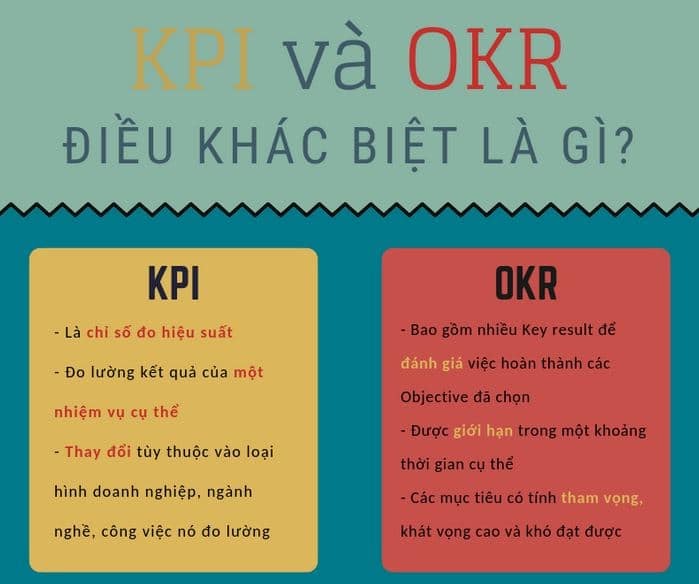
Using OKRs effectively is a great way to set goals and combine various types of KPIs to achieve a common objective.
Once you have a measurement method, a work progress tracking tool is essential. To find a suitable work progress management tool, you can learn more at work progress tracking
IV. 11 other performance evaluation methods to consider
Once you have a method for measuring work performance, the next step is to evaluate it in the most optimal way. Let’s explore 11 performance evaluation methods below.
1. Balanced Scorecard Method – BSC
The Balanced Scorecard (BSC) performance evaluation method involves building a strategic planning & management system. Its purpose is to align business activities with the organization’s vision and strategy, and to monitor the company’s operational performance against its set goals.
The BSC establishes a system for measuring business performance across four key perspectives: Financial, Customer, Internal Business Processes, and Learning & Growth.
2. Weighted Checklist Methods
With this method, performance is evaluated based on a pre-prepared checklist of behaviors that demonstrate effective or ineffective performance.
3. Graphic Rating Scales Method
Graphic Rating Scales is a format where a manager simply checks and monitors an employee’s performance level based on a 3 or 5-point scale, ranging from very poor, poor, average, good, to very good. This is also the oldest and most widely used method for performance evaluation.
4. Performance Ranking Method
Performance ranking is a performance evaluation method used to assess employees’ performance from worst to best. Based on the comparison results, managers can easily track and observe the work efficiency of employees relative to each other based on certain criteria.
5. Management by Objective (MBO) – A Performance Evaluation Method
MBO is a process where managers set objectives for employees, periodically evaluate and monitor performance, and provide appropriate rewards based on the results. This method includes the following elements:
- Setting goals through mutual agreement and consensus between employees and management
- Focusing on results rather than the methods used to achieve them
- Employees are given autonomy in the work process
- Often applied at the company’s highest management levels
6. Forced Ranking
This is a performance evaluation method for ranking employees according to a predetermined order. The results of this method provide managers with a basis for promoting the right people and avoiding overlooking talent.
7. Forced Distribution Method (Incident Method)
The Incident Method is a method of evaluating employees on a certain mandatory basis. For example, if your employees are rated as 15% excellent, 65% average, and 20% poor, then
- 15% of excellent employees will be recommended for a salary increase
- 20% of poor-performing employees will have their salary increases postponed and may be considered for termination
This method has advantages:
- Forces managers to make decisions and accurately assess the true capabilities of employees
- Improves the capabilities and work efficiency of the workforce
Disadvantages:
- Inadvertently increases unhealthy competition among employees
- Reduces the spirit of cooperation and teamwork
- Affects morale
8. 360-Degree Feedback Method (360 Feedback)
In this evaluation method, the evaluators include everyone in the company, from managers, subordinates, colleagues, and customers to the employee’s self-assessment.
This helps the person being evaluated gain an objective, multi-faceted perspective from various sources and on all aspects. However, it can also be a major cause of potential internal conflicts.
9. Essay Valuation Method
The Essay Valuation Method requires the manager to describe the employee’s strengths and weaknesses during their work performance. This evaluation method is a common technique often used in conjunction with the Graphic Rating Scales method.
Coordination skills are very important in the work process, but coordinating effectively and reasonably is a challenge for businesses. To find the answer, check out 1Office’s article: Team Task Management Software
10. Quantitative Method
The method includes 3 basic steps:
- Step 1: Identify the key requirements for performing the job
- Step 2: Classify the requirements according to different levels on the rating scale: excellent, good, average, weak, and poor. Each rating level needs to be clearly defined.
- Step 3: Evaluate each factor among the total factors
V. Benefits of periodic performance evaluation
Periodic performance evaluation is a crucial tool that helps businesses manage human resources effectively and achieve sustainable growth. Conducting regular evaluations not only benefits the company but also helps employees enhance their capabilities and clarify their career paths.
Some key benefits of periodic evaluation include:
-
Improve individual and team productivity:
Evaluations help clarify goals, track work progress, and provide timely feedback, thereby increasing the work efficiency of each individual and the entire team. -
Identify employee strengths and weaknesses:
Through evaluations, managers can identify employees’ abilities, skills, and attitudes, and then propose suitable development plans. -
Support training and personnel development planning:
Information from periodic evaluations helps build training, coaching, and capacity-building programs, ensuring that personnel always meet job requirements. -
Help businesses make decisions on salary, bonuses, and promotions:
Periodic performance evaluation provides a transparent and fair basis for determining salary levels, performance bonuses, and promotion opportunities for employees, while also helping to retain talented personnel.
In summary, periodic performance evaluation not only helps businesses optimize resources but also motivates and provides career development direction for employees, contributing to improved work quality and business efficiency.
VI. Using software for performance evaluation
From the evaluation methods mentioned above, leaders can now grasp effective ways to assess employee performance. However, to keep pace with the modernity of the Industry 4.0 era, leaders should consider using employee evaluation software to help monitor employees’ work processes, thereby enabling the most transparent and accurate performance evaluations.
Below, 1Office – an all-in-one business management software – provides managers with a multi-dimensional view of personnel performance, enabling them to make accurate, objective decisions and eliminate subjectivity.
The task management software from 1Office helps leaders:
– Evaluate work processes through a diverse reporting system (List, Gantt chart, Kanban, Dashboard) that provides performance and progress reports for every individual and department based on real-time data:
- Are employees completing tasks on schedule?
- Is anyone overloaded with work or underperforming?
- Are implementation and inter-departmental collaboration effective?
- Discrepancies between the plan and actual implementation
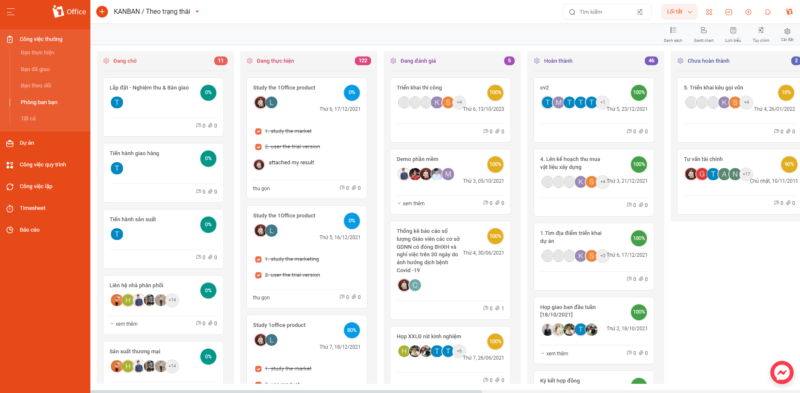
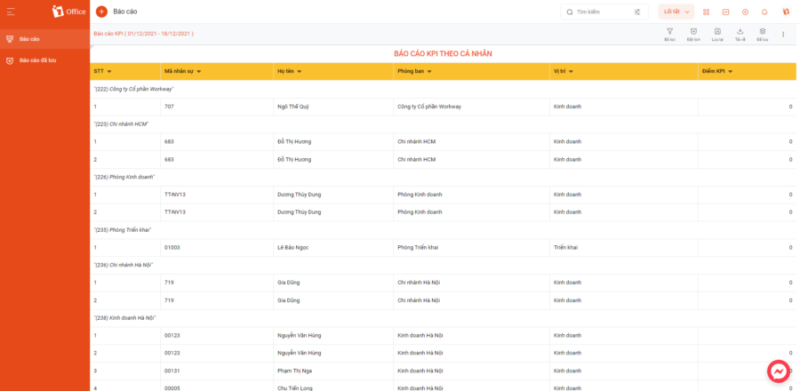
– Accurately assess employee competency by managing a library of criteria, targets, and KPI results for the entire enterprise
- Set up criteria and evaluation forms as needed
- Visually track the evaluation results for each criterion for individuals/departments
- Evaluation results are automatically sent to higher management for confirmation and finalization
- Automatically update evaluation results into the payroll to calculate salaries quickly and automatically
Thus, the article above has introduced you to various performance evaluation methods. It also suggested a tool to help managers evaluate employee performance effectively, clearly, transparently, and objectively. To receive more detailed consultation, please register for a consultation at:
For more details, please visit:
Website: https://1office.vn/
Fanpage: https://www.facebook.com/1officevn/
Youtube: https://www.youtube.com/channel/UCeTIRNqxaTwk0_kcTw6SxmA




