


 10/05/2026
  197 views
Properly setting goals not only creates strong motivation for work but also helps measure progress and improve work performance. The article below will point out models that help managers set suitable goals and common mistakes made when setting goals.
Mục lục
- 1. What is goal setting?
- 2. Why do managers need to set goals?
- 3. Distinguishing between goals and purpose
- 4. Top 3 accurate goal-setting models recommended by many managers
- 5. Common Mistakes in Goal Setting and How to Avoid Them
- 6. The Role of Goal Setting in Human Resource Management and Performance (OKRs & KPI)
- 7. 1Office Software – A comprehensive goal management tool for businesses
1. What is goal setting?
Goal setting is the process of identifying the results or achievements you want to attain within a specific period. Having precise, clear goals helps you stay on the right track, creates motivation, and allows you to focus on the most important tasks to achieve success in life and work.
2. Why do managers need to set goals?
Setting goals is not just about defining a direction; it also brings a series of important benefits as listed below:
- Measure work progress: By breaking down goals into smaller objectives and clearly defining performance indicators using OKRs and KPIs for those smaller objectives. You should regularly monitor progress to ensure your organization is on the right track. This also helps you know when to adjust goals or increase performance to ensure they are met on schedule.
- Focus on the final outcome: Goals provide you with a clear vision of your purpose and direction. When you know what final outcome you are aiming for, you will have stronger focus and drive to achieve it.
- Create work motivation: Goals can be a powerful source of motivation, pushing you to overcome challenges and difficulties at work. For teams, setting specific and clear goals also stimulates members’ enthusiasm, encourages collaboration and communication, and enhances work performance.
3. Distinguishing between goals and purpose

Goals and purpose are often used together to shape and direct activities and plans within an organization. However, many managers often confuse or mix up these two concepts in speech and writing.
Goals are the journey to achieve the purpose
Goals are the results that need to be achieved, the actions that need to be taken to reach the ultimate purpose.
For example: To achieve the purpose of “getting more website traffic,” you need to set these goals:
- Get the website to rank in the top 3 of search results,
- Write 10 – 20 – 50 blog posts per month
- Reduce page load time
There are many goals, but only one purpose
In the process of defining and implementing goals to move towards the ultimate purpose, the number of goals is unlimited.
Conversely, if you pursue one goal that aims at multiple purposes, it can easily lead to a situation where everything is left unfinished with no final result, making it harder to achieve the purpose.
Goals can be abandoned, but purpose cannot
If a goal leads you off track, you can adjust, or even eliminate and completely change it for another goal to reach the ultimate purpose. However, you cannot change the purpose while keeping the same goals because goals are built based on the purpose. If you change the destination, you will have to set new goals from the beginning.
When is it necessary to set goals?
Defining goals is necessary and crucial for any individual or organization. If you have identified your purpose—what you want to see—then you need to define your goals—what you need to do. By clearly defining the tasks, you will determine the results that need to be achieved.
For managers, when managing a project or a work team, it is necessary to clearly outline goals to lead the team and monitor the project’s progress. When aiming to achieve business targets or purposes, managers need to set business goals to ensure the organization’s operations achieve the desired efficiency and profitability.
4. Top 3 accurate goal-setting models recommended by many managers
To set accurate, well-directed, and effective goals from the start, refer to the 3 easy-to-apply goal-setting models recommended by many managers below.
4.1. Setting goals with the SMART model
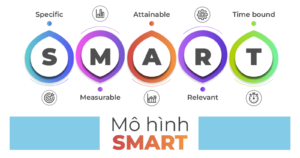
The SMART model is the most popular and easy-to-apply method for setting goals for individuals, teams, and departments. This model can be applied not only in business but also in many other areas of a company.
The elements of the SMART goal model:
S – Specific: A goal needs to be outlined clearly, thoroughly, and in detail to avoid confusion and omissions during implementation.
M – Measurable: Measurable goals help you track progress, identify what tasks need to be added or optimized to complete the goal on time.
A – Attainable/ Achievable: Attainability is used to evaluate a goal by comparing the expected results you want to achieve with your available resources and capabilities.
R – Relevant/Realistic: The goal set needs to be realistic and relevant to your other objectives to create synergistic value for the organization.
T – Time-bound/Timely: A deadline for completion helps you avoid procrastination and giving up midway, while also motivating personnel to strive every day towards achieving the common goal.
The SMART goal-setting method can be applied to most subjects and contexts, such as individuals, businesses, non-profit organizations, projects, learning, personal development, etc.
Example of setting a goal using the SMART model
- Specific: Increase website traffic by publishing SEO-optimized blog posts and building backlinks.
- Measurable: Increase website traffic by 10,000 visits and get 100 conversions.
- Achievable: Attract users to the website by optimizing the website interface and building a set of SEO-standard keywords
- Relevant: Improving the number of visitors can help increase brand awareness and the number of potential customers.
- Time-bound: The website will increase traffic by 10,000 visits within one year.
⇒ Goal: Increase website traffic by 10,000 visits and generate 100 conversions within 1 year by building a keyword set, publishing 100 SEO-standard blog posts, and optimizing the website interface to enhance brand recognition and the number of potential customers.
4.2. Setting goals using the 4C principle
The 4C goal-setting principle consists of the main rules for achieving successful goals in business management practice. Therefore, this principle is often used by leaders of groups such as organizations, companies, departments, etc., to evaluate, define strategies, build plans, and set goals for members.
The 4 principles of the 4C model include:
- Commitment: In a team, one person’s results can affect all other members. Commitment is not just about the goal, but also about the actions and results that need to be achieved.
- Clarity: A goal needs to be clear, quantifiable, and tied to a specific timeframe for implementation. This way, members will clearly understand what they need to do to achieve the final objective.
- Challenging: Your employees will always crave the feeling of conquering challenging goals because it makes them feel a sense of personal victory. Therefore, you should not set a goal that is too easy, but it should not be so difficult that it’s “impossible.”
- (Task) Complexity: Your employees cannot perform overly complex tasks in too short a period. For more complex projects and tasks, personnel need more flexibility in their implementation time and require support and training to complete the goal.
Example of setting goals using the 4C principle:
Goal: Increase sales of product X by 20% in 2023 through marketing and sales on Facebook, such as posting 200 sales articles, running ads to generate 1000 conversions, seeding in 50 groups each month, etc.
- Commitment:
- In addition to committing to posting and seeding the correct number of times, the sales department also needs to change the sales script and introduce the product to 50 customers/day.
- The Marketing department must commit to supporting the sales team in implementing brand-building activities on social channels, such as seeding and posting 2-3 articles/day/platform.
- Clarity: This goal is clearly stated (Increase sales of product X), measurable (20%), and has a specific deadline (In 2023).
- Challenging: The above goal has measurable indicators, implementation milestones, and evaluations, so each employee strives to complete the set KPIs.
- (Task) Complexity: The above goal has a moderate level of difficulty. As long as the marketing and sales teams meet the set KPIs, they will be able to achieve the goal of increasing sales for product X by 20% in 2023.
4.3. Setting goals using the GROW method

The GROW method was first developed in the 1980s by business coaching experts Graham Alexander and Sir John Whitmore. This method helps businesses identify difficulties and challenges that may hinder goal achievement, from which managers can develop a suitable action plan.
The “GROW” method includes 4 steps:
Goal – Expected outcome: First, the manager needs to define the goals to be achieved, and these goals must be specific, measurable, and achievable.
Reality – Current situation: In this step, the manager will try to explore the current issues and situation of the business. Through this, they can assess and clearly understand the obstacles the business is and will be facing. By determining the current situation, the manager will have a better overview of their company, department, and personnel.
Options – Solutions: After identifying the current situation, the manager needs to propose the most optimal options to eliminate the “obstacles” from the Reality step. Some questions that can be asked include:
- What can the business do?
- Are there any backup solutions?
- What support resources are available?
Will (or Way Forward) – Commitment to Action: In this stage, your team needs to make commitments to take action towards the common purpose and goals. As a manager, you also need to create a detailed work plan with specific deadlines to achieve that goal and be flexible in handling any issues that arise.
Example of setting goals using the GROW method:
- Goal – Expected Outcome: Increase revenue by 20% in 2024.
- Reality – Current Situation: The company’s revenue in 2023 was 100 billion. In the next 6 months, the company has 2 new product launch projects. Company’s challenges: Increasingly fierce competition from rivals, shortage of talent and resources, customer and market demands may change.
- Options – Solutions:
- Research the market and customer needs to develop new products and services that meet market demands.
- Increase investment in marketing and promotion to enhance brand awareness and attract customers.
- Recruit new talent and train to improve the capabilities of the current staff.
- Will (or Way Forward) – Commitment to Action:
- In the first 6 months of 2023, the company will establish a market research team to survey customer needs.
- In the next 9 months, the company will increase investment in marketing and promotion with a budget of 10 billion.
- Within 12 months, the company will organize employee training and development programs to enhance employee capabilities and engagement.
5. Common Mistakes in Goal Setting and How to Avoid Them
Vague, non-specific goals: When goals are not clear and specific, it’s difficult to describe and communicate them to other staff and hard to evaluate progress.
>> How to avoid: Clearly express the goal with numbers or detailed tasks. This helps you have a clearer view of the direction to take and the roadmap to achieve that goal.
Example of a non-specific goal and a correct goal:
- Increase website traffic -> Increase website traffic by 10,000 visits
- Reach more potential customers, increase revenue -> Reach 5,000 potential customers, achieve 50 million in sales.
Setting unrealistic goals: Setting goals that are too high or too difficult to achieve, leading to feelings of failure and loss of motivation.
>> How to avoid: Ensure that goals are set based on available resources. Do not set goals that are too high; instead, define goals that are achievable and promote sustainable growth.
Example:
- A small company sets a goal for the sales department to increase revenue by 200% in 3 months.
- A Facebook ad post reaching 10 million people in 1 month.
Setting goals that are too easy: If a goal is too simple, you may not feel enthusiastic about completing it, or you might not take it seriously, failing to achieve significant results.
>> How to avoid: Consider a difficulty level that is appropriate for your employees’ abilities and your current resources.
Not setting a deadline for the goal: Lacking a specific timeframe for achieving a goal can lead to laziness and procrastination.
>> How to avoid: Set specific deadlines for each goal. This helps you stay focused and plan reasonably to execute step by step.
Not reviewing goals regularly: Goals should reflect the actual operations of the department and the company’s development. Not reviewing goals regularly will lead to pursuing the wrong objectives.
>> How to avoid: Review your goals regularly and adjust them as necessary to ensure they reflect your long-term objectives.
Example: A company sets a goal to grow revenue by 20% for the year. However, the company does not review the goal regularly. This could lead to the company failing to achieve the goal if economic conditions change, such as an economic recession.
Not breaking down goals into smaller steps: Setting large, complex goals without breaking them into smaller steps can make you feel lost, unmotivated, and unsure where to start.
>> How to avoid: To optimize performance and motivation, break large goals into smaller tasks and track each step.
Example: A business sets a goal to expand into foreign markets. However, the business owner does not break the goal down into specific steps like: Market research, finding partners, etc. This makes it difficult for subordinates to execute, leading to the business failing to achieve its goal.
6. The Role of Goal Setting in Human Resource Management and Performance (OKRs & KPI)
Setting goals is not only the foundation of strategic management but also the backbone of human resource management and Performance Management. A clear goal system helps connect business strategy with the specific actions of each employee, ensuring everyone is working towards a unified vision.
6.1. Connecting individual goals with organizational goals
One of the most important roles of goal setting is to synchronize direction from the top down.
When a business has clear organizational-level goals (company goals), departments and individuals can easily determine what they need to contribute to achieve the common result.
For example:
-
Company-level goal: “Increase revenue by 30% in 2025”
-
Sales department-level goal: “Expand into the Central market and achieve 10 billion in revenue in Q1”
-
Individual sales employee goal: “Increase the number of potential customers by 15% each month”
When goals are set in an aligned chain, each individual understands their role clearly, reducing fragmented or undirected work.
6.2. Using KPIs to measure execution progress
KPI (Key Performance Indicator) is an index for measuring work results, helping managers evaluate the level of completion of set goals.
Establishing KPIs linked to goals helps:
-
Measure performance specifically and based on evidence rather than subjective assessment.
-
Detect deviations in the work process early for timely adjustments.
-
Motivate employees to strive, as they know exactly what the criteria for success are.
For example: if the goal is “Increase customer retention rate to 90%”, specific KPIs could be “Number of customers reusing the service/month” or “Customer satisfaction rate (CSAT)”.
6.3. Applying OKRs to create motivation and goal transparency
Besides KPIs, OKR (Objectives and Key Results) is a modern goal-setting model applied by Google, Intel, and many large corporations.
Unlike KPIs – which focus on measuring results, OKRs emphasize inspiration and development direction.
The OKR structure consists of:
-
O (Objective): A qualitative goal that expresses the desired vision or achievement.
-
KR (Key Results): Measurable key results to assess progress towards achieving the O.
For example:
-
Objective: Enhance the customer experience on the e-commerce platform.
-
Key Results:
-
Increase NPS score from 60 to 80 in 3 months.
-
Reduce the average CS response time to under 5 minutes.
-
Achieve a repeat purchase rate of > 40%.
-
Applying OKRs helps employees understand the bigger goals, empowers them with autonomy, and encourages them to work with a spirit of commitment – not just compliance. At the same time, managers can also easily track progress in real-time and evaluate performance more fairly and transparently.
See more: Popular and easy-to-use OKR software for businesses
7. 1Office Software – A comprehensive goal management tool for businesses
During the customer care process, 1Office has noticed that many businesses, despite establishing criteria and performance evaluation sheets, lack the tools to track and measure implementation. Some businesses are even unsure where their goals are facing issues or when to evaluate and adjust them appropriately. All these difficulties stem from their inability to see visual reports on goals and work results to build subsequent strategies.

To help businesses overcome these difficulties, 1Office offers a solution for setting up and managing KPIs with the following advantages:
- Allows for the creation of evaluation criteria, targets for those criteria, and the importance level of each criterion.
- Customize KPI evaluation formulas according to the manager’s preferences.
- Digitize, manage, and store evaluation criteria clearly and in detail on the software.
- Allows setting the number of evaluators and the importance level of each evaluator.
- Personnel evaluation results are automatically forwarded to higher management levels to continue the evaluation process.
- Visually track the evaluation results of each criterion for every individual or department through the Dashboard.
- The comprehensive evaluation results can be directly linked to the payroll to automatically calculate salaries.
1Office has many features that help managers set goals, track the implementation of tasks, and evaluate and optimize goal achievement performance.
—————————
We hope this article helps you understand how to set goals and avoid unnecessary mistakes. Contact the 1Office team of experts now for in-depth advice on the goal evaluation feature!
- Hotline: 083.483.8888
- Facebook: https://www.facebook.com/1officevn/
- Youtube: https://www.youtube.com/@1office-chuyendoisodn
















