Financial Income: Principles and Detailed Accounting Method


Financial activities revenue is an important item in corporate accounting, but not everyone clearly understands what it includes and how it is recorded. If you are looking to learn about the concept of financial activities revenue, the principles of recognition, and how to account for Account 515, this article will help readers understand everything from theory to practical examples.
Mục lục
- What is financial activities revenue?
- The importance of financial activities revenue
- Principles for accounting for financial activities revenue 515
- The role of account 515 in a company’s accounting system
- Structure and content reflected in financial revenue
- Guide on how to account for financial revenue for businesses
- Examples of Financial Income – Accounting for Account 515
- Notes for Accountants on Financial Income
What is financial activities revenue?
Financial activities revenue is one of a company’s significant sources of income, originating from financial investment activities. Specifically, financial activities revenue includes profits from interest, dividends, gains from the sale of financial investments, and foreign exchange differences.
This income does not come from the company’s main business operations, but from financial activities such as investing, trading securities, or asset management. For example, a business can earn profits from investing in the shares of other companies or from depositing money in a bank to receive interest.
From another perspective, financial revenue also reflects the diversification of a company’s income sources. Instead of relying solely on sales revenue, many businesses expand into investing in bonds, stocks, or contributing to joint ventures. This helps the company achieve a more stable cash flow, especially when its main business activities face difficulties. However, seeking financial profits always comes with risks, such as exchange rate fluctuations or stock market downturns. If not managed well, expected revenue can turn into a significant loss.
To optimize financial revenue, a business needs a clear capital management strategy. First, it must develop a cash flow plan to identify the amount of idle capital available for investment. Next, the choice of investment channels should be based on the company’s risk tolerance: manufacturing companies often choose safe channels like bonds or term deposits, while financial firms may accept investments in stocks or more volatile products.
Finally, businesses need to leverage technology—from accounting software to ERP and data analytics—to monitor, forecast, and promptly adjust financial decisions. When these steps are implemented rigorously, financial revenue becomes a useful tool that helps businesses both increase profits and optimize capital efficiency in the short and long term.

Financial activities revenue includes:
- Bank deposit interest: This is the interest income a business receives from its bank deposits.
- Income from securities investment: A business can invest in stocks and bonds and receive returns from these investments.
- Dividends received: If a business invests in other companies, it may receive dividends from those companies’ profits.
- Interest from lending activities: A business can lend capital to other entities and earn profit from the loan interest.
This revenue is recorded in account 515 – “Financial Activities Revenue.” This is a crucial account in a company’s financial accounting, helping to accurately reflect the company’s financial situation in each accounting period.
The importance of financial activities revenue
Financial activities revenue not only helps businesses optimize idle capital but also brings significant benefits such as:
- When a business has an additional source of income from financial activities, it helps reduce risks when revenue from main business operations does not meet expectations.
- Instead of leaving cash idle, a business can use this capital to invest and generate profits, thereby increasing shareholder value.
- Revenue from financial activities is reflected in the income statement, contributing to the improvement of financial ratios such as net profit, return on equity (ROE), and return on assets (ROA).
- Having an additional source of income from financial activities helps a business better cope with fluctuations in its main business operations.
- Revenue from financial activities contributes to maintaining financial stability and supports future investment activities for business expansion.

Principles for accounting for financial activities revenue 515
When accounting for financial activities revenue, businesses need to adhere to some basic principles to ensure accuracy and transparency. Account 515 is the accounting account used to record revenue from a company’s financial activities.
Principles for recognizing financial activities revenue:
- Financial revenue is recognized when financial transactions actually occur, regardless of when the money is received. For example, interest from a bank deposit will be recognized when the interest is due, even if the interest has not yet been transferred to the company’s account.
- If financial revenue arises over multiple accounting periods, it needs to be reasonably allocated to the corresponding periods.
- A clear distinction must be made between revenue from core business activities and revenue from financial activities to ensure clarity and transparency in financial statements.
- When accounting for revenue in account 515, related financial expenses (such as transaction fees, interest expenses) must also be fully recognized to accurately reflect the financial results.
- Businesses must comply with international accounting standards and Vietnamese legal regulations when accounting for financial revenue.
- Revenue from financial activities is transferred to account 911 to determine the business results at the end of the period.

The role of account 515 in a company’s accounting system
In the Vietnamese accounting system, account 515 – Financial Revenue – plays a crucial role as it records all income arising from financial activities. These include bank deposit interest, loan interest, dividends received, profits from securities investments, and exchange rate differences. As a result, account 515 clearly reflects the portion of revenue not derived from core business activities, helping managers understand which sources are generating financial income for the company.
Account 515 is also considered a “mirror” reflecting the company’s financial health. If this revenue accounts for a very high proportion of total profit, it may indicate that the company is heavily reliant on financial investment activities rather than focusing on its core business. Conversely, when financial revenue plays only a supplementary role, the company typically has a more stable business foundation.
Additionally, account 515 is directly linked to the year-end profit because all figures from this account are transferred to account 911 – Determination of Business Results. Therefore, any error in recording financial revenue can lead to inaccuracies in financial statements and affect tax obligations. This is why audit and tax authorities often pay close attention to this item. For managers, account 515 is also a tool for evaluating the efficiency of idle capital utilization and the level of transparency in financial reports.
Structure and content reflected in financial revenue
Structure of financial revenue account 515
➤ Debit side entries:
- Record the amount of value-added tax (VAT) payable under the direct method (if any).
- Transfer the entire financial revenue from account 515 to account 911 – Business Results.
➤ Credit side entries:
- Record interest, profits, and dividends received by the company.
- Gains from the sale of investments between a parent company and its subsidiaries, as well as between joint ventures and associates.
- Payment discounts received by the company from purchases.
- Gains from exchange rate differences arising from the sale of foreign currency.
- Interest earned during the period, such as interest on loans.
- Gains from foreign exchange rate differences due to the revaluation of monetary items denominated in foreign currencies at year-end.
- Transfer and re-allocate exchange rate differences related to capital construction activities in the pre-operating period, which were included in the financial revenue of the previous year.
- Other financial revenues arising during the period.
Note:
- Account 515 has no closing balance, meaning all amounts arising in this account are fully transferred at the end of the period.
- The financial revenue account does not have any sub-accounts, meaning it is not further broken down.
Accounting diagram for financial revenue account 515
To help accountants better understand how to calculate financial revenue, here is a simple accounting diagram:
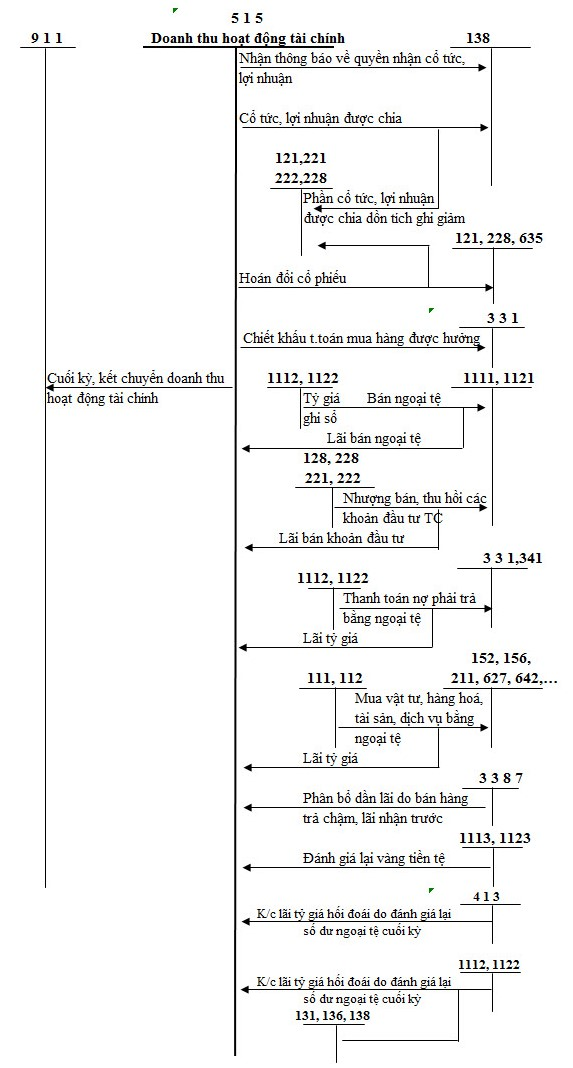
Guide on how to account for financial revenue for businesses
To ensure that accounting for financial revenue is accurate and effective, businesses need to perform specific accounting steps according to various scenarios.
➤ Reflecting revenue from dividends or profits received from capital contributions:
- Upon receiving notification of dividends or profits, record:
- Debit Acct 138
- Credit Acct 515
- If the dividends or profits received include accrued investment interest from before the business acquired the investment, the accountant needs to allocate this interest amount:
- Debit Acc 138: Total dividends, profits received.
- Credit Acc 121, 221, 222, 228: The portion of dividends, profits accrued before the business acquired the investment.
- Credit Acc 515: The portion of dividends, profits earned in periods after the business acquired the investment.
➤ Periodically confirmed collection of loan interest
For loan interest, including bond interest, deposit interest, deferred payment interest, and installment interest, the periodic loan interest received is recorded as follows:
- Debit Acc 138
- Debit Acc 121, 128 (If periodic loan interest is capitalized)
- Credit Acc 515
If the principal receivable is not considered a bad debt, a provision must be made, or a debt confirmation and repayment commitment from the debtor must be obtained. Other evidence, if any, must be retained.
➤ Transferring or recovering financial investments
- Debit Acc 111, 112, 131 (Cash, bank deposits, and receivables)
- Debit Acc 635 (If the sale transaction results in a loss)
- Credit Acc 121, 221, 222, 228 (Financial investments)
- Credit Acc 515 if the sale transaction results in a profit.
➤ When swapping shares
- Debit Acc 121, 128: Shares received at fair value.
- Debit Acc 635: The difference if the value of shares received is lower than the book value of the shares exchanged.
- Credit Acc 121, 228: Shares exchanged at book value.
- Credit Acc 515: The difference if the value of shares received is higher than the book value.
➤ Selling foreign currency
- Debit Acc 111, 112
- Debit Acc 635 (if the actual exchange rate is lower than the book exchange rate)
- Credit Acc 111, 112
- Credit Acc 515 (if the actual exchange rate is higher than the book exchange rate)
➤ Purchasing and paying in foreign currency
If the transaction exchange rate at the time of occurrence is higher than the rate in the accounting books:
- Debit Acc 152, 156, 211.
- Credit Acc 111, 112.
- Credit Acc 515: To record the gain from the actual exchange rate being higher than the book rate.
➤ Payment for purchases in foreign currency
If the book exchange rate for Acc 111, 112 is lower than the rate for accounts payable:
- Debit Acc 331
- Credit Acc 515.
- Credit Acc 111, 112 (Cash or bank deposits)
➤ Collecting receivables in foreign currency
If the actual exchange rate at the time of collection is higher than the book rate:
- Debit Acc 111, 112
- Credit Acc 515
- Credit Acc 131
➤ Sales on a deferred or installment payment basis
Recognize revenue at the cash sale price and record the difference between the deferred price and the cash price in Acc 3387:
- Debit Acc 111, 112, 131: Cash, bank deposits, or receivables.
- Credit Acc 511: Sales revenue.
- Credit Acc 3387: Other financial income (difference between deferred price and cash price).
- Credit Acc 3331 (VAT payable)
➤ Periodically transfer deferred and installment interest revenue
- Debit Acc 3387
- Credit Acc 515
➤ Determine and transfer interest for loans or bonds with interest received in advance
- Debit Acc 3387
- Credit Acc 515
➤ Handling year-end foreign exchange rate differences
When re-evaluating the balances of monetary items denominated in foreign currency, transfer the entire foreign exchange gain:
- Debit Acc 413
- Credit Acc 515
➤ Transfer all financial income to determine business results
- Debit Acc 515
- Credit Acc 911
Examples of Financial Income – Accounting for Account 515
To illustrate more clearly, let’s consider some examples of financial income and how it is recorded in practice.
Example 1: Company A deposits 1 billion VND into a bank savings account with an interest rate of 6%/year for a 1-year term. After 6 months, the company receives 30 million VND in interest. Upon receiving the interest:
- Debit Acc 112 (bank deposits): 30 million VND
- Credit Acc 515 (revenue from deposit interest): 30 million VND
Example 2: Company B sells a financial investment of 200 shares at a selling price of 50,000 VND/share. The cost price was 45,000 VND/share. The total revenue from selling the shares is 10 million VND, while the cost of goods sold is 9 million VND, resulting in a profit of 1 million VND.
- When the company sells the shares:
- Debit Acc 131 (accounts receivable): 10 million VND
- Credit Acc 515 (revenue from selling shares): 10 million VND
- When recording the cost of the shares:
- Debit Acc 632 (cost of goods sold): 9 million VND
- Credit Acc 121 (trading securities): 9 million VND
Example 3: Company C receives a dividend of 100 million VND from a subsidiary. This dividend is transferred to Company C’s bank account. Upon receiving the dividend:
- Debit Acc 112 (bank deposits): 100 million VND
- Credit Acc 515 (revenue from dividends): 100 million VND
Notes for Accountants on Financial Income
Accounting for revenue from financial activities requires great care and accuracy. Here are some notes that accountants need to remember:
- To effectively manage and control economic transactions related to recording financial revenue, as well as to facilitate the explanation of financial statements, accountants should break down the financial revenue account into sub-accounts. For example: Account 5151 – Bank deposit interest; Account 5152 – Loan interest; Account 5153 – Dividends, shared profits…
- Upon receiving notification of the right to receive dividends or profits from investment activities, the accountant should immediately create an accounting entry debiting Account 138 and crediting Account 515, instead of waiting until the dividends or profits are actually received to make the entry.
- For investment income received from accumulated investment interest before the enterprise acquired that investment, the accountant needs to record a reduction in the original cost of that bond or stock investment.
- In the case of receiving stock dividends, the accountant only tracks the increase in the number of shares on the financial statement. Do not record the value of the shares received, do not recognize financial revenue, and do not recognize an increase in the value of the investment in the company.
- Invoices, books, and documents must be arranged and stored carefully and systematically to avoid losing documents or facing difficulties when reconciliation is needed.
- The accountant must regularly monitor and gather all transactions related to revenue from financial activities completely, accurately, and in a timely manner to serve as a basis for determining the enterprise’s business results.
- It is necessary to thoroughly check the figures and link with other accounting modules to ensure the data matches correctly, avoiding errors or omissions in accounting entries.
Accounting for financial revenue not only requires a deep understanding of accounting principles but also demands that accountants have a firm grasp of current legal regulations and accounting standards. We hope that with the detailed information shared by 1Office, your business can easily apply and effectively manage its revenue from financial activities.