11/05/2026
  1001 views
Are you looking for a standard appointment decision template to use in your business or a state agency? Drafting one from scratch is not only time-consuming but also prone to errors in format and content according to current regulations.
In this article, 1Office has compiled 12+ complete and detailed appointment decision templates.
Mục lục
- I. What is an appointment decision?
- II. What basic content is required for a standard appointment decision?
- III. Appointment decision templates by business organization model
- IV. Appointment decision templates by position
- 1. Director Appointment Decision Template
- 2. Chief Accountant Appointment Decision Template
- 3. Department Head Appointment Decision Template
- 4. Production Team Leader Appointment Decision Template
- 5. Personnel Appointment Decision Template
- 6. Official and Civil Servant Appointment Decision Template
- 7. Board of Directors Appointment Decision Template (Word file)
- 8. Management Staff Appointment Decision Template (Word file)
- 9. Deputy Director Appointment Decision Template (Word file)
- V. What Do Businesses Need to Know When Appointing a Position?
- VI. How to Use an Appointment Decision Template to Ensure Legality
- VII. The Process of Issuing an Appointment Decision in a Business
- VIII. Common mistakes when drafting an appointment decision
- 1. Mistake 1: Signing without proper authority
- 2. Mistake 2: Lacking specific legal basis
- 3. Mistake 3: Missing personnel and position information
- 4. Mistake 4: Not clearly defining authority and responsibilities
- 5. Mistake 5: Not specifying the effective period
- 6. Mistake 6: Lack of transparent announcement and storage
- IX. What are the differences between an appointment decision and an employment contract?
- X. Frequently Asked Questions
I. What is an appointment decision?
An appointment decision is a decision to assign an individual or a group of people to a specific position, title, or role within an organization. These decisions are typically made and authenticated by an authorized individual or organization.
These decisions are expressed through official documents, notices, or other materials in accordance with regulations. They serve as a crucial basis for the appointer and relevant parties to implement and record the appointment.

II. What basic content is required for a standard appointment decision?
According to Decree 30/2020/ND-CP, appointment decision documents must include the following basic content:
- National emblem and motto.
- Name of the appointing business, agency, or unit.
- Decision number.
- Time and place of the decision.
- Title of the decision and its content.
- Basis for the appointment decision.
- Information of the person authorized to appoint, the appointee, and the recipient of the appointment decision. (For example: full name, gender, date of birth, ID or citizen card number, position, etc.)
- Recipients of the decision.
- Position of the person issuing the appointment decision.
- Signature and full name of the person issuing the appointment decision.
III. Appointment decision templates by business organization model
Below are 3 appointment decision templates based on business organization models, specifically for state agencies, joint-stock companies, and limited liability companies.
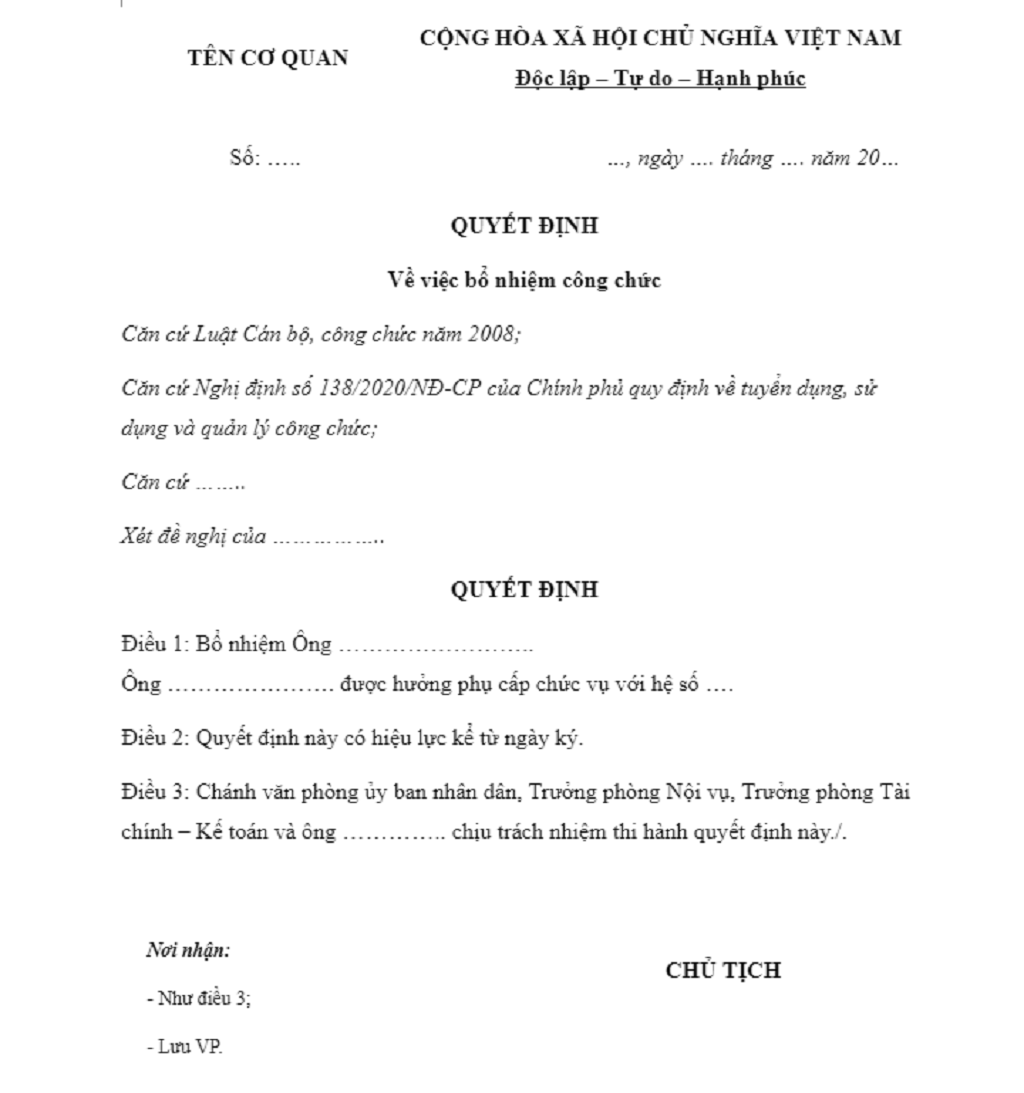
1. Appointment decision template for state agencies
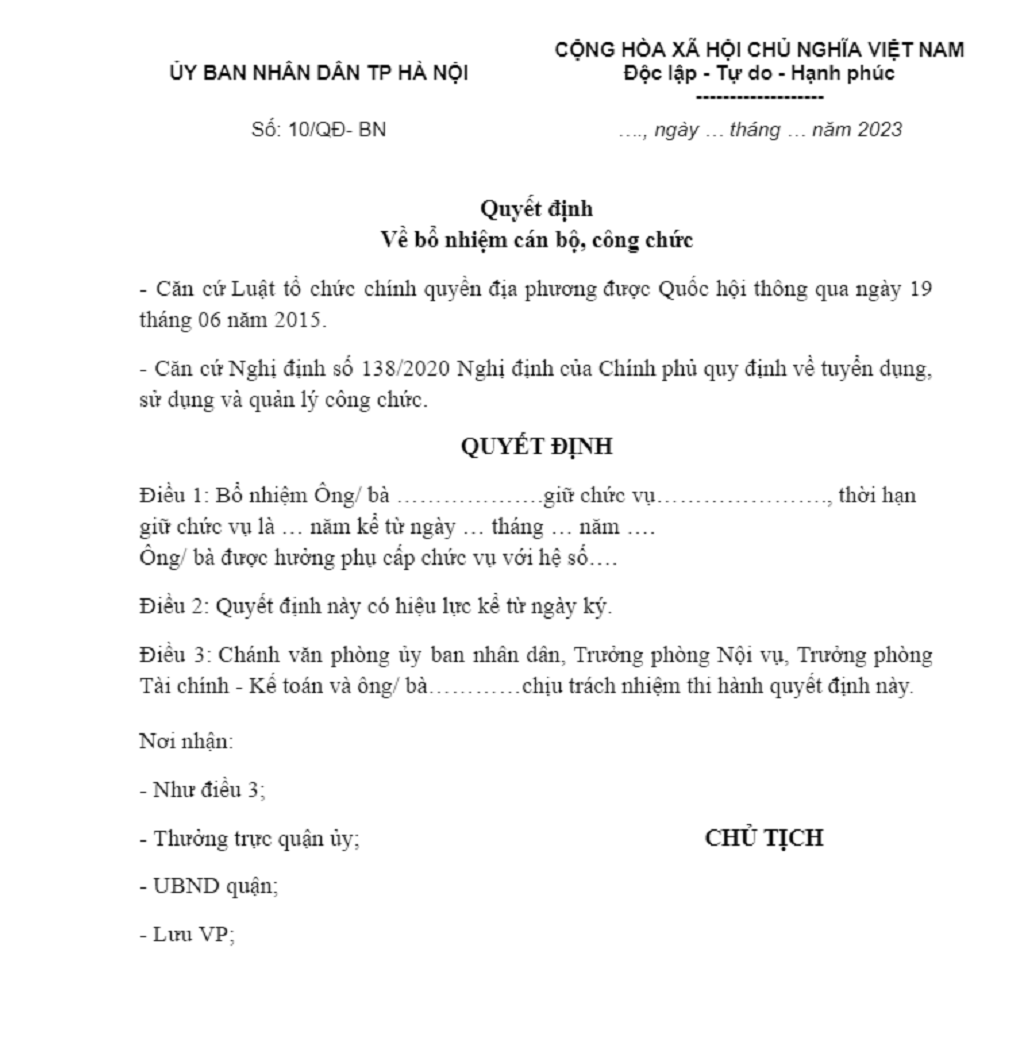
The appointment decision template for state agencies is an important administrative document issued by an authorized person to officially appoint officials and civil servants to new positions in accordance with the Law on Cadres and Civil Servants 2008 (amended and supplemented) and Decree 138/2020/ND-CP. With a standard structure including legal basis, appointee information, new position, term, and effective date, this template ensures transparency, legality, and serves as the basis for implementing salary, allowance regimes, and related benefits. This is an indispensable document for administrative and public service agencies, helping the appointment process proceed smoothly and professionally.
FREE DOWNLOAD LINK: Appointment decision template for state agencies
2. Appointment decision template for joint-stock companies
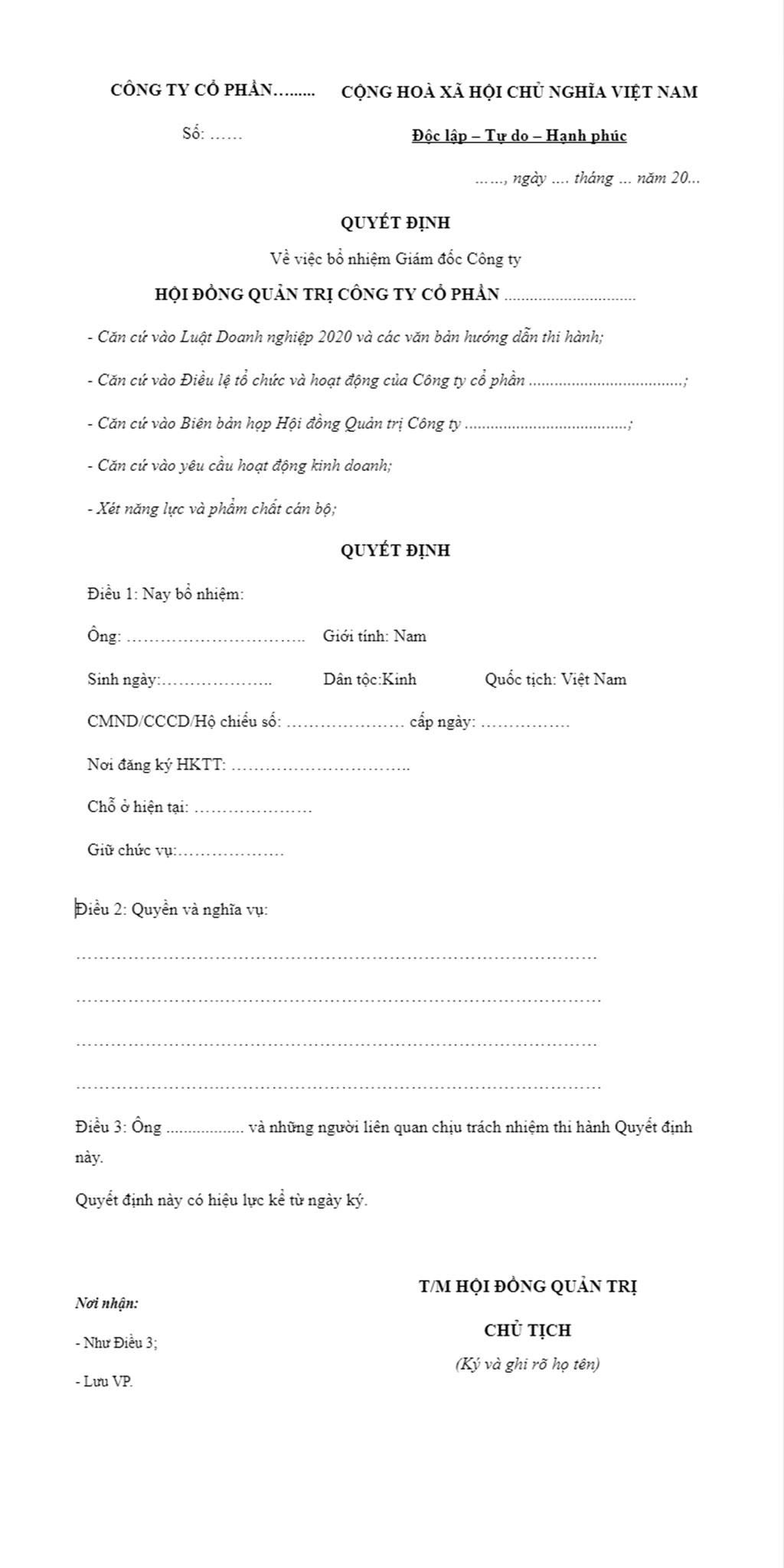
The appointment decision template for a joint-stock company is an internal document issued by the Board of Directors or the General Meeting of Shareholders to officially appoint personnel to leadership or management positions in accordance with the company’s Charter and the Law on Enterprises 2020. With clear content regarding the basis for appointment, personal information, new position, and term, this template not only confirms the role of the appointee but also ensures legality and transparency in corporate governance. This is an ideal choice for joint-stock companies that want to demonstrate professionalism and legal compliance when changing senior personnel.
FREE DOWNLOAD LINK: Appointment decision template for joint-stock companies
3. Appointment decision template for limited liability companies (LLC)
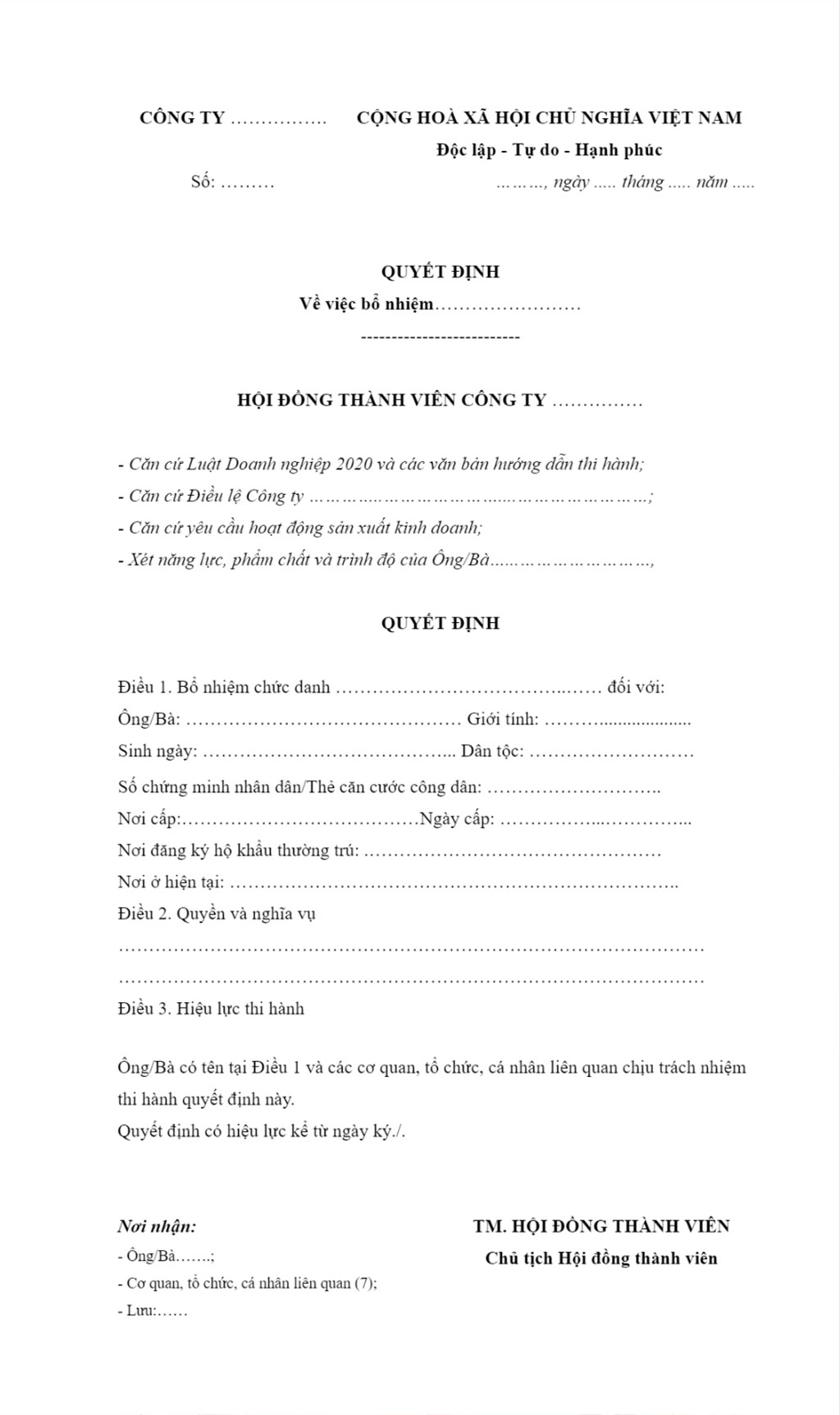
The appointment decision template for a limited liability company (LLC) is a document issued by the Chairman or the Members’ Council to appoint personnel to management positions in accordance with the company’s Charter and the Law on Enterprises 2020. This template focuses on being concise and clear, with information on the basis for appointment, the new position, and accompanying responsibilities, helping the LLC operate efficiently and transparently. This is a necessary document for single-member or multi-member LLCs, ensuring the appointment process is legal and professional.
FREE DOWNLOAD LINK: Appointment decision template for limited liability companies (LLC)
IV. Appointment decision templates by position
1Office has compiled all appointment decision templates for positions including director, chief accountant, department head, production team leader, personnel, and officials and civil servants.
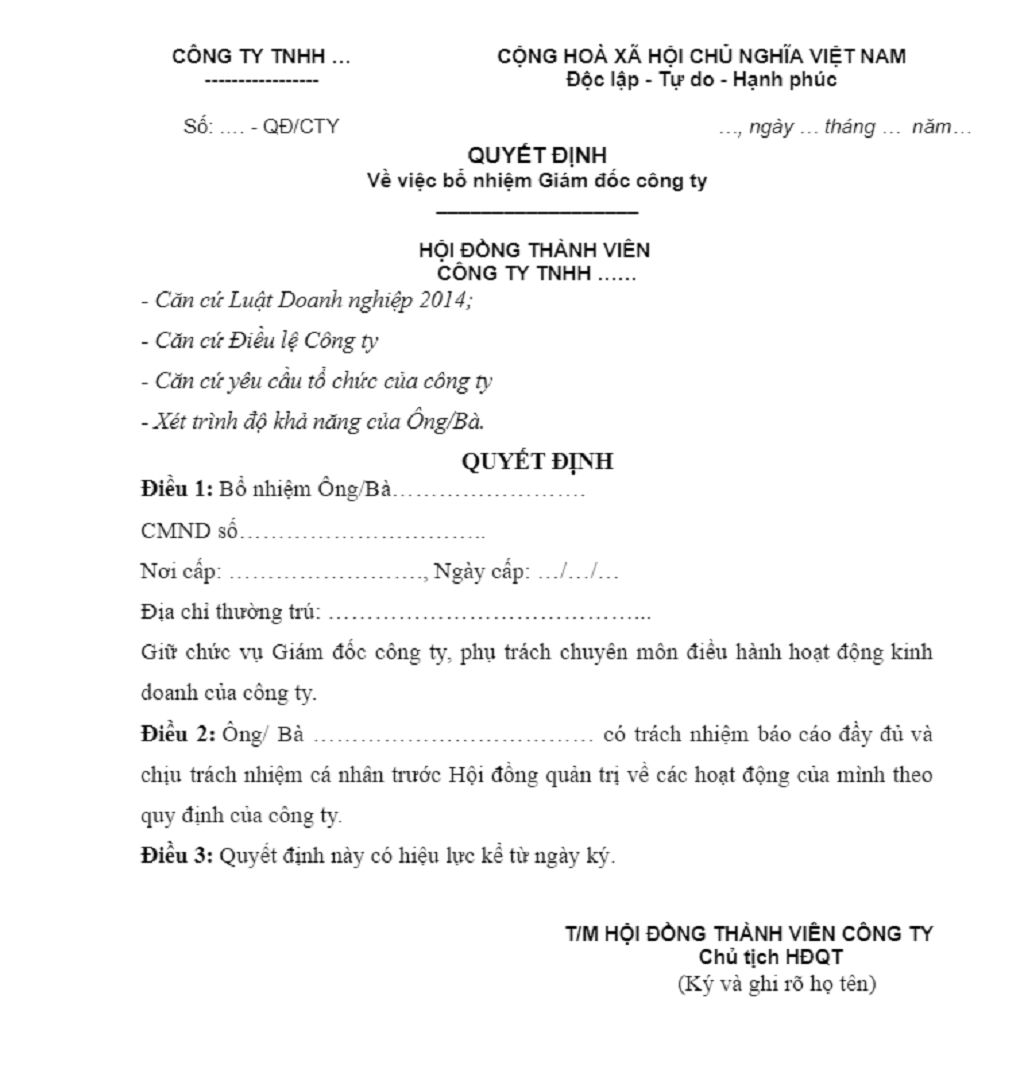
1. Director Appointment Decision Template
The director appointment decision template is the most important document in a business, issued by the Board of Directors or the owner to officially grant executive authority to the head of the company in accordance with the Law on Enterprises. With detailed content on the legal basis, new director’s information, scope of authority, and term of appointment, this decision template not only affirms the highest leadership position but also serves as the legal basis for registering changes with the Department of Planning and Investment. This is a standard template for all types of businesses wanting to appoint a director professionally and in compliance with regulations.
FREE DOWNLOAD LINK: Director Appointment Decision Template
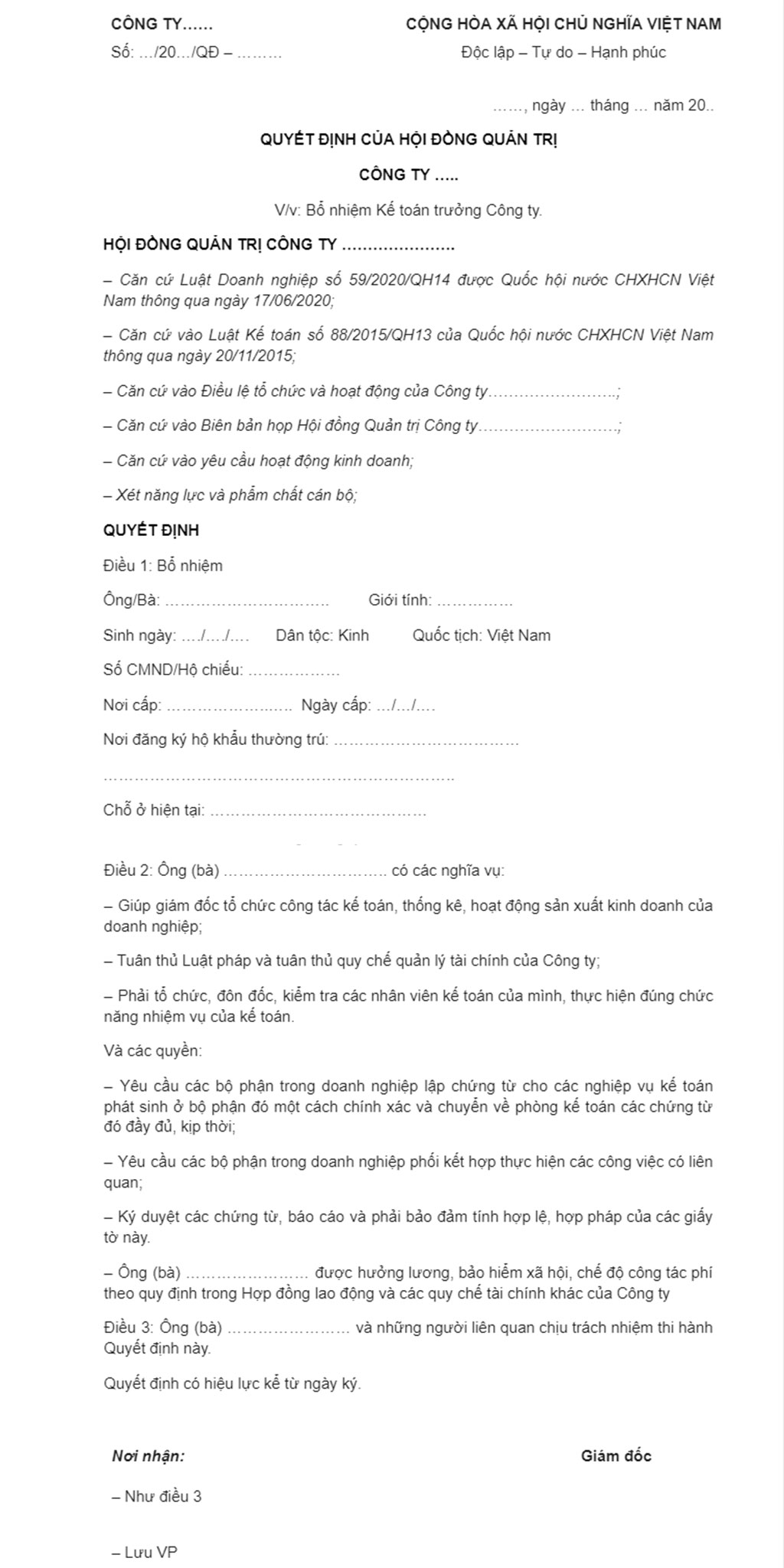
2. Chief Accountant Appointment Decision Template
The chief accountant appointment decision template is an important internal document that helps a business officially assign financial and accounting management duties to a qualified individual in accordance with the 2015 Law on Accounting and Decree 174/2016/ND-CP. This template emphasizes the basis for appointment, professional standards, financial reporting responsibilities, and the term, ensuring transparency and compliance with tax and accounting laws. This is an essential document for all businesses, especially when changing the chief accountant, helping to avoid legal risks and improve financial management efficiency.
FREE DOWNLOAD LINK: Chief Accountant Appointment Decision Template
3. Department Head Appointment Decision Template
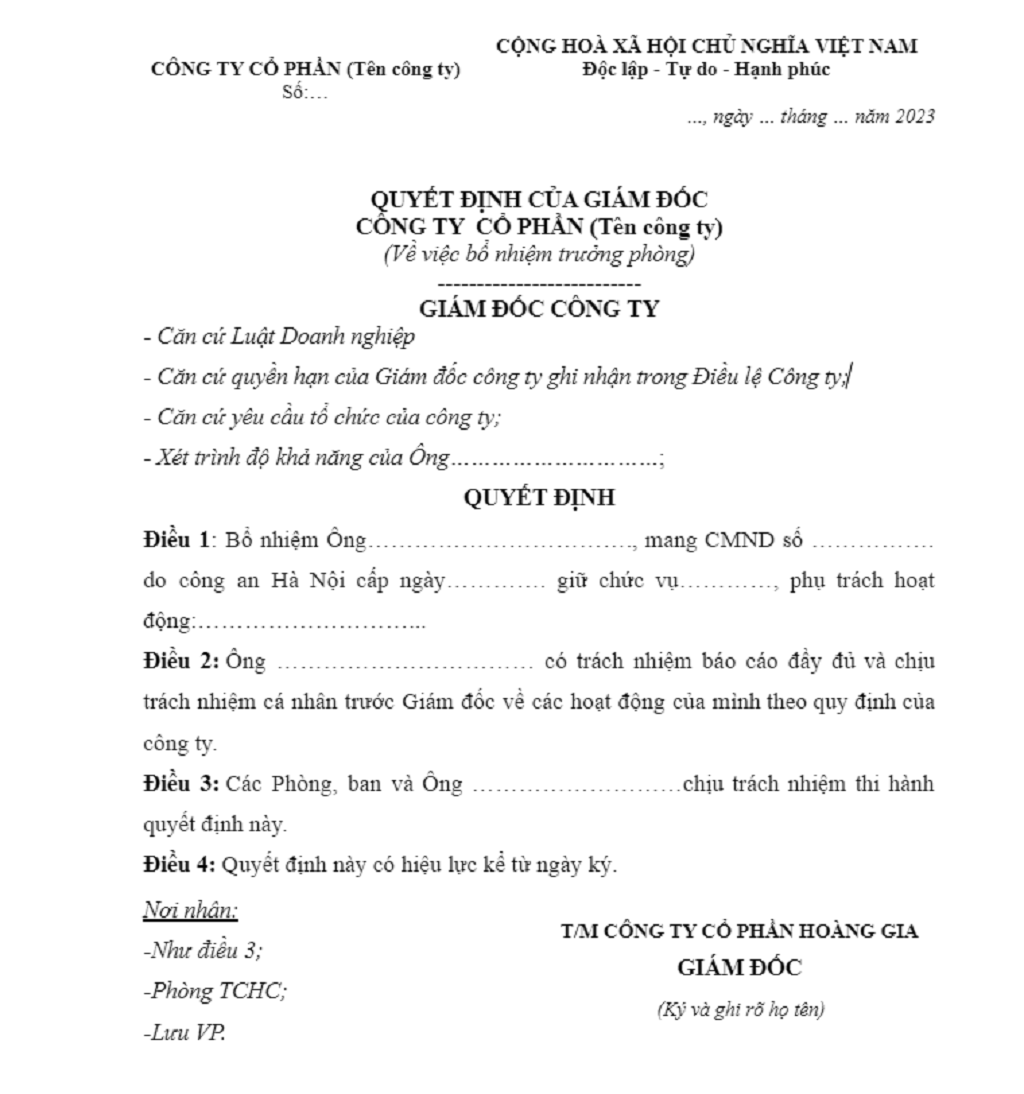
The department head appointment decision template is an internal document that helps a business officially grant leadership authority to the head of specialized departments, in accordance with the company’s charter and internal regulations. With a clear structure regarding the basis for appointment, personal information, scope of responsibility, and term, this decision template not only demonstrates professionalism but also motivates employees. This is a suitable choice for businesses that want to build a tight organizational structure, encourage internal development, and ensure effective departmental operations.
FREE DOWNLOAD LINK: Department Head Appointment Decision Template
4. Production Team Leader Appointment Decision Template
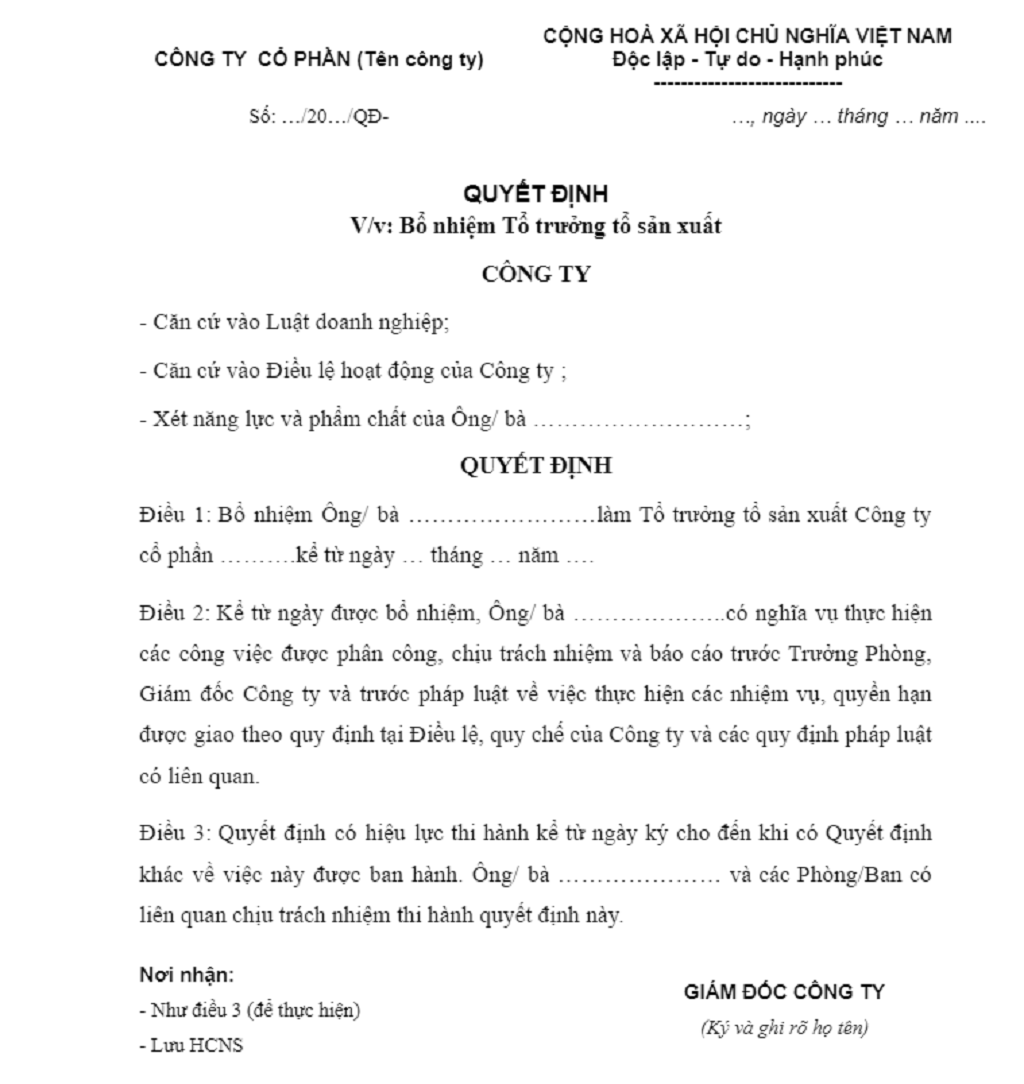
The production team leader appointment decision template is an internal document for manufacturing businesses, intended to officially assign team management duties to outstanding employees in accordance with labor regulations. This template clearly records the responsibilities of supervising production, ensuring labor safety, and meeting targets, while also acknowledging the employee’s contributions. This is an essential document to help improve production line efficiency, motivate workers, and maintain discipline in the factory environment.
FREE DOWNLOAD LINK: Production Team Leader Appointment Decision Template
5. Personnel Appointment Decision Template
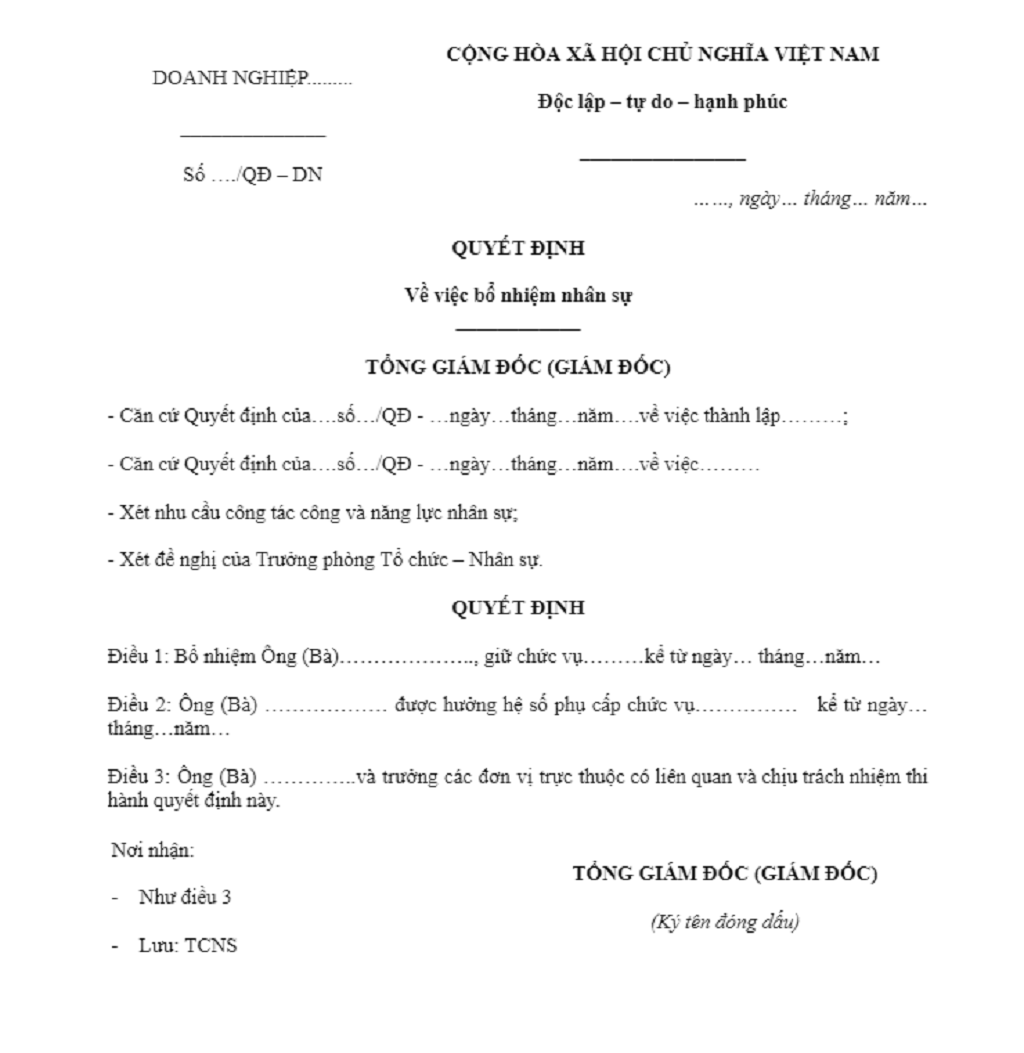
The personnel appointment decision template is a flexible document applicable to all positions in a private enterprise, helping to formalize the promotion or transfer of employees in accordance with the Labor Law and the company’s charter. With concise yet complete content on the basis, new position, and responsibilities, this decision template not only affirms the employee’s career development but also contributes to building a positive corporate culture. This is a standard template for businesses of all sizes that want to appoint personnel professionally and transparently.
FREE DOWNLOAD LINK: Personnel Appointment Decision Template
6. Official and Civil Servant Appointment Decision Template
The decision template for appointing officials and civil servants is an important state administrative document, issued by competent authorities in accordance with the 2008 Law on Cadres and Civil Servants and Decree 138/2020/ND-CP, to officially appoint individuals to new ranks and positions. With a standard structure including legal basis, appointment criteria, term, and benefits, this decision template ensures transparency, fairness, and compliance with the selection process. It is an essential document for state agencies, helping to build a high-quality team of officials and effectively develop public service human resources.
FREE DOWNLOAD LINK: Decision Template for Appointing Officials and Civil Servants
However, due to the specific nature of each business sector, every company has different requirements for appointment decisions, demanding a significant amount of time from managers and CEOs in the management process. Yet, many operational software solutions fail to meet these needs.
> See more: Salary Increase Decision Template: How to Write & Standard Download File
7. Board of Directors Appointment Decision Template (Word file)
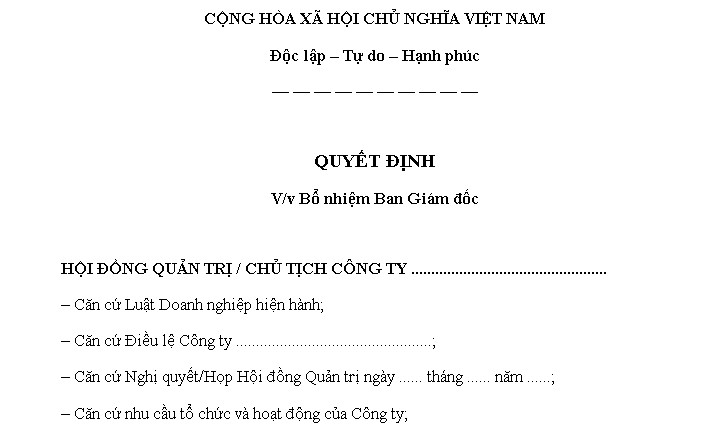
The decision to appoint a board of directors is the highest strategic document in a company, issued by the General Meeting of Shareholders or the Board of Management to officially establish or change the senior leadership team in accordance with the Law on Enterprises. This decision template clearly records the list of board members, their positions, powers, and appointment terms – serving as the legal basis for registering changes with the Department of Planning and Investment. It is a crucial document that helps businesses build a strong leadership structure, clearly assign responsibilities, and ensure continuous business operations, especially during periods of transition or expansion.
FREE DOWNLOAD LINK: Board of Directors Appointment Decision Template (Word file)
8. Management Staff Appointment Decision Template (Word file)
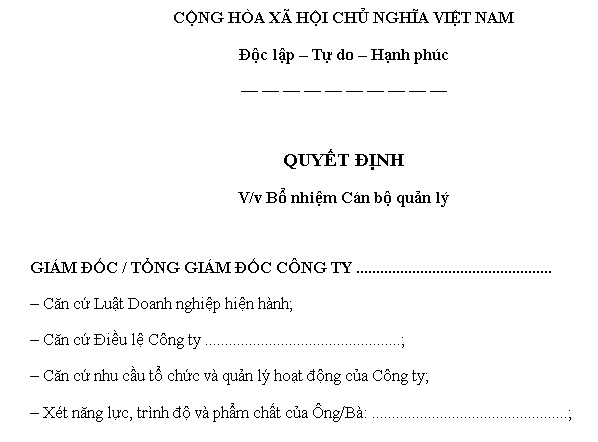
The management staff appointment decision template is an internal document that helps businesses officially assign leadership responsibilities for mid-level and senior management positions (department heads, deputy heads, project managers, etc.) in accordance with internal labor regulations and the Law on Enterprises. With a standard structure including the basis for appointment, personal information, new position, and scope of authority, this decision template not only recognizes competence but also contributes to building a solid organizational structure and motivating employees for career advancement. It is an ideal choice for any business wanting to appoint management staff professionally, transparently, and to promote a culture of internal development.
9. Deputy Director Appointment Decision Template (Word file)
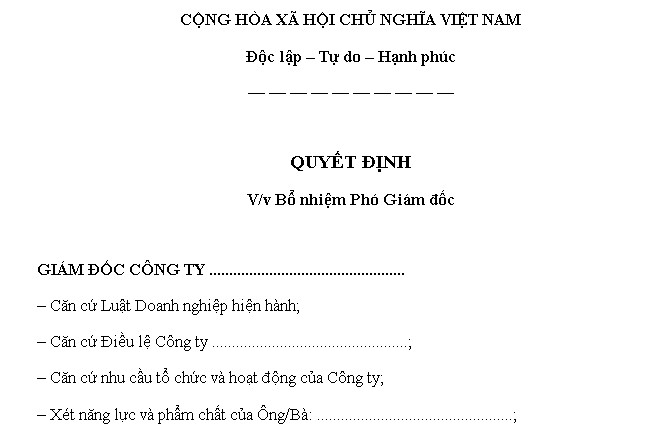
The deputy director appointment decision template is an important internal document issued by the Board of Management or the company’s Director to officially grant senior leadership authority to the person assuming the deputy director position, in accordance with the 2020 Law on Enterprises and the company’s charter. With clear content regarding the basis for appointment, scope of authority, responsibilities, and term, this decision template not only affirms the role of supporting the CEO but also ensures transparency and legality in the leadership structure. It is an essential document for any business aiming to appoint a deputy director professionally, foster internal development, and prepare for long-term leadership succession.
FREE DOWNLOAD LINK: Deputy Director Appointment Decision Template (Word file)
V. What Do Businesses Need to Know When Appointing a Position?
When appointing any position, businesses need to be clear on the following basic points:
1. When is an appointment decision required?
The cases requiring an appointment decision are clearly stipulated in the 2014 Law on Enterprises. Below are the mandatory cases where an appointment decision is needed:
- Appointment of Board of Management members: Appointing or replacing members of the Board of Management, including the Chairman, Vice Chairman, and other members.
- Appointment of a Director: Appointing or replacing the company’s Director.
- Appointment of a Chief Accountant: Appointing or replacing the company’s Chief Accountant.
- Appointment of an auditor: Appointing or replacing an internal auditor or a contracted auditor.
- Appointment of the Supervisory Board: Appointing or replacing members of the Supervisory Board.
In Vietnam’s 2014 Law on Enterprises, the rights and authority for appointments are stipulated in Chapter II, Section 2, from Article 73 to Article 82. Depending on the position and appointment powers, the appointing authority will belong to different individuals/organizations.
For example: The authority to appoint a Director falls under the purview of the Board of Directors or an authorized individual.
3. Term of Appointment
Regulations regarding the term of appointment will vary depending on the position, benefits, and business model. The company will base its decision on these factors to set an appointment term that aligns with practical needs and legal regulations.
For example: Article 154 of the 2020 Law on Enterprises stipulates: “The term of office for a member of the Board of Directors shall not exceed 05 years and they may be re-elected for an unlimited number of terms. An individual may only be elected as an independent member of the Board of Directors of a company for no more than 02 consecutive terms.”
Clause 3, Article 20 of Decree No. 174/2016/ND-CP stipulates: “The term of appointment for a chief accountant of accounting units in the state accounting sector, and the term of appointment for an accountant-in-charge of the units specified in Point a, Clause 2 of this Article is 5 years, after which the procedures for re-appointing the chief accountant or accountant-in-charge must be carried out.”
4. Other Considerations
In addition to the important considerations above, when making appointments for corporate positions, businesses also need to pay attention to the following:
- Comply with legal regulations and internal company policies.
- Ensure fairness and transparency in the appointment process.
- Properly assess the competence and experience of the appointee.
- Communicate information consistently among all relevant parties.
- Archive all relevant documents after the appointment decision for reference.
VI. How to Use an Appointment Decision Template to Ensure Legality
An appointment decision is not just an administrative procedure, but also a crucial legal basis that helps businesses avoid disputes and affirm the legality of their human resource management. To ensure the appointment decision is legally valid, you need to note the following:
- Clear legal basis: Always fully cite documents such as the 2020 Law on Enterprises, the 2019 Labor Code, the company’s charter, or internal regulations. If issued by the Board of Directors/Members’ Council, the resolution/meeting minutes must be clearly stated as the basis.
- Correct issuing authority: The signatory must be the person authorized by the charter (Director, General Director, Chairman of the Board of Directors/Members’ Council). If signing on behalf, a valid authorization decision must be attached.
- Form & format: Must have a decision number, date of issuance, national emblem and motto (if a state agency), and be presented in accordance with Decree 30/2020/ND-CP on administrative document formatting.
- Signature and seal: The decision requires a direct signature or digital signature of the authorized person, accompanied by the company seal to enhance its legal value.
- Detailed and complete information: Clearly state the full name, date of birth, appointed position, effective date, term of appointment (if any), benefits (salary, allowances), and obligations (reporting, management responsibilities).
- Effective date and recipients: Clearly state when the decision takes effect and the list of recipients: HR department, accounting, administration, and the appointee. This serves as proof that the document has been announced and circulated according to procedure.
- Transparent archiving: Store the original copy in the personnel file, and also digitize and manage it on an HRM system (like 1Office) for easy retrieval and to reduce future disputes.
A properly drafted and issued appointment decision not only helps avoid legal risks but also creates transparency and fairness in human resource management, thereby strengthening employee trust in the company.
VII. The Process of Issuing an Appointment Decision in a Business
An appointment decision is not merely a document to be “signed and done with,” but a legal and administrative process with many closely linked steps. If a business skips or performs these steps carelessly, the decision can easily be considered invalid and may even lead to disputes during an inspection.
Below are 9 standard steps to help businesses issue appointment decisions in a legal and transparent manner:
Step 1: Identify the Need for Appointment
The business needs to clearly define the reason: promotion, filling a vacant position, adding management personnel, or formalizing a concurrent role. Without a specific need, the decision can easily be seen as arbitrary.
Step 2: Verify Personnel Qualifications
Review the individual’s profile: experience, degrees, and certifications. Some positions (e.g., chief accountant) require professional practice certificates; failure to meet these requirements will render the decision invalid.
Step 3: Conduct a Legal Review
Check the legal basis to be included in the decision:
- Law on Enterprises 2020
- Labor Code 2019
- Company charter
- Meeting minutes, resolutions of the Board of Directors/Members’ Council (if any)
Specific referencing helps the decision “stand firm” during inspections.
Step 4: Approve the policy
The competent authority (Board of Directors/Members’ Council/General Director) reviews and approves via a resolution or meeting minutes. This serves as the basis for the HR department to draft the official document.
Step 5: Draft the decision
A standard appointment decision usually has the following structure:
- Legal basis (law, charter, resolution)
- Personnel information (full name, date of birth, identification number)
- Appointment details (position, scope of authority, responsibilities)
- Remuneration (salary, allowances, term of appointment)
- Implementation clauses (effective date, recipients, implementation responsibility)
For example: “Mr. Nguyen Van A is appointed as Head of Sales, with the authority to sign contracts valued up to 1 billion VND.”
Step 6: Sign and stamp
The signatory must have the proper authority as stipulated in the charter. If signing on behalf of someone, a valid power of attorney is required. The decision is then stamped with the company seal to enhance its legal validity.
Step 7: Announce the decision
The decision needs to be announced internally (via email, department meetings, notice boards) so that all personnel are aware and can comply. This avoids situations where an employee “doesn’t know they’ve been appointed” or related departments are unaware of the new authority.
Step 8: Hand over work and update systems
- If there is a change in position, a handover record for work, documents, and assets must be created.
- Simultaneously, update the HRM/ERP system, organizational chart, and signature permissions.
Step 9: Archive the records
- Store the original copy in the HR & Admin/Clerical department.
- Digitize and store it in software for easy retrieval during audits/inspections.
This serves as evidence to protect the company in case of disputes.
With these 9 steps, an appointment decision is not only legally compliant in form but also creates transparency and enhances professionalism in human resource management.
VIII. Common mistakes when drafting an appointment decision
Drafting an appointment decision is not just an administrative task; it is a legally binding document tied to the company’s HR activities. If done carelessly, the decision may be considered invalid or create difficult-to-resolve disputes. Therefore, it is essential to clearly identify the most common mistakes, analyze their consequences, and learn how to fix them to ensure appointment documents always meet the standard.
This mistake occurs when the person signing the decision is not the authorized level according to the company charter or internal regulations. Without this compliance, the decision lacks legal validity from the outset, putting the company at risk.
When a decision is signed without proper authority, its entire legal effect will not be recognized. The appointed personnel cannot legally exercise their authority and responsibilities, and the company loses its basis for defense in disputes or inspections from regulatory agencies.
The solution is to clearly define in the regulations who has the authority to sign decisions for each job level. In cases where a substitute signature is needed, a written power of attorney must be attached. Additionally, the HR department needs to review carefully before submitting for signature to avoid errors.
2. Mistake 2: Lacking specific legal basis
Another common mistake is when the document only makes a general reference to the law or charter without specifying the relevant articles, resolutions, or meeting minutes. This makes the decision ambiguous, non-binding, and difficult to prove its validity.
Without a specific basis, the document will be considered legally weak and easily dismissed during an inspection. The company will also face difficulties in providing explanations, which undermines its credibility and transparency in HR management.
To ensure it is robust, the decision must clearly cite the applicable legal articles, resolution numbers, dates of meeting documents, or relevant internal regulations. This not only increases its legality but also helps the decision maintain long-term value.
3. Mistake 3: Missing personnel and position information
Many appointment decisions only briefly state the name and job title, omitting the date of birth, identification number, term of appointment, or scope of authority. This leaves the document lacking crucial data to accurately identify the appointed individual.
When information is incomplete, the personnel’s responsibilities and authority are not clearly defined. This can cause confusion in management, lead to internal conflicts, and be difficult to handle in case of a dispute.
In every decision, it is necessary to ensure that all essential personal information, job title, scope of authority, and effective term are clearly stated. This completeness is the foundation for the document’s legal validity and ease of application.
Some appointment decisions only state the job title without specifying the authority and responsibilities. This makes it difficult for the employee to determine their scope of authority, leading to ambiguity in the management process.
This lack of clarity on authority and responsibilities reduces operational efficiency. Employees may abuse their power or, conversely, evade responsibility, causing disruptions in the management system and affecting work performance.
The decision should clearly define the scope of authority, level of responsibility, and reporting obligations. Clarifying these from the outset helps the employee understand their role and provides the company with a basis for control.
5. Mistake 5: Not specifying the effective period
Many documents only state the signing date without specifying the start or end date of its validity. Without a specific timeline, the decision becomes ambiguous and complicates long-term personnel management.
The company will face difficulties when trying to dismiss, rotate, or reappoint someone. The employee might object on the grounds that their term has not ended, leading to disputes and affecting organizational stability.
Each decision must clearly state the effective date and the term of appointment. For management positions, specifying the duration is essential for the company to proactively adjust its human resources plan.
6. Mistake 6: Lack of transparent announcement and storage
Another common mistake is when a company only sends the decision to the appointed individual without announcing it internally or storing the original document properly. This causes the document to lose its necessary transparency.
When the decision is not widely communicated, relevant departments are unaware of the employee’s new authority, causing difficulties in work coordination. If the original document is not stored, the company can also face trouble during inspections by regulatory agencies.
The solution is to officially announce the decision internally and store the original copy in the HR and administration department. Additionally, digitizing the document on an HRM system will make it easy to look up when needed.
IX. What are the differences between an appointment decision and an employment contract?
Appointment decisions and employment contracts often go hand in hand in human resource management, but these two types of documents have entirely different natures and legal values. If a company confuses or uses them incorrectly, the consequences can be a lack of transparency in an employee’s authority or the risk of legal disputes. Therefore, it is necessary to clearly analyze the differences between these two documents to understand and use them correctly.
1. Difference in purpose
An appointment decision is issued to define the position, authority, and management responsibilities of an individual within the organizational structure. In contrast, an employment contract focuses on establishing the labor relationship, specifying the job, working hours, salary, and benefits of the employee.
If a company only issues an employment contract without an appointment decision, the manager will lack the basis to exercise their authority. Conversely, if there is only an appointment decision without an accompanying employment contract, there will be no binding basis for salary and benefits.
The solution is to always use both documents simultaneously to complement each other. The appointment decision defines the management position, while the employment contract binds the work relationship and benefits.
2. Difference in signing parties
An appointment decision is issued by the company, and the signatory must be an authorized person according to the company’s charter, usually the CEO or the Board of Directors. An employment contract, on the other hand, is a two-party agreement signed by the employer and the employee.
If the company makes a mistake and allows an unauthorized person to sign the appointment decision or contract, the document will be invalid. This will directly affect the employee’s rights and the legality of management decisions.
The company needs to clearly define the authorized signatory for each type of document. The appointment decision must comply with the company charter, while the employment contract must have the signatures of both parties.
3. Difference in scope of application
An appointment decision applies internally within the company, reflecting the assignment of management duties and authority within the organization. An employment contract has a broader legal binding scope, is protected by labor law, and applies to the relationship between the employee and the employer.
If the company relies solely on the appointment decision to regulate salary, it will lack a basis during a labor inspection. Similarly, without an appointment decision, a manager will lack the authority to manage or approve documents.
It is essential to understand the different scopes to issue the appropriate documents. The appointment decision comes with internal management authority and responsibilities, while the employment contract is a tool to bind the relationship and benefits according to legal regulations.
X. Frequently Asked Questions
Is it mandatory for an appointment decision to have the company seal?
An appointment decision is not required to be sealed. However, in practice, many companies still use a seal to make the document more formal, consistent with internal procedures, and convenient for record-keeping, verification, or working with related parties.
Does an appointment decision need to be sent to all employees in the company?
It is not necessary to send it to all employees in every case. The company should announce the appointment decision on a need-to-know basis, especially to departments and individuals directly related to the appointee to ensure work coordination.
Does an appointment decision need to include a job description or a list of authorities?
It is not mandatory to attach them, but the company should clarify the authority, responsibilities, and scope of work of the appointee.
What is the difference between an appointment decision and a power of attorney?
An appointment decision is a document issued by a company to formally assign a position or management role to an individual. In contrast, a power of attorney is primarily used to authorize a person to act on behalf of another person or an organization to perform a specific task, transaction, or authority within the authorized scope. Simply put, an appointment is tied to a more long-term position and responsibility, while an authorization is tied to a specific scope of representation or task handling.
Can an appointment decision be revoked or replaced?
Yes. In practice, an appointment decision can be revoked, adjusted, or replaced when the company changes its organizational structure, personnel, job titles, appointment terms, or scope of authority.
Above are the best appointment decision templates for all positions, with free downloadable files. Download these templates now to prepare for upcoming appointments, and don’t forget to read the latest updates from 1Office!