


 11/05/2026
  403 views
What is the ASK model that is so widely used in human resource management for businesses? This model is often applied to two main personnel groups: job candidates and current employees. The article below will give you the best overview of what the ASK model is and its importance to your business.
Mục lục
1. Overview of the ASK model
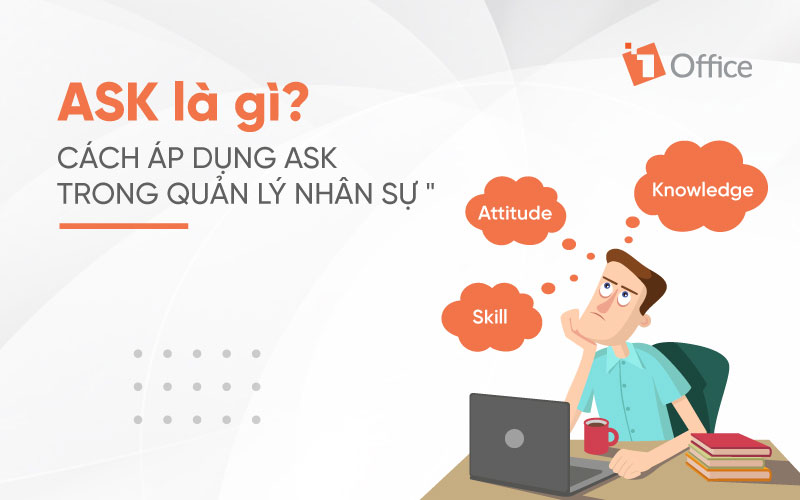
The ASK model is an acronym for Attitude – Knowledge – Skill. ASK is one of the standard models commonly used by businesses today. Its purpose is to assess employee competency based on 3 main factors: Attitude – Knowledge – Skill.
Specifically, the ASK model is often applied to both personnel groups. These are job candidates and your current employees.
For job candidates, you can use the ASK assessment model to select individuals with the right expertise for the position. In addition, factors like a positive attitude and relevant professional skills are also used to rank candidates on the recruitment list.
For current employees, the ASK model is incredibly significant, helping businesses classify employee levels by proficiency, attitude, or skills. This allows for making sound management decisions, appointments, work assignments, rewards, etc.

So, now you know what ASK is: a competency assessment model for a company’s candidates and employees. The people who directly apply this model are HR leaders and HR managers/department heads.
Learn about 1Office’s ASK competency assessment feature
2. What is the importance of ASK for HR and businesses?
According to a competency survey by the Society for Human Resource Management (SHRM), 93% of 500 C-level executives surveyed stated that competency assessment models are very important for company performance. HR experts also assert that success in human resource management is attributed to organizations having clearly defined competency assessment models.
Thus, to manage a business effectively, you need to clearly understand the importance of what ASK is and how to apply it in human resource management.
2.1. Quantifying personnel skill gaps
It’s hard to overlook skill gaps when they are causing significant disadvantages to business operations. You may be aware of your workforce size and know you need to strengthen your human resources. However, you might not know the means to quantify the skill gaps among your personnel.
A leader’s decisions will shape the company’s future. Therefore, it is certain that ASK is an effective human resource management method. The ASK model helps you generate competency assessment data and analyze personnel skill gaps. From there, you can make informed decisions, confidently direct, and allocate people to suitable jobs.
For candidates in the recruitment process, you can screen applicants based on data about their attitude, knowledge, and skills, which are divided into different levels. For employees in the company, you can classify and assess the skill level of each individual.

2.2. Driving Promotion and Improvement
The reality is that today’s organizations and businesses are evolving at an increasingly rapid pace. Even when an employee is upskilled or retrained, some of their skills may have already become obsolete.
Awareness of new trends and the skills to understand the world around us are extremely important. For this reason, the importance of the Model ASK is what determines the competency of individuals in particular and the business as a whole.
Business revolves around skill renewal, assessing competency for specific roles, and future orientation. Promoting competency in your organization begins when you create a cycle of continuous assessment, development, and re-evaluation of the skills and tasks performed. It provides you with a continuously updated picture of competency at any time. This helps businesses build an effective human resource management system.
Therefore, you need to build an employee evaluation method ASK for your business. The purpose is to boost employee performance, streamline HR operations, and improve every step of the workflow.
| Read more: Risks in Human Resource Management and How to Mitigate Them |
3. How to evaluate personnel using the ASK model
3.1 Attitude-based evaluation
Attitude is the first element in the ASK model. Personnel evaluation based on attitude focuses on the following 5 levels:
- Fully focused
- Determined
- Interested
- Neutral
- Uninterested
3.2 Skill-based evaluation
To evaluate the second element in ASK, the following levels are used:
- Expert
- Proficient
- Practitioner
- Developing
- Beginner
3.3 Knowledge-based evaluation
This is the final element in the ASK model. To evaluate competency, consider the following levels:
- Comprehensive
- Good understanding
- Basic understanding
- Limited understanding
- No knowledge
See more: Top 9 accurate and effective employee evaluation software
4. 3 Ways to apply ASK in HRM
Thus, the information above provides a basic overview of what ASK is and its importance. The key objective is to build a set of criteria for the ASK model.
4.1. Building criteria for screening and recruiting personnel
Candidate screening is the process of reviewing submitted job applications. The purpose of screening is to filter out a sufficient number of potential and suitable CVs from hundreds or thousands of applications to meet the company’s requirements. Screening candidates helps your business save recruitment costs and time.

To build a set of criteria for screening employees, you need to note the following:
- Professional qualification criteria: Depending on the job requirements, the business needs to clearly define the professional qualification criteria for the position through degrees, professional certificates, etc.
- Work experience criteria: Recruiters require increasing work experience for each level. For example, a specialist may have 1-3 years of experience, a manager 5-8 years, and a director over 10 years. Depending on the difficulty of the job and the salary and benefits budget for the successful candidate, the business will specify the experience requirements to screen resumes.
- Key skills criteria: Each position should have different key criteria and skills. For example, communication skills, work organization skills, time management, logical reasoning skills, etc.
4.2. Building a competency framework for internal personnel evaluation
To build a personnel evaluation competency framework, you must first clarify the purpose of the ASK framework. Different purposes, such as training, human resource development, compensation, and salary payment, will lead to the selection of different levels.
We suggest the following structure to help you build a personnel competency framework:
- Role-based competencies: A compilation of practical competencies such as strategic thinking, self-management, leadership, etc.
- Core competencies such as communication skills, problem-solving skills, public speaking skills, language skills, etc.
- A professional competency framework linked to a specific field and the specific position of each employee. For example, sales skills, communication skills, programming skills, customer care skills, design skills, etc.
- Behavioral competencies are defined in terms of behavior, with the aim of ensuring applicability and proficiency. Managers can use supporting tools such as DISC, MBTI, etc.
4.3. Providing clear orientation and personnel development
To foster business growth, it’s necessary to have a clear orientation and development plan for what ASK entails.
First, have a clear and professional training strategy. According to a report on personnel aspirations at 1Office, up to 85% of potential employees expressed a desire for additional training in management and leadership skills.
Second, develop managers into professional advisors for employees. You should guide managers and leaders to become truly effective coaches. This allows them to leverage their experience and motivate other employees.
Third, emphasize soft skills. The link between people and work performance is soft skills. Therefore, these skills are also called the golden key to strengthening team spirit and enhancing the ability to monitor personnel activities.
However, to guide and develop personnel clearly, effectively, and intelligently, you cannot follow traditional methods. This means relying on paper-based definitions, complex top-down employee management processes, and fragmented, isolated tools. Therefore, you and your business need to optimize the ASK human resource management process on smart software.
5. Effective Personnel Evaluation with 1Office’s HRM Module
Based on a survey of 5,000 CEOs of businesses nationwide, up to 65% of leaders said they are using HRM software to manage human resources. However, although businesses were aware of the ASK model, they did not fully apply it.
1Office is currently the number 1 total business management solution in Vietnam. Its HRM module is integrated flexibly and conveniently for all businesses.
The HRM 1Office module provides the following ASK personnel evaluation framework for businesses:
Manage and store evaluation criteria:
- Users can build competency evaluation criteria and manage them centrally right on the software.
- Allows customization of the competency framework to evaluate each department and position within the business.
- Can create diverse, visual evaluation templates for easier viewing and quicker overall assessment.
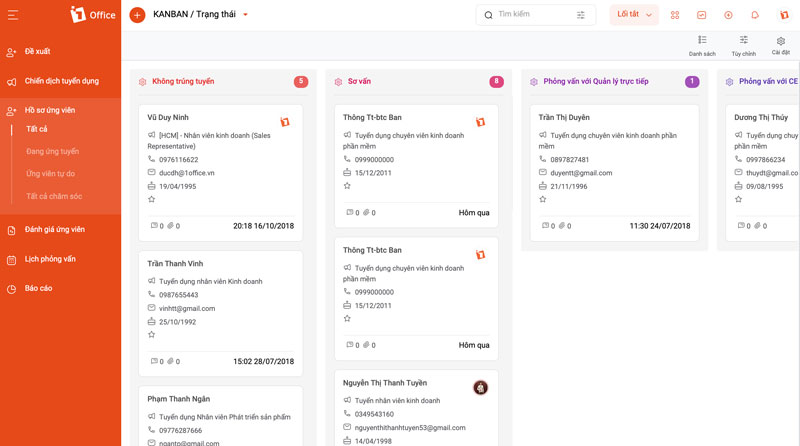
Evaluate competency results:
- Users can easily set up evaluations weekly, monthly, quarterly, seasonally, annually, or randomly.
- Customizable settings for criteria scoring formulas and average competency score formulas.
- Based
















