


 11/05/2026
  271 views
Customer behavior plays a crucial role in every successful marketing strategy. Understanding the factors that influence customer behavior helps businesses optimize their products and services and build effective advertising strategies. However, not everyone understands how to properly research and analyze customer behavior. In this article, 1Office will share some valuable tips. If you want to improve your marketing effectiveness and create strategies that align with the actual needs of your customers, don’t miss the important information below!
Mục lục
- 1. What is Customer Behavior?
- 2. The Importance of Researching Customer Behavior
- 2.1. Optimize Marketing Strategies
- 2.2. Improve Customer Experience and Build Loyalty
- 2.3. Develop Products/Services that Meet Market Needs
- 2.4. Predict Consumer Trends and Market Behavior Changes
- 2.5. Increase Revenue and Optimize the Sales Process
- 2.6. Minimize Risks and Unnecessary Costs
- 2.7. Creating Differentiation in a Competitive Market
- 3. Types of Customer Behavior
- 4. Factors Influencing Customer Behavior
- 5. Customer Behavior Models
- 6. Customer Behavior Research Process
- 7. Methods for researching customer behavior
- 8. Tools to Support Customer Behavior Analysis
- 9. Conclusion
1. What is Customer Behavior?
Customer behavior is the sum of actions, thoughts, and emotions that customers display during the process of searching for, purchasing, and using a product or service. This is not just about the purchasing decision, but also includes factors such as perception, motivation, and the influence of the surrounding environment (cultural, social, psychological) on consumer behavior. Understanding customer behavior helps businesses predict demand, optimize products, improve marketing strategies, and enhance the user experience.
Customer behavior can be divided into various types, from habitual buying behavior to complex decisions based on thorough research. Analyzing customer behavior helps businesses optimize their sales process and create effective marketing strategies tailored to specific customer segments.

2. The Importance of Researching Customer Behavior
Researching customer behavior is not just a supporting tool in marketing but also the foundation for building a sustainable and effective business strategy. By understanding customer behavior, businesses can make more accurate decisions regarding products, marketing strategies, and customer care services. Below are the detailed reasons why researching customer behavior is extremely important:
2.1. Optimize Marketing Strategies
Researching customer behavior helps businesses better understand how potential customers search for information, make purchasing decisions, and consume products. With this understanding, businesses can optimize their marketing strategies to target the right audience, use appropriate communication channels, and apply persuasive marketing messages. This not only increases campaign effectiveness but also minimizes advertising costs.
2.2. Improve Customer Experience and Build Loyalty
Researching customer behavior helps businesses understand the needs, expectations, and emotions of customers throughout their interaction with a product or service. From there, businesses can optimize the customer experience, ensuring that every touchpoint with the brand brings satisfaction. When customers feel their needs and desires are met, they are more likely to become loyal customers, reducing churn rates and increasing long-term customer value.
2.3. Develop Products/Services that Meet Market Needs
One of the key applications of customer behavior research is helping businesses develop products and services that align with the actual needs of customers. Understanding the problems customers face, the factors driving purchasing decisions, or new market trends helps businesses adjust or innovate products to meet customer demands. This not only improves product quality but also helps businesses seize future growth opportunities.
2.4. Predict Consumer Trends and Market Behavior Changes
Customer behavior is constantly changing, and researching it helps businesses predict future consumer trends. By analyzing current consumer behavior data, businesses can identify changes in customer needs and preferences, thereby developing appropriate business strategies. Accurately predicting trends helps businesses not only keep up with the market but also potentially lead it, staying ahead of competitors.
2.5. Increase Revenue and Optimize the Sales Process
Understanding customer behavior not only helps improve marketing strategies but also helps optimize the sales process. By understanding the factors that motivate customers to buy, businesses can improve stages in the customer journey, from awareness and evaluation to the purchase decision. Insights into consumer behavior help businesses build suitable sales strategies, thereby increasing conversion rates and boosting revenue.
2.6. Minimize Risks and Unnecessary Costs
Understanding customer behavior helps businesses make more accurate decisions and minimize ineffective strategies. With correct information about what customers truly want and need, businesses can avoid unnecessary expenses such as ineffective advertising, developing unsuitable products, or strategies that do not deliver practical value. This not only helps save costs but also optimizes the company’s resources.
2.7. Creating Differentiation in a Competitive Market
In today’s fiercely competitive market, researching customer behavior helps businesses create differentiation and enhance brand value. By understanding customer behavior and expectations, businesses can offer unique products and services tailored to specific customer groups. This not only helps build loyalty but also allows the business to stand out from the crowd of competitors.
3. Types of Customer Behavior
Understanding customer behavior is key for businesses to effectively adjust their business strategies. However, customer behavior is not always the same and can be classified into different groups depending on various influencing factors. Below are some common classifications of customer behavior that businesses need to be aware of.
3.1. Habitual Buying Behavior
Habitual buying behavior occurs when customers choose a product or service based on familiarity and long-term habits, rather than a detailed analysis of options. This type of behavior is common for everyday consumer products that are low-cost and have little variation, such as food, beverages, and personal care items.
Characteristics:
- Repetitive Purchases: Customers frequently choose the same type of product or service they have used before.
- Low Interest in Advertising: They are less influenced by new marketing campaigns or advertisements.
- Time-Saving: Choosing products out of habit helps reduce the time and effort spent searching for new products.
Marketing Application: To reach these customers, businesses should focus on maintaining product stability and reliability, while also building long-term customer retention strategies through loyalty programs and special promotions.
3.2. Complex Buying Behavior
Complex buying behavior typically occurs when customers have to make purchasing decisions for high-value or specialized products or services. This type of behavior is evident in major purchasing decisions such as cars, houses, or complex technological devices.
Characteristics:
- Research-Based Decisions: Customers often spend time researching, comparing options, and consulting various sources before making a decision.
- Requires Detailed Information: Customers in this group require extensive information about the features, quality, price, and benefits of the product/service.
- Seeks Assurance: They often look for warranty commitments, after-sales services, and reviews from previous users to ensure their decision is the right one.
Marketing Application: For this type of customer, businesses need to provide detailed, easy-to-understand, and clear information about the product, while also establishing reputable warranty and customer support policies. Their decision-making process should be supported by reviews, certifications, and transparent information.
3.3. Variety-Seeking Buying Behavior
Variety-seeking behavior occurs when customers want to try new products or change their consumption habits. This is common for non-essential products or items with many substitutes, such as clothing, cosmetics, or electronics.
Characteristics:
- Explores New Products: Customers are always looking to try new and novel products or services, moving away from familiar choices.
- Motivated by Creativity and Innovation: They seek innovation to feel excited and comfortable when using new products.
- High Flexibility: This type of customer is willing to change and experiment; if a product does not meet their expectations, they will quickly switch to another.
Marketing Application: To reach this customer group, businesses need to focus on creativity in product design, offering new and appealing experiences. Marketing strategies can include promotions, discounts on new products, or opportunities for free product trials.
3.4. Dissonance-Reducing Buying Behavior
Dissonance-reducing behavior occurs when customers feel uncomfortable or have doubts about their purchasing decision, especially for high-value or high-risk products, such as insurance, financial products, or premium services.
Characteristics:
- Feeling of Uncertainty: Customers may feel anxious or not fully confident in their purchasing decision.
- Needs Reassurance: They tend to seek assurance from the seller or third parties, such as reviews from previous users, warranty programs, or money-back guarantees.
- Values Customer Service: Customers in this group place a high value on customer care and after-sales support.
Application in marketing: Businesses need to build trust by providing policies that protect customer rights, such as warranties, product returns/exchanges, or after-sales support. Marketing strategies like offering quality certifications or money-back guarantees can also help reduce customer anxiety.
3.5. Emotional Buying Behavior
Customers may make purchasing decisions based on emotions and psychological states rather than rational factors. This behavior is common for luxury products, gifts, or highly personal items like jewelry and fashion.
Characteristics:
- Influenced by emotions: Customers are drawn in by emotional factors, such as a connection to the brand or a desire for self-expression.
- Purchase triggers: Factors like emotionally charged advertising or environmental stimuli (discounts, special events) can lead customers to make a purchase without much thought.
- Focus on image and personal values: They buy products that express their personality, style, or personal interests.
Application in marketing: Businesses should focus on building a strong brand with a recognizable image and positive emotional associations. Marketing campaigns should evoke emotions and reflect the personal values and lifestyles of customers.
4. Factors Influencing Customer Behavior
4.1. Cultural Factors
Culture is a major factor influencing customer behavior, especially in purchasing decisions. Culture encompasses the values, beliefs, attitudes, and habits of a group of people, formed over generations, and it directly affects how customers choose products or services.
Characteristics:
- Values and beliefs: Cultural values such as religion, traditions, or social customs can determine whether a customer accepts or rejects a product or service. For example, some countries have a trend of consuming vegetarian or organic food due to cultural factors that value health and the environment.
- Customs and traditions: Social habits, such as festivals and special occasions, can drive purchases or influence customer spending behavior.
- Influence from cultural groups: Different cultural groups will have different consumption habits, directly affecting their acceptance or rejection of a business’s products and services.
Application in marketing: To reach customers in different cultures, businesses need to research and adapt their products and communication strategies to align with the specific values and customs of each target group. Advertising and marketing campaigns must accurately reflect the cultural identity of the target market.
Social factors include influences from the social groups a customer belongs to, such as family, friends, colleagues, or larger communities like online groups and hobby clubs. These social factors play a significant role in shaping consumption habits and purchasing decisions.
Characteristics:
- Family: Family can be a decisive factor in consumer behavior, especially for family-oriented products like food, household goods, or educational services. Purchasing decisions can be governed by the collective needs of the family.
- Peer groups and colleagues: Friends and colleagues can influence an individual’s purchasing decisions. For instance, if a group of friends or colleagues is using a particular product or service, a customer may feel influenced to buy a similar product.
- Influence from communities and social media: Social media communities and interest groups can exert powerful influence. New consumer trends, viral campaigns, or products promoted by celebrities or influencers can drive the consumer behavior of others.
Application in marketing: Businesses can leverage social factors by building user communities around their products or services, encouraging customers to share their experiences, and creating influence among peer groups and colleagues. Additionally, strategies like influencer marketing or word-of-mouth marketing will help increase credibility and drive purchasing behavior.
4.3. Personal Factors
Personal factors relate to the unique characteristics of each customer, such as age, occupation, income, lifestyle, and other demographic traits. These factors can directly influence a customer’s preferences, needs, and spending capacity.
Characteristics:
- Age and life stage: Purchasing decisions can change with age and life stage. For example, teenagers tend to buy tech products, while families with children will be interested in household utility products.
- Occupation and income: Occupation and income level affect spending capacity and product choices. Those with high incomes may prefer premium products or luxury services, while those with lower incomes might choose more cost-effective products.
- Lifestyle and interests: Lifestyle and personal interests also play a significant role in consumer behavior. For example, sports enthusiasts might spend money on sports products or participate in sports-related activities, while health-conscious individuals may seek out organic and nutritional products.
Application in marketing: Businesses need to segment the market based on these personal factors to build targeted marketing strategies. Advertising campaigns can focus on products suitable for each customer segment based on age, income, occupation, and lifestyle.
4.4. Psychological Factors
Customer psychology strongly influences how they make purchasing decisions. Factors such as motivation, perception, beliefs, and attitudes play a crucial role in shaping consumer behavior.
Characteristics:
- Motivation and needs: Customers make purchasing decisions when they feel their needs are not being met. These needs can be basic (like food, water) or higher-level (like self-expression, affirming personal value through luxury products).
- Perception: How customers perceive products and services can change their approach and purchasing decisions. Information about the quality, value, and reputation of a product can influence the buying decision.
- Beliefs and attitudes: The values and beliefs a customer holds about a brand, product, or service can have a powerful influence. A trustworthy brand will easily attract customers, while a doubted brand may be rejected even if the product is good.
Application in marketing: Marketing strategies need to tap into and correctly address customer motivations and needs. Additionally, building trust and a positive attitude from customers through product and service quality, as well as strong marketing campaigns, can help increase business effectiveness.
5. Customer Behavior Models
5.1. The AIDA Model (Attention, Interest, Desire, Action)
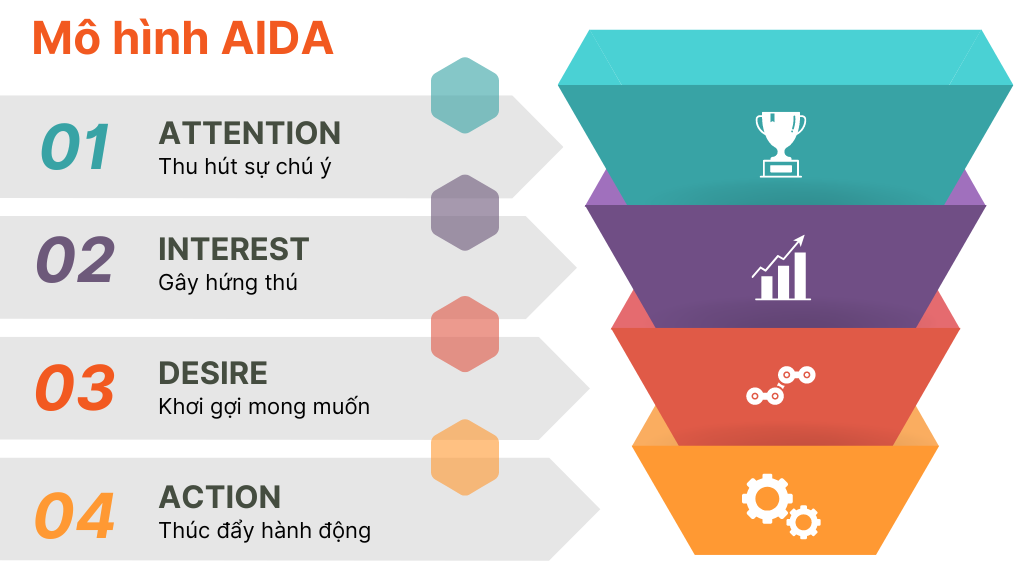
The AIDA model is one of the most basic and popular models in marketing, used to describe the stages a customer goes through in the purchasing decision process. This model helps businesses clearly understand the customer journey from initial awareness to making a purchase decision.
The stages of the AIDA model:
- Attention: The customer first becomes aware of the existence of the product or service. This is the initial stage where advertising, marketing, and branding create the first impression.
- Interest: After capturing their attention, the customer begins to learn more about the product, service, or brand. The business needs to provide detailed information to retain the customer’s interest.
- Desire: After generating interest, the customer develops a desire to own the product or service based on personal needs and motivations.
- Action: This is the stage where the customer takes the action to purchase. Factors like promotions, customer support, and payment policies can encourage this action.
>>> See more: What is the AIDA Model? How to Apply It Effectively for Your Business
5.2. The EKB (Engel-Kollat-Blackwell) Model
The EKB model is more detailed than the AIDA model and is often used to describe the customer’s purchasing decision process from start to finish. This model analyzes customer behavior as a systematic process and can be applied to high-value or complex products.
The stages in the EKB model:
- Problem Recognition: The customer recognizes a deficiency or a problem they need to solve, such as the need for a new product or a replacement for an old one.
- Information Search: After recognizing the problem, the customer will search for information from various sources to solve it. This may include searching online, consulting friends, family, or experts.
- Evaluation of Alternatives: The customer compares different products or services based on factors like quality, price, features, and brand reputation.
- Purchase Decision: After evaluating the alternatives, the customer makes a purchasing decision based on the factors they consider most important.
- Post-Purchase Behavior: After purchasing the product, the customer may feel satisfied or dissatisfied. This satisfaction will influence their subsequent behavior, such as using the product or sharing their opinion with others.
5.3. The Black Box Model
The Black Box model focuses on explaining the external factors that influence a purchasing decision without delving into the details of the customer’s thought process. According to this model, customer behavior is determined by stimuli and responses, without deeply analyzing psychological factors or the decision-making process.
Components of the Black Box model:
- Stimuli: These are external factors that influence customers, such as advertising, promotions, the appearance of new products, or changes in the economic environment.
- Responses: The customer’s reaction to stimuli, such as interest, purchase action, or product rejection.
5.4. Customer Journey Mapping Model
The Customer Journey model focuses on identifying and analyzing the entire process a customer goes through, from becoming aware of a product to making a purchase and subsequent stages. This model helps businesses better understand each stage the customer experiences and how they interact with the brand.
Stages in the customer journey model:
- Awareness: The customer becomes aware of their problem and may start looking for solutions.
- Consideration: After becoming aware of the problem, the customer begins to consider alternatives, comparing products or services.
- Decision: The customer makes a purchasing decision based on factors such as value, quality, and other elements.
- Experience: After purchasing, the customer uses the product and has a real-world experience.
- Post-purchase: The customer may share opinions, review the product, or even become a loyal customer if satisfied.
5.5. The 5A Model (Aware, Appeal, Ask, Act, Advocate)
The 5A model was developed by Nielsen and refers to the stages a customer goes through from awareness to brand loyalty. This model helps businesses build more effective marketing strategies by optimizing the customer experience.
Stages in the 5A model:
- Aware: The customer becomes aware of the product’s or brand’s existence.
- Appeal: The customer feels attracted and begins to take an interest in the product or service.
- Ask: The customer seeks more information about the product through various channels, such as online searches and reviews from others.
- Act: The customer decides to purchase after comparing and evaluating options.
- Advocate: After purchasing and using the product, the customer is satisfied and willing to recommend it to others.
6. Customer Behavior Research Process

6.1. Define Research Objectives
The first step in any research process is to define clear objectives. Businesses need to understand why they need to study customer behavior and the specific goals they want to achieve. Research objectives can include understanding consumer habits, analyzing product feedback, or evaluating changes in customer behavior after a marketing campaign.
Questions to ask:
- What does the business want to learn about its customers (e.g., purchasing behavior, satisfaction, the influence of social factors)?
- Is the goal to improve the product, service, or marketing strategy?
6.2. Data Collection
After defining the research objectives, the next step is to collect data. Data collection can be done through various methods, including surveys, interviews, observation, and gathering data from secondary sources.
Data collection methods:
- Surveys: Use online or in-person questionnaires to gather customer opinions. Questions can relate to satisfaction levels, shopping habits, product needs, etc.
- Interviews: Conduct in-person or phone interviews with potential or current customers to better understand their purchasing decisions.
- Observation: Observe customer behavior directly in-store or through online platforms like websites or social media.
- Secondary Data: Collect and analyze market research reports, previous studies from reputable research organizations, or public data.
6.3. Data Analysis
After collecting data, the next step is to analyze the information obtained. This is a crucial step to transform raw data into valuable, actionable insights. Data analysis helps businesses understand trends in customer behavior, perceptions, and attitudes.
Data analysis methods:
- Descriptive analysis: Provides an overview of the data, helping to identify trends in customer consumer behavior.
- Statistical analysis: Uses statistical methods such as correlation or regression analysis to identify factors influencing customer behavior.
- Qualitative analysis: Used when studying the psychological factors or motivations behind customer behavior. Often applied in interviews or in-depth studies.
6.4. Develop strategies and solutions
Based on the results of data analysis, businesses will develop specific strategies and solutions to improve their marketing strategy, products, or services. This may include changing communication strategies, optimizing customer touchpoints, or adjusting products/services to better meet customer needs.
Strategy implementation steps:
- Product development: Based on customer feedback and needs, businesses can adjust or develop new products to meet market demands.
- Improve customer service: Service improvement strategies, such as reducing wait times or optimizing the customer experience, will help increase customer satisfaction and loyalty.
- Optimize marketing strategy: Advertising strategies can be adjusted to target specific psychological factors or customer needs.
6.5. Measure and evaluate results
Finally, after implementing the strategies, businesses need to measure and evaluate the results to see if the strategies are truly effective. This helps in adjusting strategies if necessary and ensures that the business keeps up with changes in customer behavior.
Measurement tools:
- Campaign performance analysis: Use analytics tools like Google Analytics or CRM software to measure the effectiveness of marketing campaigns.
- Customer surveys: Conduct customer surveys to assess satisfaction and the success level of the implemented strategies.
- Net Promoter Score (NPS): Assess customer loyalty and identify opportunities to improve relationships with existing customers.
7. Methods for researching customer behavior
7.1. Surveys
Surveys are the most common data collection method in customer behavior research. They help businesses gather information from a large number of customers in a short amount of time. Surveys can be conducted through online questionnaires, over the phone, or in-person at stores.
Advantages:
- Quick information gathering: Surveys help collect opinions from a large number of participants, providing a general overview of customer behavior.
- Cost-effective: Compared to other research methods, surveys are relatively low-cost.
- Easy to analyze: Data collected from surveys is often easy to analyze and statistical tools can be used to draw conclusions.
7.2. In-depth Interviews
In-depth interviews are a method of collecting information through direct or phone conversations with customers. This is a qualitative research method that helps to explore more deeply the psychological factors and motivations behind customer behavior.
Advantages:
- Detailed information: In-depth interviews help gather detailed information about customers’ thoughts, feelings, and motivations, which is difficult to achieve with other methods.
- Ability to uncover hidden issues: In-depth interviews help detect issues or concerns that customers may not have clearly expressed in surveys.
- Develop suitable solutions: Interviews help businesses clearly understand customer needs and expectations, thereby developing appropriate marketing strategies.
7.3. Observation
Observation is a method of researching customer behavior by monitoring and recording the actions, attitudes, and habits of customers in specific situations. This method can be conducted in stores, shopping centers, or by tracking customer behavior on online platforms.
Advantages:
- Understand actual behavior: Observation helps record customers’ actual behavior rather than relying solely on their self-reported feedback.
- Discover hidden habits: Businesses can identify behaviors that customers are not consciously aware of or cannot articulate in surveys or interviews.
- Non-intrusive: Because customers are unaware they are being observed, their behavior is usually natural and reflects their actual habits.
7.4. Focus Groups
A focus group is a qualitative research method where a group of customers is invited to discuss a specific topic. In a focus group, customers share their opinions, viewpoints, and feelings about a product, service, or brand.
Advantages:
- Ability to gather diverse opinions: Focus groups allow for collecting opinions from multiple customers at once, providing a diverse perspective on the research issues.
- Discover customer perspectives: Group discussions help businesses gain a deeper understanding of customers’ emotions, attitudes, and perceptions regarding a product or service.
- Opportunity for interaction: In focus groups, members can interact with each other, share opinions, and build new perspectives on the product or service.
7.5. Secondary Data Analysis
Secondary data analysis is a research method that uses data previously collected from external sources, such as market research reports, industry statistics, or public data from research organizations.
Advantages:
- Low cost: Secondary data analysis is cost-effective as it does not require collecting data from scratch.
- Rich data: Secondary data sources often provide a large amount of useful information about customer behavior, market trends, and industry-influencing factors.
- Fast and easy: Analyzing secondary data saves time and can provide a general overview of customers and the market.
7.6. A/B Testing
A/B testing is a method of researching customer behavior by testing two different versions of an element, such as a webpage, advertisement, or product, to see which version performs better.
Advantages:
- Provides real-world data: A/B testing gives businesses an intuitive view of customer behavior in real-life situations.
- Optimizes marketing strategies: Testing helps optimize marketing strategies, from advertising to elements in the sales process, to achieve maximum effectiveness.
- Data-driven decisions: A/B testing allows businesses to make decisions based on actual data rather than assumptions.
8. Tools to Support Customer Behavior Analysis
8.1. Google Analytics
Google Analytics is the most popular web analytics tool, helping businesses track and analyze customer behavior on their website. This tool provides detailed information about traffic volume, traffic sources, user behavior, conversion rates, and other important metrics. Google Analytics helps businesses understand what customers are doing on their website, thereby optimizing the website and marketing strategies.
Marketing applications:
- Track website behavior: Google Analytics helps to understand customer behaviors such as the number of visits, average time on page, and the pages with the most customer interaction.
- Optimize user experience: It provides data on the website’s strengths and weaknesses, helping businesses improve the customer experience and thus increase conversion rates.
8.2. Hotjar
Hotjar is a powerful tool that helps analyze user behavior on a website through heatmaps and session recordings. With features like user journey recording and heatmaps, Hotjar helps businesses better understand how customers interact with their website, identifying areas that need improvement to enhance the user experience.
Marketing applications:
- Heatmaps: Provide a visual overview of the website areas customers interact with the most, helping to adjust web design and content to retain customers longer.
- Session recordings: Help track the actual customer journey when browsing the website, thereby identifying obstacles in the purchasing process and improving the user experience.
8.3. 1Office CRM (1CRM)
1Office CRM is an excellent customer relationship management (CRM) tool that helps businesses not only manage customers but also analyze customer behavior during interactions. 1Office CRM provides powerful features such as tracking customer interaction history, recording actions, and analyzing data to help businesses build effective customer outreach strategies.
Marketing applications:
- Manage customer information: 1Office CRM helps track all customer-related information, from conversations and emails to shopping activities, helping businesses clearly understand customer behavior and needs.
- Analyze and predict behavior: Based on data collected from customers, 1Office CRM can analyze shopping behavior and predict future needs, helping businesses prepare suitable marketing strategies.
- Integrate with communication channels: 1Office CRM can integrate with communication channels like email, social media, and phone, helping to record all customer touchpoints and analyze them to improve the experience.
Social Listening tools like Hootsuite, Brandwatch, or Sprout Social help businesses monitor and analyze conversations about their brand, products, or services on social media. These tools provide insights into customer sentiment and attitudes, helping businesses identify issues, trends, and market opportunities.
Marketing applications:
- Sentiment analysis: Social Listening tools help businesses track customer attitudes and emotions through posts, reviews, and comments on social media.
- Trend detection: These tools help identify new consumer trends and hot topics on social media, allowing businesses to adjust their marketing strategies or develop products that meet customer needs.
8.5. SEMrush and Ahrefs
SEMrush and Ahrefs are two powerful SEO tools that not only help analyze SEO strategies but also provide detailed information about customer search behavior. Through the keywords customers search for, these tools help businesses better understand customer needs and trends.
Marketing applications:
- Keyword analysis: SEMrush and Ahrefs help identify the keywords customers are searching for, allowing businesses to adjust their content and SEO strategies to attract potential customers.
- Improving SEO strategy: These tools provide information on the competitiveness of keywords, helping businesses build effective SEO strategies that meet customer search needs.
9. Conclusion
Researching customer behavior is an indispensable part of modern marketing strategy. A clear understanding of the factors influencing customer behavior, from psychological and social to cultural elements, helps businesses make more accurate and effective decisions. Customer behavior models like AIDA, EKB, or the Customer Journey not only provide deep insights into the customer’s decision-making process but also help businesses optimize marketing strategies and develop products that meet real-world needs.
Additionally, customer behavior analysis tools like Google Analytics, Hotjar, or 1Office CRM provide powerful solutions for collecting and analyzing data quickly and accurately, helping businesses create effective marketing strategies, increase conversion rates, and build lasting relationships with customers.
The key to success in marketing lies not only in understanding current customer needs but also in predicting and meeting future ones. By applying customer behavior research methods and tools, businesses can create powerful marketing strategies, develop suitable products, and enhance the customer experience, thereby differentiating themselves and achieving a sustainable competitive advantage in the market.
















