


 12/05/2026
  528 views
The Agile model is becoming a popular project management method in modern work environments for getting work done in a complex, ever-changing world. Agile thrives in adaptive cultures where team members quickly change course if it results in a more effective work experience. In this article, let’s learn more about Agile project management, its key components and principles, and how to implement the Agile method.

Mục lục
I. Why is the Agile model so popular?
According to the management consulting firm McKinsey & Company, “The Agile model is on fire” as organizations realize the value of the Agile method in the new era of work. The rapid technological advancements of the 21st century have dominated the entire work landscape, affecting every industry.
The potential benefits of the Agile solution were first discovered by software development teams, who used it to accelerate their projects and reduce the time between product launches. Now, other companies are choosing Agile to speed up their workflows and keep pace with the fast-paced future of work. According to a recent study by the Agile Organization, surveying professionals in 19 countries, nearly half of all organizations have been using the Agile method for three years or more.
To fully understand the growing popularity of Agile project management, let’s delve deeper into some of its key benefits.
II. General overview of the Agile model
1.1 What is Agile?
Agile project management is an iterative approach to project management that focuses on breaking down large projects into more manageable tasks, which are completed in short iterations throughout the project lifecycle. For teams applying the Agile model, it helps accelerate work progress, adapt to project changes, and easily optimize workflows. The Agile model allows teams to be better prepared to change direction easily. The Agile method allows them to evaluate the work they are doing and adjust it step-by-step, so they can adapt if customer requirements or team goals change.
1.2 What are the benefits of Agile?
The benefits of Agile project management will vary from case to case, as different teams implement best practices in their own ways. Here are 6 common benefits that Agile brings to project management.
Increased customer experience
By involving customers in the development process, Agile teams keep them in the loop and show that they value their opinions. Stakeholders want to be involved throughout the project lifecycle so they can provide feedback and ensure the final product will meet their needs. These tailor-made products are likely to improve the overall user experience and increase customer retention.
>> See now: Top 10 best customer care management software

Improved quality
Agile methods use an iterative approach to project management, meaning processes are improved after each time-boxed iteration. This consistent focus on improvement and quality control is one of the core principles of Agile, and it helps create superior products. Additionally, managers should learn about the 4 functions of management to better apply them in managing and operating the business.
Adaptability
The central theme of Agile is flexibility. Agile teams can respond to change, even at the last minute, and can adapt to it without much disruption. Project deliverables are not set in stone, so teams can easily re-evaluate their plans and adjust their priorities to align with updated goals. Adaptability means teams can deliver consistently and manage changing customer requirements effectively.
Predictability
Agile teams work in short time periods, sometimes called sprints. These fixed timeframes (e.g., two weeks) make it easier for project managers to measure team performance and allocate resources accordingly. It is also easier to predict costs over shorter periods than for a long-term project, simplifying the estimation process.
Better communication
Agile teams prioritize face-to-face communication and continuous interaction. They will often conduct daily meetings to ensure everyone is on the same page and working towards the same goals. By communicating with each other regularly, they eliminate potential confusion to achieve their goals successfully. It is clear that the Agile model method offers many benefits for software development teams and other fields.

Risk mitigation
Developers regularly assess progress during sprints, which means they have better visibility into the project and can quickly detect potential obstacles. These small issues can be addressed before they escalate, creating an effective risk mitigation process and giving the project a higher chance of success.
III. The core values of the Agile model
1. Individuals and interactions over processes and tools
The first value emphasizes teamwork and communication. We must understand that software development is a human activity, and the quality of interaction between people is crucial. Tools are an important part of software development, but creating great software depends more on teamwork, regardless of the tools the team may use.
2. Working software over comprehensive documentation
Documentation has its place and can be a great resource or reference for users as well as colleagues. However, the main goal of software development is to develop software that brings business benefits rather than extensive documentation.
See more: Top 10 Best Free Project Management Software in 2025 for Businesses
3. Customer collaboration over contract negotiation
Development teams must work closely and communicate with their customers regularly. By listening and receiving feedback, teams will understand what all stakeholders truly want. Therefore, businesses need to enhance the customer experience by always understanding and taking the best care of their customers.
4. Responding to change over following a plan
Changes are a reality in software development, a reality that your Software process must reflect. A project plan must be flexible enough to change as the situation requires.
IV. Agile Project Management Methodologies
So far, we have primarily learned what Agile project management is, including its main characteristics. Now, let’s take a more detailed look at the process and some of the most popular Agile management styles and methodologies.
1. Scrum Methodology
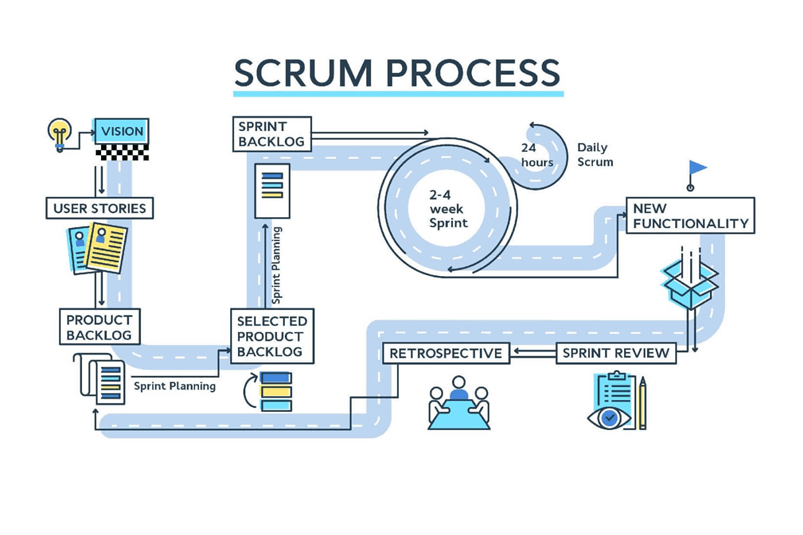
It is a lightweight Agile framework that can be used by project managers to control all types of iterative and incremental projects. In Scrum, the product owner creates a product backlog that allows them to work with their team to define and prioritize system functionality. The product backlog is a list of everything that needs to be done to deliver a successfully working software system – this includes bug fixes, features, and non-functional requirements. Once the product backlog is defined, no additional functionality can be added except by the respective team.
2. Extreme Programming (XP) Methodology
This is a disciplined approach that focuses on speed and continuous delivery. It promotes increased customer involvement, rapid feedback loops, continuous planning and testing, and close teamwork. Software is delivered periodically – usually every one to three weeks. The goal is to improve software quality and responsiveness in the face of changing customer requirements.
3. Kanban Methodology
Kanban is a visual workflow management method that allows teams to proactively manage product creation – emphasizing continuous delivery – without adding stress to the software development life cycle (SDLC). It has become popular among teams that also practice Lean software development.
4. Dynamic Systems Development Method (DSDM)
It is a response to the need for a common industry framework for rapid software delivery. DSDM is based on eight key principles; failure to adhere to any one of the principles risks the successful completion of the project. The eight principles are:
- Collaboration
- On-time delivery
- Proven control
- Continuous, clear communication
- Continuous focus on business needs
- Iterative development
- Incremental creation from a solid foundation
- Never compromise quality
5. Feature-Driven Development (FDD)
It combines software engineering best practices – such as feature-driven development, code ownership, and domain object modeling – to create a short, model-driven, and cohesive iterative process. FDD begins by defining the overall model shape, from which a feature list is created. The method then proceeds in two-week iterations and focuses on planning by feature, designing by feature, and building by feature. If a feature takes more than two weeks to build, it should be broken down into smaller features. The main advantage of FDD is that it is scalable – even for large teams – because it uses the concept of “just enough design initially,” or JEDI.
V. Some Pros and Cons of the Agile Model
Advantages:
- Faster software deployment, which helps increase customer trust.
- Better adaptability to rapidly changing requirements and faster response times.
- Helps receive immediate feedback that can be used to improve the software in the next step.
- Provides direction in planning the corporate organizational structure model
- People – Not Processes. Individuals and interactions are prioritized over processes and tools.
Disadvantages:
- For large software projects, it is difficult to estimate the effort required in the early stages of the software development lifecycle.
- Agile development is more focused on code and produces less documentation.
- Agile development is highly dependent on customer input. If the customer is vague in their vision of the final outcome, the project is likely to go off track.
- Face-to-face communication is more difficult in large-scale organizations.
- Only senior programmers are capable of making the necessary decisions during development. Therefore, it is a difficult situation for new programmers to adapt to the environment.
VI. What are the steps in the Agile method?
The Agile model is a project management method that creates shorter development cycles and more product releases compared to traditional project management. This short timeline allows project teams to accommodate changes in customer needs most effectively. Below are the 6 steps in the Agile model you need to know:
1. Project Planning
As with any project, before starting, your team should understand the ultimate goal, the value to the organization or customer, and how to achieve it. This allows the business to easily develop the project scope. However, the purpose of applying Agile project management is to handle changes, helping to supplement the project in the most effective way.
2. Create a Product Roadmap
A roadmap is a breakdown of the features that will make up the final product. This is a crucial step in the Agile planning phase because your team will build these individual features in each sprint. At this stage, you should develop a product backlog to create a final, complete product. If you plan your sprints early, your team will pull tasks from this backlog.
3. Release Planning
In traditional waterfall project management, there is one implementation date that comes after the entire project has been developed. However, when applying the Agile model, your project should use shorter development cycles with features released at the end of each cycle. Before the project begins, you will create a high-level plan for feature releases, and at the beginning of each sprint, you will revisit and re-evaluate the release plan for that feature.
4. Sprint Planning
Before each sprint begins, stakeholders need to hold a sprint planning meeting to determine what will be completed by each person in that sprint, how it will be achieved, and to assess the task volume. It is important to share the load evenly among team members so they can complete their assigned tasks within the sprint timeframe. You should also visualize the workflow accurately to create transparency within the team, making it easy to identify and eliminate bottlenecks.
5. Daily Stand-ups
To help your team complete their tasks in each sprint and assess whether any changes need to be made, hold short daily stand-up meetings. During these meetings, each team member will briefly talk about what they completed the previous day and what they will do that day. They are not meant to be lengthy problem-solving sessions or opportunities to talk about general news items. Some teams will even hold these meetings standing up to keep them brief.
6. Sprint Review and Retrospective
After each sprint ends, your team will hold two meetings: first, you will hold a sprint review with project stakeholders to show them the completed product. This is important for maintaining communication and relationships with stakeholders. A face-to-face meeting or video conference allows both groups to build rapport and discuss any product issues that arise.
The above is the most basic and important information about the Agile model in project management. As you can see, this Agile principle will help you change your mindset and start working together to be more flexible and adapt to changes as they occur. Agile is not the only project management method, but teams that use it will reap significant benefits, including streamlined workflows and rapid innovation.
For more details, please visit:
Fanpage: https://www.facebook.com/1officevn/
Youtube: https://www.youtube.com/channel/UCeTIRNqxaTwk0_kcTw6SxmA
















