12/05/2026
  357 views
Building a corporate culture is one of the important tasks in shaping the unique culture and identity of each organization. Especially during digital transformation, corporate culture plays a role in creating innovative initiatives, attracting abundant human resources, and stimulating creativity. So how can you build a digital corporate culture to help your organization grow? Let’s explore with 1Office in the article below.
Mục lục
- 1. The Levels of Corporate Culture
- II- The Role of Corporate Culture
- III- The Process of Building an Optimal Corporate Culture
- Step 1: Understand the business environment and strategy
- Step 2: Assess Current Culture & Values
- Step 3: Hire the right people
- Step 4: Define what you want for your business
- Step 5: Define the role of leadership in building culture
- Step 6: Reinforce the company’s core values
- Step 7: Identify the elements that make up corporate culture
- Step 8: Bridge the gap between employees and the business
- Step 9: Evaluate corporate culture
- IV- Examples of Corporate Culture Building from Major Corporations
1. The Levels of Corporate Culture
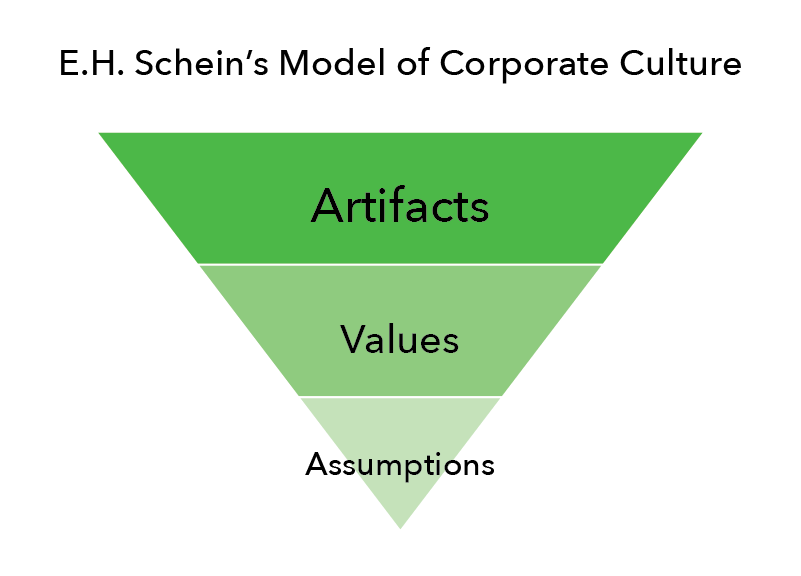
We can understand that the levels of corporate culture are a way to “visualize” the elements mentioned above to examine the culture within an organization. According to Edgar Henry Schein – a former professor at the MIT Sloan School of Management and an expert in group process consultation and organizational culture, corporate culture is divided into 3 levels:

1.1 Level One: Artifacts (Visible Processes and Structures)
These are things that can be seen immediately upon first contact because you can recognize them clearly. We can mention some factors such as:
- Architecture, company layout
- Organizational structure, departments
- Documents regulating the organization’s operating principles
- HR Policies
- Company logos, symbols, mission statements, etc.
- Common behaviors of members working there.
Through the factors mentioned above, it can be seen that this level is heavily influenced by the industry in which the business operates. In addition, it is also formed based on the desires, goals, and mindset of the company’s leadership. Because these are easily noticeable factors, at this level, corporate culture is also easy to change and less reflective of an organization’s core values.
1.2. Level Two: Espoused Values and Beliefs
The espoused and accepted values in this second level include:
- Core values
- General code of conduct, company regulations
- Company strategy, mission
As you can see, these are often widely published documents intended to guide members within the company. This is the “guiding star” of an organization; members will perform their duties based on these values.
In reality, large enterprises often have very clear statements about the above factors, as they not only guide employees’ beliefs but also represent the long-term goals of an organization. Furthermore, from a communications perspective, the regulatory documents at this level also help the public get an accurate view of the business.
1.3. Level 3: Basic Underlying Assumptions
Basic assumptions can be understood as the true values of a corporate culture. They are the beliefs and perceptions that are taken for granted within a company.
Forming these assumptions often takes a long time and involves experiencing many real-life situations, so individuals in an organization treat them as unwritten rules that are naturally accepted without explanation. According to experts, this is the pinnacle of corporate culture because all rules and perceptions have become deeply ingrained in the behavior of people within the organization, becoming a part of each individual’s self-awareness.
By dividing corporate culture into 3 levels, we can understand the important components for building a culture within a business. The higher the level, the lower the adaptability and the harder it is to change. However, from this, leaders can build development strategies for the organization in stages.
II- The Role of Corporate Culture
You have probably heard somewhere that: Culture is the core value of a business. What benefits does a business with a healthy, progressive culture bring? Let’s explore its role in an organization together.
1. Easy Brand Recognition
Again, it’s about the issue of a company’s image in the eyes of the public and the market. The founder of Zappos – an online clothing and footwear retail brand based in LA, USA, declared “Your culture is your brand” – Your culture determines your company’s brand.

Customers are often quite wary of a company with internal conflicts and frequent employee turnover. After all, how can you retain customers when you can’t even retain your own employees?
| Read more: Brandkey – The “master key” to positioning a business’s brand |
2. Increase employee retention
Job hopping is a major issue today. With the mentality of “senior employees hazing newcomers,” this is a reality that many recent graduates face. Additionally, many businesses lack a documented system of rules for compensation, salary, and benefits for employees. Overlapping regulations and principles are not applied consistently, making the workforce feel treated unfairly. This leads to a high turnover rate, and unstable human resources affect the entire operation of the business.
3. Easier recruitment
Corporate culture helps the public form a better perception of an organization. A key reason large corporations strive to build their culture is to enhance their brand image and increase public recognition.
And a high level of recognition contributes to easier recruitment. We can see that large corporations often don’t have to search for candidates; candidates come to them. This creates a plentiful talent pipeline, helping to reduce costs and giving the business more options.
4. Employee development
When working in a civilized, modern environment, companies will always encourage their employees to come up with new ideas and enhance their creativity. For employees, the opportunity to hone their skills and knowledge to facilitate personal development is what they always strive for. Additionally, having a human resource management system with automation capabilities helps improve performance and manage HR operations quickly and effectively.
5. Improve work performance
A business with a good cultural environment will attract top talent. Building a corporate culture connects individuals into a team with a shared foundation and skills, enabling them to interact and support each other at work, thereby improving operational performance.
In a healthy corporate environment, employees see themselves as part of the organization and derive satisfaction from the company’s overall success. When employees feel they are contributing to the team’s success, their commitment to quality work also improves.

6. Reduce conflict
Working in a cultural environment with a system of clear regulations helps members feel they are treated fairly and respected. This fosters a comfortable working spirit, where constructive competition helps everyone progress. A good cultural environment attracts good individuals, so conflicts are less likely to occur.
Do you know how to implement an effective internal communication plan for your business? Check out how to
Build an Internal Communication Plan in 6 Simple Steps + Detailed Template Form
7. Create a competitive advantage
A business with a good culture will attract customers and partners. External parties will want to work with you not only for your products but also because of the trust and initial impression you create.
Corporate culture represents your company’s core values, mission, behaviors, and management style. In the digital age, a digital corporate culture is highly valued and is often expressed through media channels such as social media pages, websites, internal communication platforms, and more.
It can be said that building a healthy corporate culture is an effective tool for promoting the product brand. Therefore, major companies in the market today place great emphasis on building their culture and work environment.
Read more: Corporate Core Values and 5 Steps to Define Core Values for Your Organization
III- The Process of Building an Optimal Corporate Culture
Now that you understand the levels of corporate culture, do you know how to build an effective culture for your business? Let’s explore the following steps for building a corporate culture:
Step 1: Understand the business environment and strategy
To form a company’s culture, the first thing managers must do is clearly understand the business’s environment and its target strategy:
- Environment: Living environment: The living environment significantly affects an individual’s behavior. This aspect includes many factors such as weather, geographical area, and physical and chemical conditions that surround a person and play an important role in their development.
- Work environment: The work environment includes aspects such as: the landscape, the business ecosystem, colleagues, leaders, etc.
- Environment is a broad concept, but it greatly influences the behavior, lifestyle, and working style of each individual. Therefore, this is a fundamental factor in determining the cultural style for the business.
- Strategy here includes elements such as: the mission, business methods, and long-term goals of a business. Strategy is often difficult to research and takes a long time to define because it has a long-term impact on the organization’s development process.
The two factors of environment and strategy are the foundation that needs to be defined to start the plan for building corporate culture.
Step 2: Assess Current Culture & Values
A company’s culture is a single entity within the general social culture of the entire community. Therefore, we must build our culture based on the common goals of society, and each organization has shared responsibilities to the community. A part of corporate culture must also be built based on the culture of a specific society.

Moreover, assessing culture also involves evaluating ideological culture and material culture.
- Ideological culture: Includes the beliefs and ideals based on which individuals in the company develop emotions and intellect that govern daily activities.
- Material culture: Includes the achievements and teamwork methods that bring results to the company.
After identifying the cultural elements that need attention, managers must also rely on the existing factors and goals of the business to create a plan for building their company’s culture.
Step 3: Hire the right people
To form a strong organization, the individuals within it must also be strong. To have an effective personnel recruitment process, the business needs to note the following:
- Develop a suitable system of interview questions about the company’s vision, mission, and values
- Ask questions that allow candidates to express their views on the values a business should have
Having a clear view of the candidate’s perspective will help you determine if they are a good fit for your organization’s culture and work style.
Step 4: Define what you want for your business
For a business, it’s important to build something long-lasting and great. Therefore, from the very beginning, always clearly define your organization’s development goals. To do this, answer the following questions:
- What: What does your business serve?
- Who: Who does your business serve?
- How: How will your business serve?
Each organization will have its own goals and unique characteristics, so don’t imitate any other business. Instead, research, learn, and build your own plan for developing your corporate culture.
Step 5: Define the role of leadership in building culture
Company culture is built by leaders and is largely nurtured by their perspectives and decisions. Managers who show enthusiasm and have a professional work style will help inspire a spirit of dedication in each individual.
Besides that, transparency must always be a top priority. A good work culture is an environment where everyone must feel comfortable and treated fairly, not just one where only the managers feel it is fair. Therefore, build from the smallest things, which is the inner character of the leaders themselves.
Step 6: Reinforce the company’s core values
Core values are the elements that managers must always uphold and develop. We can understand this as the center of a circle, and development will always revolve around it.
In general, to reinforce core values, you need to pay attention to the following factors:
- Encourage work-life balance for employees.
- Incorporate technology into the work environment and workflows.
- Create opportunities for employees to build relationships.
- Recognize employee achievements.
- Ensure that employees know what is expected of them.
Step 7: Identify the elements that make up corporate culture
Each company has its own culture; this is a rather general concept, but when applying it to a specific entity, we must identify the specific corporate culture elements to build for the organization.
Therefore, to successfully build a corporate culture, managers must correctly identify the important elements existing within the company and then plan to develop those elements reasonably, depending on the organization’s timeframe and pace of development.
Step 8: Bridge the gap between employees and the business
Bridging the gap will help create a more comfortable working environment, thereby increasing creativity in each individual. If the team doesn’t understand each other and interaction is limited, your cul
ture will not be able to develop.
In fact, bridging the gap between employees and creating a spirit of unity are activities that are receiving a lot of attention at the moment. A typical example of this goal is Team Building, which is being applied by many businesses today.
Step 9: Evaluate corporate culture
Culture is not immutable, so business owners must continuously evaluate the effectiveness of the work for employees, customers, and the public. Human behavior always changes with market trends, so it is necessary to regularly update and make appropriate changes.
We can see that corporate culture is a holistic process, not just a single element. As a “guiding principle” that helps the business survive and grow, it can be said that this is an important aspect of building corporate culture that leaders must pay attention to.
| Read more: What makes a corporate culture positive and strong: 8 things to know |
IV- Examples of Corporate Culture Building from Major Corporations
After learning the theory of corporate culture and the process of building it, let’s now look at what large corporations around the world have been doing in practice:
1. Google’s Corporate Culture
When talking about corporate culture, it’s impossible not to mention Google. Here, culture is seen as a driving force for development, encouraging creativity and dedication among employees. It is one of the pioneering corporations in allowing employees the freedom to work in their desired style because its leaders understand that employees should have the freedom of choice, flexibility, and an expansive workspace.

One of Google’s standout features is continuous innovation. They always focus on self-development, allowing employees and managers to spend about 20% of their weekly time on whatever they want. This leads to unique, pioneering ideas for product development in the currently competitive tech market.
Additionally, Google has demonstrated its care for employees by ensuring the workplace aligns with their desires. Besides providing food, entertainment services, etc., it shows that Google’s leaders are creating a two-way street of “Give and Take”—giving care to employees in every aspect to receive the highest work performance from their subordinates in return.
2. FPT Corporation’s Corporate Culture
In Vietnam’s economic market, when discussing corporate culture, let’s consider FPT Corporation: Here, employees are always proud of the exclusive STCo (Sáng tác company) that no other company has. All activities that form the company’s culture, care for employee life, and work environment are centered around STCo. .
FPT’s model is based on teamwork and democracy, so individual opinions are always respected. If conflicts between ideas arise, there is a culture of reconciliation and strengthening team spirit.
Building a corporate culture remains a difficult challenge for leaders. The newer and smaller the business, the easier it is to build. Therefore, start now to create a cultural environment that develops with the flow of your business.
1Office is a leading provider of management process automation solutions in Vietnam. With over 5,000 businesses and 450,000 users, the 1Office solution is an excellent choice to help your business build a digital culture and achieve breakthroughs in operational activities.
For more detailed information, please see:
- Hotline: 083 483 8888
- Fanpage: https://www.facebook.com/1officevn/
- Youtube: https://www.youtube.com/channel/UCeTIRNqxaTwk0_kcTw6SxmA