


 13/05/2026
  366 views
In a fiercely competitive market, understanding customer psychology is the key for businesses to gain a competitive edge over their rivals. How to effectively understand customer psychology and increase the ability to close sales is a problem that managers and sales specialists are constantly trying to solve. To help businesses successfully win over customers, 1Office will show you how to analyze customer psychology and master the top skills for understanding it.
Mục lục
- 1. Why understand customer psychology?
- 2. Classifying customer psychology by personality and behavior
- 3. How to Understand Customer Psychology to Increase Closing Rates
- 4. Skills for Understanding Customer Psychology
- 5. Phrases that appeal to customer psychology
- 6. Effectively understand customer psychology with the 1Office CRM module
1. Why understand customer psychology?
Customer psychology refers to the emotions, thoughts, and perspectives of consumers during their interaction with a business’s products and services.
Understanding customer psychology is the effort a business makes to comprehend its customers, including their motivations, needs, and problems. The art of understanding customer psychology is the key that helps businesses effectively win over customers by:
Enhancing the customer service experience
Customers with different personalities and psychologies will require different purchasing experiences. Therefore, a good salesperson is one who knows how to understand customer psychology to adjust their behavior accordingly. Understanding customer psychology will help businesses develop appropriate customer approach methods, provide excellent experiences, increase customer benefits, and improve the quality of care services.
Stimulating purchase demand and accelerating the decision-making process
The consumer’s purchasing process goes through many different stages and requires a long time to research and weigh options. Therefore, understanding the customer’s thoughts and concerns during the decision-making process will help businesses develop strategies that appeal to customer psychology. This will act as a catalyst to stimulate purchase demand and accelerate the customer’s decision-making process, thereby shortening the time to close a deal.
Building customer trust and loyalty
When customers feel understood, their satisfaction and trust in the quality of products and services will increase, leading them to become loyal customers of the brand. Therefore, the art of understanding customer psychology plays a crucial role in helping businesses effectively attract and retain customers.
Do you know how to effectively increase long-term customer retention rates? Read the article now:
|
What is Retention Rate? Effective Methods to Improve Customer Retention Rate |
2. Classifying customer psychology by personality and behavior
Understanding customer psychology through the 4 DISC personality groups
DISC – developed by Marston, is a popular model used in behavioral research and human personality analysis. Applying the DISC model in sales will help you easily understand customer psychology, their personality, and behavioral tendencies, allowing you to interact and communicate in the way they prefer.
The DISC model categorizes customers into 4 personality groups:
- Group D – Dominance: The Dominant
- Group I – Influence: The Influencer
- Group S – Steadiness: The Steady
- Group C – Compliance: The Compliant
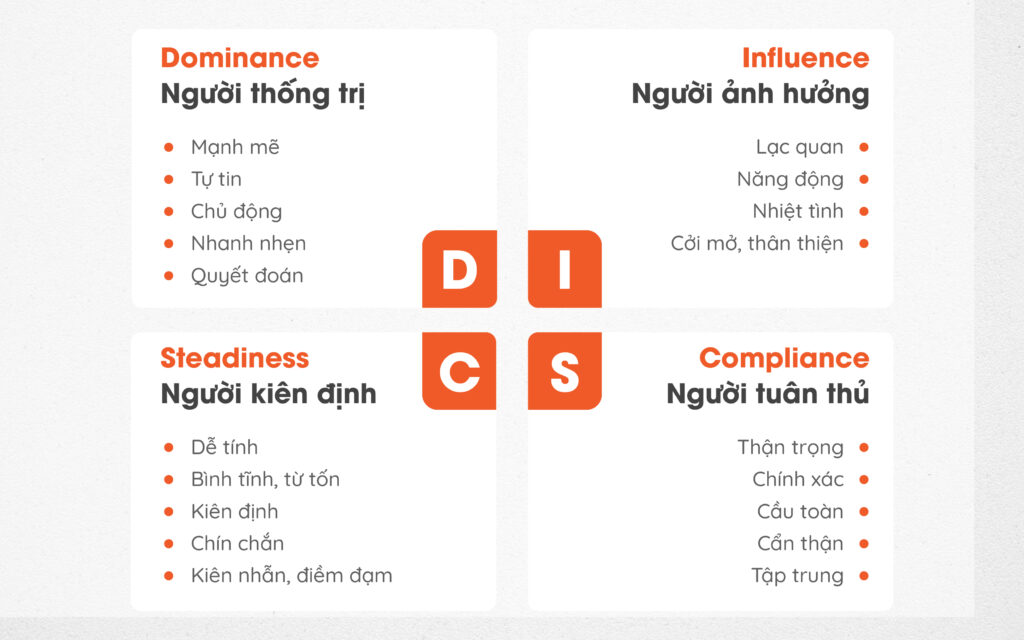
By analyzing these 4 personality groups, you can develop suitable sales strategies and act flexibly to meet the exact needs of your customers. Refer to the following table:
| Group | Personality | Identifying Signs | Principles of Interaction |
| Group D – Dominance |
|
|
|
| Group I – Influence |
|
|
|
| Group S – Steadiness |
|
|
|
| Group C – Compliance |
|
|
|
Understanding Customer Psychology Through the Buyer’s Journey
From the moment a need arises to the product experience stage, it is a long journey in which customers go through various emotional states. Each stage requires the seller to skillfully understand customer psychology and act as a catalyst to accelerate the purchasing process.
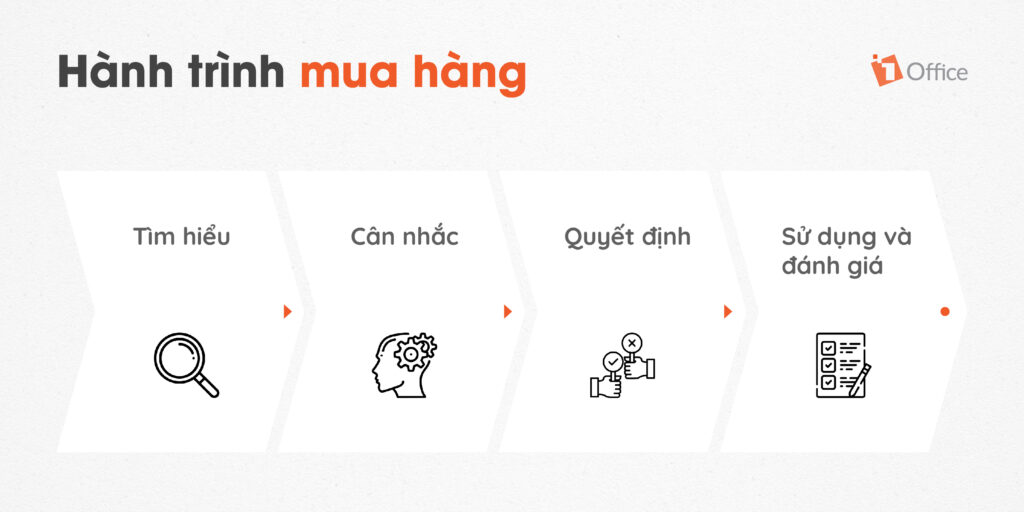
Typically, a buyer’s journey goes through the following 4 stages:
| Stage | Customer psychology & behavior | Response strategy |
| 1. Research |
|
|
| 2. Consideration |
|
|
| 3. Decision |
|
|
| 4. Usage & evaluation |
|
|
3. How to Understand Customer Psychology to Increase Closing Rates
Identify the Target Customer Audience
To effectively understand customer psychology, the first step is to identify the target customers. This task will help the business determine who they are serving and which audience group their product caters to. From there, they can develop sales strategies that tap into customer psychology to attract and retain them.
Customer Segmentation
As analyzed above, a business’s customers are distinct individuals with different lifestyles and viewpoints. Therefore, to meet their needs correctly, your task is to segment customers into smaller groups for easier analysis. Customer groups can be classified according to the following criteria:
- Age
- Generation
- Social Class
- Profession
- Interests
Research Customer Behavior
The final stage is “reading” the customer’s psychology. To grasp the psychology and behavior of each customer group, first, create a customer persona with identifying characteristics such as demographics, status, lifestyle, and purchasing behavior. Two useful tools that can assist you in this analysis process are the DISC model and the customer journey map mentioned above.
It should be noted that to accurately understand customer psychology, the prerequisite is to put yourself in their shoes. “Role-play” as a buyer and experience the actual product to understand what customers need and expect from the business.
Once you have a complete overview of the customer, you can develop appropriate behavioral strategies for each one.
See more: Forms of Customer Care Professional, Effective – Leading Customer Service Strategy
4. Skills for Understanding Customer Psychology
Focus on What You Can Do for the Customer
Always focus on what you can do for the customer rather than just on the product’s features. Customers don’t really care about the technical specifications of the product. If a customer comes to you, it means they are facing a personal problem and are expecting a solution.
Therefore, focus on solving the customer’s problem. You need to concentrate on exploring the issue by asking questions about the customer’s current situation and proposing solutions. Additionally, always starting the conversation with “How can we help you?” will be a plus in gaining the customer’s favor.
Use Friendly Language
A friendly, open atmosphere will be a favorable condition to “lead” customers to the product more effectively. Every customer wants to feel cared for thoughtfully. Therefore, the way you interact with customers will be the key to creating a successful “deal.”
To master this skill of understanding customer psychology, your language must be conversational and friendly. Provide customers with the most dedicated, high-quality consulting service by making them feel comfortable and close to the brand.
Learn more: Sales management software helps simplify customer information process management
Show Empathy
One of the effective skills for understanding customer psychology is showing empathy. An emotional connection is a necessary catalyst for building a relationship with customers. To do this, you should listen to the customer’s problem sincerely, carefully, and remember important details. Additionally, using facial expressions and gestures is a good way to express your understanding to the customer.
Respond Quickly and Always Be Ready
No customer likes the feeling of waiting or being ignored. Therefore, you must always be in a state of readiness to serve. Show customers that you are willing to dedicate time and energy to help them.
When talking to customers, you need to react quickly to their questions. And if it takes more time to answer, let the customer know that you will respond in a few minutes.
Be Reliable
To build trust and credibility with customers, you must first prove that you are a reliable person. Demonstrate your competence by quickly resolving customer issues as they arise. Whenever possible, you should try to resolve customer issues during the first interaction with them.
If customers have to wait for you to resolve the issue at another time or longer than necessary, they will feel anxious and doubtful about the business’s ability to meet their needs.
| For your reference: 8+ most detailed and comprehensive customer survey forms of 2022 |
5. Phrases that appeal to customer psychology
When solving a customer’s problem
- “Please be assured that we can fully resolve your issue.”
- “I will do my best to resolve the issue for you.”
- “I understand your situation now. We currently have the following solutions…”
When consulting about a product
- “Could you spare a moment for me to provide a more detailed consultation on the product?”
- “I believe this is the most suitable product for your current needs. What do you think?”
- “This product is currently available in limited quantities. Would you like to pre-order?”
When showing empathy to the customer
- “I understand your frustration/inconvenience.”
- “I would feel the same way if I were in your position.”
Ending the conversation
- “Thank you for your time today.”
- “Is there anything else I can assist you with?”
- “We hope you have a great experience with the product.”
- “If you have any further questions, please contact us via the hotline…”
- “Thank you for choosing our product. We look forward to serving you again in the future.”
6. Effectively understand customer psychology with the 1Office CRM module
To succeed in winning over customers, businesses not only need to flexibly apply the art of understanding customer psychology but also need to leverage technology to optimize this process. CRM software is one of the most superior customer analysis and care modules on the market today.
1Office helps businesses effectively understand customer psychology and develop appropriate customer care strategies through these features:
- Easily create new profiles and automatically classify customer groups to have suitable care scripts.
- Build a professional customer care process with automated multi-channel scripts, and send automatic reminder notifications to the person in charge when a customer care appointment is scheduled.
- Store all customer-related information such as invoices, purchase contracts, complaints, tickets, etc., to assist with future issue resolution.
- Features like sending emails, making calls, or texting customers, as well as signing and approving quotes and contracts, can be performed directly within the software with simple operations.
Through this article, 1Office has provided readers with ways to understand customer psychology and effective skills for doing so. The 1Office software solution is the key to helping businesses bridge the gap with their customers. For a free consultation and a trial experience of the software, please contact us using the information below:
For more detailed information, please see:
- Hotline: 083 483 8888
- Fanpage: https://www.facebook.com/1officevn/
- Youtube: https://www.youtube.com/channel/UCeTIRNqxaTwk0_kcTw6SxmA
















