


 13/05/2026
  394 views
A bottleneck is one of the reasons why business processes slow down, consume more resources, and struggle to achieve expected performance. But what is a bottleneck, where does it come from, and how can you accurately identify it? This article will help you understand the concept, the different types of bottlenecks, and how to find them in your operations.

Mục lục
- I. What is a Bottleneck?
- II. Causes of Bottlenecks in a Business
- III. Common Types of Bottlenecks
- IV. 4 Fastest Ways to Identify Bottlenecks in a Business
- V. Effective solutions for resolving bottlenecks in a business
- VI. Optimize operational processes with the 1Office all-in-one business management platform
I. What is a Bottleneck?
1.1. Concept
A bottleneck refers to the shape of a bottle: a wide body and a narrow neck. Because the neck is the narrowest part of the bottle, it restricts the flow of its contents. In business, a bottleneck is a point (or points) in a process where the workflow is delayed or completely disrupted.
Like on a production line, a bottleneck prevents the workflow from moving forward, rendering the process essentially useless and overloading employees—especially if multiple bottlenecks affect different processes simultaneously.
Although the image of a bottleneck is more recognizable or obvious to spot on a production or assembly line, process bottlenecks can become clearer once you understand how to detect their causes.
2.1. The difference between a “Constraint” and a “Bottleneck”
A constraint is anything that limits the output of an entire process. It can be related to equipment, personnel, lack of information, or documents like policies or standard operating procedures.
A bottleneck is a constraint that impacts the output of a process and prevents it from achieving its defined goals. A constraint can become a bottleneck if it starts to affect the overall output and productivity of a business process.
Now that you understand the concept of what a bottleneck is, let’s explore the causes of bottlenecks in a business.
See more: 5 Steps to Build an Effective Process Management System with 1Office
II. Causes of Bottlenecks in a Business
1. Manual data processing
Manually collecting, entering, and updating data in systems and databases can be more harmful than helpful, as it causes issues like errors or duplicate data. This not only leads to mistakes but also creates potential risks such as fraud, over or underpayments, and incorrect customer information.
2. Outdated workflows
If the workflows that make up a business process are not functioning, then by default, the business process as a whole is not functioning either. This can have a major impact on overall production, collaboration (both within and between teams), and efficiency.
3. Too much time spent on repetitive tasks
If someone spends five hours a week on the same task, such as drafting and sharing an email that could be standardized and automated, that’s 20 hours spent each month doing the same thing over and over.
4. Teams or individuals working beyond their capacity
When a business workflow includes approvals or reviews from individuals who do not have enough bandwidth to handle them, the likelihood of a bottleneck is very high.
See more tips: Building an Effective Internal Training Process for Your Business
III. Common Types of Bottlenecks
1. Short-term bottlenecks
These are mostly temporary, occurring when an employee leaves. In such cases, the workload increases while the number of employees available to handle the tasks is insufficient, causing a bottleneck.
2. Long-term bottlenecks
These are present throughout the production process, are permanent, and lead to significant losses, such as machine breakdowns.
3. Regulatory-induced bottlenecks
Bottlenecks created by incomplete or inefficient processes or rules. For example: A process that once worked no longer does after a major company shake-up; a process was not mapped out before being built; too many rules slow down the workflow.
4. Operational bottlenecks
Bottlenecks caused by people, systems, or tools lacking the capacity to match the workload. For example: Approvals are required for work to progress; a delay in one connected process negatively affects other processes and departments.
5. Infrastructure bottlenecks
Bottlenecks due to a lack of resources or a proper process structure. For example: Important actors or tasks were missed during process mapping, which is now causing delays; the wrong software was chosen to run a process, creating productivity issues.
IV. 4 Fastest Ways to Identify Bottlenecks in a Business
1. Map your processes
Your business should map its existing processes, which allows you to get a broader view when analyzing the flow and overall performance of a process. Observe each step of the process, the resources, interactions, process lead time, and any outstanding issues. This way, you can identify what is limiting production capacity and performance, which will reveal existing bottlenecks.
2. Look at the data your process provides
All of a business’s problems are reflected in the results it produces. So, start by looking at the data related to your process to assess what is causing the bottleneck and ask:
- Do tasks often stall at a certain point?
- Is there a trend of delays linked back to a specific person or owner?
- Trends, themes, and patterns are what you should look for when analyzing your process data.
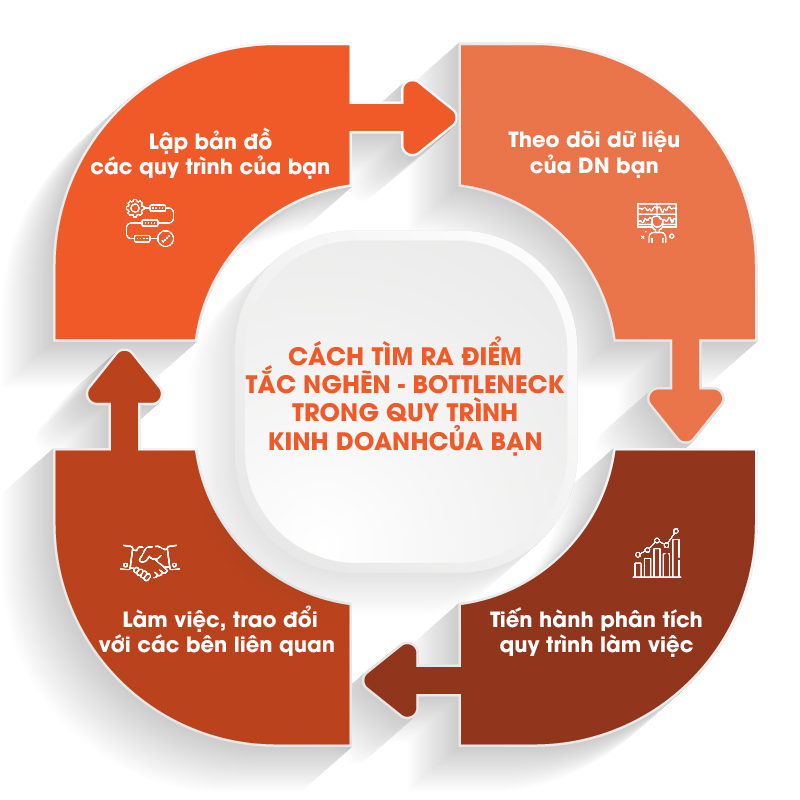
3. Work with stakeholders
While data often reveals the truth about a process, it’s not the only truth to consider. Talking to the people involved in a process provides an extra layer of insight that data might not offer, such as:
- Are people overwhelmed with their workload?
- Are there communication breakdowns?
- Are teams understaffed?
4. Conduct a workflow analysis
A workflow analysis is an opportunity to examine the sequence of tasks and activities that produce a specific workflow outcome. As you review, look for redundancies, existing bottlenecks, and other issues that could create future bottlenecks.
See more: The most effective work management process for businesses
V. Effective solutions for resolving bottlenecks in a business
1. Find creative solutions to problems
Once you identify bottlenecks in your organization’s operational processes, you can view them objectively and start researching how to solve these issues. To resolve the problems, you need to call on/engage everyone in the organization to achieve the fastest results. Working as a team with different perspectives and ideas might be what you need to find creative and effective solutions.
Besides generating more ideas, encouraging interaction will also help the team stay integrated and committed to implementing necessary changes.
2. Always have alternative solutions
You always need to have backup plans in case the primary solution doesn’t achieve the desired results. Don’t dismiss any alternatives presented while searching for solutions to your problems; consider all options. It’s essential to monitor your processes regularly to keep them updated and effective. You can’t set up processes rigidly; they must be flexible enough to adapt to internal and external changes.
3. Continuously seek and implement improvements for bottlenecks
The team must understand all steps of the improvement process, from mapping processes to identifying bottlenecks, finding solutions, and building and implementing an action plan.
Keeping the improvement process dynamic and continuously re-evaluating the results is a must, as it’s very likely the first idea for a solution won’t be the perfect answer to the problem. However, it’s important to put your plan into practice to receive feedback, evaluate its effectiveness, and then continue to optimize the workflow. Continuous improvement through planning, acting, checking, and evaluating will provide you with the information and data to make any necessary adjustments.
Read more: What is B2B? Characteristics and popular B2B business models
VI. Optimize operational processes with the 1Office all-in-one business management platform
With the 1Office software, your business will comprehensively standardize its operational processes, from HR and sales to internal communication and task management, thanks to comprehensive functional modules such as:
Workplace
Formatted like a mini social network to update the activity status of each individual in the company
- Receive notifications about new company policies and regulations
- Build workflows to standardize processes
- Track work progress directly on the system
- Access the company’s available document repository
HMR
HR management has never been easier with a series of features:
- Manage employee profiles directly on the system
- Create and approve requests 24/7
- Track timekeeping and work shifts
- Automatically calculate payroll and generate payslips with custom formulas suitable for each specific business
- Manage the recruitment process: Recruitment progress, effectiveness of recruitment channels, etc.
- Support the company’s training process
CRM
- Manage the company’s Marketing campaigns: Campaign progress, costs, campaign results, etc.
- Manage the organization’s revenue, expenses, and inventory
- Manage the sales process, KPIs of each department, individual, etc.
- Manage inventory, goods receipts, and issues directly on the system.
The information above explains What is a Bottleneck? If your business is facing problems in its operational processes, please contact us – the leading unit in business digital transformation in Vietnam – for dedicated consultation on solutions from our experts.
















