13/05/2026
  271 views
A business strategy map is an important and popular solution in organizations today. It is an excellent tool for promoting thinking and communicating strategies, directions, and priorities within your organization. If you are in a management role and need a clear, visual way to represent your organization’s main objectives, you may find a strategy map to be an indispensable solution. So, what is a strategy map, how is it used, and what should be included? All will be answered in the article below.
Mục lục
I. What is a Strategy Map? An Overview of its Role for Businesses
1. What is a strategy map?
A strategy map is a powerful planning method that helps companies visualize their entire strategy. Simply put, it is a diagram that provides an overview of your organization’s strategies and objectives. A strategy map is visually presented to showcase your organization’s strategy and goals. It is designed to lay out your entire strategy on a single, easy-to-understand page.
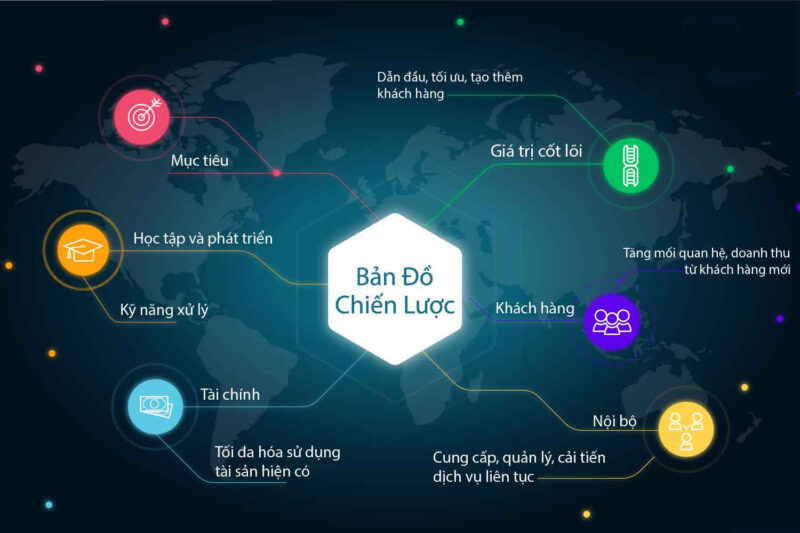
This allows leaders and employees to know how a company is working to achieve its goals as quickly as possible. A strategy map should be simple and easy to understand and is considered an indispensable tool for an organization in building and planning its business strategy.
Strategy mapping is often considered part of the Balanced Scorecard (BSC) methodology, a strategic planning tool for setting a team’s overall objectives.
2. Benefits of a strategy map
Creating a strategy map helps business leaders better visualize their objectives and communicate them to the organization. Here are some of the main benefits of using a business strategy map.
- Set clear financial and customer objectives
- Outline the connections between different ideas and turn those ideas into concrete results
- Identify necessary organizational components, support commitments and new changes, including training and business process changes
- Communicate the business’s objectives and how they will be achieved.
- Provide a starting point for each department and show how they fit into the overall strategy
3. Principles for creating a strategy map
Before creating a map for your business using existing templates, you should thoroughly understand the basic principles of strategy mapping below.
Ensure balance
The first principle when creating a strategy map is to ensure balance. This is because the map needs to include what your business wants and what your customers want. Therefore, the strategy must balance consumer needs with your organization’s interests.
To ensure balance in the business’s strategic objectives, many leaders have applied the BSC model in building business strategies. The BSC Balanced Scorecard helps managers accurately prioritize objectives, build effective management reports, and expand the business’s strategies.
Differentiate the customer value proposition
A good strategy must not only ensure business efficiency but also meet customer needs and deliver what they want. To do this, the business needs to accurately identify the target customer insight. Therefore, when defining the company’s strategy, you need to ensure that your organization’s services are differentiated from those of other businesses.

Create value with internal business processes
The third principle to remember is to consider your internal business processes and how they set you apart from other organizations. Can your team complete work efficiently? Can you develop a new way to produce new products? Always ensure that your advantages are integral to those strategies.
Think in complementary, simultaneous themes
To build a strategy map, you need to constantly consider internal and external resources when creating the map, and activities at different stages need to operate in parallel. Note that the strategy map needs to synchronize various aspects of the business, both internal and external.
>> See more: 8 effective planning principles, enhancing feasibility with the golden 5W1H2C5M formula
II. Elements of a Strategy Map
A complete strategy map consists of 4 main elements, arranged from top to bottom, starting with the one most closely tied to shareholder value: the financial element, the customer element, the process element, and the learning & development element.
1. The Financial Element
Financial objectives are crucial among all established goals. Within the strategy’s financial objectives, the business must clearly state what the financial goals are and the steps to achieve them. For example, in private sector companies, the goal is to create value for the company’s shareholders. For public sector organizations, the goal is to determine how to generate profit and revenue.

2. The Process Element
Processes are a critical element that every strategy map must have, as they help achieve financial and customer objectives. When defining the process element in the strategy map, it’s important to know how we can achieve our financial and customer goals.
For example, a process objective could be to speed up the sales process and their response times. This can help the business increase revenue, and sales is a key financial objective.
3. The Learning and Development Element
Learning and development objectives are goals related to the organization’s employees, helping to enhance their skills and develop their abilities. Like internal process objectives, these goals are often linked to other objectives and are located at the bottom of your strategy map.
As you can see, learning and development objectives are related to every type of objective on the organization’s strategy map. These objectives form the foundation for other objectives and, despite their position on the map, play a role just as important as any other type of objective.
4. The Customer Element
Any strategy must ensure it meets customer needs and delivers what customers want. Therefore, the business’s task is to figure out what to do to attract more customers. When you understand what customers want from your products and services, you can easily identify the most suitable objectives for your organization and how those objectives relate to other parts of your strategy map.
| Read more: What are business goals? How to build effective business goals |
III – How to Build a Corporate Strategy Map
Once you understand the benefits and elements of building a strategy map, let’s explore the steps to create a complete one:
Step 1: Define Mission and Vision
Before implementing a strategy, an organization needs to define its mission, vision, and core values. The mission is an internally focused statement describing the purpose and activities the business is aiming for.

Defining the mission and vision plays a crucial role in helping company stakeholders understand what the company aims for and what it achieves. This helps the business clearly define them, which will provide a solid foundation for your strategy map.
Step 2: Understand Your Environment
Before formulating a strategy, you need to understand the context, field, and industry in which the organization operates. By identifying industry trends, you can understand what to include in your strategy map.
When analyzing your organization’s environment, a key aspect to focus on is the various stakeholders (customers, suppliers, competitors, investors, etc.) you interact with, their roles, and the issues they might create.
Step 3: Define the Strategy for the Business Model
Next, you need to focus on defining the strategy to achieve the organization’s goals, mission, and vision. Ensure that your strategy brings together the activities you need to perform to create a sustainable differentiation in the market. For example, you can create sustainable differentiation by offering a product that provides greater value to customers than your competitors.

>> Learn more: 3 Modern 4.0 Management Models and Key Management Trends Leaders Need to Know
Step 4: Highlight Causal Relationships
Once you have identified the objectives for implementing your strategy, you need to show how they are interconnected. You can use arrows between objectives to illustrate the cause-and-effect relationships.
For example, if you provide training and a career path for your employees, they will be more loyal and dedicated to the business.
Step 5: Represent Themes in the Strategy Map
Currently, some organizations prefer to highlight themes in their strategy map by arranging objectives vertically. When themes are highlighted in the strategy, they can represent areas such as sustainability, safety, etc.
Step 6: Create the Strategy Map
Finally, you proceed to create the strategy map for your organization. A strategy map should show how the organization’s values influence learning and growth to improve internal processes. This, in turn, increases customer satisfaction and helps achieve financial goals to realize the stated objectives.A well-designed strategy map makes creating a balanced scorecard easier. This facilitates the communication of the message and strategy throughout the organization.
|
IV- Applying technology to improve elements in a business’s strategy map
As theories on accelerating digital transformation suggest, the power of technology can drive all processes and implement a strategy map most effectively. Applying technology helps businesses tightly link and operate all elements simultaneously. This enables accurate performance measurement, helping managers make more suitable decisions and adjustments.
In Vietnam, 1Office is currently one of the leading companies providing a comprehensive business management and operations platform. Trusted by over 5,000 Vietnamese businesses and more than 450,000 users from various companies. 1Office is one of the most comprehensive business management solutions that helps solve all encountered problems such as: process management, business operations management, human resource management, and internal communications on a single platform.
1. Comprehensive work, process, and project management solution suite
The 1Office work management tool is a comprehensive productivity management solution that helps easily digitize the entire workflow of each individual and department. With the software, managers can quickly plan, assign tasks, and monitor employee progress. This allows employees to proactively perform their work, not miss important information, and helps to best improve employee performance.
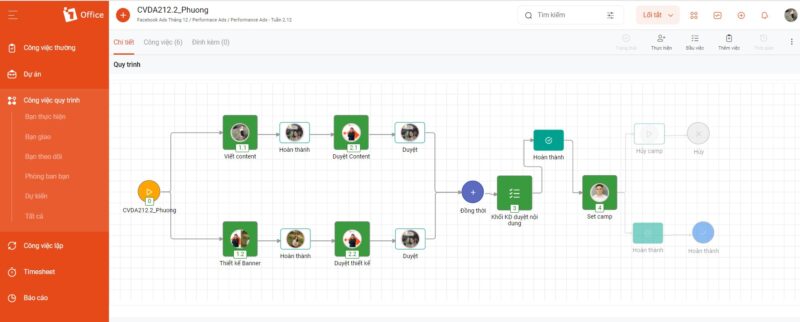
- Effectively control and monitor progress, assignees, and work results on a single platform
- Measure work results visually and accurately with charts and tables, optimizing data mining capabilities
- Track the progress of work, processes, and projects with real-time automatic reports, and handle emerging issues
- Helps employees easily grasp the big picture to proactively organize their work
- Update reports and data on business activities such as (sales, projects, HR, communications…)
- Divide work specifically by department and job position with clear assignments for each unit. This helps limit delays and prevent assigned tasks from being missed
Get a free consultation & software demo
2. Customer management and care toolkit
1Office CRM customer care software is a comprehensive solution that helps store data, has high security, and is suitable for all business sizes and types. With many smart and effective features, the software automatically saves care history to report customer status and accurately evaluate employee quality.
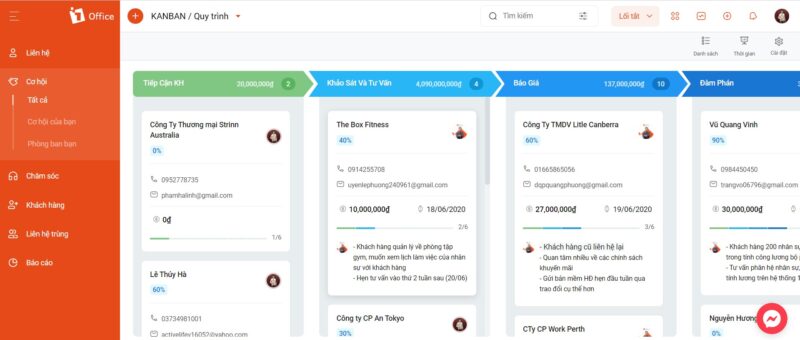
Outstanding features of the software:
- Update and manage customer information directly on the software for quick lookup of customer history
- Easily add a new person in charge to manage the business’s customer lifecycle
- Allows for the creation of order and contract information directly on the software
- Easily perform customer care actions directly on the software, such as: sending emails, making calls, or texting customers, and easily signing and approving quotes and contracts right on the software. You can learn more about digital signature software for businesses, which helps managers sign all documents and contracts anytime, anywhere with ease.
3. Comprehensive human resource management and development solution suite
HRM – Human Resource Management is a comprehensive human resource management tool that helps businesses manage the entire process of all HR-related tasks such as: recruitment, employee records, timekeeping, and payroll quickly and centrally. This helps managers save maximum time and effort compared to manual methods.
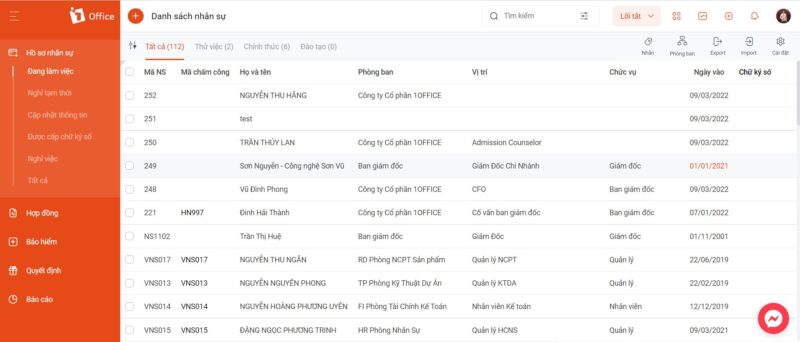
- Quickly digitize leave requests and employee records and update them to the timesheet
- Connects directly with the time clock to effectively manage employee check-in and check-out times. Helps HR save time on calculations and easily manage employee working hours…
- Connects with other modules to retrieve data for timekeeping and payroll calculations, such as: KPIs and sales figures, helping HR save 85% of the time spent on banking procedures.
- Track the working status of personnel, helping managers understand personnel fluctuations to devise the best solutions.
- Timekeeping via GPS location; just set the location, and you can clock in from anywhere without having to be at the office.
- Pay salaries directly on the system through MB Bank quickly and conveniently
Thus, the article above has provided you with a comprehensive overview of the role and key benefits of a corporate strategy map within an organization. It also presents a total enterprise management solution to help organizations optimize work and personnel management processes, saving time and effort in planning and building the company’s strategy.
We hope the information above is helpful to you. For consultation and support on using the 1Office business management software, please leave your phone number, and our consulting experts will contact you today.
For more detailed information, please contact us via:
- Hotline: 083 483 8888
- Fanpage 1Office: https://www.facebook.com/1officevn
- Youtube: https://www.youtube.com/c/1OfficeNềntảngquảnlýtriệtthểDoanhNghiệp