13/05/2026
  338 views
To achieve success, a leader needs more than just profound knowledge to lead the company; the skill of delegating tasks to employees is also a crucial factor.
For the benefit of both the company and yourself, you need to become a leader who knows how to delegate work to employees wisely.
Therefore, as a manager, you need to know exactly what to delegate, to whom, and how to do it for maximum efficiency. Let’s join 1Office to explore the steps in the task delegation process for managers!

1. CHOOSE TASKS TO DELEGATE
Before choosing tasks to delegate, managers need to categorize tasks by priority: important, urgent, not important, not urgent. This categorization will ensure work efficiency and order.
- Important and urgent: For top-priority, red-alert tasks like these, the leader must handle them immediately.
- Important and not urgent: You can delegate this task to an employee and participate directly with them.
- Not important but urgent: Managers will delegate this task to employees while closely monitoring their progress and providing reminders.
- Not important and not urgent: You can delegate this task directly to an employee.
2. PLAN FOR DELEGATING TASKS TO EMPLOYEES
To delegate tasks effectively, you need a detailed plan that clarifies work-related issues, including:
- Define the task’s objective: Employees will lack motivation if they don’t understand the objective of their work. Therefore, you need to clearly define the ultimate purpose of the task and the reason they need to do it.
- Identify the assignee: You need to clearly assign who is responsible for this task. Overstepping authority can easily occur during work. Therefore, a document outlining the employee’s authority, position, and responsibilities is essential.
- Create a plan: Clearly break down the work along with criteria and deadlines.
- Monitor, coach, and adjust: To ensure progress and efficiency, you need to monitor the employee’s work status. Sometimes, you also need to provide constructive feedback and guidance when employees face difficulties.
- Evaluate the results: After the task is completed, you need to evaluate the quality and effectiveness of the work, provide feedback, and identify suitable methods for future tasks. At the same time, listen to their opinions about the work and don’t hesitate to reward and encourage your employees if they do well.
3. CHOOSE THE RIGHT EMPLOYEE TO DELEGATE TO

This is one of the most important steps that directly determines the outcome of the work. As a leader, you need to clearly understand the strengths and weaknesses of your employees. From there, you can assign tasks according to the following two classifications:
Knowledge – Skills – Work Attitude
In this classification, employees are divided into 4 types. Depending on the characteristics of each type, you can arrange the appropriate level of suitability for the assigned task.
- R1: Employees with good skills and work attitude. For these employees, tasks should be assigned according to a process.
- R2: These employees have good knowledge and attitude but lack work experience and skills. Therefore, when assigning tasks, you must clearly explain the purpose of the job.
- R3: These employees have good knowledge and skills, but their work attitude is not serious. Therefore, a commitment letter when assigning tasks is very necessary to ensure work quality.
- R4: This is considered the elite type of employee that every business wants to recruit. They possess all three elements: knowledge, skills, and attitude. They are the ones trusted by managers to be assigned tasks and delegated authority.
IQ – EQ (Intelligence and Emotional Quotient)
Determined by 4 factors: Intelligent, Ignorant, Hardworking, and Lazy. For this classification, you need to pay attention to 2 types:
- Hardworking and intelligent: These are also the company’s potential employees. Therefore, you should assign them important and valuable tasks.
- Intelligent but lazy: Assign them difficult-to-solve tasks or emerging issues.
Those are the 3 basic steps in the process of effectively assigning tasks to employees. However, not every manager can execute this process well.
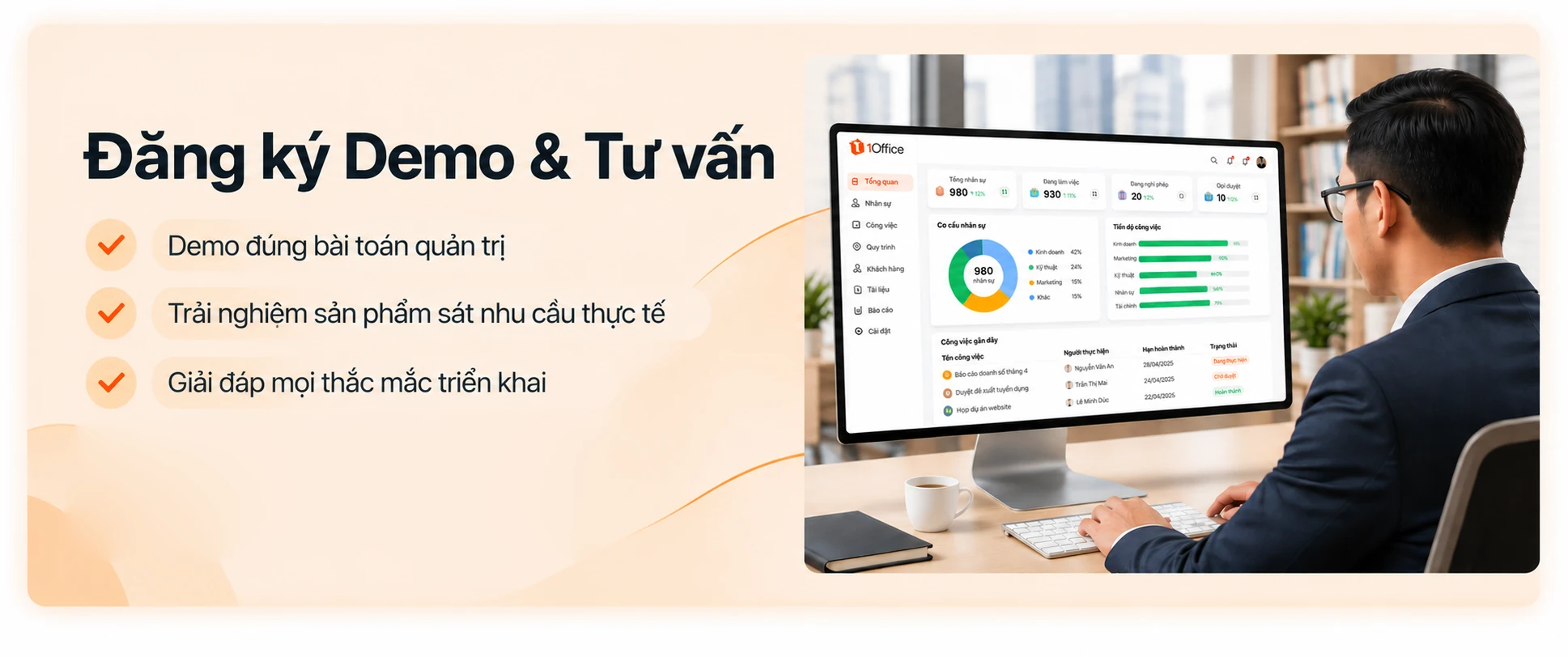
Recognizing this difficulty, the 1Office business management software was created to meet the needs of leaders in arranging job types, managing employees, tracking work progress, and evaluating results directly on the system, along with countless other optimal features such as:
- Human resource management,
- Customer management,
- Work management and
- Internal communication
Let’s save maximum time with 1Office, every task will be resolved more simply than ever before