


 13/05/2026
  435 views
Free download of the 13th-month salary template Excel file and an update on the most accurate bonus and salary calculation method for businesses. This tool helps accountants and HR simplify year-end bonus and salary procedures, ensuring maximum benefits for employees.
Mục lục
- Overview of the 13th-Month Salary
- What does a 13th-month salary template include?
- Free Download: 13th-Month Salary Template (Excel File)
- The Most Accurate Way to Calculate 13th-Month Salary Today
- Digital Transformation from Excel to 1HRM: Save 90% of Your Time
- Frequently Asked Questions about the 13th-Month Salary
- Conclusion
Overview of the 13th-Month Salary
What is the 13th-month salary?
The 13th-month salary is essentially a bonus that businesses pay to employees at the end of the year (usually for the Gregorian New Year or Lunar New Year).

Legally, the 2019 Labor Code does not have the term “13th-month salary”. This amount is understood as a form of bonus (according to Article 104). Whether the 13th-month salary is paid depends on:
- The company’s production and business results for the year.
- The employee’s level of work completion.
- Agreements in the labor contract, bonus regulations, or the company’s collective labor agreement.
Although not legally required, the 13th-month salary has become an “unspoken rule” of employee benefits in Vietnam to retain talent and boost employee morale.
What is a 13th-month salary calculation template?
A 13th-month salary calculation template is a document or file (usually in Excel format) created by the Accounting or Human Resources (HR) department to calculate the specific bonus amount for each employee in the company.
Using a standard calculation template helps businesses avoid unnecessary numerical errors and saves maximum time processing large amounts of HR data during the busy year-end period.
What does a 13th-month salary template include?
A 13th-month salary template typically includes employee information, basic salary, working time, 13th-month bonus amount, allowances, deductions, and the total net income.
The specific information is as follows:
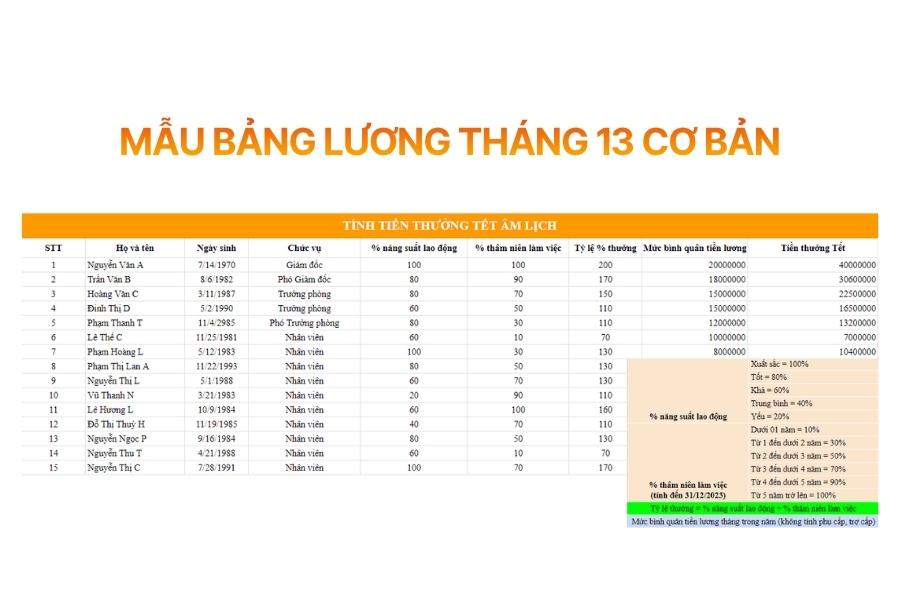
- Employee information: serial number, employee ID, full name, position, and department to accurately identify the beneficiary and avoid confusion between departments.
- Basis for calculation: Data on the official start date, total actual months worked in the year, and the base salary for calculation (can be the basic salary for social insurance contributions or the average net salary).
- Coefficients and applicable conditions: Criteria for work completion rating (KPI), seniority coefficient, or adjustments related to maternity leave or unpaid leave.
- Total 13th-month salary (Gross): The amount calculated based on the company’s formula before any deductions are made.
- Personal Income Tax (PIT): The tax deduction as stipulated by current law for income from bonuses.
- Actual amount received (Net): The final figure that the employee actually receives after tax deductions (if any).
- Payment and confirmation information: Payment method (cash or bank transfer), bank account information, and a column for the employee’s signature or notes for special cases.
Discover more:
What Salary Level is Subject to Personal Income Tax? [New 2026 – Detailed Guide]
Social Insurance Calculator: Formulas and the latest social insurance calculation template for 2026
Free Download: 13th-Month Salary Template (Excel File)
To help you optimize your year-end calculation process and minimize manual errors, we have prepared professional 13th-month salary templates in Excel. You can download them completely for free and flexibly customize the 13th-month salary template according to your company’s specific bonus regulations
The Most Accurate Way to Calculate 13th-Month Salary Today
Currently, the law does not stipulate a rigid formula for calculating the 13th-month salary. However, depending on each company’s bonus policy as stated in the labor contract or collective labor agreement, the calculation method is usually divided into the following cases:
Case 1: Employees who have worked for a full 12 months
For employees who have worked continuously for 12 months or more up to the bonus finalization date (usually the end of December 31st), the 13th-month salary is typically calculated in two ways:
Method 1: Based on the average 12-month salary
| 13th-month salary = (Total salary of 12 months) / 12 |
Method 2: Calculate based on the December salary (or the most recent month)
| 13th-month salary = December’s salary |
(This method is often applied to businesses with stable income and without significant fluctuations in allowances.)
Case 2: Employee works less than 12 months (calculated pro-rata)
If an employee has not worked for a full 12 months as of the bonus finalization date, the 13th-month salary will be calculated proportionally to the actual time worked (often referred to as calculating based on months of service).
| 13th-month salary = (Actual months worked / 12) x Average salary |
For example: Employee A has an average salary of 10 million VND and has worked for 6 months. 13th-month salary = (6/12) x 10 = 5 million VND.
Case 3: Based on the actual number of working days
Some businesses with stricter bonus policies or specific jobs calculated on a daily basis will apply the calculation method based on the total number of working days in the year to ensure absolute fairness.
| 13th-month salary = (Total actual working days in the year / Standard number of working days in the year) x Monthly salary |
Note: The standard number of working days is usually 312 days (if working 6 days/week) or 260 days (if working 5 days/week).
Read now: The Most Accurate Way to Calculate Tet Bonuses for 2026: A Method Every Business Can Apply
Case 4: For employees on maternity leave
Currently, the law does not require businesses to include maternity leave time in the seniority calculation for the 13th-month salary. Therefore, payment for these employees will depend entirely on the bonus regulations and specific welfare policies of each company.
Typically, businesses will apply one of the following two options:
Option 1: Do not include maternity leave time
The business only pays the 13th-month salary based on the number of months the employee actually worked during the year (excluding the 6 months of statutory leave).
| 13th-month salary = (Base salary for bonus calculation / 12) x Actual months worked. |
For example: An employee with a salary of 20,000,000 VND takes 6 months of maternity leave during the year (actual working time is 6 months). The bonus received is: 20,000,000 x (6/12) = 10,000,000 VND.
Option 2: Including maternity leave (Calculated at 100%)
To show care and retain talent, many businesses still stipulate that maternity leave is counted as working time for the purpose of receiving the 13th-month salary.
Calculation: Employees on maternity leave still receive a full month’s salary (if they have met the required working duration beforehand) or have their leave period included in the total number of working months for the year.
See also: 7+ Standard Maternity Leave Application Form Templates for Female Employees
Digital Transformation from Excel to 1HRM: Save 90% of Your Time
Currently, businesses often face many difficulties when calculating and managing the 13th-month salary manually, especially in data consolidation, tax calculation, and year-end bonus approval:
- Information is scattered across various Excel files (from 12-month payroll sheets and timekeeping data to personnel records), making consolidation time-consuming and prone to data loss.
- Manual setup is required for different employee groups such as those who have worked the full year, new hires, employees on maternity leave, or those on unpaid leave, leading to a very high risk of errors.
- Combining the 13th-month salary with the final month’s income for Personal Income Tax (PIT) finalization according to the progressive tax schedule is extremely prone to confusion if done by hand.
- Waiting for hard copy approvals or sending files via email causes delays and makes it difficult to control the security of salary and bonus information.
So why should you choose 1HRM to calculate the 13th-month salary instead of Excel?
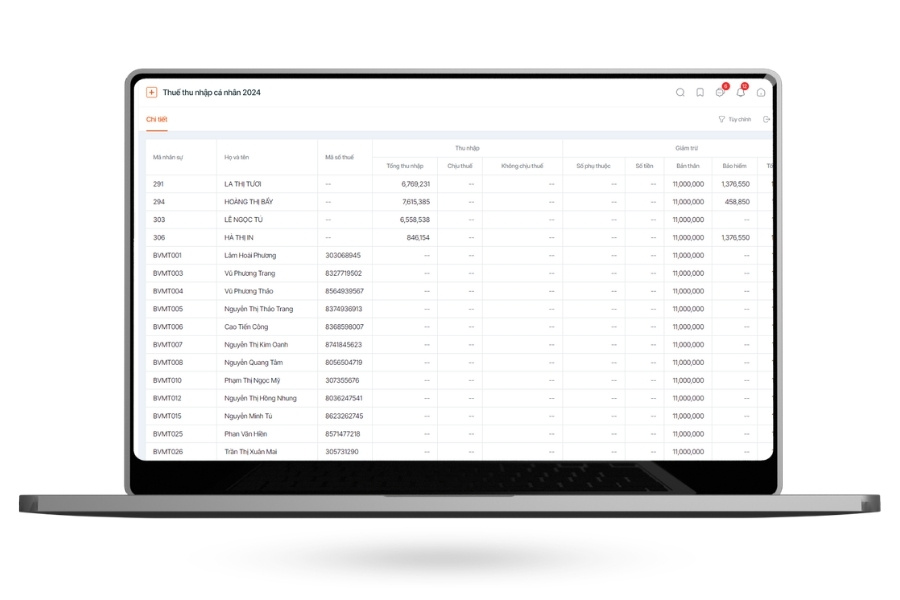
- Automatic Data Inheritance: The system automatically consolidates the salary fund and workdays from January to December for each employee, providing an immediate basis for bonus calculation without manual data entry.
- Flexible Formulas: Set up any 13th-month salary calculation scenario (based on seniority, proportion of months worked, maternity leave, or KPIs) on an intuitive interface, ensuring formulas don’t “jump” or have broken data links.
- Accurate Tax & Insurance Calculation: The system automatically separates bonuses that are not subject to Social Insurance contributions and applies the latest PIT schedule, ensuring 100% accuracy in calculating net income.
- Online Approval & Security: The approval process is carried out directly on the software according to hierarchy (Manager → CEO). The edit history is clearly tracked, ensuring absolute confidentiality of salary and bonus information.
- Transparent Payslips: After approval, employees can look up their detailed 13th-month payslip directly on the mobile app, helping businesses eliminate 100% of complaints and inquiries about bonuses.
With the 1HRM module of 1Office, instead of spending weeks consolidating and reviewing Excel files, accountants can now generate a completely accurate 13th-month payroll in just 5-10 minutes. The system also supports bank integration for bulk salary transfers, making the Tet bonus process faster and more professional than ever.
Frequently Asked Questions about the 13th-Month Salary
If I resign before Tet, will I receive the 13th-month salary?
It depends on the company’s policy. If the policy states that employees must be actively working at the time of payment, you will not receive it. Conversely, if the policy allows for payment based on the proportion of actual months worked during the year, you will still be paid.
Are the 13th-month salary and Tet bonus the same thing?
No. Essentially, they are two different payments. The 13th-month salary is usually calculated based on seniority and a fixed salary. The Tet bonus is a flexible amount that depends entirely on the company’s business profits. However, in practice, many companies often combine these two payments into one.
Are employees on probation eligible for the 13th-month salary?
Usually, NO. Employees on probation are typically not entitled to this benefit, unless there is a clear commitment or agreement for payment in their probation contract or the company’s policy.
Is the 13th-month salary calculated based on the basic salary or the actual take-home pay?
This is determined by the company. The law does not mandate a specific formula. Most businesses currently calculate it based on the basic salary (the salary used for insurance contributions), but some calculate it based on the actual take-home pay (including allowances). This should be clearly stated in the Labor Contract or Collective Labor Agreement.
If a business is unprofitable, can it delay or not pay the 13th-month salary?
YES. According to Article 104 of the Labor Code, bonuses are paid based on business performance. If the company is unprofitable, it has the right not to pay or to postpone the 13th-month salary (unless the labor contract guarantees it as a fixed payment regardless of business results).
Is the 13th-month salary subject to Personal Income Tax (PIT)?
YES. The 13th-month salary is considered income from wages and salaries, so it is subject to PIT. To save time, businesses can use the 1HRM solution to have the system automatically combine this bonus with the income of the payment month and accurately calculate the tax payable according to the latest progressive tax schedule.
Is the 13th-month salary subject to Social Insurance (SI) contributions?
NO. According to social insurance regulations, bonuses (including the 13th-month salary) are not used as a basis for calculating mandatory SI contributions.
Professional payroll management software like 1HRM comes with a pre-configured mechanism to automatically separate bonuses from the salary fund used for insurance contributions, helping businesses ensure transparency and legal compliance.
Conclusion
The 13th-month salary is not just a year-end bonus but also a worthy recognition of employees’ efforts over the past 12 months. We hope that with the complete set of 13th-month salary templates in Excel and the detailed calculation guide for each case that we provide, you will be able to create bonus payrolls quickly, accurately, and transparently.
To completely eliminate the risk of errors from manual calculations and to professionalize your salary and bonus process, implement the 1HRM automation solution today.
















