11/05/2026
  662 views
Personnel are the greatest asset but also the most difficult variable for a business to control. How can you not just ‘manage’ but also effectively ‘lead’ your team? In this article, 1Office will help you discover 12 effective personnel management methods used by CEOs to build a disciplined, engaged, and proactive team.
Mục lục
- 1. 12 effective personnel management methods for businesses
- 1.1. Choose a personnel management style
- 1.2. Understand each person’s capabilities
- 1.3. Provide job orientation and development direction for employees
- 1.4. Listen to employee opinions – a secret to personnel management
- 1.5. Rotate talented employees
- 1.6. Set work goals and evaluation standards
- 1.7. Motivate and encourage employees to work
- 1.8. Create an effective teamwork environment
- 1.9. Every employee has the right to speak up
- 1.10. Stop scolding employees
- 1.11. Provide clear feedback
- 1.12. Monitor and evaluate regularly
- 2. Common HR management mistakes that cause businesses to lose talent
- 3. Data-driven HR management: An inevitable trend in the digital age
- 4. How to effectively manage employees with 1Office HR management software
1. 12 effective personnel management methods for businesses
1.1. Choose a personnel management style
First, you need to choose a personnel management style that suits you. Every manager interacts with their employees in different ways. Therefore, the way leaders manage employees also has a significant impact on how employees feel about their jobs.

In fact, one study found that nearly half of all employees said they had quit a job because of a bad manager. If you look closer, you can see a direct correlation between a leader’s ability and important factors like employee engagement, job satisfaction, and happiness.
That’s why mastering your management style is one of the key factors in nurturing and developing a successful team.
1.2. Understand each person’s capabilities
Employee evaluation can be considered one of the most important steps in the employee management process. It allows you to review an employee’s job performance and suitability for their role over a specific period to determine an appropriate reward system.
A manager must be able to oversee and have a clear grasp of all issues. They need to know the true capabilities of each person to plan task assignments and enhance each individual’s skills during the work process.
Each employee has different strengths and weaknesses. Therefore, managers need to be considerate and careful when assigning their team members to specific positions.
Take the time to learn what they have studied, how they have accumulated experience, and what their strengths are. This is what you need to do when you take over a team to achieve the highest efficiency at work.
Read more: What is MBTI? Applying personality tests to evaluate personnel and candidates
1.3. Provide job orientation and development direction for employees
A sustainably growing business must first manage its people correctly, finding the right person for the right role to optimize human resources.

Among these, employee orientation and development are crucial as they represent a commitment to creating a supportive environment for employees. This allows them to see their professional progress at each stage and have a clear direction on their career path. Good employee orientation increases job satisfaction and fosters a positive work attitude through a learning and sharing environment.
1.4. Listen to employee opinions – a secret to personnel management
In the workplace, most leaders are the ones who do the talking, and employees are tasked with listening. However, if managers learn to listen to their employees, they will notice positive changes in them.
According to a recent survey by Impraise, 72% of respondents found that two-way feedback between managers and employees helped improve their performance.
Listening to employee opinions not only helps them improve their work performance and limit unnecessary internal conflicts but also increases employee engagement, thereby enhancing the quality of work.
>>>Read now: 10 must-read Japanese business management secrets
1.5. Rotate talented employees
Honda is one of the companies with a policy of rotating and training employees. Typically, managers tend to want to keep their best employees from rotating to other departments.
However, in the long run, a policy of rotating talented employees is very beneficial for the entire company.

You should understand that if anyone does the same job over and over, year after year, they will become too familiar with the work, leading to complacency and a gradual loss of their ability to explore and be creative.
Therefore, without infusing new talent and rotating skilled employees, the business can easily stagnate, or worse, regress.
1.6. Set work goals and evaluation standards
Employee evaluation is an indispensable and effective human resource management method for any business aiming for long-term growth. This process should be conducted regularly as it plays a crucial role in the company’s future development. Employee performance is assessed based on their work output and hours. Using KPI templates, managers can evaluate the work efficiency of each employee.
Through KPIs, managers can assess each employee’s performance level to make appropriate adjustments to their workload.
1.7. Motivate and encourage employees to work
Every employee desires career advancement and recognition for their contributions to the organization. Therefore, managers must understand the essential needs of their staff to help them maintain a positive and comfortable mindset at work.
Managers should focus on motivating employees. This means inspiring them, understanding their aspirations, and tapping into their desires to show them that hard work will lead to achieving their personal and professional goals.

Managers need to implement digital transformation in recruitment and human resource management to improve their work efficiency and quality.
1.8. Create an effective teamwork environment
Building an effective teamwork environment is a key aspect of human resource management that managers should prioritize. A comfortable work atmosphere not only helps current employees thrive but also attracts new talent to the company.
Completing a project requires managers to have a human resource management strategy that fosters daily and continuous collaboration between teams. A work environment where employees can be themselves, ask questions, propose ideas, and be respected is what all working professionals hope for.
1.9. Every employee has the right to speak up
As a manager, you need to ensure that all company members participate in contributing their opinions on company issues, even the smallest ones.
This should also be widely applied in all meetings and annual planning processes.
Listening to everyone’s perspectives allows you to receive valuable feedback from employees, leading to improvements in the workplace.
1.10. Stop scolding employees
As a manager, you must understand that scolding is not the best way to solve problems in every situation. At the world’s second-largest car manufacturer – Toyota, a rule is set that managers are not allowed to yell at or punish their subordinates when mistakes occur. Instead, errors are reported immediately to find the root cause and make appropriate corrections
Scolding not only creates a distance between employees and managers but also affects work performance. Regardless of how you feel, first and foremost, respect your employees with basic courtesy.
| Read more: 5 Effective Human Resource Management Models Every HR Needs to Know |
Above are 10 human resource management tips that managers can apply to their businesses. Implementing these tips step-by-step will help you optimize your human resources while also promoting the development of employee capabilities and performance. To systemize these tips comprehensively, methodically, and quickly, please leave your information at the button below
1.11. Provide clear feedback
One of the reasons employees make the same mistakes repeatedly is that the manager’s feedback is unclear and lacks a constructive nature.
For example, before commenting that an employee’s performance is poor, help them see where they are going wrong and the right direction for the future, while also providing them with case studies to give them a foundation to follow.
1.12. Monitor and evaluate regularly
Although you trust and empower your employees, you still need to monitor them regularly to ensure work proceeds smoothly, on schedule, and does not deviate from the intended direction, and have a plan to address issues as soon as they arise.
Empower, but still ensure that your employees are responsible for the work they have been assigned
2. Common HR management mistakes that cause businesses to lose talent
No matter how well-structured the processes or how good the corporate culture is, some HR management mistakes can still cause a business to lose its top performers. Especially in the context where Gen Z employees increasingly value experience and personal development, a manager’s role is not just to assign tasks—it’s also to retain people. Below are the common mistakes that managers often make:
Assigning tasks without goals, vague expectations
Many leaders assign tasks without clarifying expected goals or providing specific evaluation criteria. This leaves employees unsure of what “success” looks like, which can easily lead to conflicts or a sense of unfairness in evaluations.
Subjective, non-data-based evaluations
One of the reasons top performers feel unrecognized is subjective performance evaluations. Many managers only look at the final result while ignoring the process, or they evaluate based on personal feelings rather than actual data.
Lack of constructive feedback and timely recognition
Top performers don’t need constant praise, but they do need feedback to know they are on the right track. Missing the “golden” opportunities to recognize their efforts or failing to provide feedback for improvement makes them feel unappreciated and more likely to leave.
Failing to create a development and learning environment
A work environment without challenges or new learning opportunities will quickly stifle the motivation of talented individuals. Ambitious employees will not stay long if they cannot see a clear career future at the company.
Unclear and non-transparent compensation
Developing non-transparent compensation policies and inconsistent rewards and punishments can easily create a sense of comparison and demotivation. Especially for top performers, they always expect to be compensated fairly for the value they bring—both financially and in terms of respect.
Suggested solution: Instead of managing subjectively, businesses should switch to a data-driven HR model, using HR management software to standardize processes, while also applying AI tools to help evaluate, recognize, and develop the team more accurately and objectively.
3. Data-driven HR management: An inevitable trend in the digital age
In the past, most HR decisions were based on a manager’s intuition. However, in the digital age, where every activity can be measured and analyzed, effective HR management needs to be based on a clear data foundation.
What is Data-driven HR?
Data-driven HR is the practice of using metrics, data, and analytics to make decisions about personnel: from recruitment, retention, and performance evaluation to developing career paths for each employee.
Benefits of data-driven HR management:
-
Accurately measure the work performance of individuals, teams, and the entire organization
-
Early detection of potential turnover signs or risks of performance decline
-
Optimize the process of task assignment, training, and KPI evaluation
-
Make decisions based on evidence rather than intuition
-
Increase transparency and fairness in management
How to apply Data-driven HR effectively?
-
Use HR management software with integrated performance data tracking and analysis features, such as 1Office
-
Establish a clear set of KPI/OKR metrics for each role
-
Periodically synthesize and analyze HR data to adjust HR policies and strategies
-
Apply AI tools like 1AI Performance to automatically assess competencies and suggest suitable development plans for each employee
Data-driven management not only helps businesses control personnel better but also creates a fair and transparent environment where talented individuals want to contribute and develop long-term.
4. How to effectively manage employees with 1Office HR management software
4.1. HRM – a powerful toolkit for human resource management
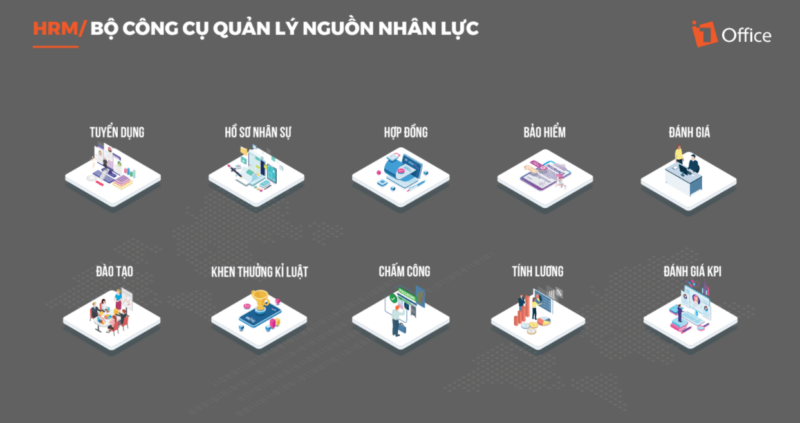
Understanding the challenges businesses face during digital transformation, 1Office offers a comprehensive business management solution that includes the HRM human resource management toolkit – supporting the resolution of human resource management tasks within the enterprise. This saves time, costs, and other resources. It is a powerful tool that helps leaders manage personnel with ease.
The HRM toolkit can solve all problems in personnel management by rapidly digitizing all data. The process of nurturing, classifying, and screening candidate profiles during recruitment is also carried out in detail with a clear, transparent process. In particular, managers can visually evaluate employees based on the ASK competency framework.
Users can build competency assessment criteria and manage them centrally right on the best HR software. The system allows for customizing the competency framework to evaluate each department and position within the business. Based on the results, managers can understand and assess employee capabilities to create a clear development path.
Furthermore, the data security feature is also enhanced to minimize the risk of information leaks, preventing malicious actors from exploiting it and affecting the business.
4.2. Businesses using HRM – HR management becomes simpler than ever
In Vietnam, many businesses have successfully undergone digital transformation, such as: MB Bank, Cộng Cà Phê, F88, Phong Vũ, ToCoToCo,…
“1Office helps me control timekeeping for the office block as well as 80 stores. 1Office also solves the problem of shift scheduling, shift changes, overtime, and leave request approvals. In addition, the software also supports building and calculating payroll very conveniently.” – Mr. Phung Anh Tuan (CEO of F88) on the solution that helped him succeed in digital transformation.
In addition, 1Office’s solution has helped the Cộng Cà Phê coffee chain manage all HR-related tasks, making them simpler, automated, and saving costs as well as manpower, by managing all tasks comprehensively instead of using multiple fragmented solutions as before.
Besides, 1Office has been selected by the Ministry of Information and Communications as a pioneering platform in the national digital transformation program, being a solution that brings sustainable efficiency to businesses.
The content above has shared 10 effective HR management methods that have been and are being implemented by many businesses today. It also presents a comprehensive HR management solution to help organizations optimize recruitment processes and manage personnel quickly and easily. Click the button below to receive the most useful advice to help you manage personnel effectively with 1Office’s HRM software.
Register for a consultation: 083 483 8888
For more details, please visit:
Fanpage: https://www.facebook.com/1officevn/
Youtube: https://www.youtube.com/channel/UCeTIRNqxaTwk0_kcTw6SxmA