13/05/2026
  352 views
Conceptual skills are one of the essential skills for a manager, especially for senior managers. A manager’s conceptual skills are decisive for the company’s strategies and policies. If managers do not equip themselves with an accurate thinking system, it can easily lead to deviations in setting management goals for the business. So, what are a manager’s conceptual skills? How are conceptual skills applied in business management? Let’s find out in the article below.
Mục lục
1. What are a manager’s conceptual skills?
Conceptual Skills are, simply put, the ability that allows an individual to view complex situations with depth and from multiple perspectives to develop creative solutions.
From an organizational perspective, a manager’s conceptual skills are the ability to see the organization’s complex issues through the big picture and identify the relationships and mutual influences between departments to find the most optimal solution. Conceptual skills always place managers in hypothetical situations, stimulating them to generate new ideas and transform thoughts into action-oriented solutions.
The conceptual skills of senior managers are particularly important for an organization, requiring them to understand the nature of the company’s policies and development strategies, as well as the ability to analyze and forecast for future goals.
Read now: What is a leadership style? 8 Common leadership styles today
2. 4 essential conceptual skills for managers
Conceptual skills are divided into many types; understanding and mastering each type comes with different benefits. In this article, we will focus on presenting conceptual skills in management and providing real-world examples of a manager’s conceptual skills.
2.1. Analytical skills
Just like when starting to solve a math problem, the first thing to do is to “decode” the given data; analysis is the foundational step for a manager to approach a problem. Analytical skills require managers to collect and classify all data related to the problem, then make observations and assessments to serve decision-making. Analytical thinking helps managers view problems from multiple perspectives, thereby deeply understanding the issue they are facing and finding a suitable direction.
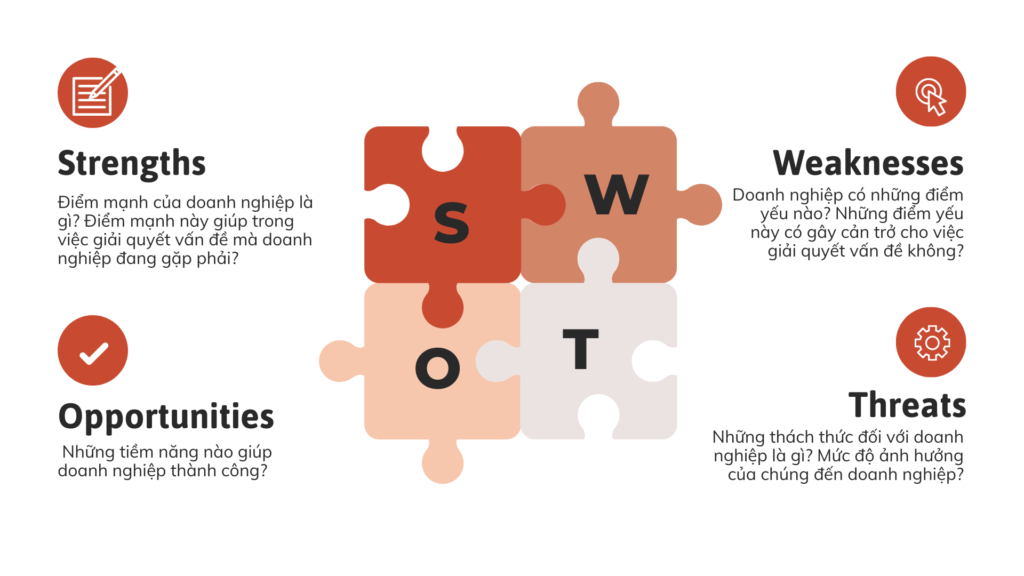
A tool you can use to support analytical thinking is the SWOT model, which includes:
- Strengths: What are the business’s strengths? How do these strengths help in solving the problem the business is facing?
- Weaknesses: What weaknesses does the business have? Do these weaknesses hinder problem-solving?
- Opportunities: What potential opportunities can help the business succeed?
- Threats: What are the threats to the business? What is their level of impact on the business?
Example: You plan to launch a tech product startup but are having difficulty deciding on a niche market. By using analytical skills, you will start to view your plan from a multi-dimensional perspective: What are the trends in this market? Will they facilitate or hinder product sales? Does my product meet market demand? What are the product’s strengths that need to be developed? What weaknesses need to be overcome to fit the market? Depending on the analysis results, you can determine the feasibility of your business idea.
2.2. Decision-making skills
Decision-making skills relate to the ability to solve problems quickly and effectively. Whether you are interacting with colleagues or handling a project, being able to make effective decisions at all levels is crucial for management success. This skill is especially important when the business faces unusual situations that require a timely response.
To develop this skill, you must be able to synthesize information from analyzed data and be agile when facing problems.
Example: You are the owner of a famous restaurant chain. When faced with customer doubts about product quality, if not handled promptly, you could lose a large number of customers in a short period. You decide to invite the Food Safety Management Board to inspect and issue a certificate to reassure the public. In this situation, quick decision-making skills helped the business handle the scandal effectively and regain customer goodwill.
2.3. Critical thinking skills
Critical thinking is the ability to view and evaluate things and events from all aspects, especially those that are easily overlooked, and then ask appropriate questions to understand the true nature of the problem instead of accepting it hastily. A key characteristic of someone with critical thinking skills is their ability to find flaws in proposed solutions and to challenge the opinions and viewpoints of others.
To develop your critical thinking skills, you can use the following questions:
- How is this problem similar to and different from other problems?
- What are the possible outcomes?
- Would this method still be effective if applied in a different situation?
- Do you agree with this viewpoint? What is the convincing evidence?
Example: A company wants to develop an online game for office workers because it recognizes this group needs a tool for entertainment during breaks. However, a market research specialist argues that office workers have to sit and work continuously, and playing games on the computer would easily cause fatigue due to always maintaining one posture.
2.4. Creative Thinking Skills
Creative thinking skills in management refer to a breakthrough way of thinking—unique, novel, and unprecedented—to find suitable solutions to problems. This way of thinking helps managers step out of their comfort zones and avoid established ruts. Some questions used in creative thinking to assess the “novelty” of a solution are as follows:
- Has this happened before?
- What would happen if this solution were implemented?
- Is there another way to do this?
- Can this problem be approached from a different angle?

Example: When conducting an internal training class on sales skills for sales staff, each instructor will apply different teaching methods:
- Present the content and have trainees watch sales scenario videos
- Pose a specific situation and ask trainees to think of a solution
- Present the content and have trainees practice selling through role-playing interactions.
See more: Lateral Thinking – A Thinking Method to Keep You Creative!
3. 5 Ways for Managers to Effectively Train Their Thinking Skills
3.1. Communicate Diligently
Communication skills are the ability to influence others through words and non-verbal gestures. Communication helps you continuously receive and think about new issues and convey your thoughts to others. With good communication skills, you can easily talk to your team or encourage those around you to succeed and work towards business goals.
See more: Communication Skills at Work to Help You Achieve Success
3.2. Don’t Be Afraid to Debate
Although many people tend to avoid conflict, debating is the best method to stimulate thinking skills. It’s important to remember that the ultimate goal of a debate is not to win or prove yourself right, but to find the truth and the most optimal solution to the problem. When debating, you will have to combine thinking skills with other skills such as listening, communication, etc.
3.3. Never Stop Reading!
One of the easiest ways to enhance your thinking skills is to read regularly. Choose books and magazines that you enjoy, but also look for texts that challenge your abstract thinking abilities. Reading not only helps you learn from others’ ways of thinking but also enriches your own perspectives.
3.4. Master Your Professional Knowledge
Thinking skills are only effective when you have a solid foundation of knowledge. You cannot think through developing a marketing plan without professional knowledge in the field of Marketing. Always learning, constantly honing your professional knowledge, and combining it with thinking skills will help you become a true leader.
4. Applying Technology to Solve the Management Thinking Challenge
Managing a business requires many skills, but when those skills are combined with a superior tool, the challenge of management thinking can be better applied from theory to practice. Applying technology will help managers maximize management efficiency within the enterprise.
1Office is an all-in-one business management platform that helps managers maximize their organization’s potential. The business management platform provides leaders with:
- Dashboard System: Monitor the overall health of the entire business (HR, Finance, Accounting, etc.)
- Reporting System – Standardize the entire business operating system (Processes, Organizational Charts, Systems)
- Real-time data updates help address issues as they arise
- Ability to control work down to the individual and department level
The article above has provided readers with knowledge about a manager’s thinking skills and how to apply them in management. The article also presents a solution for applying digital technology in business management. If you need any further information or consultation, please contact us for a free consultation.
For all inquiries, please contact:
- Hotline: 083 483 8888
- Fanpage: https://www.facebook.com/1officevn/
- Youtube: https://www.youtube.com/channel/UCeTIRNqxaTwk0_kcTw6SxmA