


 12/05/2026
  393 views
For sustainable business development, human resource management is a top priority for leaders. Choosing and applying a suitable human resource management model will help businesses optimize their human resources and improve business efficiency. Let’s explore the 5 most popular human resource management models today with 1Office to apply them reasonably and effectively for your business!
Mục lục
I. What is a Human Resource Management Model?
A human resource management model can be understood as a system of policies, activities, and human resource management processes aimed at meeting and implementing strategic goals as well as operational efficiency within a business.
The human resource management model is closely related to the business’s business model. With a good human resource management model, a business can:
- Attract and train high-quality personnel for the business
- Develop and maintain the number of personnel to ensure business and production activities proceed according to plan
- Maximize the effective use of resources.
II. The 5 Most Popular Human Resource Management Models Today
Currently, there are many human resource management models for businesses to consider. But basically, there are 5 popular HR models developed based on famous theories of human resource management. Depending on the scale, vision, and cultural characteristics, a business will choose a suitable human resource management model for itself.
1. The Standard Causal Model of HRM
This is the most famous human resource management model, originating from many similar models that emerged in the early 2000s. This model shows a causal chain that begins with business strategy and human resource management outcomes, leading to improved internal performance, including productivity, innovation, and quality. These results lead to improved financial performance (e.g., profit, financial revenue, better profit margins, and ROI).
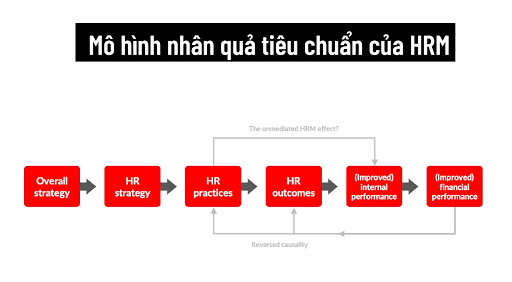
According to this model, human resources will only be effective if its strategy aligns with the business’s business strategy. The overall strategy originates from and is the basis for the business’s HR strategy. If the business performs well, investment in the HR department will be stronger, leading to better results. In addition, HR activities must also closely follow the HR strategy. Examples include recruitment, training, appraisal, and compensation.
See more: Human Resource Management Strategy for Each Stage of Business Development
2. Paul Boselie’s 8-Box Model of HRM
The 8-box model shows how various external and internal factors affect the effectiveness of what we do in human resource management. First, the model shows contexts such as the general market, general institutions, and population market as external factors affecting the business’s human resource management. Next are knowledge of culture, history, and technology. In addition, all factors that influence the business also affect its HR policies.
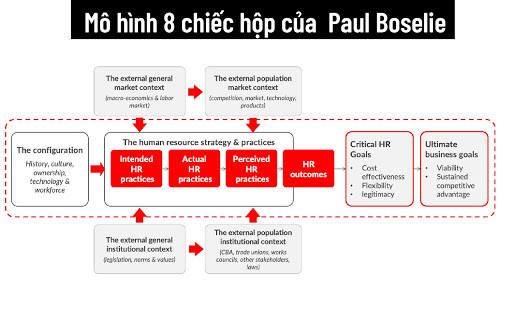
The HR strategy consists of 6 parts:
- Intended HR practices: These are the manager’s intentions regarding recruitment, training, and other practical issues, but this model shows that it is only the starting point.
- Actual HR practices: We may have great intentions, but the implementation of HR activities is a collaboration between HR and the manager. When the manager decides to do things differently, the intentions may be good, but the actual reality can be very different.
- Perceived HR practices: This is how employees perceive what is happening in the organization. HR and managers may do their jobs well, but they may have different feelings that are completely different from the intention, and perceptions will not reflect the actual HR activities.
- HR outcomes: Perceived HR practices lead to certain HR outcomes. These are similar to the standard HRM model described above.
- Critical HR goals mean cost-effectiveness, flexibility, legitimacy, etc.
- Ultimate business goals: from HR goals lead to profit, market share, market capitalization – all related to the organization’s viability and other factors that help build a competitive advantage
Read more: Optimal Human Resource Management Process for Businesses
3. The HR Value Chain Model
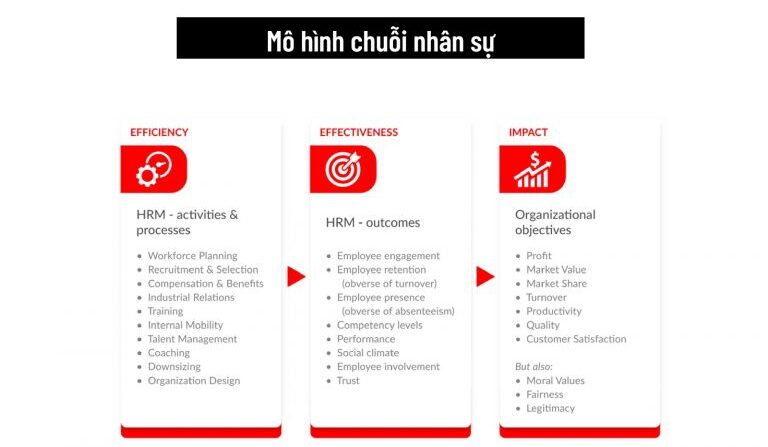
According to the HR value chain, everything we do (and measure) in human resource management can be divided into 2 categories:
- HRM Activities: daily activities, including recruitment, compensation, training, and succession planning. These activities are often measured quantitatively using metrics. These are called efficiency metrics. The cheaper the company can hire and the faster it can train, the better.
- HRM Outcomes: the goals that the business tries to achieve with its HRM activities. These outcomes include employee satisfaction, motivation, retention, and presence.
For example, a business might spend more time hiring a new employee if that person is a better fit for the set goals. When HR management activities achieve their desired outcomes, it leads to better job performance. This means that when a business has sound HRM activities, the result is outstanding growth.
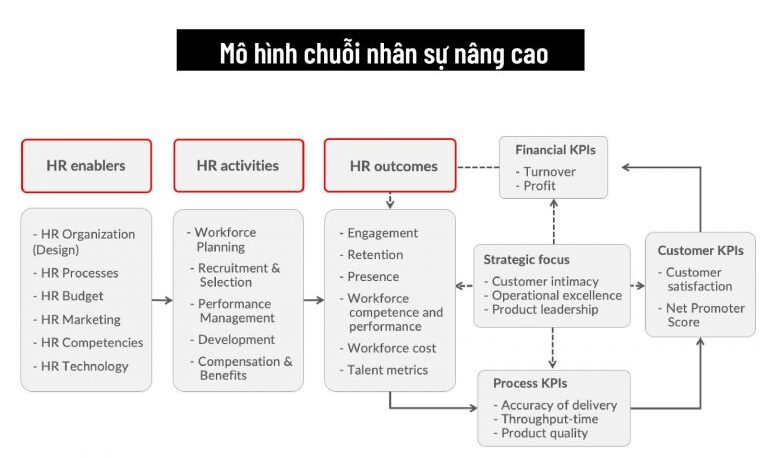
4. The Advanced HR Value Chain Model
This model is fundamentally similar to the standard value chain, but it has two notable differences:
- First, organizational performance is defined in a balanced scorecard. The balanced scorecard contains key performance indicators from financial, customer, and process perspectives. This document helps align and demonstrate the added value of HR to the business.
- Second, the model begins with a number of HR enablers. These enablers are key to what HR does within the business.
Read now: What is Employee Engagement? Solutions to Enhance Employee Engagement in Your Business
5. The Harvard Model of HRM
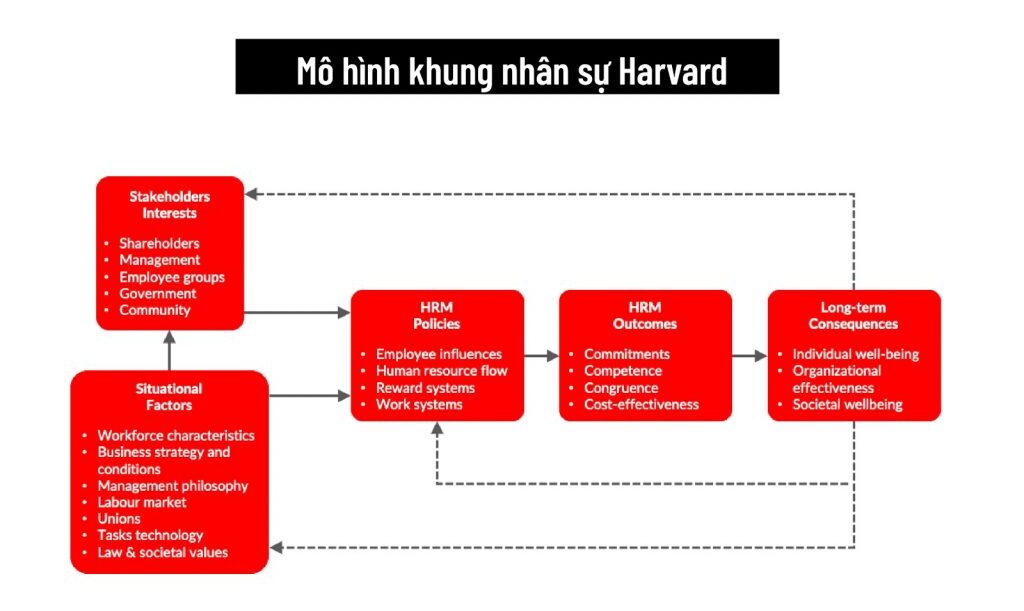
This is one of the most important and influential models of human resource management. It was initially developed by a number of experts led by Michael Beer in 1984 at Harvard University.
The Harvard model of HRM operates with five key components: situational factors, stakeholder interests, HRM policies, HRM outcomes, and the long-term consequences that the organization aims to achieve. It focuses primarily on 3 relationships: communication, exchange, and employee motivation. Accordingly, employees will be affected by: Human resource flows, work systems, and reward systems.
This model takes a more holistic approach to HR, demonstrating multiple levels of outcomes.
| Read more: What is ASK? How to apply the ASK model in human resource management |
III. 1Office – A comprehensive human resource management solution for businesses
Applying HRM software not only helps businesses keep up with the market’s digital transformation trend and create a distinct competitive advantage, but also contributes to optimizing resources and saving maximum time and costs. With 1Office – a total business management software, leaders can manage all HR-related operations quickly and easily on a single platform.
Completely solve every HR problem from a holistic perspective
More than just an application that supports common tasks like timekeeping – payroll or employee profile management software – providing a complete data platform, 1Office is also a comprehensive human resource management system that helps evaluate, analyze, and plan resources, optimizing personnel costs for the business:
- Recruitment: Standardize and digitize the recruitment process to make hiring simpler and more effective; save up to 85% in time and costs
- Personnel Utilization: Help leaders assign and coordinate work more effectively. At the same time, minimize management and document storage costs
- Performance Appraisal: Provide managers with a multi-dimensional view of employee performance to make accurate, objective decisions, eliminating emotional factors
- Training & Human Resource Development: Managers can track and evaluate the personnel situation from recruitment, onboarding, and training throughout their entire employment at the company. This allows for the creation of a clear and scientific training and development roadmap for each employee.
- Internal Culture Development: Ensure consistency – transparency – objectivity within the business. Help businesses build a professional, proactive, and flexible work culture.

Build an effective human resource management process with 1Office
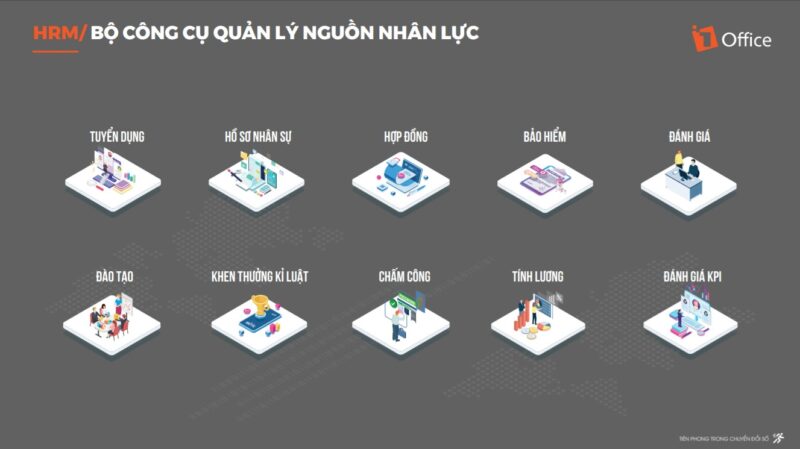
Digitize records – towards a paperless office
Instead of managing employee information manually, now with 1Office, all data, timekeeping processes, and payroll calculations are digitized on the software. As a result, businesses will save maximum time, effort, and costs on cumbersome and inefficient manual management tasks.
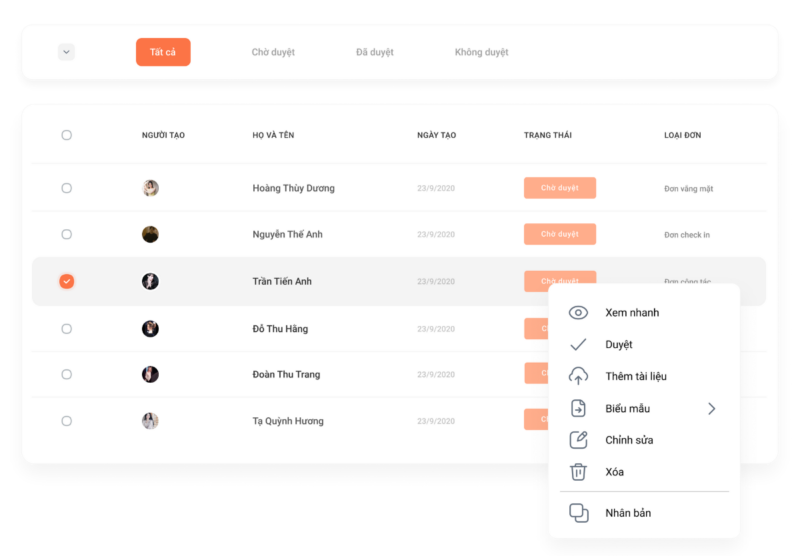
Customizable and automated – the outstanding advantages of 1Office
There are many software on the market today that provide smart, professional human resource management systems to help manage employees effectively. However, finding a suitable human resource management software for the scale and field of each business is not simple.
With 1Office, users can proactively set up and flexibly adjust features to suit their usage needs. In addition, the software also automatically aggregates data for reporting systems, approval systems, and alert systems, thereby helping leaders manage conveniently, simply, and save time
Reasonable & flexible pricing
Most software today charges based on fixed packages (minimum package is for 30 people or more). This inadvertently inflates the cost and wastes many resources. Meanwhile, 1Office charges on a “subscription” basis – the usage cost corresponds to the number of users. Starting from only 2,000 VND/user/month, businesses can enjoy the full benefits of 1Office.
Thanks to its outstanding features, 1Office has comprehensively met the needs of over 3,500 businesses in various industries/fields such as: Manufacturing, Real Estate, Commerce, Services, Construction, Tourism, Logistics, etc.It’s time for your business to digitize its human resource management system to optimize management costs, increase work accuracy, and “free up” labor!
Contact us via hotline: 0834 838888 or leave your information in the form below to be consulted and supported by 1Office experts as quickly as possible.
For more details, please see:
- Hotline: 083 483 8888
- Fanpage: https://www.facebook.com/1officevn/
- Youtube: https://www.youtube.com/channel/UCeTIRNqxaTwk0_kcTw6SxmA
















