


 10/05/2026
  557 views
Today, HRM software for the real estate industry is the key to attracting and retaining talent and creating an efficient operational system. In the real estate industry, human resources are the most valuable asset but also the biggest management challenge. High employee turnover rates, complex commission structures, and the constant need for training demand a solution that goes beyond a typical CRM. This article by 1Office will provide a detailed review of 7 software solutions that help businesses thoroughly solve this problem.
Mục lục
1. Review of the 7 Best HRM Software for the Real Estate Industry
The real estate industry requires an HRM solution that is not only strong in core HR functions (recruitment, employee records, timekeeping, payroll) but also capable of handling complex commission policies and integrating deeply with business operations. The software solutions below were selected based on their ability to meet these demanding requirements.
Overall Comparison Table
| Software | Key HRM Features for the Real Estate Industry | Best for |
| 1Office | Comprehensive employee lifecycle management, automated salary & commission calculation, AI and LMS integration. | Businesses of all sizes needing a unified, fully automated HRM solution. |
| MISA AMIS HRM | Strict compliance with labor laws, records management, timekeeping, payroll, and social insurance. | Medium and large enterprises prioritizing compliance with Vietnamese laws. |
| Landsoft | Performance management and permission delegation for the sales team. | Large brokerage firms focusing on sales team management and security. |
| Arito ERP | Provides detailed salary and commission reports, integrates financial data. | Businesses needing a comprehensive management solution with financial transparency. |
| Viindoo | Integrates HR management, recruitment, timekeeping, and leave management within one ERP system. | Businesses needing a highly customizable ERP solution with multiple integrated functions. |
| 1EZSale CRM | Agent performance evaluation, sales team management. | Businesses focused on measuring KPIs and sales team efficiency. |
| Bitrix24 | Task management, basic timekeeping, suitable for onboarding and task tracking. | Startups and small businesses looking to optimize initial costs. |
1.1. 1Office 1HRM – A Comprehensive AI-Integrated HR Management Solution
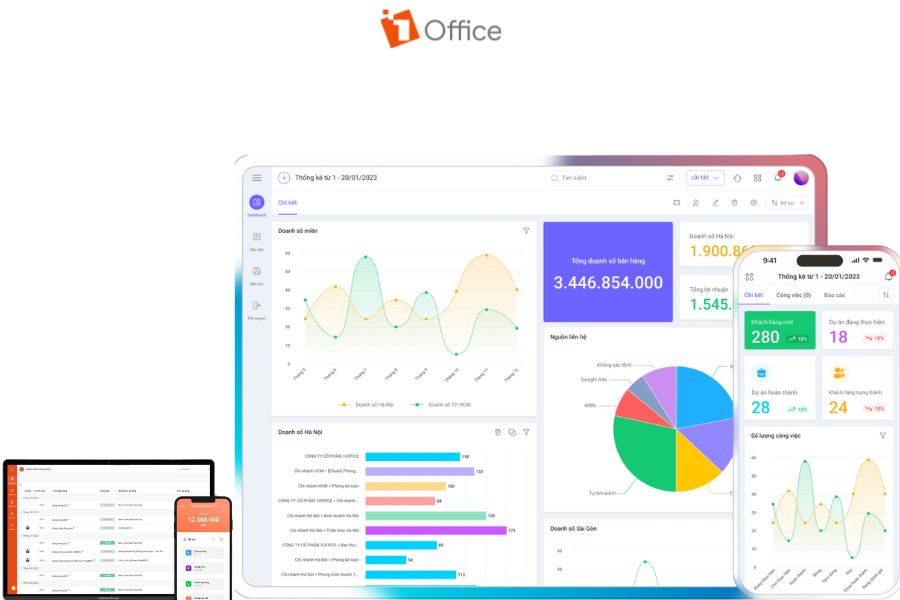
1Office is a unified business management platform, where the 1HRM module is designed to comprehensively manage the entire employee lifecycle, especially suitable for the complex requirements of the real estate industry.
Key Features:
- Recruitment & Training Management: Automates high-volume recruitment processes, integrates AI for CV screening, and manages onboarding for new employees. The built-in Learning Management System (LMS) helps businesses systematically create training courses on projects and sales skills.
- Flexible Payroll and Commission System: This is a standout strength of 1Office. Businesses can set up their own multi-level, tiered, and group-based commission formulas. The system automatically inherits sales data from the CRM module to calculate salaries and commissions without manual data entry, ensuring accuracy and transparency.
- Performance Management (KPIs/OKRs): Build and track performance indicators for sales specialists. KPI results are directly linked to the payroll to automatically calculate bonuses, creating strong motivation.
- HR Process Automation (No-code): Businesses can design their own automated workflows for leave approvals, advance requests, and especially for approving and paying commissions, minimizing waiting times and paperwork.
1.2. MISA AMIS CRM & HRM
This is a specialized HRM solution suite, trusted by many Vietnamese businesses for its ability to comply well with legal regulations.
Key Features:
- Core HR Management: Very strong in managing basic tasks such as employee profiles, labor contracts, and timekeeping.
- Payroll and Legal Compliance: Automates the accurate calculation of salaries, social insurance, and personal income tax, helping real estate businesses always comply with legal regulations.
1.3. Landsoft (Specialized Real Estate CRM)
Although it is a CRM, Landsoft provides important features that support HR management for the sales team.
Key Features:
- Sales Team Management and Authorization: Allows setting up detailed access rights to the property inventory and customer data, helping to secure information.
- Off-boarding Process Support: The strict authorization feature helps revoke access rights of departing employees, minimizing the risk of customer data loss.
1.4. Arito ERP (Total Management)
Arito is an ERP solution that provides a specialized HRM module called AritoHRM.
Key Features:
- Comprehensive HR Management: Provides a full range of functions from profile management and timekeeping to payroll.
- Detailed Salary and Commission Reports: Capable of generating in-depth analytical reports on salary and commission costs, directly linked to the financial data of the entire ERP system.
1.5. Viindoo (Comprehensive ERP)
Viindoo is an open-source ERP solution that allows for flexible customization to fit business needs.
Key Features:
- Integrated HRM Solution Suite: Provides all necessary HR modules such as recruitment, employee management, timekeeping, leave, and payroll.
- Unified HR Data: Thanks to the ERP platform, HR data is tightly linked with other modules like accounting and project management, helping to synchronize information.
1.6. 1EZSale CRM
EZSale CRM focuses on managing and optimizing the performance of the sales team, thereby indirectly supporting HR management.
Key Features:
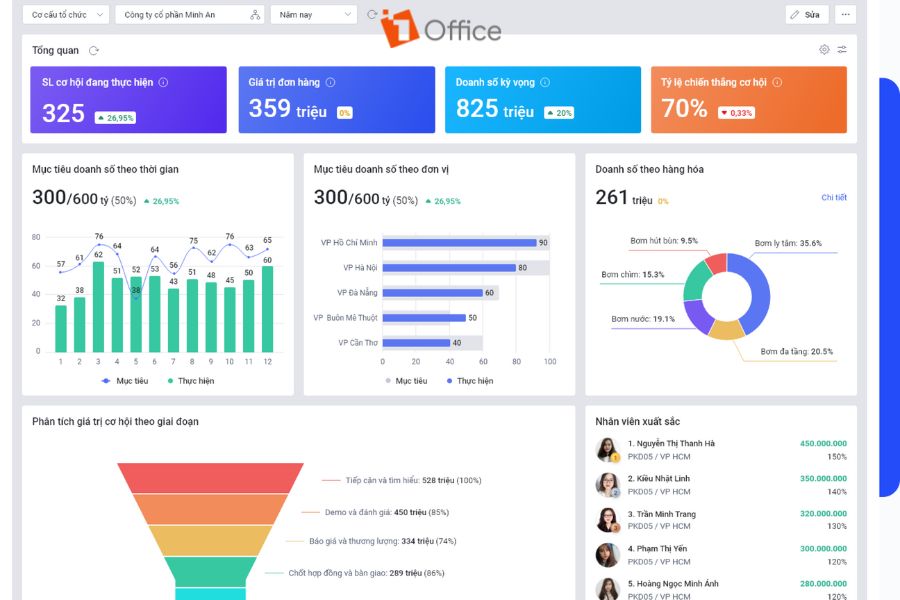
- The software supports performance evaluation for agents through a detailed KPI reporting system, which serves as crucial data for the HR department to make decisions on compensation, bonuses, and training.
1.7. Bitrix24 (Free & All-in-one)
Bitrix24 is a collaborative work platform that provides basic-level HRM tools, suitable for small teams.
Key Features:
- Basic HRM Tools: Provides an employee directory, an internal portal, task management, and simple timekeeping.
- Onboarding Support: The task management and internal communication features are very useful for orientation training and assigning tasks to new employees.
2. Challenges in Human Resource Management in the Real Estate Industry
Human resource management in the real estate industry is not just about routine administrative tasks; it’s a strategic challenge facing 5 major hurdles:
2.1. Complex Salary/Commission Calculation
This is the biggest HRM challenge. Commission structures are often multi-layered (individual, team, manager), dependent on customer payment schedules, and other KPI metrics. Manual calculation is not only time-consuming and prone to errors but also lacks transparency, which can demotivate the sales team.
2.2. Continuous Recruitment and Training
The turnover rate in the real estate industry is very high. The HR department must constantly operate at full capacity to recruit large numbers of employees continuously. Additionally, onboarding new employees on company culture, project knowledge, and sales skills needs to be done quickly and effectively.
2.3. Managing a Mobile Sales Force
The primary workforce consists of sales professionals who frequently work off-site. From an HRM perspective, this presents challenges in timekeeping, tracking actual work performance, assigning tasks remotely, and ensuring the team complies with company regulations.

2.4. Scattered Data
Information about an employee is often scattered across multiple places: personal details in an HR Excel file, performance data in a sales team leader’s file, and sales figures in the CRM software. This fragmentation prevents HR from getting a 360-degree view of employees, making it difficult to evaluate, plan, and develop personnel.
2.5. Information Security
When a sales employee resigns, the biggest risk is that they take customer lists and sensitive business information with them. The HR department needs a strict off-boarding process, including the swift and systematic revocation of access to all systems to protect company assets.
3. Specific Requirements for Choosing HRM Software for Real Estate Businesses
To address the challenges above, an HRM software for the real estate industry must meet the following specific criteria:
3.1. Payroll Module with Customizable Commission Formulas
The software must allow the HR department to set up complex commission formulas without IT intervention. Most importantly, the payroll module must be able to integrate and automatically pull sales data from the CRM or Excel files for calculation, completely eliminating errors from manual data entry.
3.2. Flexible Timekeeping Management (Mobile Check-in/GPS)
A mobile application is a mandatory requirement. It must allow employees to clock in via GPS/Check-in at specific locations, submit leave requests, view payslips, and receive company announcements. For managers, the mobile app must support approving requests and viewing team performance reports anytime, anywhere.
3.3. Deep Integration with CRM and Accounting
HR data cannot exist in a silo. An effective HRM system must have two-way connectivity with CRM software to pull sales data and with accounting software to sync payroll cost data for bookkeeping purposes.
3.4. Learning Management System (LMS)
With the constant need for training, having a built-in LMS is a huge advantage. It helps the HR department standardize the onboarding process, create online training courses on products, policies, and soft skills, and also track and evaluate the effectiveness of training programs.
4. Conclusion
Choosing HRM software for the real estate industry is not just a technology decision, but a strategic investment in human capital. A suitable system will help businesses thoroughly solve specific challenges, from recruitment, training, and talent retention to building a transparent and fair salary, bonus, and commission policy.
Are you ready to build an elite sales team and a transparent compensation policy? Contact 1Office today for an in-depth consultation and a live experience of the human resource management platform trusted by over 6,000 businesses.
















