


 13/05/2026
  377 views
“If You Fail to Plan, You Are Planning to Fail.” (If you fail to plan, you are planning for your own failure.) Not every plan can help a business achieve success. There are always obstacles that cause a plan to remain “on paper,” leading to results that don’t meet expectations. If you don’t want to “prepare for failure” for your organization, managers need to adhere to the following planning principles.
Mục lục
1. 3 Mistakes That Make Managers’ Plans Unfeasible and “Stuck on Paper”
1.1. Unrealistic Plans
An overly ambitious goal or tasks that don’t match capabilities are the cause of a failed plan. This can easily demoralize employees, making them discouraged because they put in a lot of effort, but the goal remains “out of reach.”
1.3. Overly General Plans
A plan with vague directions and no specific guidance can easily make employees “get lost,” unable to clearly define their tasks and responsibilities, leading to low performance.
1.2. No Contingency Plan
A rigid plan that leads to only one outcome always carries the risk of failure. In reality, situations always arise that are beyond human control. Without a plan to respond promptly, it will cause confusion among employees and make all previous efforts “collapse.”
If your plan is facing the issues mentioned above, you might need a set of planning principles and a specific reference framework for your plan. First, refer to the planning process and the criteria to pay attention to in the article below:
See more: 5 Steps to Strategic Planning – Things to Note When Creating a Strategic Plan
2. Planning Made Easy with the 5W1H2C5M Formula
5W1H2C5M is one of the model formulas considered the “backbone” for shaping a complete plan. Think through and answer all the questions below before you start planning:
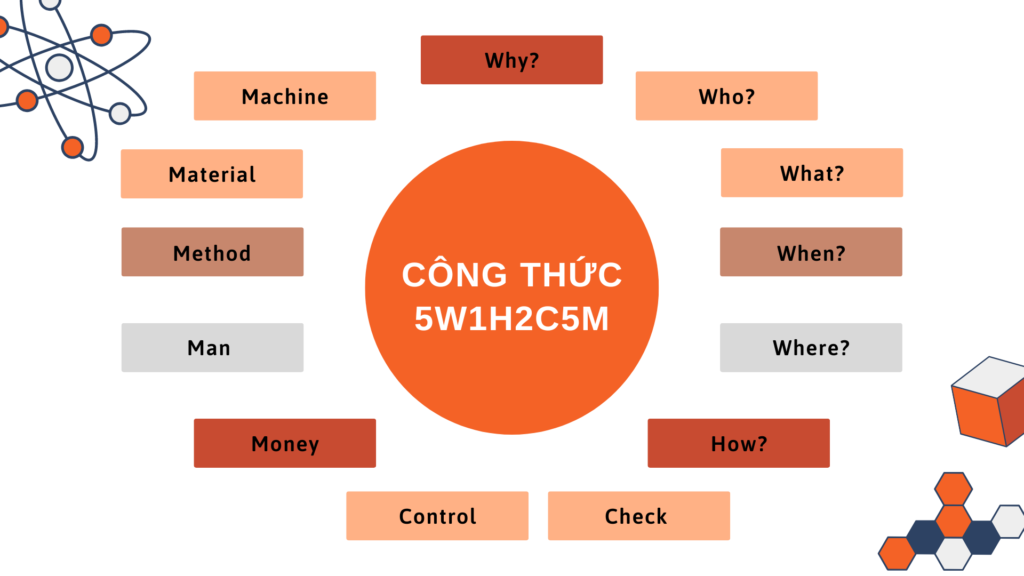
- Why?: Why is this plan necessary? What is the goal of the plan?
- Who?: Who will participate in this plan?
- What?: What tasks need to be implemented to execute the plan?
- When?: When will you start implementing the plan? When will the plan end?
- Where?: Where will the plan take place?
- How?: How will the plan be implemented in detail?
- Check: Who will check and evaluate the plan? How will it be checked?
- Control: How will the plan be controlled? What are the key control points?
- Money: What financial resources will be used to implement the plan?
- Man (Human Resources): Who will execute the plan and who will support its implementation?
- Method: What tools and methods will be used to implement the plan?
- Material: What materials will be used to serve the plan?
- Machine: What machinery and technology will be applied to execute the plan?
See more: What is OGSM? Tips for Application and the Most Detailed, Effective OGSM Template for Businesses
3. 8 Planning Principles to Help You “Win Every Battle”
3.1. The Principle of Goal Orientation
This is one of the crucial planning principles that determines the success or failure of a project. According to this principle, every plan must make a positive contribution toward achieving the organization’s objectives. These objectives need to meet all 5 elements of the SMART model, including:
- Specific: The target audience and implementation method need to be clearly stated in the plan’s objective. E.g., Increase the number of fan page followers by running Facebook ads.
- Measurable: The objective needs to provide specific, quantifiable figures to track and measure progress. E.g., Increase fan page followers by 15%.
- Achievable: The objective must be consistent with available resources and be attainable. E.g., Spend more money on Facebook ads within the allowed budget to increase reach and fan page followers.
- Relevant: The set objective must align with the company’s direction and situation. E.g., If the business wants to expand its customer base, an increase in fan page followers means more people will be reached and become aware of the product, thereby enhancing brand recognition.
- Time-bound: How long will it take to achieve the objective? E.g., In Q1 2022.
3.2. The Prioritization Principle
To prevent the plan from falling behind schedule, managers need to evaluate and arrange tasks by importance from high to low, prioritizing more critical tasks. Specifically, you can use the Eisenhower time management matrix to classify tasks by execution level as follows:
- Urgent and important: These are the tasks you need to complete first. E.g., Completing a project proposal due tomorrow.
- Important but not urgent: You need to schedule time for these tasks in advance and avoid interruptions. E.g., Collecting customer feedback to improve the product.
- Urgent but not important: Delegate to others. E.g., Taking meeting minutes.
- Not urgent and not important: Eliminate from the to-do list. E.g., Browsing the web, updating social media status.
3.3. The Flexibility Principle
The plan must be flexible to adapt to changes in both the external environment and within the organization. This will help the business respond quickly to circumstances and prevent or minimize unnecessary losses.
E.g., During a complex pandemic that disrupts the plan, the execution method can be changed from offline to online to ensure progress.
3.4. The Balance Principle
The set objectives must be aligned with the resources and the ability to achieve them to avoid shortages or surpluses, wasted resources, or overlapping tasks.
E.g., To get 200 email sign-ups for a document in one month, 10-20 emails need to be sent daily, handled by one employee.
3.5. The Time Principle
When setting objectives for the organization, the deadline to achieve these objectives must be clearly defined. Tasks must be completed on time to avoid failing to meet deadlines. This requires team members to manage their time effectively. A large task can be broken down into smaller deadlines to always keep track of the execution progress.
| Read more: 7 time management tips to improve business efficiency |
3.6. The Limiting Factor Principle
When planning, it is necessary to consider the factors that limit the company’s ability to execute the plan. The manager’s job is to anticipate difficulties and resource limitations that hinder the plan and find remedies or alternative solutions.
For example: The business needs to consider whether it has enough resources to meet the plan’s requirements. If not, it should consider outsourcing or having employees work overtime.
3.7. The Cooperation Principle
During the planning process, full cooperation from managers at all levels, from low to high, is necessary for the plan to be implemented effectively. The full participation of all members helps the business achieve consensus on the planning premises and ensures close coordination during implementation.
3.8. The Commitment Principle
And finally, no matter how perfect a plan is, it cannot succeed if members are not committed to implementing it. Therefore, during the plan’s implementation, it must be ensured that all departments and individuals adhere to the commitments stated in the plan.
4. Plan Effectively with 1Office’s WORKPLACE Task Planning Software
In addition to the planning principles mentioned above, using the WORKPLACE task planning software is a superior and effective solution that helps managers save time and effort in planning. The WORKPLACE module of 1Office possesses many smart, outstanding features that help you easily track progress and remind employees to perform tasks, such as:
- A planning tool that helps users create specific and realistic work plans, is easy to operate, and delivers the highest efficiency.
- Automatically assign tasks to individuals or groups based on job position or department.
- Automatically update tasks on personal schedules, helping employees easily keep a close watch on their work.
- Automatically update progress and tasks, helping managers grasp the detailed status of work.
- Visualize work reports in formats like Dashboards, Gantt Charts, and dynamic reports.
Thus, the content above has introduced readers to the principles of planning and an effective planning solution with the WORKPLACE module of 1Office. It is clear that building a scientific plan will help each individual and business have a clear direction and strategy to achieve their set goals.
For more detailed information, please visit:
Fanpage: https://www.facebook.com/1officevn/
Youtube: https://www.youtube.com/channel/UCeTIRNqxaTwk0_kcTw6SxmA
















