11/05/2026
  379 views
The HR & Admin department’s year-end report is not just a summary, but also a “mirror” reflecting the entire internal operations of the business. So, what content should the report include? How can you ensure it is both data-rich and demonstrates the strategic role of the HR & Admin department in the eyes of leadership? In this article, 1Office will guide you on how to build a professional year-end report for the HR & Admin department – complete with a 7-step implementation guide, key metrics, and a clear, easy-to-apply report template.
Mục lục
- 1. What is the purpose of the HR & Admin department’s year-end report?
- 2. 7 basic components of the HR & Admin department’s year-end report
- 2.1. Overview of the personnel situation during the year
- 2.2. Report on recruitment effectiveness
- 2.3. Report on personnel training
- 2.4. Salary Fund Report
- 2.5. Report on Compliance with Internal Regulations
- 2.6. Evaluation of HR Performance
- 2.7. Proposals for Improvement and Direction for the Coming Year
- 3. What Content Should an HR & Administration Report Include for Different Industries?
- 4. What to Note When Creating a Year-End HR Admin Report?
- 5. Suggestions for the Latest Easy-to-Use HR Report Templates
- 6. Create Automated, Visual HR Reports with 1Office
- 7. Frequently Asked Questions
1. What is the purpose of the HR & Admin department’s year-end report?
The HR & Admin department’s year-end report is a summary of the personnel situation over a year, aimed at evaluating the effectiveness of internal activities, proposing improvement solutions, and recommending a plan of action for the HR & Admin department in the coming year.

The year-end HR & Admin report is one of the most important documents, holding strategic significance in corporate governance. The report provides business owners with a comprehensive overview of human resource management activities over the past year, while also measuring the quality of the workforce and reviewing all work processes of the HR & Admin department. From this, the business will have a basis for developing strategies to improve labor productivity and enhance the effectiveness of human resource management.
See more: Job Analysis Skills in Human Resource Management to Triple Management Efficiency
2. 7 basic components of the HR & Admin department’s year-end report
2.1. Overview of the personnel situation during the year
The first mandatory requirement of a year-end HR & Admin report is to provide a comprehensive picture of the organization’s personnel situation over the past year. This section will help leadership get the most general and comprehensive view of the state of human resource management within the company, while also identifying the key areas that require attention. To summarize the company’s overall personnel situation, the report creator needs to highlight the following key points:
- Personnel situation during the year: Statistics on the number of employees currently working at the company (full-time employees, part-time, probationary employees, interns…), the number of employees who have resigned, and employees on statutory leave
- Employee turnover rate: Calculated by dividing the number of employees who left by the average number of employees during the year. A high rate means that the company’s recruitment costs for that year were significant.
- Personnel structure by job role: Statistics on the number of personnel for each specific position and department to identify which departments are understaffed and which are overstaffed.
In addition, the report should summarize the HR activities carried out over the past year, including recruitment, training, performance appraisal, and internal events.
2.2. Report on recruitment effectiveness
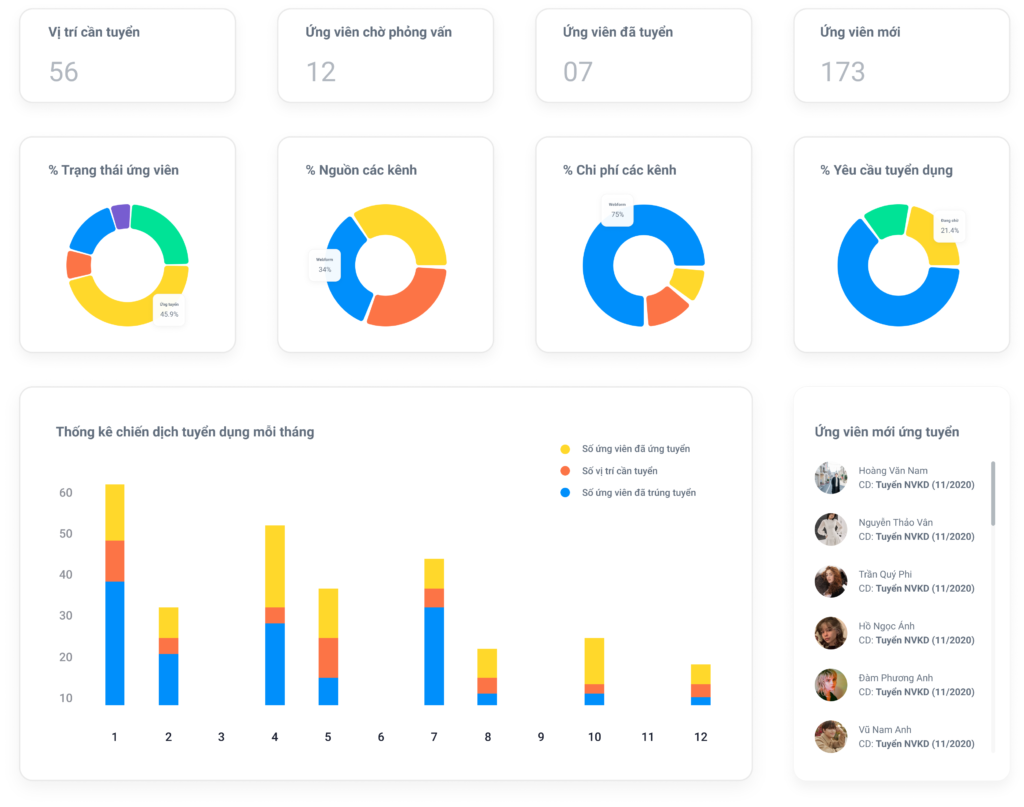
The next section of the report will delve into a detailed analysis of the implementation of HR activities over the past year. The first issue to be addressed is recruitment. In the recruitment report, the writer needs to indicate the resource needs and recruitment effectiveness through statistical indicators:
- Total number of CVs received from recruitment campaigns
- Ratio of qualified candidates to the total number of valid CVs
- Recruitment costs over one year across all campaigns and the average cost per candidate
2.3. Report on personnel training
The personnel training situation is an important topic to clarify in the HR & Admin department’s year-end report. In this section, HR needs to provide detailed information about the costs of human resource development and training, as well as the results after the training process. Specifically:
- Training costs include fees for designing training programs, hiring training experts, preparing necessary facilities for training, etc.
- The outcomes of the training process are demonstrated through positive changes in productivity, quality of work, and new achievements by personnel after their professional skills have been enhanced.
2.4. Salary Fund Report
The salary fund report presents the salary structure and current income levels of personnel, including statistics on average income for each job title, allowances, bonuses, and benefits paid out in the past year.
This serves as a basis for the company to balance its salary fund against the general market and consider it in parallel with employee attitudes and capabilities to develop a suitable compensation and benefits policy.
2.5. Report on Compliance with Internal Regulations
One of the main tasks of the HR and Administration department is to ensure discipline and order throughout the organization’s operations. Therefore, the situation of compliance with internal regulations is an issue that needs close attention and clear presentation. Specifically, the year-end report from the HR and Administration department should clarify:
- The number of violations of departmental and company rules and regulations, categorized by the severity of the offense
- Employee leave rate, clarifying the reasons (illness, personal matters, etc.) to find ways to minimize it
- Statistics on total late arrivals during the year from the timesheet
2.6. Evaluation of HR Performance
After clearly presenting the status of HR management activities over the year, it is necessary to provide general comments and evaluations on the company’s HR and administrative work. In this section, the writer needs to assess whether HR activities have achieved their planned objectives, and what the successes and limitations in human resource management have been.
2.7. Proposals for Improvement and Direction for the Coming Year
Summarizing all HR and administrative activities for the year provides the basis for managers to propose solutions to improve HR effectiveness. Based on the results achieved and the remaining limitations, the reporter will set the direction for HR management activities in the coming year, including training plans, strengthening management, and building a better working environment.
Try the leading HRM software 1Office for free
3. What Content Should an HR & Administration Report Include for Different Industries?
Each industry has its own unique personnel characteristics, so a one-size-fits-all template cannot be applied to the year-end HR & Administration report. To accurately reflect the situation and support leadership in decision-making, HR needs to create reports tailored to each specific field.
3.1. F&B and Retail Industry
In F&B and retail, the workforce is large, turnover is high, and shifts change constantly. The year-end report must pay special attention to factors related to work shifts and salary costs.
-
Shift and Working Time Report: summarizes the number of shifts, OT shifts, holiday leave, and associated allowances.
-
Personnel Fluctuation Report: turnover rate, new hires by branch/store.
-
Salary and Benefits Cost Report: personnel costs make up a large part of the budget, requiring comparison between points of sale.
-
Training and Compliance Report: number of employees trained in service procedures and compliance with hygiene and safety standards.
3.2. Manufacturing and Construction Industry
For manufacturing and construction, occupational safety and work productivity are the focus of all year-end HR reports.
-
Timekeeping and Overtime Report: number of work hours, overtime hours, night shifts to calculate hazard pay and overtime.
-
Occupational Safety Report: incidents, violations, and compensation costs (if any).
-
Productivity and Headcount Report: summarizes output per capita, compared with benchmarks.
-
Social Insurance and Benefits Cost Report: insurance contribution rates, maternity and sick leave benefits.
3.3. Service and Technology Industry
In the service and technology sectors, the quality of human resources and project performance are often more important than the number of personnel. The year-end report must clarify performance factors and talent retention strategies.
-
KPI and Work Performance Report: completion rate of OKRs, projects, individual and team KPIs.
-
High-quality personnel fluctuation report: number of new hires, turnover rate in the technical/specialized personnel group.
-
Training and development cost report: investment in skill courses, new technologies.
-
Soft benefits policy report: remote, hybrid work policies, learning allowances, benefits for talent retention.
3.4. Finance – Banking – Insurance Industry
In finance, banking, and insurance, compliance and personnel discipline play a vital role. Year-end reports need to focus heavily on business performance and transparency.
-
Legal compliance report: timekeeping, leave, labor policies in strict compliance with regulations.
-
Sales/Service KPI report: target achievement rate of each business department.
-
Performance-based salary and bonus cost report: sales-based bonuses, quarterly bonuses, Tet bonuses.
-
Key personnel report: list, fluctuations of management-level personnel and key experts.
4. What to Note When Creating a Year-End HR Admin Report?
Clear and understandable content
The summary report of the HR admin department must be presented clearly and coherently so that readers can easily follow and extract information. The report’s content must be comprehensive, summarizing the entire human resource management process over a year and covering all aspects of HR administration.
Visual and engaging report
A major “don’t” when creating a year-end report for the HR admin department is presenting a text-heavy document. This makes it very difficult for readers to systematize the content. Therefore, the information in the year-end HR report should be presented using data and charts (bar, pie, or line) to give management a visual overview and facilitate easy evaluation and comparison of the HR situation between years.
5. Suggestions for the Latest Easy-to-Use HR Report Templates
Essentially, the year-end report of the HR admin department is a compilation of monthly HR reports. Therefore, HR report templates are the foundation for managers to build the year-end report. To assist managers in HR management reporting, 1Office provides standard, easy-to-use HR report templates for HR professionals:
Download 4 free, standard, and most detailed HR report templates
6. Create Automated, Visual HR Reports with 1Office
1Office – The all-in-one business management solution with an intelligent reporting system is the key to helping HR managers create effective year-end summary reports. With automated, in-depth reporting features and over 1000+ detailed, visual templates, 1Office is a powerful assistant that helps businesses optimize HR management.
- Automatically compiles HR information in an instant, minimizing data collection and consolidation steps for HR
- Provides accurate HR metrics such as personnel fluctuation and turnover rates with a visual, multi-dimensional dashboard system
- HR data is updated in real-time with smart filters, allowing managers to easily retrieve information by day, month, or year
In the article above, 1Office has guided readers through the process of creating a standard year-end report for the HR admin department, while also introducing an HR management solution that helps businesses optimize human resource management efficiency. 1Office is the leading business management solution on the market today. For a consultation and software trial, please contact us using the information below:
7. Frequently Asked Questions
Which metrics should a year-end HR admin report prioritize for easy viewing by leadership?
You should prioritize metrics that directly impact operations, such as personnel fluctuation, recruitment, personnel costs, turnover rate, productivity, and training. These figures help leadership quickly assess the situation and make decisions for the following year.
If recruitment, turnover, and timekeeping data do not match, how should it be handled?
You should review the original data source, standardize the reporting timeline, and check if all departments are using the same recording method. Before including it in the report, HR should finalize a single data source to avoid discrepancies.
What should the HR & Admin department report to get next year’s budget proposal approved more easily?
Budget proposals should be linked to actual data such as recruitment needs, turnover rates, training costs, employee performance, and issues affecting operations. When there is clear data and reasoning, the proposal is more likely to be approved.
How can we obtain more accurate data on training, performance, and personnel fluctuations?
Data should be updated regularly on a unified system instead of being compiled at the end of the year from various files. This method helps HR reduce errors and retrieve data more quickly when reporting is needed.
Is there any software that can help HR automate year-end report compilation?
Yes. If your business wants to compile HR reports faster and reduce manual work, you can consider the 1Office employee evaluation software to manage data centrally and support more convenient report exporting.
- Hotline: 083 483 8888
- 1Office Fanpage: https://www.facebook.com/1officevn
- Youtube Channel: https://www.youtube.com/c/1OfficeNềntảngquảnlýtổngthểDoanhNghiệp