11/05/2026
  17307 views
The recruitment process is a series of activities carried out from identifying recruitment needs to onboarding new employees. An effective recruitment process helps businesses find suitable candidates and contributes to improving business efficiency. In this article, 1Office will explore the personnel recruitment process flowchart according to ISO standards and provide tips for building an effective recruitment process.
Mục lục
- 1. What is an effective recruitment process?
- 2. Personnel Recruitment Process Flowchart
- 3. What is the ISO standard personnel recruitment process?
- 4. Differentiating Between Internal & External Recruitment Processes
- 5. Challenges in Implementing an ISO-Standard Recruitment Process
- 6. Reference: Company Recruitment Process Template
- 7. Effective onboarding process after recruitment
- 8. Examples of recruitment processes at large corporations
- 9. Frequently Asked Questions about HR Recruitment Process Diagrams (FAQs)
- 10. Conclusion
1. What is an effective recruitment process?
An effective recruitment process is a well-designed system of steps aimed at connecting the right person to the right position at the right time, ensuring a balance between candidate quality, operational costs, and the speed of filling vacancies.
In summary, a recruitment process is considered effective in a business if it meets the following 3 criteria:
- Effectiveness: The recruitment process must help the business find the most suitable candidates for the position, meeting the job requirements and company culture.
- Objectivity: The recruitment process must be conducted objectively, fairly, and without bias towards any candidate.
- Optimization: The recruitment process should be optimized to save time and costs.
An intelligent personnel recruitment process helps managers closely monitor the recruitment process, ensuring all steps are followed correctly and avoiding errors or oversights. It also helps the business accurately assess candidates’ abilities, contributing to improved business performance.
>> See also: 7-Step ISO Standard Personnel Management Process Flowchart
2. Personnel Recruitment Process Flowchart
A personnel recruitment process flowchart is a general model that illustrates the main steps and activities in the recruitment process. A complete recruitment process will include the following steps:
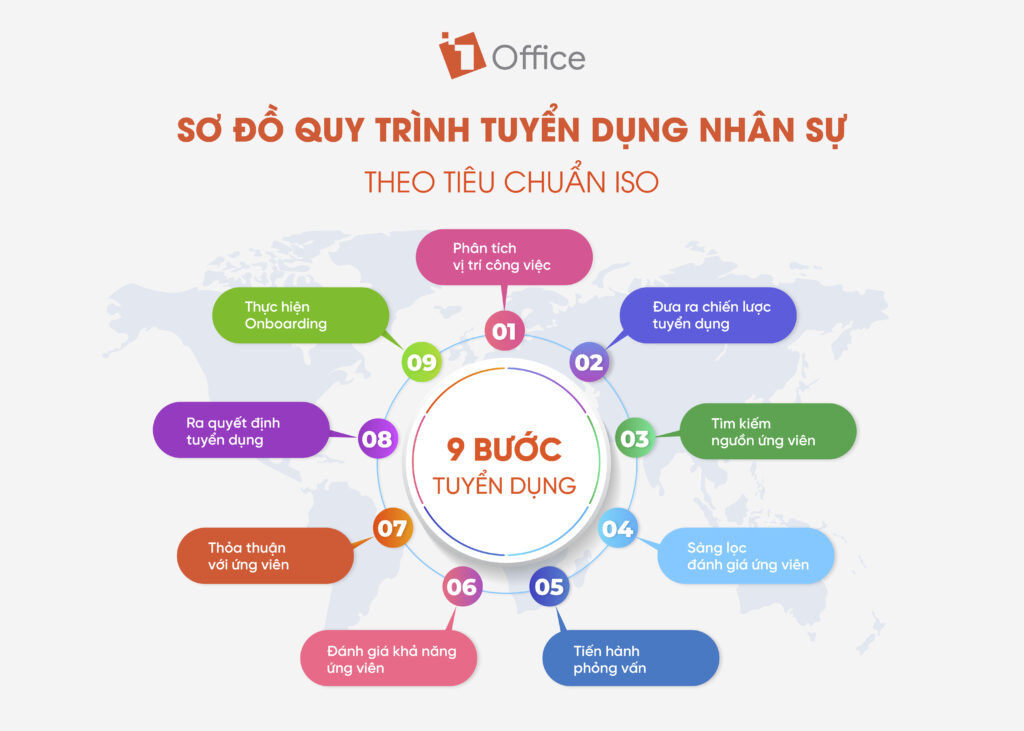
- Step 1: Analyze the job position
- Step 2: Develop a recruitment strategy
- Step 3: Source candidates
- Step 4: Screen and evaluate candidates
- Step 5: Conduct interviews
- Step 6: Assess candidate capabilities
- Step 7: Negotiate with the candidate
- Step 8: Make a hiring decision
- Step 9: Implement Onboarding
>> Read more: Top 11 Most Popular Recruitment Software in 2023
3. What is the ISO standard personnel recruitment process?
The personnel recruitment process according to the ISO 9001 standard is an effective, scientific recruitment process adopted by many businesses. This process consists of 6 main steps, as follows:
Step 1: Recruitment Planning
This is the first step in the ISO standard personnel recruitment process. This step includes the following tasks:
- Identify recruitment needs: The business needs to clearly define the position to be filled, the number of personnel required, the recruitment timeline, and the selection criteria.
- Create a recruitment plan: The manager needs to create a detailed recruitment plan, including content such as: recruitment timeline, recruitment budget, candidate sourcing channels, recruitment methods, etc.
- Assign recruitment tasks: The business needs to assign recruitment tasks to appropriate staff members.
Step 2: Job Announcement
The business needs to announce the job opening to attract candidates. A professional and effective job announcement should be clear and provide complete information about the position, job requirements, candidate benefits, etc.
Some media channels that can easily reach and attract potential candidates for businesses to consider include: social media sites like Facebook and LinkedIn, recruitment websites such as Top CV, CareerBuilder, Vietnamworks, or the company’s official website.
Step 3: Receiving and Screening Resumes
The business receives candidate resumes from various recruitment channels and simultaneously proceeds to classify, organize, and screen CVs based on the established recruitment criteria.
Recruitment criteria are the requirements set by the business for candidates to assess whether they are suitable for the position. These criteria are usually divided into 3 main groups:
- Knowledge and skills: These are the requirements for professional knowledge and skills necessary to perform the job.
- Experience: These are the requirements for work experience in the relevant field.
- Personality and attitude: These are the requirements for personality and attitude that align with the company culture.
Step 4: Conducting Interviews
The interview is a crucial step in the recruitment process, giving both parties the opportunity to discuss directly and address any questions about the job. Therefore, the business needs to interview candidates to assess their skills, experience, personality, and attitude.
Some interview formats that recruiters can consider include phone interviews, in-person interviews, video interviews, group interviews, etc. The choice of format depends on the job position and the company’s objectives.
Additionally, to ensure the interview process is as effective and accurate as possible, recruiters should use an interview evaluation form to review the interview process and select the most suitable candidate.
Step 5: Probation
Probation is a period for the candidate and the company to get to know each other. Typically, the probationary period in Vietnamese companies lasts from 1 to 2 months. The business needs to evaluate the candidate during this time to ensure they are a good fit for the position.
Step 6: Making the Hiring Decision
Based on the candidate’s performance, attitude, and effort during the probationary period, the company will decide whether to offer a permanent position or end the collaboration. If the employee passes probation, the employer should send a notification via email and proceed to sign an official labor contract, which clearly states the rights and obligations of each party.
Conversely, if the candidate does not pass the probationary period, the company should send a thank-you email and inform them of the reasons for the unsuitability.
4. Differentiating Between Internal & External Recruitment Processes
Internal and external recruitment are two common methods of hiring personnel today. Each method has its own advantages and disadvantages, suitable for the needs and goals of different businesses.
4.1. Internal Recruitment Process
The internal recruitment process is the process of hiring personnel from the existing human resources within the company. The business will prioritize hiring employees internally before recruiting from external sources.
Advantages of the internal recruitment process:
- Saves time and costs associated with searching for and attracting external candidates.
- Boosts employee morale and commitment to their work.
- Increases the new employee’s ability to integrate into the company culture.
Disadvantages of the internal recruitment process:
- May lead to a lack of diversity in the workforce.
- May lead to situations where managers hire acquaintances rather than basing decisions on merit.
4.2. External Recruitment Process
This is the process of hiring personnel from human resources outside the company. The business will search for and attract candidates from various sources, including: recruitment websites, social media sites, employment agencies, etc.
Advantages of the external recruitment process:
- Creates diversity within the workforce.
- Can recruit highly competent candidates who meet the company’s requirements.
Disadvantages of the external recruitment process:
- Time-consuming and costly to find and attract external candidates.
- Difficulty in assessing the capabilities of candidates.
The HR manager needs to choose a recruitment process that suits their needs and goals. If the company needs to recruit senior personnel or highly specialized employees, external recruitment sources should be prioritized. Conversely, if the company wants to boost employee morale and engagement, it should prioritize internal recruitment sources.
Additionally, companies can combine both internal and external recruitment methods to optimize recruitment efficiency.
5. Challenges in Implementing an ISO-Standard Recruitment Process
Implementing an ISO-standard recruitment process brings significant benefits: a transparent process, reduced risk of errors, and enhanced reputation with candidates and partners. However, in practice, many businesses face considerable difficulties. Common challenges include:
5.1. Cost and Resources
ISO requires the creation of detailed process documentation, training for dedicated personnel, and maintenance of a monitoring and evaluation system. This demands significant costs.
Many SMEs lack the budget or specialized personnel to fully operate the ISO process. This can easily lead to a “half-hearted” and inconsistent implementation.
5.2. Extended Timeline
From approving recruitment needs, posting jobs, screening CVs, interviewing, and conducting skills tests to signing contracts, each step requires documentation and signed approvals, making the recruitment time longer than usual.
In a competitive labor market, a delayed process can easily cause top candidates to accept offers from more agile competitors.
5.3. Lack of Commitment from Leadership
If leadership does not truly see ISO as a strategic management tool but only implements it to “get by” or obtain certification, the process will quickly be shortened or ignored.
When leadership is not committed, it is difficult for subordinates to maintain seriousness in compliance.
5.4. Difficulty in Customizing to Business Realities
ISO provides a framework of standards, but each industry and business has its own unique characteristics. If applied mechanically without adjustments, the process can become cumbersome and impractical.
The gap between the “process on paper” and the “actual process”: Some businesses draft an ISO process for auditing purposes but do not apply it in practice, resulting in zero effectiveness.
5.5. Change Management
People tend to be accustomed to old ways of working. When required to follow a new, more complex process, many employees will react negatively.
In the initial phase of ISO implementation, staff spend time getting used to the paperwork, forms, and verification steps, which slows down the recruitment progress.
6. Reference: Company Recruitment Process Template
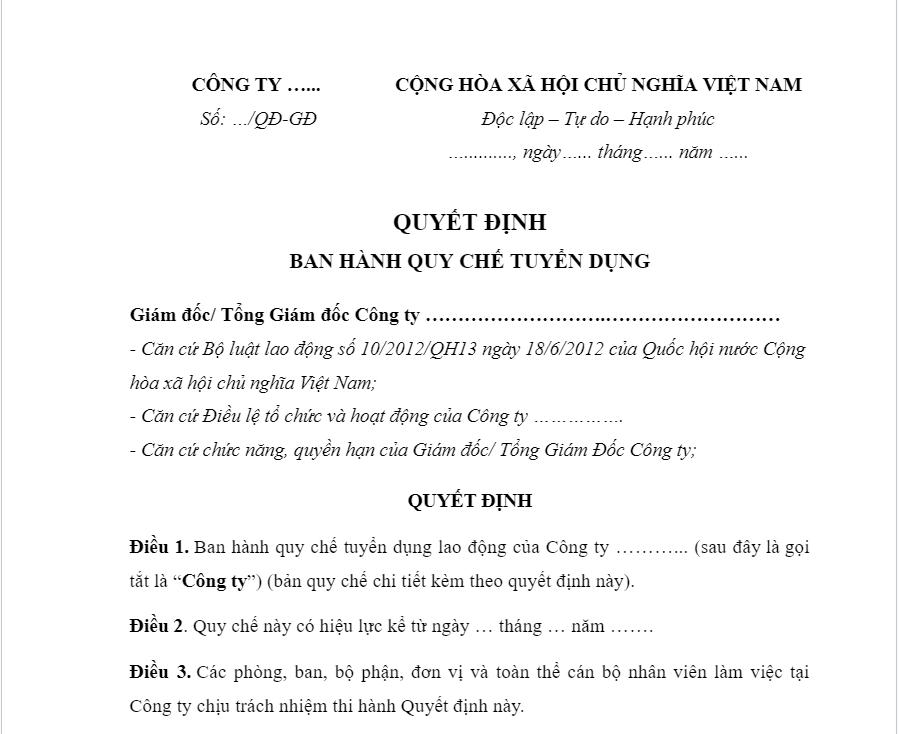
A recruitment policy is a document that outlines the principles, processes, records, procedures, and responsibilities of all parties involved in a company’s recruitment activities. Issuing a recruitment policy helps the company organize its recruitment activities scientifically and effectively. It also ensures transparency, fairness, and compliance with legal regulations while meeting the company’s needs.
Free Download: [1Office] Complete Set of 20+ Recruitment Process Templates
Below is a sample company recruitment policy issuance:
>> Free Download: [1OFFICE] Company Recruitment Policy Template.docx
7. Effective onboarding process after recruitment
Hiring the right person is just the beginning. For new employees to quickly integrate, connect, and reach their full potential, businesses need to build a clear and scientific onboarding process. A well-structured process not only helps new employees feel less overwhelmed but also demonstrates professionalism and increases long-term retention rates.
The process typically includes the following stages:
7.1. Preparation before the first day
Before the employee officially starts, the company should prepare everything to make a good first impression:
-
-
Send a welcome letter, share basic information about the culture, rules, and work schedule.
-
Prepare the desk, computer, email account, and necessary software or tools.
-
Inform relevant departments about the new employee for proactive coordination.
-
7.2. The first day
The first day is a crucial milestone to help new employees feel welcome:
-
-
Introduce the employee to colleagues, departments, and their direct manager.
-
Organize a brief orientation about the company, products, services, and core values.
-
Answer basic questions to ease the new employee’s anxiety.
-
7.3. The first week
This is the period when the employee gradually gets accustomed to the job and the environment:
-
-
Assign a mentor or buddy for support and guidance.
-
Provide detailed guidance documents and basic training programs.
-
Set short-term goals to give the employee a clear direction and help them achieve early success.
-
7.4. The first 30 – 60 – 90 days
During the three-month probationary period, continuous monitoring and support are crucial:
-
-
Organize regular check-in meetings with the manager to assess progress.
-
Recognize and reward small achievements to boost morale.
-
Collect feedback from the new employee to adjust and improve the onboarding process.
-
7.5. Evaluation and development
After the probationary period, the company needs to provide a clear evaluation and development direction:
-
-
Conduct a transparent evaluation based on KPIs or agreed-upon criteria.
-
If they meet the requirements, provide a career path, training plan, and promotion opportunities.
-
Create motivation for the employee to stay with the company long-term.
-

8. Examples of recruitment processes at large corporations
Vinamilk’s recruitment process flowchart
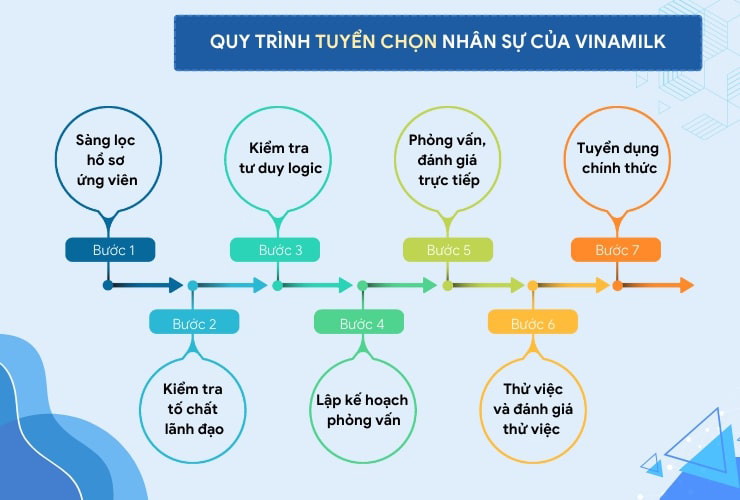
Vinamilk’s recruitment process flowchart includes the following steps:
- Candidate profile screening: Based on criteria such as education level, experience, skills, etc.
- Leadership potential assessment: These tests often focus on factors such as communication skills, decision-making skills, management skills, etc.
- Logical reasoning test: Vinamilk often focuses on factors such as problem-solving ability, analytical skills, reasoning ability, etc.
- Interview planning: Based on the results of the previous screening steps, the interview plan will include interview questions, the interviewer, and the interview schedule.
- Direct assessment interview: Aims to evaluate the candidate’s skills and experience. These interviews are usually conducted by recruiters or senior managers.
- Probation and probation assessment: Vinamilk will have the candidate work on a probationary basis for a certain period to assess their practical abilities. During the probationary period, the candidate will be evaluated by their direct managers.
- Official hiring: After completing the probationary period, Vinamilk will decide to officially hire the candidates who meet the requirements.
Viettel’s HR Recruitment Process Diagram
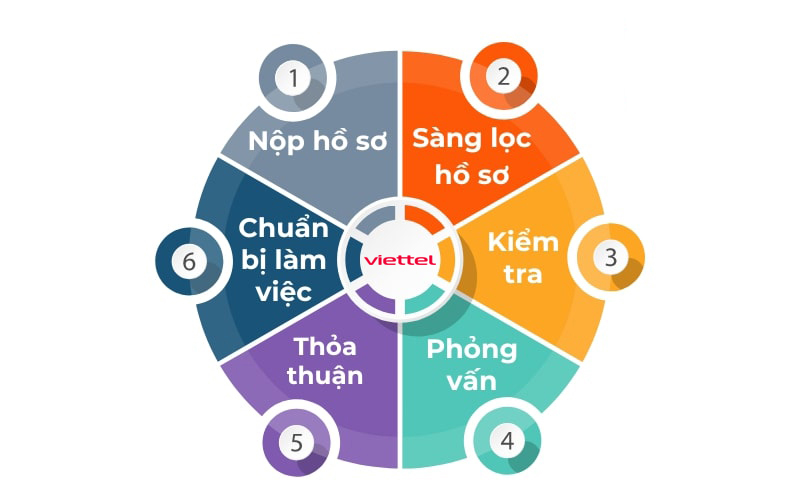
Viettel’s HR recruitment process diagram includes the following steps:
- Recruitment planning: Includes information such as the position to be filled, the number of personnel needed, recruitment timeline, recruitment budget, recruitment channels, and recruitment methods.
- Sourcing and screening candidate profiles: Through recruitment channels such as job websites, social media, employment centers, etc. Based on predetermined recruitment criteria regarding expertise, experience, skills, past achievements, etc.
- Competency assessment: Viettel will require candidates to take competency tests to evaluate their abilities.
- Interviewing candidates: Through various interview formats such as in-person interviews, phone interviews, and video interviews.
- Offer and probation: The probationary period is about 2 months to assess the candidate’s actual capabilities.
- Making the hiring decision: Based on the results of the probationary period and the preceding recruitment steps.
Vingroup’s HR Recruitment Process Diagram
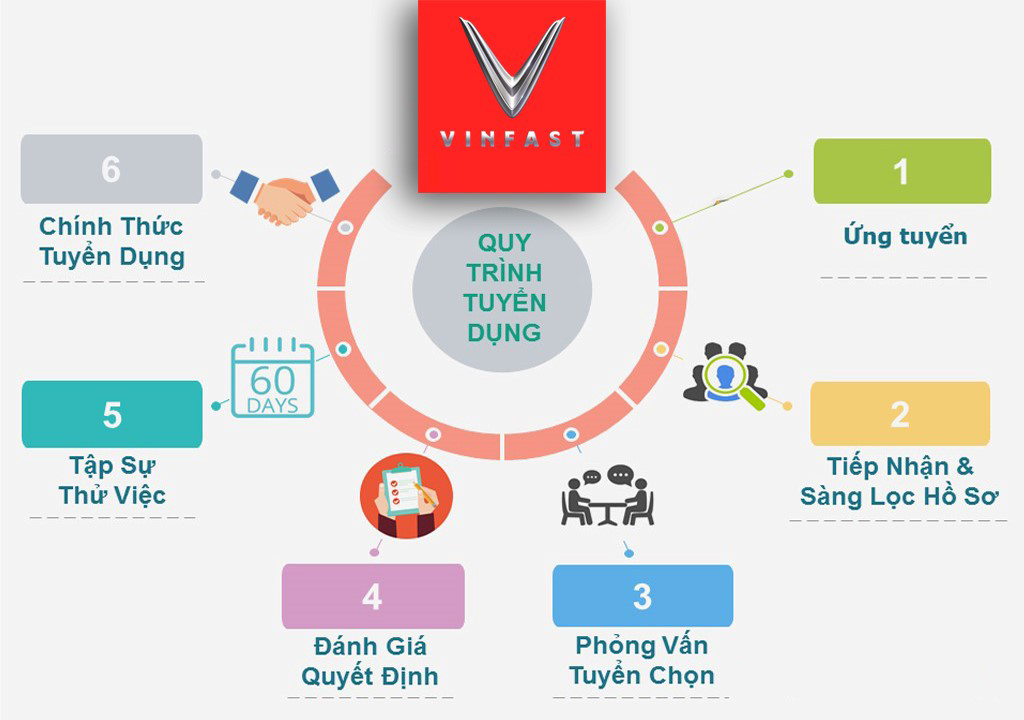
Vingroup’s HR recruitment process diagram includes the following steps:
- Identifying recruitment needs: Vingroup will determine its recruitment needs based on the business plan and current staffing situation.
- Sourcing and screening candidates: Vingroup will source candidates through recruitment channels such as job websites, social media, employment centers, etc.
- Selection interviews: Vingroup will interview candidates through various formats such as in-person interviews, group interviews, and video interviews.
- Evaluation and decision: Based on predetermined recruitment criteria regarding expertise, experience, skills, past achievements, etc.
- Probation: Vingroup will have candidates undergo a probationary period to assess their actual capabilities.
- Making the hiring decision: Vingroup will make the hiring decision based on the results of the recruitment steps and the management’s assessment during the probationary period.
9. Frequently Asked Questions about HR Recruitment Process Diagrams (FAQs)
Why should businesses apply an ISO-standard recruitment process?
Applying ISO standards helps businesses standardize work steps, minimize errors due to subjectivity, ensure objectivity, and enhance brand reputation in the eyes of potential candidates.
How can the recruitment time be shortened while still ensuring candidate quality?
Businesses should apply technology to automate the resume screening stage, build a “candidate pool,” and establish a clear set of evaluation criteria (Scorecard) to make interview decisions more quickly.
Should internal recruitment or external recruitment be prioritized?
It depends on the goal: internal recruitment is suitable for optimizing costs and motivating current employees; external recruitment is the optimal choice when the business needs a “fresh perspective,” innovative thinking, or specialized skills that the current team cannot provide.
Is the Onboarding process really necessary?
Extremely necessary. A well-structured Onboarding process helps new employees overcome initial psychological barriers, clearly understand job expectations and company culture, thereby reducing the turnover rate within the first 3 months.
When does a business need to change or update its recruitment process diagram?
Businesses should review their recruitment process when the early turnover rate is high, Time-to-hire is prolonged, or when scaling up makes manual methods inefficient.
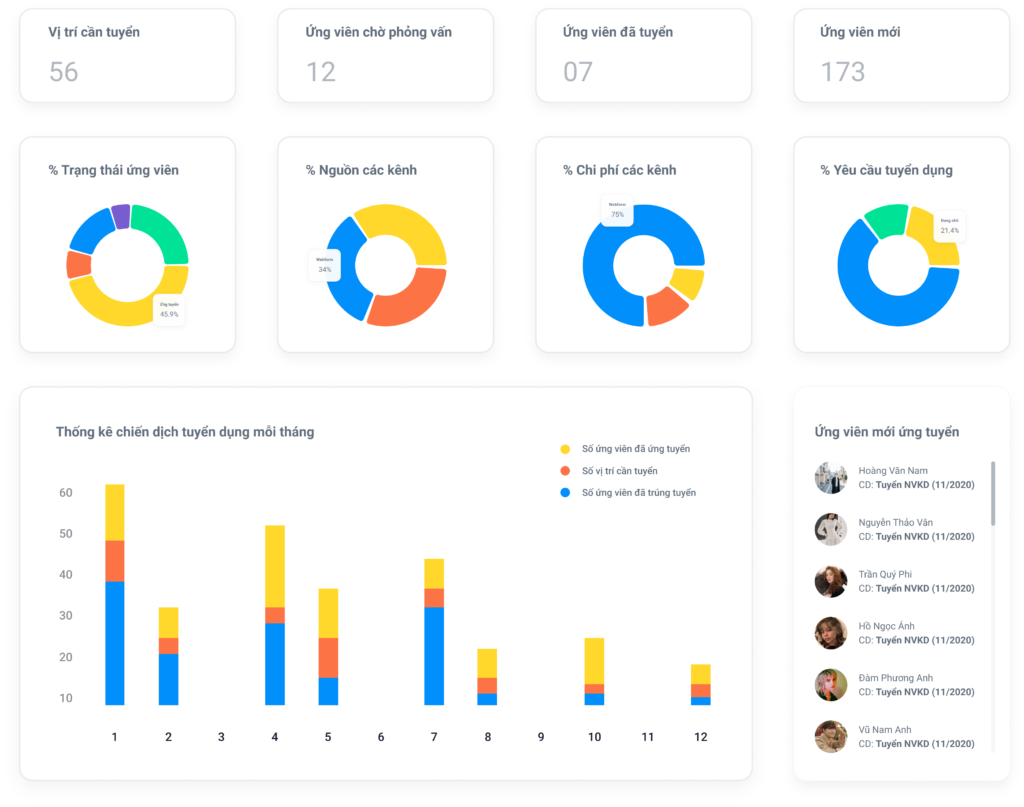
In this context, 1Office’s 1HRM becomes a comprehensive support solution for:
- Standardizing the entire recruitment process
- Automatically screening resumes and evaluating candidates
- Sending automated job offers
- Tracking recruitment metrics in real-time
Helping managers optimize strategies and improve recruitment efficiency.
10. Conclusion
The above is all the information about the personnel recruitment process flowchart, along with a sample template that 1Office wants to share with businesses. Hopefully, through this article, managers have gained a deeper insight into a professional, ISO-standard recruitment process and can differentiate between external and internal recruitment processes.
Thus, creating an effective recruitment process is essential to help businesses build an optimal workforce. As a manager, you need to learn about different recruitment processes and apply them intelligently to your business.
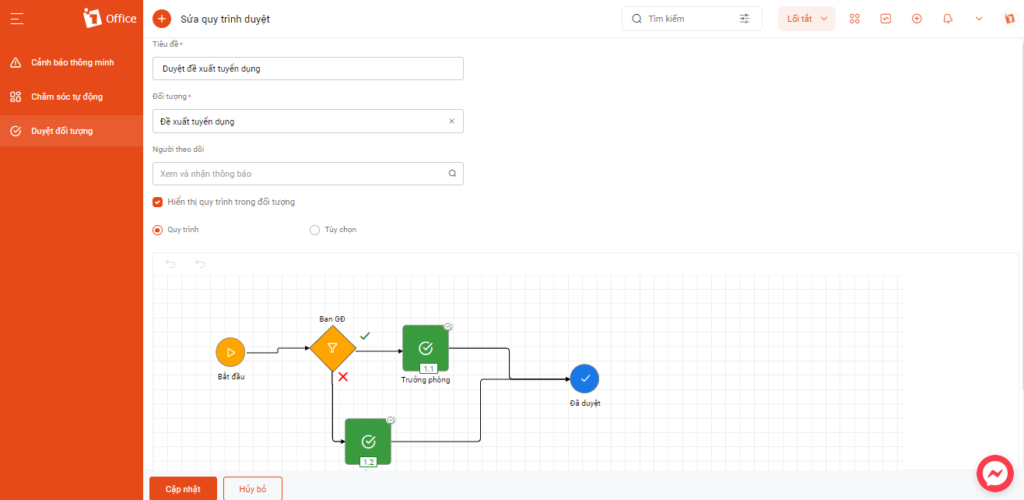
In addition, if your business is looking into 1Office HRM recruitment management software – which standardizes the recruitment process from workforce planning to evaluation and sending offers to candidates, please contact us at:
- Hotline: 083 483 8888
- Facebook: https://www.facebook.com/1officevn/
- Youtube: https://www.youtube.com/@1office-chuyendoisodn