10/05/2026
  27694 views
The human resource training and development process plays a foundational role in helping businesses stand firm to compete in a volatile market. However, not every business has a standard process to build a quality workforce, leading to ineffective training and unskilled employees. To solve this problem, 1Office shares with you a standard human resource training and development process for businesses, along with a standard training plan template.
Mục lục
- 1. What is the human resource training and development process?
- 2. When is it necessary to train and develop personnel?
- 3. The A-Z Process of Human Resource Training and Development in a Business
- 4. Human Resource Training and Development Plan Template
- 5. The Importance of Human Resource Training and Development for Businesses
- 6. Common Mistakes in the HR Training and Development Process
- 7. Standardize the Human Resource Training and Development Process with 1Office’s HRM Solution
1. What is the human resource training and development process?
- Training is the activity of providing employees with the specialized knowledge and necessary skills to perform their jobs more effectively.
- Development is the activity aimed at preparing employees with the capacity to approach new professional tasks, opening up their potential to adapt to the organization’s changes and growth.
Thus, the human resource training and development process is the process of planning and organizing the training, fostering, and equipping of personnel with the necessary professional skills to meet job requirements and aim for higher results.
The purpose of human resource training and development is to solve and overcome current problems and prepare for future changes by improving the quality of the workforce and maximizing human resources to enhance the organization’s effectiveness.
>> See more: Detailed Review of the TOP 10 Most Effective Employee Training Management Software Today
2. When is it necessary to train and develop personnel?
In reality, many situations arise within a business that require human resource training and development, such as:
- Applying new equipment and technology to the work process
- There are changes in work methods and procedures
- Developing new product lines
- Changes in the company’s strategy
- Employees have low performance and work ineffectively
- The business has a shortage of human resources
- Minimizing accidents and incidents at work
- Creating a multi-skilled workforce to promote job rotation
| Read more: What is a competency framework? How to build the most effective competency framework for businesses |
3. The A-Z Process of Human Resource Training and Development in a Business
Human resource training and development is a systematic series of activities that helps businesses not only enhance the capabilities of their current team but also build a solid foundation for the future. This process includes analyzing needs, planning, implementing training programs, and evaluating and developing long-term career paths for employees.
3.1. Training
3.1.1. The Human Resource Training Process
A standard human resource training process in a business needs to be carried out sequentially and completely through the following steps:
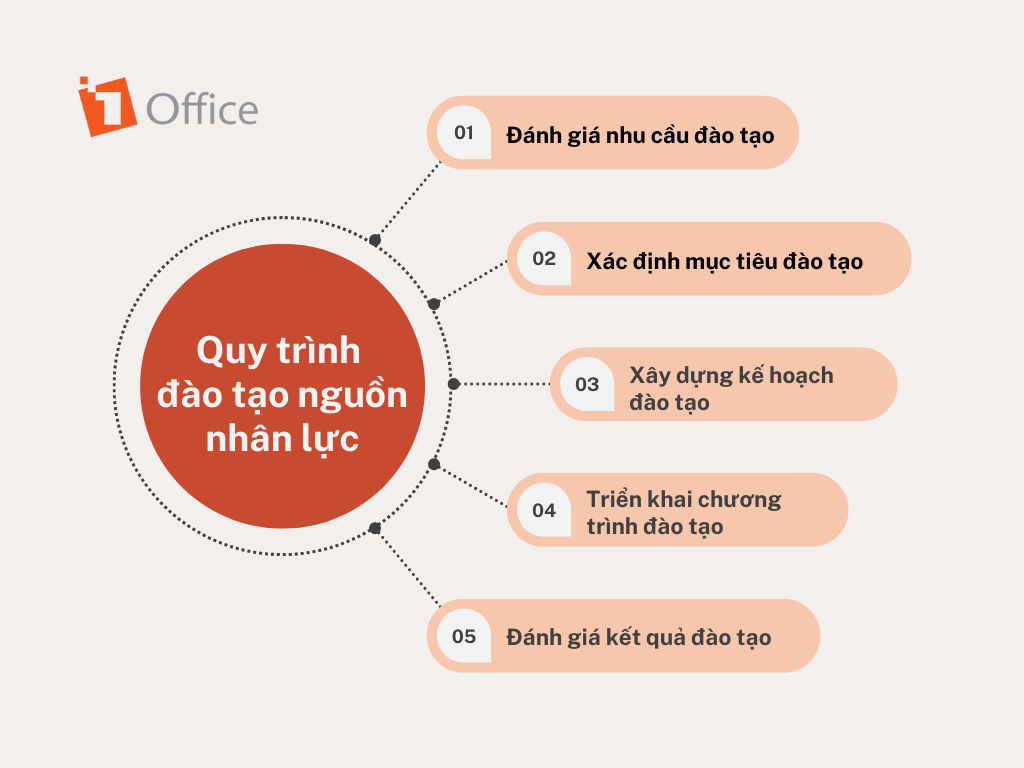
Step 1: Assess Training Needs
This is the first step in the process to determine whether training is necessary given the company’s current situation. The training needs analysis is carried out by many stakeholders, such as managers at all levels, training specialists, and the employees who directly perform the jobs.
To assess training needs, the following factors should be considered:
- The number of employees lacking skills
- The severity of the skill gap
- The importance of the skill
- The extent to which the skill can be improved through training
Methods that businesses can use to identify training needs include:
- Discussing with direct managers and supervisors
- Surveying employees through interviews, questionnaires, etc.
- Observing employees as they perform their tasks
- Analyzing reports and records of job performance
Step 2: Define Training Objectives
The next step is to transform the identified needs into clear, measurable objectives. These objectives will guide the training efforts and serve as the basis for evaluating results after the training program is completed.
To define the objectives of the training plan, you need to answer the following questions:
- What knowledge and skills will employees acquire?
- How will employees’ job performance be improved?
- How will the quality of the workforce and the effectiveness of the company’s business strategy be improved?
A good objective is determined by the 5 factors in the SMART model: Specific, Measurable, Achievable, Relevant, and Time-bound.
Example: Help employees master the knowledge and improve their ability to operate sales management software within 2 months, thereby improving the accuracy and speed of the inventory import and checking process by 2 times.
Step 3: Develop the Training Plan
This is arguably the most crucial step, determining the success of the training program. Developing a training plan involves many stages, from brainstorming ideas to deciding on training methods. To build a complete and detailed plan, the following tasks need to be performed.
- Design training materials: including the training curriculum, slides, and other documents used during instruction.
- Plan the training budget: based on the number of employees to be trained, salaries for trainers, costs for equipment and teaching tools, etc.
- Decide on training methods: You should choose a variety of training methods and encourage two-way interaction to prevent employees from becoming bored or finding it difficult to follow due to passive, one-way learning.
| Reference: “The Golden Formula” for Building a Sales Staff Training Program to Double Efficiency |
Step 4: Training Implementation
The next step is to organize the training according to the established plan. During the implementation process, it is necessary to monitor the trainees’ reactions to make adjustments if needed.
Step 5: Evaluating Training Results
The final stage in the human resource training process flowchart is evaluating and accepting the results. A popular tool often used in this stage is Donald L. Kirkpatrick’s Four-Level Training Evaluation Model, which includes 4 levels:
- Level 1: Reaction – At this level, you will collect feedback on the learner’s experience. Questions are used to check if the learners felt comfortable and satisfied with the training environment and content.
- Level 2: Learning – This level measures whether the learner has acquired the knowledge, skills, and attitudes after completing the program. Methods used: questionnaires, surveys, observation, theoretical tests, practical tests, group assessments, and self-assessments.
- Level 3: Behavior – Level 3 measures the extent to which the trainee’s behavior has changed after the training program. For example: measuring how the learned knowledge, skills, and attitudes are applied to the actual job (before and after the program).
- Level 4: Results – Data on costs, productivity, revenue, and the time required to perform a task should be collected before and after the training. Then, the two sets of results are compared to quantify the training outcomes.
| Read more: 5 Steps to Build an Effective Internal Training Process for Your Business |
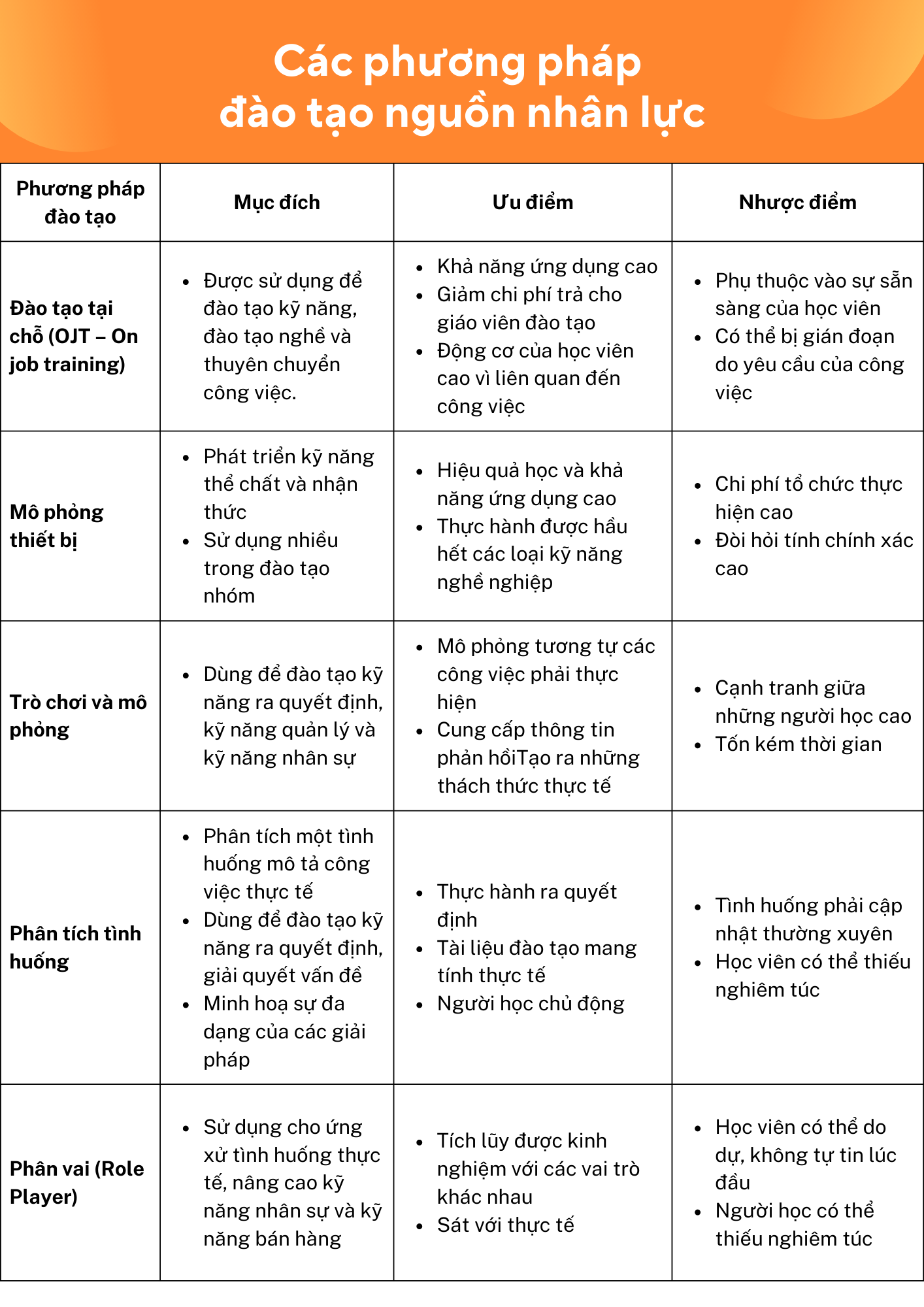
3.1.2. Employee Training Methods
3.2. Development
3.2.1. Process for Building a Human Resource Development Strategy
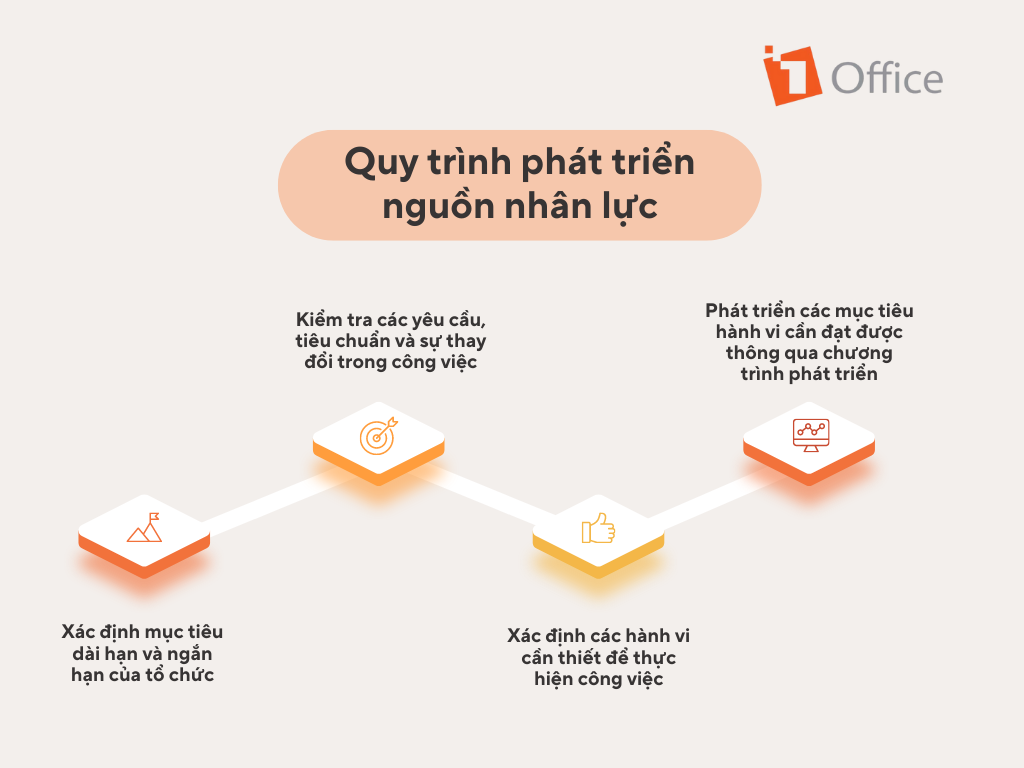
Step 1: Define the organization’s long-term and short-term goals
The purpose of the human resource development process is to equip employees with the necessary competencies to keep pace with the company’s growth. Therefore, the organization’s long-term and short-term strategic goals are the foundation for designing employee development roadmaps. These goals will determine how the workforce will mature and develop in the future.
Managers need to paint a picture of the company in the next 1 to 10 years and spread this vision to all levels of the organization so that employees clearly understand the significance of the development program.
See more: Building a Human Resource Strategy Map – A Tool to Optimize the Human Resource Management Process
Step 2: Review job requirements, standards, and changes
To meet the organization’s improvement needs, many processes and standards will have to change, replacing outdated norms and operating methods. Therefore, HR needs to conduct job analysis to identify the new requirements that must be met.
Step 3: Identify the necessary behaviors to perform the job
Your task is to identify the behaviors that need to be adjusted to complete the job in the best way possible. This includes the method of performing the work, the frequency of performance, and building a model process for employees to easily follow.
Step 4: Develop behavioral objectives to be achieved through the development program
After designing a complete set of new operating procedures, you need to help employees change their behavior to achieve new work goals through development programs.
Remember that the ultimate purpose of employee development is to create a stepping stone and a favorable environment for employees to get accustomed to new tasks, so the key outcome the program needs to achieve is to create change in the participants.
3.2.2. 04 Typical Human Resource Development Strategies HR Must Know
Internal Culture
Although internal culture is an environmental factor, it plays a very important role in the development of the workforce. A dynamic cultural environment that encourages a creative spirit will motivate employees to develop personal skills and talents such as analytical, negotiation, and writing abilities, etc.
Sending employees for professional development training
Professional development training programs are designed for outstanding and excellent employees. The goal of this training is to help employees absorb and inherit advanced external technologies, creating a stepping stone for them to become experts in their fields.
Job Rotation
Rotating employees to other departments creates opportunities for them to be exposed to new professional tasks and working methods. Trying out a new field helps employees discover their own potential while also creating a multi-skilled workforce with a high capacity to adapt to change.
Assigning employees to special projects
This is a common method used to leverage talent. Nominating employees for special projects allows them to be exposed to new work processes, different from their daily tasks, thereby accumulating experience and creating new methods to perform their work.
| Read more: 5 steps to build a career path – Enhance the quality of human resource management |
4. Human Resource Training and Development Plan Template
To provide HR with a structured roadmap for training and developing human resources, 1Office offers a detailed, standard-form human resource training and development plan template for 2022.

5. The Importance of Human Resource Training and Development for Businesses
Human resource training and development is not just an activity for “skill supplementation” but a strategic lever that helps businesses achieve sustainable growth. When implemented correctly, a training program brings comprehensive benefits to both individuals and the organization:
-
Enhance professional expertise and soft skills: Employees get updated with new knowledge, improving their teamwork, communication, time management, and creative thinking skills – factors that directly impact job performance.
-
Increase productivity and operational efficiency: When the team masters processes and professional skills, the business minimizes errors, shortens task completion time, and thereby optimizes personnel costs.
-
Build a succession team and retain talent: Employees who have opportunities to learn and develop tend to stay with the company longer. This forms the foundation for the business to create an internal leadership pipeline, avoiding dependence on external recruitment.
-
Create a sustainable competitive advantage: In a rapidly changing market, a business with a high-quality and flexible workforce can easily adapt, innovate, and lead the industry.
6. Common Mistakes in the HR Training and Development Process
Despite understanding the importance of training, many businesses still invest improperly, leading to training outcomes that fall short of expectations. Here are some common mistakes:
-
Lack of alignment between training objectives and business strategy: Training programs are organized in a fragmented manner, not serving growth objectives, which leads to a waste of budget and time.
-
Focusing only on short-term skills, neglecting long-term development: Providing immediate technical training without helping employees develop leadership thinking, management skills, or innovative capabilities.
-
Failure to measure post-training effectiveness (Training ROI): Many businesses stop at “organizing a course” without tracking the actual impact on employee performance or KPIs.
-
Lack of commitment from leadership and middle management: If managers do not support and evaluate after training, it is difficult for employees to apply new knowledge to their actual work.

For example: A company organizes a “professional communication skills” course for its entire sales team. However, the program is not linked to the goals of increasing the deal closing rate or improving the customer satisfaction score (CSAT), making the course a formality that provides no specific measurable value.
7. Standardize the Human Resource Training and Development Process with 1Office’s HRM Solution
HR training and development is a continuous process that requires collaboration among many stakeholders within the company. To optimize the human resource training and development process and achieve the highest efficiency, applying technology and support software in training is essential.
To help businesses standardize their human resource training and development process, 1Office provides HRM software that helps manage and implement internal training courses easily and scientifically.
- With the feature to create new training campaigns, users can input relevant information such as time, location, instructor, and participants, so all stakeholders are clear on the course content.
- Easily track training progress with statuses: In Progress, Completed, Planned, Expired, etc.
- Evaluate trainees post-training directly on the software with a system of evaluation criteria that can be designed and customized to fit the training program
Human resources are the backbone of a business. A strong workforce leads to a stable business. Therefore, mastering the human resource training and development process is a prerequisite for building a large, professionally competent, and highly skilled workforce.
We hope this article from 1Office has provided managers with a solution to the challenge of the business’s personnel training and development process. To receive a consultation and experience Vietnam’s leading human resource management software, 1Office HRM, please register for a free consultation here:
For more detailed information, please contact:
- Hotline: 083 483 8888
- 1Office Fanpage: https://www.facebook.com/1officevn
- Youtube Channel: https://www.youtube.com/c/1OfficeNềntảngquảnlýtổngthểDoanhNghiệp