


 13/05/2026
  307 views
Have you ever wondered how companies like Facebook and Google are organized to become the world’s leading “giants”? To achieve such success, applying a suitable corporate organizational structure model is a crucial factor that helps any business stand firm in today’s volatile market. Whether a business is large or small, it needs a corporate organizational structure model to manage its apparatus and the business itself effectively and professionally. If your business is still struggling to establish an organizational structure and personnel system, don’t miss the article below.

Mục lục
1. What is a corporate organizational structure model?
An organizational structure is a system that outlines how certain activities are directed to achieve a company’s business objectives. These activities can include rules, roles, and responsibilities. It also determines how information flows between levels within the company. For example, in a centralized structure, decisions flow from the top down, while in a decentralized structure, decision-making power is distributed among various levels of the organization.
Determining a suitable organizational model is also a crucial factor in the process of organizational design. In the initial steps of building an organizational structure model for their business, leaders can refer to successful existing organizational models to devise a direction for building a stable and smooth operating system.
2. Common types of corporate organizational structure models
There are currently 7 common types of corporate organizational structures that many businesses apply. Understanding how each type of corporate organizational structure model works will help you make a more informed decision about which one is best to implement in your workplace.
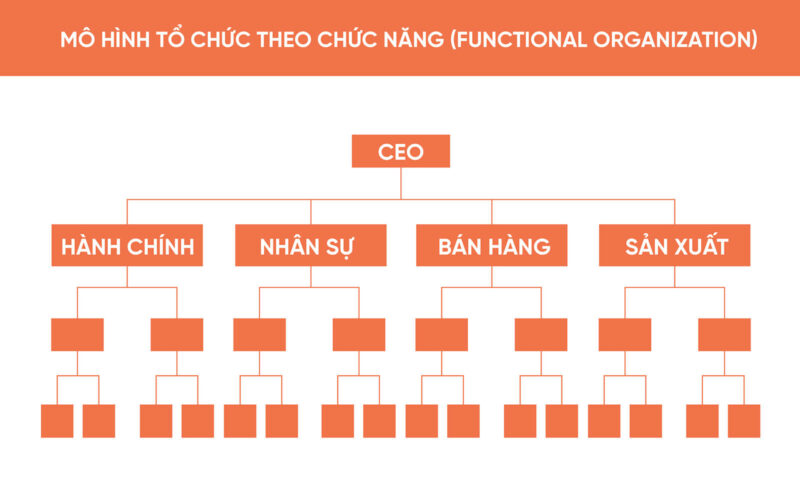
2.1 Functional Hierarchical Structure
In a divisional structure, different groups work together towards a single common goal. Each of these divisions has its own executive who manages how that branch operates, controls its budget, and allocates its resources. Large companies use this type of organizational structure. An example of a divisional structure is a car company that separates its company into SUV, electric vehicle, or sedan branches. Although each branch has its own functions, they all work towards the same goal of selling cars. This is also known as a multi-divisional structure.
2.2 Divisional Organizational Structure
The corporate organizational structure model is divided into divisions based on specific products, services, or geographical regions. For this reason, this structure is often used by large companies that operate in wide geographical areas or own separate, smaller companies. Each division has its own executive leadership, departments, and resources. For example, a large software company might separate its organization based on product type, thus having a cloud software division, an enterprise software division, and a personal computing software division.
2.3 Process-Based Organizational Structure
In a process-based structure, the business is designed around the flow of processes and the tasks that employees interact with. Instead of flowing from top to bottom, this structure outlines services from left to right.
An executive at the top of the structure oversees the departments below, which represent different processes, but each process cannot begin until the previous one is finished. And each department will have its own management and team to complete their tasks so the business can move on to the next task and ultimately achieve the final goal, such as selling a product to a consumer.
Advantages
- Improves business efficiency and speed
- Enhances teamwork between departments in the company
- Easily adapts to meet industry changes
Disadvantages
- Creates barriers or silos between teams
- Restricts communication
- Requires more resources to achieve process optimization
2.4 Matrix organizational structure
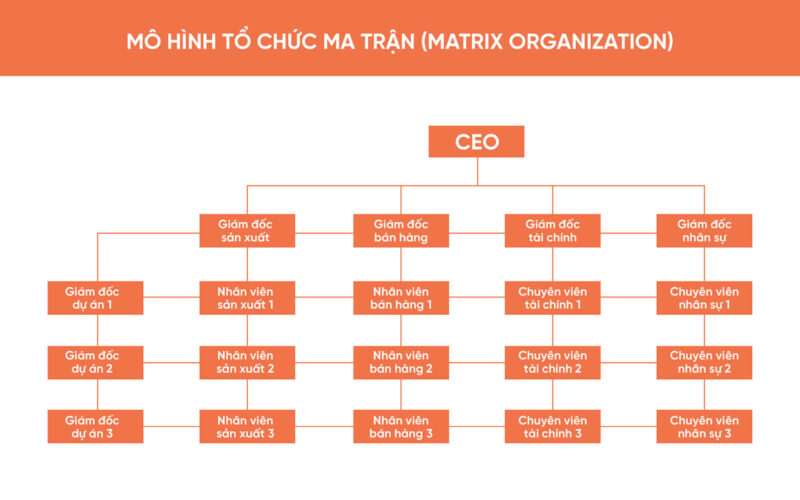
With a matrix organizational structure, employees are divided into teams that report to two managers—a project or product manager and a functional manager. In essence, the matrix structure is a combination of various other organizational structures. Because these teams have two managers, a matrix structure promotes duality and resource sharing. Employees working for companies that use a matrix structure have the potential to expand their skill sets as they can be assigned to different projects requiring varying levels of expertise or skills.
Advantages
- Supervisors can easily select individuals based on project needs
- Provides a more general overview of the organization
- Employees can apply different skills beyond their primary roles
Disadvantages
- Can lead to conflicts between department management and project management
- Can change more rapidly than other types of organizational charts
| >> Read now: MBTI Applications in Business Administration |
2.5 Flat or Horizontal Organizational Structure
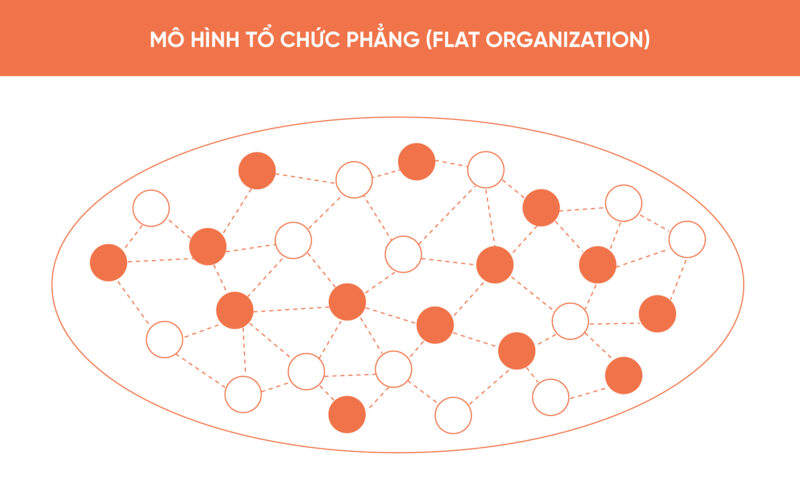
In a flat organizational structure, most middle management levels are eliminated, so there is very little separation between staff-level employees and upper management. Employees are given more responsibility and decision-making authority without the usual hierarchical pressure or supervision and can often work more effectively. This type of structure is mainly used by small companies and early-stage startups as they often have fewer employees and projects to manage. It can also be called a “horizontal structure.”
Advantages
- Reduces budget costs due to the lack of middle management
- Builds good relationships between employees and superiors
- Facilitates faster and easier decision-making
Disadvantages
- Requires extensive planning to be effective
- Causes confusion about who makes decisions
- Requires contingency plans to resolve conflicts
2.6 Circular Organizational Structure
This is an organizational structure model that differs significantly from the other structures mentioned in this section, but it is still based on a hierarchy. At the center of the organization, leaders do not issue commands down the chain of command but rather outward. While many other structures contain different departments that operate independently with individual goals, this structure eliminates that strict separation and looks at the bigger picture with all departments as part of the same whole. To manage your business effectively, you can apply business management software to digitize the entire workflow and human resources professionally and conveniently.
2.7 Network Organizational Structure
In a network structure, managers at an organization coordinate relationships with both internal and external entities to deliver their products or services. For example, a retail company might focus only on selling clothing items but outsource the design and manufacturing of these items in partnership with other companies. This structure is characterized by a focus on communication and relationships rather than hierarchies.
Advantages
- Gives the organization more agility and flexibility
- Allows the core company to focus on what it does best
- Helps reduce costs through outsourcing
Disadvantages
- Duplicates services and resources
- Causes confusion about specific job roles and functions
- Becomes overly complex and difficult to manage
2.8 Team-Based Structure
In a team-based organizational structure, employees are grouped into skill-based teams to perform specific tasks while all working towards a common goal. Typically, this is a flexible structure that allows employees to move from one team to another as they complete projects. This structure focuses on problem-solving and employee collaboration.
Advantages
- Allows for more decision-making authority with minimal management
- Increases flexibility by focusing on experience rather than seniority
Disadvantages:
- Reduces organizational consistency
- Limits contact with other functions
- Increases the potential for conflict
Thus, the article above has helped you explore the 8 most popular types of business organizational structures in 2026, as well as pointing out the pros and cons of each model. Depending on the scale and orientation of each business, you can choose different types to suit your company. To manage a business effectively, managers need to equip themselves with business administration skills and flexibly apply different models to establish an organizational structure and bring the best results for the business. In addition, applying comprehensive business management software will help you optimize your organization’s operations quickly and easily. Contact us today for consultation and support
For more details, please visit:
Fanpage: https://www.facebook.com/1officevn/
Youtube: https://www.youtube.com/channel/UCeTIRNqxaTwk0_kcTw6SxmA
















