


 12/05/2026
  347 views
Analytical skills are the foundation for understanding problems, evaluating data, and making accurate decisions at work. In a business context that is increasingly reliant on data, having strong analytical thinking becomes a major competitive advantage. In this article, 1Office will help you understand what analytical skills are, why they are important, and how to train them for effective real-world application.
Mục lục
What are analytical skills?
Analysis is the process of examining, evaluating, and deeply understanding data or information to draw well-founded conclusions. This process involves breaking down a problem or data into smaller components to identify key factors and create a comprehensive picture. The analysis process is not just about observing small details but also about connecting these elements to gain a more holistic view.

Analytical skills are the ability to apply the process of analysis in practice. This is one of the essential skills that helps people solve problems, make decisions, and optimize work performance. Having good analytical skills helps us not only see the data but also understand its meaning and know how to use it to make reasonable decisions.
Analytical thinking is often associated with experimentation, trial and error, and systematic processes, helping thinkers make rational decisions. People with strong analytical thinking skills can quickly grasp situations, problems, or topics, and often work effectively in teams to achieve common goals.
Benefits of analytical skills in business administration
In today’s increasingly complex and fiercely competitive business landscape, analytical skills play a crucial role in business administration. These skills not only help managers better understand the current state of their business but also support them in making strategic decisions, thereby improving performance and enhancing competitiveness. The effective application of analytical skills can be considered a decisive factor in a company’s success.
Improve decision-making ability

Analytical skills help improve a manager’s decision-making ability. When faced with complex situations that require quick decisions, the ability to analyze information accurately and systematically helps managers avoid unnecessary mistakes. This is especially important for decisions related to finance, marketing, and development strategy.
Effective financial management
In finance, analytical skills help managers better understand the company’s financial situation, enabling them to make effective decisions on investment, spending, and risk management. The ability to analyze financial reports, predict market trends, and evaluate financial indicators is a key factor in helping a business maintain stability and achieve sustainable growth.
Building marketing strategies
In marketing, analyzing the market and customer behavior helps businesses understand customer needs and wants, thereby building effective marketing strategies. The ability to analyze customer data, consumer trends, and market feedback helps businesses create product promotion campaigns that target the right audience, increase reach, and boost sales.
Increase HR management efficiency

In human resource management, analytical skills help managers evaluate employee performance and identify factors affecting their job satisfaction and motivation. From there, the business can implement appropriate policies to improve the work environment, enhance performance, and retain talent.
Identify and leverage business opportunities
Additionally, analytical skills help businesses identify and leverage new business opportunities. By analyzing market trends, changes in the business environment, and external factors, managers can devise new development strategies, expand into new markets, and strengthen their competitive position.
Complementary skills needed to enhance analytical ability
Communication skills
Communication skills include the ability to express oneself clearly and effectively, both verbally and in writing. This is a crucial factor in conveying your analysis results and ideas to others in an understandable way. In a business environment, this means you need to know how to write detailed reports, deliver persuasive presentations, and communicate effectively in meetings. Strong communication skills also help you receive feedback from colleagues and superiors, thereby improving the quality of your analysis.
Creative thinking

Creative thinking is not just about coming up with new ideas, but also about approaching problems from different perspectives. Creativity in data analysis can lead to the discovery of trends or relationships that were previously unseen. Creativity helps you break free from the constraints of traditional analytical methods, allowing you to find breakthrough solutions for complex problems. For example, in market analysis, creative thinking can help you identify new market niches or develop unique marketing strategies.
Critical Thinking
Critical thinking is the ability to evaluate information objectively and in detail to draw well-founded conclusions. This is a crucial skill that helps you avoid mistakes based on incorrect assumptions or information. Critical thinking involves asking important questions, verifying the authenticity and reliability of information, and detecting biases or contradictions in data. This skill helps you improve the accuracy and comprehensiveness of your analyses.
Data Analysis
Data analysis is a core skill needed to process and interpret data effectively. This skill involves using tools and techniques like Excel, SQL, R, or Python to collect, process, and analyze large and complex datasets. Knowing how to mine data helps you discover trends, patterns, and relationships within the data, enabling you to make informed conclusions and decisions. Additionally, the ability to visualize data through charts and graphs is an important part of data analysis skills.
Research Skills

Research skills are the ability to find, collect, and evaluate information from various sources. This includes using scientific documents, reports, articles, and available data to supplement your analysis. Research skills help you gain a broader and more comprehensive perspective on the problem you are analyzing. It also helps you stay updated on new trends and current research in your field, making your analyses more accurate and reliable.
Organizational Skills
Organizational skills help you manage information, documents, and workflows scientifically and effectively. This includes planning, time management, and prioritizing tasks. Strong organizational skills help you maintain consistency and efficiency throughout the analysis process. By managing documents and information well, you can easily access and reuse important data when needed, thereby improving work performance and minimizing errors.
Popular Analytical Thinking Methods
SWOT Matrix Method
SWOT matrix analysis is a useful method for evaluating the internal and external factors affecting a business or project. SWOT consists of four main elements: Strengths, Weaknesses, Opportunities, and Threats. The purpose of this method is to help an organization identify key factors to build an effective development strategy. SWOT analysis is often used during the strategic planning phase, when a business needs a comprehensive assessment of its internal and external environment to make strategic decisions.
Root Cause Method
The Root Cause Analysis method is a technique for identifying the main cause of a problem by repeatedly asking “Why?” until the underlying cause is found. The purpose of this method is to find the root cause of the problem to implement an effective solution. Root Cause Analysis is often used in quality management and process improvement, where it is necessary to identify the factors causing a problem and prevent its recurrence.
PEST Method
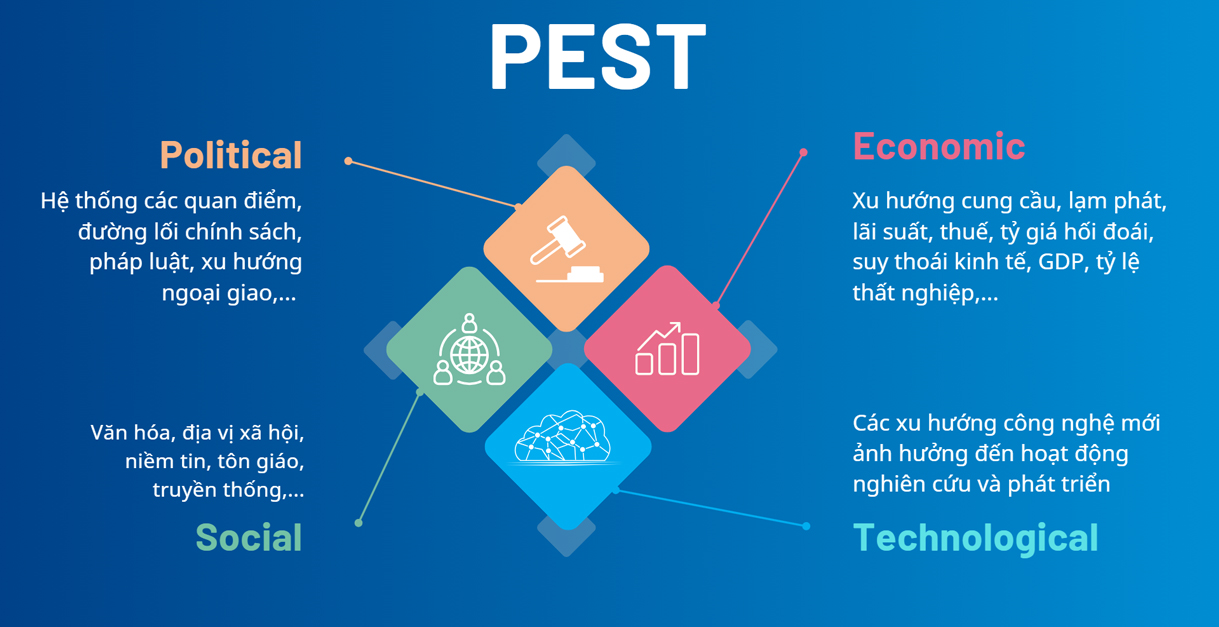
PEST analysis is a tool that helps businesses evaluate external environmental factors that can affect business operations, including: Political, Economic, Social, and Technological. The purpose of this method is to provide a comprehensive view of the external business environment and help the business prepare for future changes. PEST analysis is often applied when a business is considering market expansion or when there are major changes in the business environment that require strategic adjustments.
Fishbone (or Ishikawa) Method
Fishbone analysis, also known as a cause-and-effect diagram, helps identify the potential causes of a problem by categorizing them into main branches such as: People, Methods, Equipment, Materials, Environment, and Process. The purpose of this method is to find all the factors that could contribute to a problem to better understand its nature. Fishbone analysis is often used in group meetings to discuss and analyze problems comprehensively, especially in improving product and service quality.
How to Develop Analytical Skills in Business Management
Read and research specialized documents
Read market research reports, documents on management, finance, and other fields related to the company’s business operations. This helps you grasp industry trends and challenges, thereby improving your analytical skills and ability to make smarter decisions.
Practice data analysis in real-world projects

Participate in the company’s data analysis projects, such as customer analysis, revenue forecasting, supply chain optimization, or business performance analysis. Use tools like Excel, SQL, Python, or other specialized software to practice and solve real-world problems, thereby enhancing your data analysis capabilities.
Learn from practical experience in business projects
Participating in the company’s real-world projects will provide you with valuable experience. By solving practical problems, you will learn how to apply analytical methods in practice and improve your problem-solving skills. Proactively engage in diverse and challenging projects to accumulate practical experience.
Attend specialized courses and workshops
Companies often organize or sponsor employees to attend specialized courses and workshops. This helps you update your knowledge, learn from experts, and master advanced analytical techniques. Courses may cover topics such as data analysis, critical thinking, or research skills, helping you apply them directly to your daily work.
Practice critical thinking in your work process

Critical thinking is an essential skill for evaluating proposals, reports, and business plans. Practice critical thinking by regularly asking questions, verifying the authenticity of information, and objectively evaluating arguments. Participating in team meetings, discussions, and debating ideas will help you develop this skill and enhance your analytical abilities.
Use data visualization tools in reports and presentations
Data visualization is a crucial skill in business, helping you present analytical results clearly and understandably. Use tools like Tableau, Power BI, or Google Data Studio to create charts, graphs, and visual reports. This not only helps you analyze data effectively but also helps communicate information more clearly to colleagues and superiors.
Ask more questions
Regularly asking questions is a crucial skill for honing your analytical abilities. Don’t be afraid to ask “Why?” when you encounter a problem, and continue to ask deeper questions to better understand its nature. Using the “5 Whys” technique will help you uncover the root cause of the problem and devise effective solutions. The habit of asking more questions also helps you develop critical thinking and improve your decision-making skills.
Analytical skills are an incredibly important tool, offering significant benefits such as enhancing decision-making, optimizing operations, and sparking creative ideas. Thanks to this skill, we can achieve efficiency and success in many areas, as well as contribute positively to personal and business development. We hope that through this article from 1Office, you have gained a deeper insight into analytical skills and methods for honing them in business administration.
















